
Find and Use a Free VWAP API
for Stock Data查找并使用 免费 VWAP API
获取股票数据
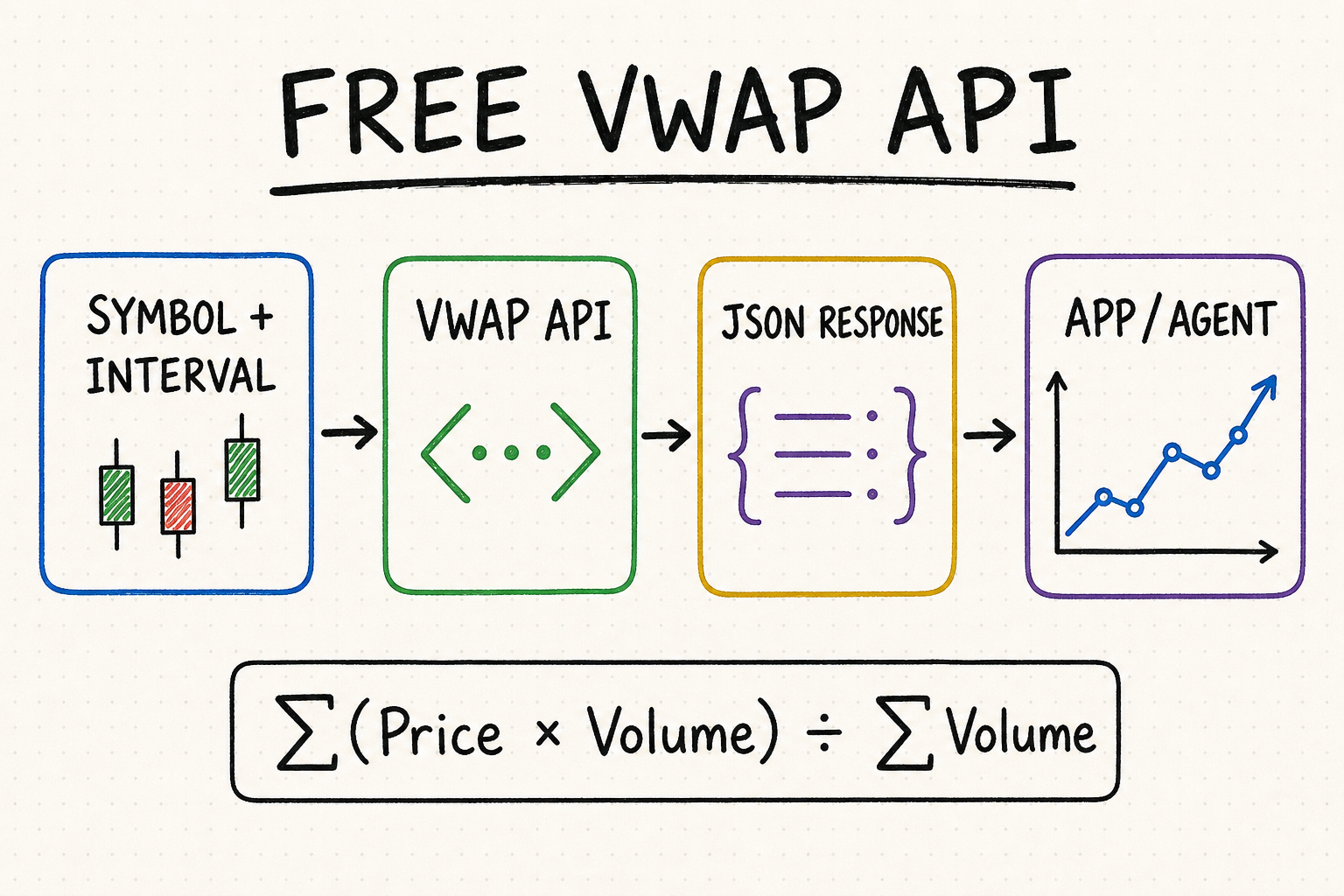
Compare Free VWAP API options, check their limits, and move from a ticker symbol to a usable volume-weighted average price response.
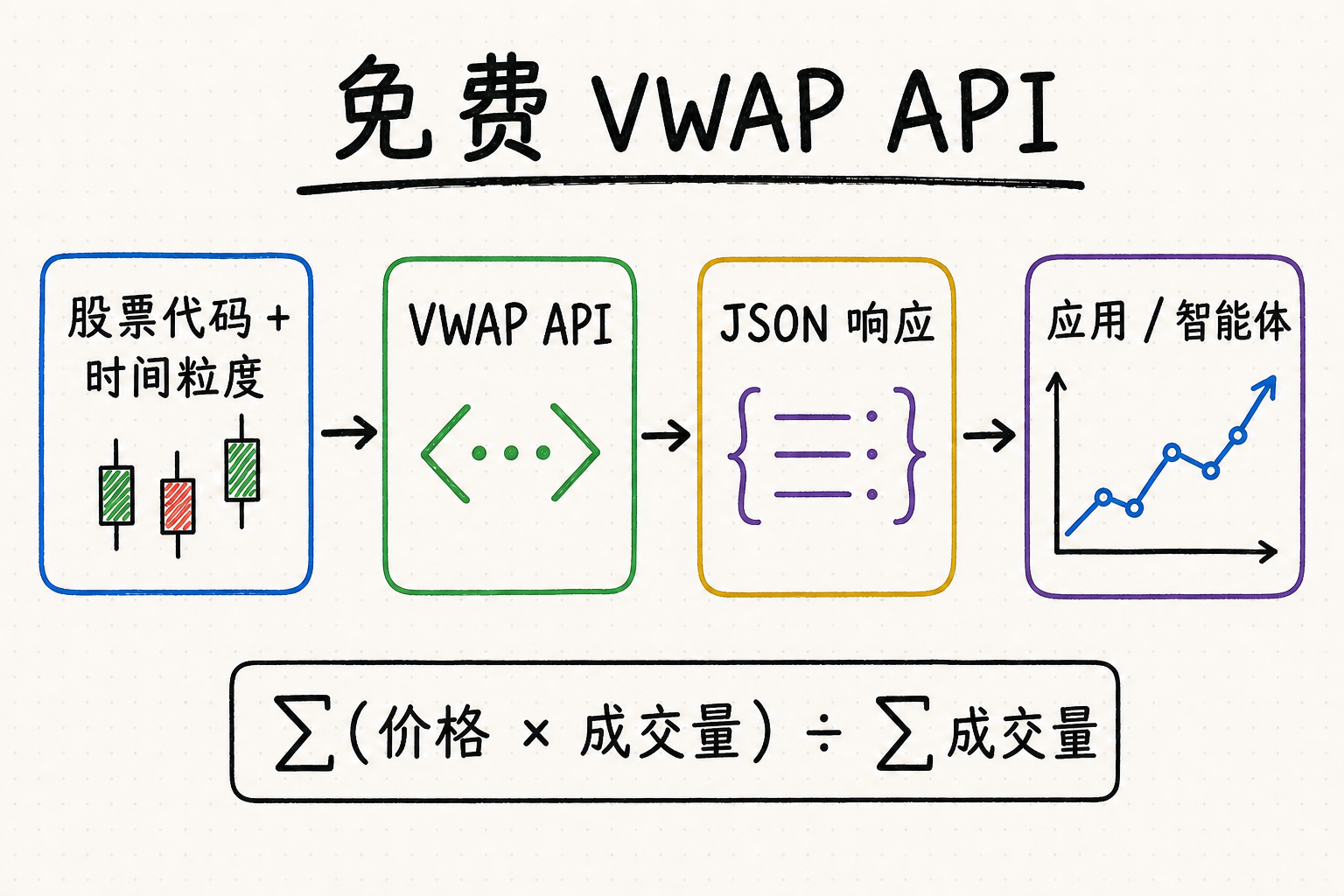
比较完全免费和提供免费套餐的 VWAP 数据方案、核对使用限制,
再把股票代码转换成可直接使用的成交量加权平均价数据。
TL;DR摘要
A free VWAP API should return the indicator directly or supply intraday OHLCV bars that let you calculate it correctly.
Check asset coverage, delay, intervals, history, rate limits, licensing, and whether signup or a card is required.
Use a dedicated VWAP endpoint for speed, or calculate cumulative VWAP from consistent price and volume bars for control.
QVeris helps agents and developers discover and inspect relevant financial-data capabilities before making a call.
免费 VWAP API 应直接返回指标,或提供足够一致的日内 OHLCV 数据,让你自行计算成交量加权平均价。
必须核对资产覆盖、延迟、时间粒度、历史范围、限额、许可,以及是否需要注册或信用卡。
直接调用专用 VWAP 接口更快捷;基于价格与成交量 K 线自行计算,则更透明,也更容易控制计算口径。
QVeris 帮助开发者和 Agent 在调用前发现、检查并选择相关金融数据能力。
How to get stock data from a free VWAP API如何通过免费 VWAP API 获取股票数据
Start with the job your application must complete: one current intraday value, a historical VWAP series, or raw bars for your own calculation. That distinction changes the endpoint, quota, storage, and validation work.
先明确应用要完成的任务:获取一个当前日内值、拉取历史 VWAP 序列,还是获取原始 K 线后自行计算。这个选择会改变端点、配额、存储和校验方式。
A VWAP data API may return a ready-made value, while a market-data API may return timestamped open, high, low, close, and volume bars.
Use the provider's ticker format, exchange timezone, regular or extended session rules, and a supported interval such as 1, 5, or 15 minutes.
Confirm whether data is real-time, delayed, or end-of-day and record quotas, pagination, retention, and commercial-use terms.
Check timestamps, missing bars, zero volume, corporate actions, and session resets before using VWAP in a chart, alert, backtest, or agent workflow.
专用 VWAP 接口可能直接返回指标;通用行情接口通常返回带时间戳的开高低收和成交量。
使用供应商规定的股票代码、交易所时区、常规或盘前盘后时段,以及 1、5、15 分钟等支持的间隔。
确认数据是实时、延迟还是日终数据,并记录请求配额、分页、保留期限和商业使用许可。
用于图表、提醒、回测或 Agent 工作流前,检查时间戳、缺失 K 线、零成交量、公司行动和每日重置。
Free VWAP API selection checklist免费 VWAP API 选型检查表
| Check检查项 | Ask the provider需要确认 | Why it matters为什么重要 | Safe default稳妥做法 |
|---|---|---|---|
| Coverage覆盖范围 | Stocks, ETFs, crypto, exchanges, and symbol format?支持哪些股票、ETF、加密资产和交易所? | A working endpoint is useless if it omits your instrument.不覆盖目标资产的端点无法使用。 | Test real target symbols first.先测试真实目标代码。 |
| Freshness实时性 | Real-time, delayed, or historical only?实时、延迟还是仅历史数据? | Alerts and live dashboards need explicit timestamps and delay terms.提醒和实时看板需要明确时间戳与延迟。 | Display the data timestamp.始终展示数据时间。 |
| Method计算口径 | Direct VWAP or OHLCV-derived; which price basis and reset?直接返回还是由 OHLCV 计算?使用什么价格和重置规则? | Different session and price rules can produce different values.不同时段和价格口径会产生不同数值。 | Document the formula and session.记录公式与交易时段。 |
| Free-tier limits免费层限制 | Requests, credits, history, redistribution, signup, and card?请求数、积分、历史、再分发、注册和信用卡要求? | A prototype can fail when a quota or license is overlooked.忽略配额或许可会让原型无法上线。 | Cache, back off, and recheck current terms.缓存、退避并复核最新条款。 |
Define which VWAP you mean. Session VWAP resets at a chosen market open, anchored VWAP starts at a selected event, and rolling VWAP uses a moving window; they answer different questions. Also document whether volume includes premarket and after-hours activity, opening and closing auctions, odd lots, off-exchange trades, or only the venues covered by the feed. Validate a completed session against the same underlying trades or bars. A fast endpoint can be internally consistent yet still disagree with a broker benchmark because its session, venue, price basis, or volume universe is different.
先定义你所说的 VWAP。日内 VWAP 在指定开盘时点重置,锚定 VWAP 从选定事件开始累计,滚动 VWAP 则使用移动窗口,三者回答的问题并不相同。还应记录成交量是否包含盘前盘后、开收盘集合竞价、零股、场外成交,或仅覆盖数据源能够提供的交易场所。验收时要用同一组底层成交或 K 线复核一个完整交易日。某个接口即使计算稳定,也可能因为交易时段、覆盖场所、价格口径或成交量范围不同,而与券商基准产生合理差异。
VWAP REST API and Python implementation examplesVWAP REST API 与 Python 调用示例
Direct endpoint request
Use a documented URL pattern such as GET /vwap?symbol=AAPL&interval=5min. Put the API key in a header or environment variable, never in client-side production code.
Python request pattern
Call the endpoint with requests.get(url, params=params, timeout=20), raise on HTTP errors, then validate the response symbol, interval, timezone, timestamps, and numeric VWAP values.
Calculate VWAP from OHLCV
For each bar, choose a documented price basis, often typical price (high + low + close) / 3. Compute cumulative price times volume divided by cumulative volume, resetting at the chosen session boundary.
Production guardrails
Cache stable history, respect Retry-After, use exponential backoff for 429 and transient 5xx responses, and do not silently substitute stale or differently licensed data.
Choose session, anchored, or rolling VWAP deliberately
Session VWAP answers where trading has occurred since a defined market open. Anchored VWAP starts at a selected earnings release, breakout, or other event. Rolling VWAP uses a fixed lookback and does not reset at the session boundary. Store the calculation type, anchor time or window, included sessions, and price basis with every value so a chart, alert, and backtest cannot silently use different indicators with the same label.
Build a reproducible acceptance fixture
Select several completed sessions that include a normal day, a half day, extended-hours activity, a split, a missing bar, and at least one zero-volume interval. Save the raw trades or OHLCV bars, exchange calendar, expected reset point, and independently calculated result. Compare the endpoint at the first bar, midday, and close with an explicit tolerance; investigate differences instead of rounding them away.
Monitor semantic drift after launch
Track last event time, arrival delay, bar count, missing intervals, zero-volume frequency, session reset, source venue coverage, and the difference between provider VWAP and a local reference calculation. Alert when the provider changes adjustment behavior, interval labels, auction coverage, or extended-hours defaults, because a numerically valid response can still become incompatible with historical research.
直接请求专用端点
使用文档规定的 URL,例如 GET /vwap?symbol=AAPL&interval=5min。API Key 应放在请求头或环境变量中,不要写入生产前端代码。
Python 请求模式
使用 requests.get(url, params=params, timeout=20) 调用,遇到 HTTP 错误立即抛出,再校验代码、间隔、时区、时间戳和 VWAP 数值。
从 OHLCV 计算 VWAP
为每根 K 线选择并记录价格口径,常见典型价格为 (high + low + close) / 3。累计价格乘成交量后除以累计成交量,并按选定交易时段重置。
生产保护措施
缓存稳定历史数据,遵守 Retry-After,对 429 和临时 5xx 使用指数退避,不要静默替换为过期或许可不同的数据。
明确选择日内、锚定或滚动 VWAP
日内 VWAP 用于判断从指定开盘时点以来的成交重心;锚定 VWAP 从财报发布、突破或其他选定事件开始累计;滚动 VWAP 使用固定回看窗口,不随交易日边界重置。每个数值都应同时保存计算类型、锚点时间或窗口、纳入的交易时段和价格口径,避免图表、提醒与回测虽然使用同一名称,实际计算的却不是同一个指标。
建立可复现的验收样本
选择若干已经结束的交易日,覆盖普通交易日、半日市、盘前盘后、拆股、缺失 K 线和至少一个零成交量区间。保存原始逐笔成交或 OHLCV、交易所日历、预期重置点及独立计算结果,并在首根 K 线、盘中和收盘三个时点按明确容差核对。发现差异时应定位口径原因,而不是用四舍五入掩盖问题。
上线后监控指标语义漂移
持续记录最新事件时间、到达延迟、K 线数量、缺失区间、零成交量频率、交易日重置、来源场所覆盖,以及接口 VWAP 与本地基准计算的差值。服务商一旦调整复权方式、周期标签、集合竞价覆盖或盘前盘后默认值,就应触发告警;因为响应即使仍是合法数字,也可能已经无法与历史研究保持一致。
Recalculate a three-bar VWAP fixture复算一个三根 K 线的 VWAP 固定样本
Assume three completed bars in the same session have documented typical prices of 100, 102, and 101, with volumes of 100, 300, and 100 shares. The calculation must accumulate both price × volume and volume; averaging the three prices would ignore where trading actually occurred.
假设同一交易时段内三根已完成 K 线的典型价格分别为 100、102、101,成交量分别为 100、300、100 股。计算时必须同时累计“价格 × 成交量”和成交量;直接对三个价格求平均,会忽略成交主要发生在哪个价位。
| BarK 线 | Typical price典型价格 | Volume成交量 | Price × volume价格 × 成交量 | Cumulative VWAP累计 VWAP |
|---|---|---|---|---|
| 1 | 100 | 100 | 10,000 | 10,000 ÷ 100 = 100.00 |
| 2 | 102 | 300 | 30,600 | 40,600 ÷ 400 = 101.50 |
| 3 | 101 | 100 | 10,100 | 50,700 ÷ 500 = 101.40 |
The expected session VWAP after the third bar is 101.40. A zero-volume bar contributes neither numerator nor denominator, so it should leave the prior cumulative VWAP unchanged while retaining an explicit zero-volume state. A missing bar is different: do not invent a zero-volume observation, because trades may be absent from the feed. Mark the interval missing, attempt a permitted repair, and withhold a validated result when completeness is unknown.
第三根 K 线结束后的预期日内 VWAP 为 101.40。零成交量 K 线既不增加分子也不增加分母,因此累计 VWAP 应保持不变,同时保留明确的“零成交量”状态。缺失 K 线则不同:不能擅自补成零成交量,因为数据源可能漏掉了真实成交。应标记该区间缺失,按许可进行修复;完整性无法确认时,不应输出“已验证”的结果。
Reset and source rule: the first included bar of the next session starts a new session VWAP. Decide in advance whether premarket, regular hours, after-hours, and auctions belong to that session. A trade-level benchmark weights actual eligible trades; an OHLCV-derived value weights a representative bar price. Both can be internally correct and still differ, so the response must state the source method rather than hiding the difference inside a tolerance.
重置与来源规则:下一交易时段纳入的第一根 K 线应重新开始计算日内 VWAP。盘前、正常交易时段、盘后和集合竞价是否纳入,必须事先确定。逐笔成交基准按符合条件的真实成交加权;OHLCV 推导值则按每根 K 线的代表价格加权。两者都可能内部计算正确却得到不同结果,因此响应必须说明来源方法,不能把口径差异简单藏进容差范围。
How QVeris helps with VWAP data API discoveryQVeris 如何帮助发现 VWAP 数据接口
QVeris is a capability routing network, not a promise that every market-data source is free or real-time. It helps an agent discover relevant capabilities, inspect their inputs and outputs, and call a suitable provider through a consistent workflow.
QVeris 是能力路由网络,不承诺每个行情数据源都免费或实时。它帮助 Agent 发现相关能力、检查输入输出,并通过一致工作流调用合适的服务商。
- Start in the QVeris tool details when you need a financial-data capability rather than a provider name.
- Inspect parameter requirements, response shape, provider terms, and freshness before using a capability in production.
- Use the QVeris documentation to connect agent workflows to discoverable and auditable external tools.
- 当你需要的是某种金融数据能力,而不是指定服务商时,可以从 QVeris 工具详情开始。
- 用于生产环境前,检查参数要求、响应结构、服务条款和数据实时性。
- 参考 QVeris 文档,把 Agent 工作流连接到可发现、可审计的外部工具。
FAQ
Yes, some providers expose a VWAP endpoint or include enough free intraday OHLCV data to calculate it. Free-tier coverage and terms vary, so verify the current provider documentation.
Send a supported symbol and interval to a dedicated VWAP endpoint, or request intraday price and volume bars and compute cumulative price-volume divided by cumulative volume.
Any documented REST endpoint returning JSON or CSV can work with Python. Prioritize stable schemas, explicit timezones, numeric fields, predictable errors, and clear rate limits.
Not necessarily. A free plan may be delayed or historical only. Treat timestamps and entitlement labels as part of the result, not as optional metadata.
Yes. Use a documented price basis and cumulative volume, but keep exchange sessions, missing bars, zero volume, and daily resets consistent with your intended benchmark.
Check instruments, exchanges, intervals, history, delay, quota, authentication, licensing, corporate-action treatment, pagination, errors, and support for your deployment region.
有些服务商直接提供 VWAP 接口,也有些服务商提供足够的免费日内 OHLCV 数据供用户自行计算。不同免费套餐的覆盖范围和使用条款并不相同,使用前应核对最新文档。
可以向专用接口提交受支持的股票代码和时间粒度,也可以获取日内价格与成交量 K 线,再用价格与成交量乘积的累计值除以累计成交量。
任何文档完整且能返回 JSON 或 CSV 的 REST 接口都可以用 Python 调用。应优先选择响应结构稳定、时区明确、错误说明和调用限额清晰的服务。
不一定。免费方案可能提供延迟行情,也可能只提供历史数据。处理结果时,应同时保留时间戳和数据权限说明。
可以。使用明确的价格口径与累计成交量,并统一交易时段、缺失 K 线、零成交量和每日重置规则。
检查资产、交易所、粒度、历史、延迟、配额、鉴权、许可、公司行动、分页、错误处理和部署地区。