
Generative AI in Finance
Use Cases, Architecture & Risk生成式AI在金融领域的应用
场景、架构与风险治理
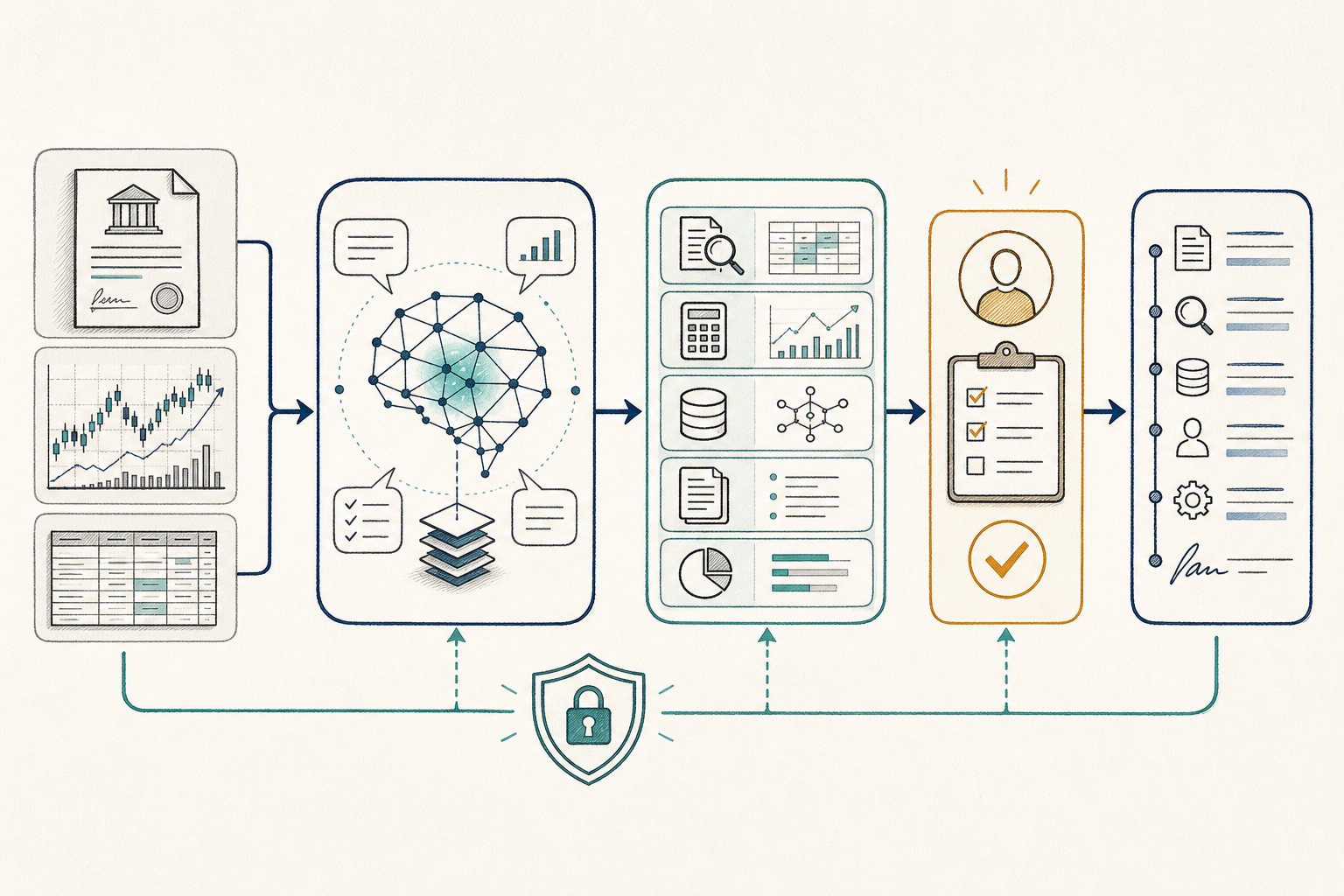
Generative AI in finance works best when teams choose bounded use cases, ground outputs in evidence, keep humans accountable, and preserve an auditable workflow.
生成式AI在金融领域的应用,应从边界明确的场景、数据依据和人工问责出发,
构建可验证、可治理、可审计的生产工作流。
TL;DR
Start with a bounded task
The best first use case has a clear input, a reviewable output, a named owner, and a safe fallback. “Automate finance” is not a usable scope.
Ground every material claim
Financial answers should point back to approved filings, internal records, policies, market data, or calculation steps instead of relying on model memory.
Keep decisions accountable
Generation can accelerate analysis and drafting. Credit, trading, disclosure, payment, and customer-impacting decisions still need proportionate controls and human authority.
Treat evidence as an output
A production workflow should preserve sources, tool calls, model and prompt versions, approvals, and exceptions so a reviewer can reconstruct what happened.
从边界明确的任务开始
首个场景应当有清晰输入、可复核输出、明确负责人和安全回退方案。“自动化金融工作”不是可执行的范围。
重要结论必须有依据
金融回答应回到经批准的财报、内部记录、制度、市场数据或计算过程,不能只依赖模型记忆。
保留决策问责
生成式AI可以加快分析和起草;信贷、交易、披露、付款及影响客户的决定仍需匹配风险的控制和人工授权。
把证据也当作输出
生产工作流应保留来源、工具调用、模型与提示词版本、审批和异常,确保复核者能重建全过程。
What generative AI in finance actually means金融行业生成式人工智能到底是什么
Generative AI in finance refers to models that create or transform text, code, explanations, scenarios, summaries, and structured outputs for financial work. It is different from a traditional forecasting model that returns a score or probability. A finance-grade system usually combines a model with approved data retrieval, deterministic calculations, controlled tools, policy checks, human review, and evidence capture.
金融行业生成式人工智能是指利用模型为金融工作生成或转换文本、代码、解释、情景、摘要和结构化结果。它不同于只输出评分或概率的传统预测模型。面向生产的金融大模型系统,通常还需要经批准的数据检索、确定性计算、受控工具、策略检查、人工复核和证据留痕。
Predictive AI, generative AI, and agentic AI are not the same预测式AI、生成式AI与智能体AI不是同一件事
Predictive AI estimates an outcome, such as default probability. Generative AI produces content or an explanation. Agentic AI adds planning and tool use so the system can take several steps. The further a system moves toward action, the stronger its permissions, approval gates, monitoring, and rollback design must become.
预测式AI估计违约概率等结果;生成式AI产生内容或解释;智能体AI进一步加入规划和工具调用,能够连续执行多个步骤。系统越接近真实动作,权限、审批闸门、监控和回滚设计就必须越严格。
It is an analysis interface, not a source of truth它是分析界面,不是事实来源
The model can help a user navigate complex information, but balances, prices, filing facts, policy requirements, and calculations must come from authoritative sources or deterministic systems. Retrieval-augmented generation can provide relevant context; it does not guarantee that the final answer is correct.
模型可以帮助用户理解复杂信息,但余额、价格、财报事实、制度要求和计算结果必须来自权威来源或确定性系统。检索增强生成可以提供相关上下文,却不能保证最终回答必然正确。
Scope boundary: this guide covers operational and analytical adoption. It does not recommend securities, automate regulated decisions without review, or treat generated content as financial advice.
范围说明:本文讨论运营和分析场景的落地,不推荐证券,不主张在无复核情况下自动执行受监管决策,也不把生成内容视为投资建议。
Generative AI use cases in finance, ranked by workflow fit生成式AI金融应用场景:按工作流适配度判断
The most useful applications of generative AI in finance turn unstructured material into a reviewable intermediate product. Good candidates reduce search, reading, drafting, or coding effort while leaving the source evidence and final authority visible. They are safer than asking a model to make an irreversible decision from an open-ended prompt.
生成式AI在金融领域更适合把非结构化材料转成可复核的中间成果。优先场景应减少搜索、阅读、起草或编码成本,同时保留来源证据和最终决策权;这比让模型根据开放式提示直接做不可逆决策更稳妥。
| Workflow工作流 | Useful output适合的输出 | Required grounding必须依据 | Human gate人工闸门 |
|---|---|---|---|
| Financial research金融研究 | Filing summaries, evidence tables, company comparisons, question lists财报摘要、证据表、公司对比、待核问题 | Source documents, timestamps, market and fundamental data原始文档、时间戳、市场与基本面数据 | Analyst verifies facts and interpretation分析师核对事实与解释 |
| Finance and accounting财务与会计 | Variance commentary, policy lookup, close checklists, draft narratives差异说明、制度查询、关账清单、叙述初稿 | Ledger, chart of accounts, approved policies, reporting periods账簿、科目表、已批准制度、报告期间 | Controller approves entries and disclosures财务负责人批准分录与披露 |
| Banking and service银行与客户服务 | Agent-assist drafts, document intake, knowledge answers, case summaries客服辅助草稿、材料受理、知识问答、工单摘要 | Product terms, customer permissions, approved knowledge产品条款、客户权限、已批准知识 | Staff confirms customer-impacting response or action员工确认影响客户的答复或动作 |
| Risk and compliance风险与合规 | Policy mapping, alert explanation, control evidence, investigation drafts制度映射、预警解释、控制证据、调查初稿 | Rules, cases, audit logs, validated detection systems规则、案例、审计日志、已验证检测系统 | Qualified reviewer owns disposition合格复核者负责最终处置 |
| Engineering and data工程与数据 | SQL or code drafts, schema explanations, tests, documentationSQL或代码草稿、模式解释、测试、文档 | Schemas, repositories, test fixtures, access controls数据模式、代码仓库、测试数据、访问控制 | Review, sandbox, tests, and deployment approval代码审查、沙箱、测试与发布审批 |
Research and document intelligence投研与文档理解
Generative AI for investment research can extract cited facts from filings, compare management commentary across periods, summarize earnings calls, and surface inconsistencies for an analyst to investigate. The answer should carry document names, dates, excerpts, and calculation provenance. For a narrower architecture, see QVeris’s guide to AI agents for financial research.
生成式AI辅助金融研究可以从财报中提取带引用的事实,比较不同时期的管理层表述,总结业绩电话会,并把矛盾点交给分析师进一步调查。输出应携带文档名称、日期、原文片段和计算来源。更具体的架构可参考 QVeris 的金融研究AI智能体指南。
Finance, accounting, and FP&A assistance财务、会计与FP&A辅助
In generative AI in finance and accounting, useful tasks include explaining period variances, answering policy questions, producing a first draft of management commentary, and converting close evidence into a checklist. The model should not post journal entries or publish disclosures simply because its draft sounds plausible.
在财务和会计场景中,可用任务包括解释期间差异、回答制度问题、起草管理层说明,以及把关账证据转换为检查清单。不能因为生成草稿看起来合理,就允许模型直接入账或发布披露。
Customer, operations, and banking workflows客户、运营与银行工作流
Generative AI in banking can assist staff with case summaries, document classification, product knowledge, and response drafts. High-risk areas such as credit eligibility, fraud disposition, complaints, payments, or personalized financial recommendations need verified rules, protected customer data, and accountable approval.
生成式AI在银行业的应用可以覆盖工单摘要、材料分类、产品知识和答复草稿。信贷资格、欺诈处置、投诉、付款或个性化金融建议等高风险事项,需要经过验证的规则、受保护的客户数据和可问责的批准。
Code, data, scenarios, and synthetic content代码、数据、情景与合成内容
Models can draft SQL, validation tests, API integrations, scenario narratives, and synthetic examples. Production use still requires schema-aware permissions, test data separation, code review, deterministic validation, and a clear label when content is simulated rather than observed.
模型可以起草SQL、验证测试、API集成、情景叙述和合成样例。进入生产仍需基于数据模式的权限、测试数据隔离、代码审查、确定性验证,并清楚标识内容是模拟结果而非真实观测。
Benefits of generative AI in finance—and how to measure them生成式AI在金融领域的价值及衡量方法
Value comes from changing a workflow, not merely adding a chat box. A useful pilot measures the entire task: how long users spend finding evidence, how many claims survive review, how often a human corrects the draft, whether the right documents were retrieved, and whether exceptions are resolved safely.
价值来自工作流改变,而不是仅仅增加聊天框。有效试点应衡量完整任务:寻找证据耗时、复核后保留的结论比例、人工修改频率、检索文档是否正确,以及异常能否安全解决。
Research speed研究速度
Measure time to a source-backed first draft, not raw token generation speed.
衡量得到“有来源支撑的初稿”所需时间,而不是单纯的生成速度。
Review quality复核质量
Track unsupported claims, material omissions, citation errors, and reviewer overrides.
跟踪无依据结论、重要遗漏、引用错误和复核者推翻结果的情况。
Operational reliability运营可靠性
Track retrieval failures, tool errors, stale data, latency, cost, and fallback success.
跟踪检索失败、工具错误、数据过期、延迟、成本和回退是否成功。
Control effectiveness控制有效性
Test whether permissions, policy checks, approvals, and audit records work under exceptions.
在异常条件下测试权限、策略检查、审批和审计记录能否真正生效。
Avoid fabricated ROI. Establish a pre-pilot baseline, define an acceptance threshold for quality and risk, then compare the same workflow with and without assistance.
不要虚构投资回报。应先建立试点前基线,定义质量与风险的验收阈值,再比较同一工作流在有无AI辅助时的实际表现。
How to implement generative AI in finance safely金融机构生成式AI落地:六步生产架构
A production design should separate generation from truth, permissions, calculations, and decisions. This creates testable boundaries: the model can propose, while governed services retrieve data, calculate values, authorize actions, and retain evidence.
生产设计应把“生成”与事实、权限、计算和决策分开,形成可测试的边界:模型负责提出内容,受治理的服务负责检索数据、计算数值、授权动作并保存证据。
1. Define the task, owner, and forbidden actions1. 定义任务、负责人和禁止动作
Write down the allowed inputs, intended output, named reviewer, maximum impact, and safe fallback. Exclude autonomous payments, trades, disclosures, or eligibility decisions unless a separately governed system explicitly authorizes them.
写清允许输入、预期输出、指定复核者、最大影响和安全回退。除非有独立治理系统明确授权,否则排除自主付款、交易、披露和资格决定。
2. Build an approved evidence layer2. 建立经批准的证据层
Inventory filings, internal policies, ledgers, market data, research sources, and APIs. Assign owners, timestamps, entitlements, retention rules, and freshness requirements. A financial data API for AI agents should expose provenance and errors, not just values.
盘点财报、内部制度、账簿、市场数据、研究来源和API,并分配负责人、时间戳、权限、保留规则与新鲜度要求。面向AI智能体的金融数据API不仅要返回数值,还要返回来源和错误状态。
3. Ground retrieval and calculations3. 让检索和计算有确定依据
Retrieve the smallest relevant evidence set, preserve document and field identifiers, and move arithmetic into deterministic code. Test retrieval recall, citation alignment, period consistency, units, currencies, corporate actions, and missing-data behavior.
检索最小且相关的证据集,保留文档和字段标识,把算术交给确定性代码。测试检索召回、引用对齐、期间一致性、单位、币种、公司行动和缺失数据处理。
4. Put tools behind policy and least privilege4. 用策略和最小权限约束工具
Each external capability should declare its purpose, input schema, data sensitivity, permission, rate limit, timeout, and side effects. Read-only tools should remain separate from tools that can change records or trigger transactions.
每项外部能力都应声明用途、输入模式、数据敏感度、权限、限流、超时和副作用。只读工具必须与能够修改记录或触发交易的工具分开。
5. Design review and exception paths5. 设计复核与异常路径
Show reviewers the generated answer beside its sources, calculations, confidence signals, and unresolved conflicts. Define when the system must abstain, request more data, escalate, or revert to the existing manual process.
向复核者同时展示生成答案、来源、计算过程、置信信号和未解决冲突。定义系统何时必须拒答、补充数据、升级处理或回到原有人工流程。
6. Evaluate, monitor, and retain evidence6. 评测、监控并保留证据
Use representative and adversarial cases. Version the model, prompt, retrieval index, tool definitions, policies, and evaluation set. Monitor quality, safety, cost, latency, drift, access violations, and human overrides after launch.
使用代表性和对抗性案例,管理模型、提示词、检索索引、工具定义、策略和评测集的版本。上线后持续监控质量、安全、成本、延迟、漂移、越权和人工推翻情况。
Risks of generative AI in finance and practical controls生成式AI金融风险与监管:风险—控制对应表
The NIST Generative AI Profile organizes risks and actions for governing, mapping, measuring, and managing generative AI. The OECD’s finance analysis treats end-to-end autonomous use as an area requiring caution. These sources support a control-first approach; they do not imply that one checklist satisfies every jurisdiction.
NIST生成式AI风险管理框架按照治理、映射、衡量和管理组织风险及行动;OECD的金融研究则对端到端自主使用保持谨慎。这些资料支持“控制优先”的方法,但不代表一张清单可以满足所有司法辖区要求。
| Risk风险 | Failure pattern失败表现 | Minimum control set最低控制集合 |
|---|---|---|
| Hallucination and omission幻觉与遗漏 | Plausible but false facts, missing caveats, wrong periods or entities似是而非的事实、遗漏限制、期间或主体错误 | Grounding, citations, deterministic checks, abstention, human review数据依据、引用、确定性校验、拒答、人工复核 |
| Privacy and leakage隐私与泄露 | Sensitive customer, employee, transaction, or deal data enters an unauthorized context客户、员工、交易或项目敏感数据进入未授权环境 | Classification, minimization, redaction, isolation, retention and vendor controls分类、最小化、脱敏、隔离、保留和供应商控制 |
| Bias and unfair treatment偏见与不公平对待 | Different quality or outcomes across protected or underserved groups受保护或服务不足群体获得不同质量或结果 | Representative tests, subgroup analysis, explanations, appeals and accountable ownership代表性测试、分组分析、解释、申诉与明确责任 |
| Prompt injection and tool misuse提示注入与工具滥用 | Untrusted content changes instructions or causes excessive data access or actions不可信内容篡改指令,导致过度取数或执行动作 | Content separation, allowlists, least privilege, approval gates, sandbox and egress controls内容隔离、白名单、最小权限、审批闸门、沙箱和出口控制 |
| Model and data drift模型与数据漂移 | Behavior changes after a model, prompt, source, schema, or market regime changes模型、提示词、来源、模式或市场状态变化后行为改变 | Versioning, regression evaluation, freshness monitoring, canary release and rollback版本管理、回归评测、新鲜度监控、灰度发布与回滚 |
| Concentration and systemic risk集中度与系统性风险 | Many institutions depend on similar providers, data, or generated signals多家机构依赖相似供应商、数据或生成信号 | Dependency mapping, fallback, stress testing, limits, independent evidence and manual continuity依赖映射、回退、压力测试、限额、独立证据和人工连续性 |
Where QVeris fits in generative AI in financeQVeris如何连接金融大模型与可验证能力
QVeris is not a language model, a source of financial truth, or a substitute for model risk management. It is a capability layer for agents and applications that need to discover, inspect, call, and audit external tools and data services. In a finance workflow, that layer can sit between model reasoning and approved financial capabilities.
QVeris不是语言模型,不是金融事实来源,也不能替代模型风险管理。它是面向智能体和应用的能力层,用于发现、检查、调用和审计外部工具与数据服务。在金融工作流中,这一层可以位于模型推理与经批准的金融能力之间。
Discover before integration集成前先发现
Teams can identify a relevant capability instead of hardcoding every provider into application logic. Discovery must still be followed by suitability, licensing, data-rights, and security review.
团队可以先找到相关能力,而不是把每个供应商硬编码进应用逻辑。发现之后仍需完成适用性、许可、数据权利和安全审查。
Inspect the contract before a call调用前检查契约
Schemas, required parameters, provider identity, and capability descriptions give the agent and developer a clearer execution boundary. For finance data architecture, read the financial data API for AI agents guide.
数据模式、必需参数、供应商身份和能力说明为智能体与开发者提供更清晰的执行边界。金融数据架构可继续阅读面向AI智能体的金融数据API指南。
Call through a controlled boundary通过受控边界调用
A model can request a capability while the surrounding application enforces identity, permissions, parameter validation, timeouts, budgets, and approval. QVeris does not make the returned data correct by itself; source quality and validation remain the implementer’s responsibility.
模型可以请求能力,外围应用负责身份、权限、参数验证、超时、预算和审批。QVeris本身不会让返回数据自动正确,来源质量和验证仍由实施团队负责。
Preserve an auditable execution trail保留可审计执行轨迹
Capability identity, inputs, timestamps, results, errors, and approval context can become part of the workflow record. That evidence complements—but does not replace—financial controls, regulatory records, or independent audit requirements.
能力身份、输入、时间戳、结果、错误和审批上下文可以进入工作流记录。这些证据是金融控制、监管记录和独立审计要求的补充,不能替代它们。
QVeris boundary: capability access and execution evidence. QVeris does not provide investment advice, guarantee model output, validate every third-party source, or authorize regulated decisions.
QVeris边界:能力访问与执行证据。QVeris不提供投资建议,不保证模型输出,不验证每一个第三方来源,也不授权受监管决策。
FAQ
What is generative AI in finance?什么是金融领域的生成式AI?
It is the use of generative models to create or transform content for financial workflows, such as cited research summaries, variance explanations, code drafts, customer-service assistance, and control evidence. A production system normally adds approved data, tools, policies, review, and monitoring around the model.
它利用生成模型为金融工作流创建或转换内容,例如带引用的研究摘要、差异解释、代码草稿、客服辅助和控制证据。生产系统通常还会在模型周围加入经批准的数据、工具、策略、复核和监控。
How is generative AI used in financial services?生成式AI在金融领域有哪些应用?
Common uses include document intake, filing and earnings-call analysis, research synthesis, policy lookup, close and FP&A assistance, case summaries, compliance drafting, code generation, and scenario exploration. The right control depends on the consequence of the output.
常见应用包括材料受理、财报与业绩电话会分析、研究汇总、制度查询、关账与FP&A辅助、工单摘要、合规起草、代码生成和情景探索。控制强度取决于输出后果。
What are the benefits for finance teams?生成式AI能为财务团队带来什么价值?
It can reduce time spent searching, reading, drafting, and translating between natural language and structured systems. Benefits should be measured after review, using quality, exception, evidence, reliability, and control metrics—not generated volume alone.
它可以减少搜索、阅读、起草以及自然语言与结构化系统之间转换的时间。价值应在复核后衡量,关注质量、异常、证据、可靠性和控制指标,而不是只看生成数量。
What are the risks of generative AI in finance?生成式AI在金融行业有哪些风险?
Key risks include hallucination, omission, data leakage, bias, weak explainability, prompt injection, tool misuse, model or data drift, third-party dependence, and overreliance on outputs. Financial impact can make ordinary model errors materially consequential.
主要风险包括幻觉、遗漏、数据泄露、偏见、可解释性不足、提示注入、工具滥用、模型或数据漂移、第三方依赖和过度依赖输出。金融影响会让普通模型错误产生实质后果。
How can a financial model reduce hallucinations?金融大模型如何减少幻觉?
Use approved retrieval, narrow the task, cite source spans, perform calculations in code, validate entities and periods, make uncertainty visible, and require abstention or review when evidence is missing or conflicting. No single technique eliminates hallucination.
应采用经批准的检索、缩小任务范围、引用原文片段、用代码计算、验证主体与期间、展示不确定性,并在证据缺失或冲突时拒答或升级复核。不存在单一技术可以彻底消除幻觉。
Can generative AI make financial decisions?生成式AI能否直接做金融决策?
It can support analysis and propose options. For high-impact decisions, accountable humans and governed systems should verify evidence, apply policy, authorize action, and preserve appeal or correction paths. Legal and regulatory requirements vary by jurisdiction and use case.
它可以辅助分析并提出选项。高影响决策应由可问责人员和受治理系统核验证据、执行策略、授权动作,并保留申诉或纠错路径。法律和监管要求会因司法辖区与场景而异。