
Find a GitHub Free Stock API
That You Can Trust如何在 GitHub 上选择可信的
免费股票 API
Evaluate the repository, upstream data source, license, rate limits, and maintenance risk before you ship.
上线前逐项核对仓库、上游数据源、许可证、
调用限制与维护风险。
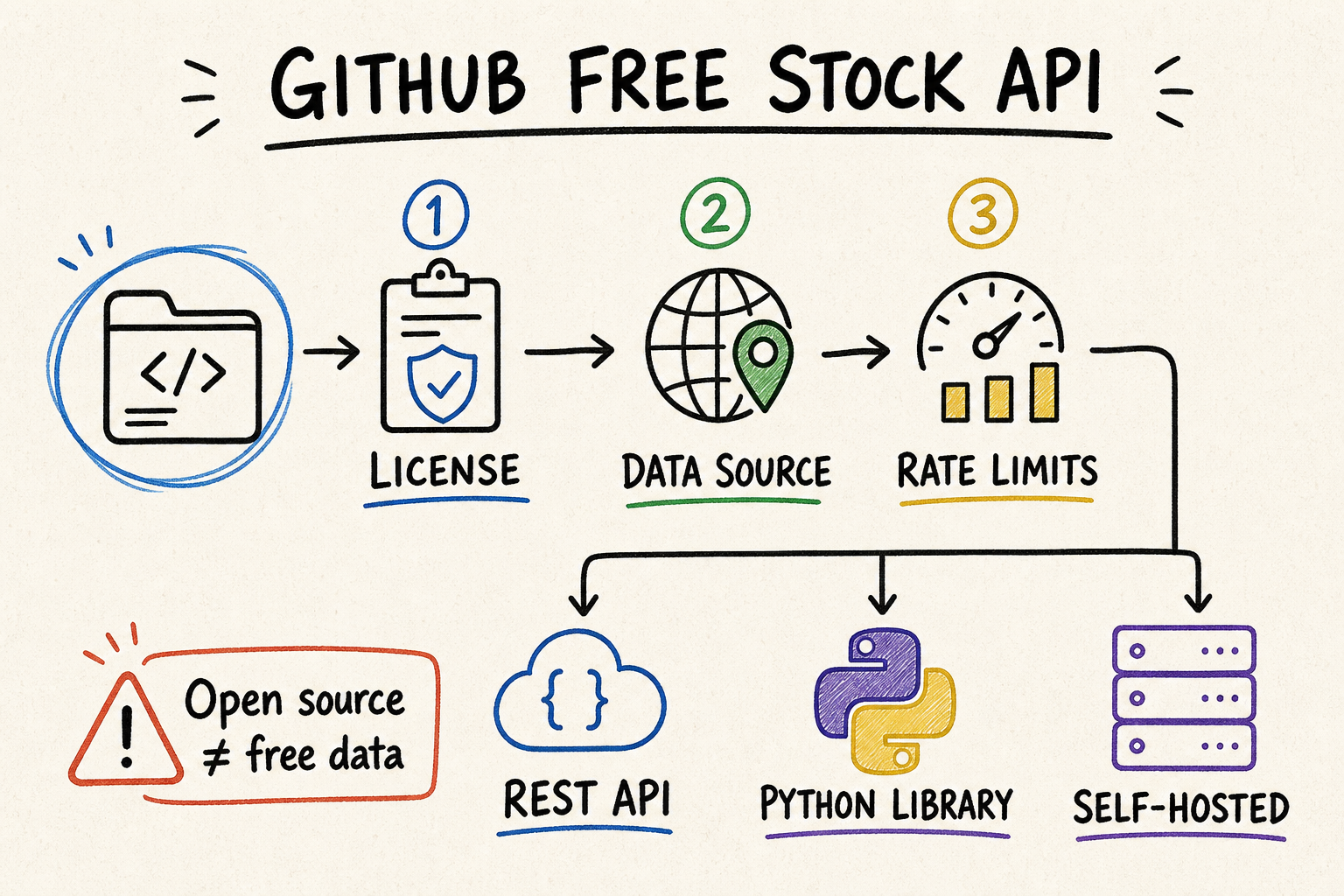
TL;DR核心摘要
A repository may provide a client library, wrapper, proxy, or server. It does not automatically grant rights to the underlying market data.
Identify whether the project calls an official vendor, scrapes a website, bundles static files, or requires your own brokerage account.
仓库可能是客户端库、封装器、代理或服务端,但并不自动授予底层市场数据的使用权。
先确认项目调用官方供应商、抓取网站、附带静态文件,还是要求连接你自己的券商账户。
What “GitHub free stock API” actually means“GitHub 免费股票 API”到底指什么
Search results mix several different things: open-source API clients, unofficial wrappers around public websites, self-hosted aggregation services, sample projects, and lists of third-party free tiers. Treat the repository as an integration component, not as proof that the data is free, licensed, real-time, or production-ready.
搜索结果会混合开源 API 客户端、公开网站的非官方封装、自托管聚合服务、示例项目,以及第三方免费套餐清单。仓库只是集成组件,不能证明数据免费、授权完备、实时或可用于生产。
Usually the safest code path. The repository simplifies authentication and endpoints, while the vendor still controls data entitlements and quotas.
Convenient for prototyping, but it can break when an undocumented endpoint or website changes. Maintenance history matters more than star count alone.
You operate the service and can control caching and schemas, but you still need a lawful, reliable upstream data source.
A clean REST surface can still depend on fragile HTML or undocumented browser calls. Identify selectors, cookies, anti-bot behavior, and the upstream terms before relying on it.
A repository may run offline because it ships a small snapshot. Check the observation date, universe, provenance, and whether an update path actually exists.
通常是最稳妥的代码路径。仓库简化鉴权与端点调用,但数据权限和配额仍由供应商控制。
适合快速原型,但未公开端点或网页一旦变化就可能失效。维护历史比单看 Star 数更重要。
你可以控制缓存和数据结构,但仍然需要合法、稳定的上游数据源。
外层 REST 接口再整洁,底层仍可能依赖脆弱的 HTML 或未公开浏览器请求。使用前要确认选择器、Cookie、反爬机制和上游条款。
有些项目无需联网即可运行,只是因为附带了一份小型快照。应核对数据日期、股票池、来源,以及是否真的存在更新路径。
Compare GitHub stock API repository typesGitHub 股票 API 仓库类型对比
| Layer层级 | Main job主要作用 | Best for适合场景 | Boundary边界 |
|---|---|---|---|
| Official SDK官方 SDK | Calls a documented provider API.调用有文档的供应商 API。 | Stable integrations and support.稳定集成与支持。 | Requires a provider key and plan.需要供应商 Key 与套餐。 |
| Community wrapper社区封装器 | Normalizes a public or private upstream source.统一公开或私有上游数据源。 | Fast experiments and scripts.快速实验与脚本。 | Breakage and terms risk.存在失效和条款风险。 |
| Self-hosted service自托管服务 | Exposes your own REST or GraphQL layer.提供自有 REST 或 GraphQL 层。 | Caching, schemas, and internal tools.缓存、统一结构与内部工具。 | You own operations and upstream compliance.自行承担运维和上游合规。 |
| Static dataset repo静态数据仓库 | Stores CSV, JSON, or sample history.保存 CSV、JSON 或历史样本。 | Tutorials and reproducible demos.教程与可复现演示。 | Usually stale and not a live API.通常会过期,也不是实时 API。 |
A seven-point repository evaluation checklist七项仓库评估清单
Confirm the code license, upstream terms, redistribution rights, commercial-use rules, and attribution requirements.
Trace every quote to its source. Determine whether it is delayed, exchange-limited, adjusted, or available only through a brokerage account.
Review recent releases, open issues, merged pull requests, security policy, dependency updates, and bus factor.
Keys should come from environment variables or a secret store, never examples, query logs, browser bundles, test fixtures, screenshots, or committed configuration.
Look for typed responses, timeouts, pagination, 401 and 429 handling, retries with backoff, and explicit empty or partial results. A happy-path demo is not an API contract.
Tests should cover schema changes, nulls, invalid symbols, throttling, and upstream errors without calling live markets on every run.
Pin a commit or release, maintain your own adapter, and know how to replace the repository or upstream provider without rewriting application logic.
确认代码许可证、上游条款、再分发权限、商业使用规则与署名要求。
追溯每条行情的来源,确认是否延迟、受交易所限制、经过复权,或必须连接券商账户。
检查近期发布、未解决 Issue、合并的 Pull Request、安全策略、依赖更新与核心维护者数量。
Key 应来自环境变量或密钥服务,绝不能出现在示例、查询日志、浏览器包、测试夹具、截图或已提交配置中。
检查类型化响应、超时、分页、401 和 429 处理、带退避重试,以及明确的空结果和部分结果。只有成功路径演示,不等于具备 API 契约。
测试应覆盖字段变化、空值、无效代码、限流和上游错误,而不是每次运行都调用真实市场。
锁定提交或发布版本,维护自己的适配层,并确保将来替换仓库或上游供应商时无需重写应用逻辑。
Use QVeris to verify before you integrate用 QVeris 在集成前完成验证
A GitHub README tells you how a project presents itself. Use the QVeris documentation and Playground to inspect callable alternatives, then compare their provider contracts with the repository’s real upstream dependency.
GitHub README 只反映项目如何介绍自己。可以先查阅 QVeris 文档,再到 Playground 验证可调用的替代方案,并把供应商契约与仓库实际依赖的上游数据源逐项比较。
- Discover stock quote, historical price, fundamentals, and market-data capabilities by use case.
- Inspect tool inputs and outputs before writing provider-specific glue code.
- Keep repository evaluation separate from live API verification and data licensing.
- 按场景发现股票报价、历史价格、基本面和市场数据能力。
- 编写供应商专用代码前,先检查工具输入与输出。
- 把仓库评估、实时 API 验证和数据授权作为三项独立检查。
FAQ常见问题
Not necessarily. The code can be open source while its upstream provider requires a key, paid entitlement, brokerage account, or limits commercial use.
It may work for research or prototypes, but you should evaluate reliability and the applicable terms before using it in production.
Only a weak one. Recent releases, response to breakages, tests, security practices, maintainers, and a documented upstream source matter more.
Only if you can own the upstream integration, security updates, tests, licensing review, and operational support—not merely keep the code compiling.
不一定。代码可以开源,但上游供应商仍可能要求 Key、付费权限、券商账户,或限制商业使用。
它可能适合研究或原型,但用于生产前必须评估可靠性和适用条款。
只能作为很弱的参考。近期发布、故障响应、测试、安全实践、维护者数量和明确上游来源更重要。
只有在你能承担上游接入、安全更新、测试、许可审查和运行支持时才适合,而不是只保证代码还能编译。
References and next steps参考资料与下一步
Alpha Vantage documentation
Alpaca market data documentation
QVeris documentation
QVeris Playground