
What Terra is designed for
GPT-6.1 Terra focuses on fast visual reasoning and precise computer use: understanding a screen or drawing, then acting in software to complete a task. Clear writing and improved coding support that workflow. Its positioning is efficient everyday execution; the most complex coding and research still favor Sol or Astra.
Terra is listed in the QVeris test catalog with text and image input and text output. This inline comparison starts with text-only questions and no external tools. The first panel defaults to Terra; choose a different model for each panel from those discussed in this article.
OpenAI documents a 1,050,000-token context and up to 128,000 output tokens. Tool calling requires the Responses API. This trial uses direct-answer mode with reasoning disabled and caps each answer at 1,024 output tokens to control costs, so it is not intended for very long reports in a single response.
Four models: capabilities and limits
Start with the task and the serving route. The official capabilities below describe the model; the final column identifies what the current QVeris route and this text-only page actually expose. Suggested trials are editorial recommendations, not a new benchmark.
| Model | Official capability and evidence | Tasks worth testing first | Serving and page limits |
|---|---|---|---|
| GPT-6.1 Terra | Visual reasoning, screen-based work and clearer writing; the release also reports stronger terminal coding than 5.6 Terra. Release | Read invoice fields, interpret a drawing, review a small function, or turn notes into a proposal. | Official tool calling requires Responses API. The test catalog does not mark this route with tools; this page offers text only, without computer control. |
| GPT-5.6 Terra | The previous balanced everyday-work model in the 5.6 family; useful as a migration baseline. Sol-specific release scores do not describe Terra. Release | Re-run existing prompts and compare field accuracy, required edits and total cost before switching versions. | A matching context window does not imply matching capability. Keep this as a baseline rather than assuming the older version is equally strong. |
| Qwen 3.7 Plus | Official documentation highlights web development, artifacts, OCR and spatial understanding, with text, image and video input. Model description | Try structured extraction, Chinese document cleanup and frontend specifications; the price table provides a lower-cost text baseline. | This QVeris route lists text/image, not video. Qwen3.7-Max or Qwen3.8-Max scores are not Plus scores; this page has no image or video upload. |
| Kimi K3 | The release targets long-horizon coding and knowledge work, including large repositories, terminal tools and native vision. Technical release | Evaluate multi-file planning, long-document synthesis and engineering explanations with explicit acceptance checks. | The current QVeris route is text-input only. Vendor demos use an Agent environment; K3 Cluster and K3.1 Pro are different configurations/models. |
What the original releases actually demonstrate
| OpenAI-reported evaluation | GPT-6.1 Terra | GPT-5.6 Terra | Conditions and interpretation |
|---|---|---|---|
| Terminal-Bench 4.0 | 50.3% | 21.5% | Maximum reasoning; terminal coding tasks. The reported difference is 28.8 percentage points. This is a vendor-reported comparison. |
| Internal factual-error test | 16.7% | 53.6% | Low reasoning; lower is better. This internal prompt set is not a universal hallucination rate. |
OpenAI uses invoice-to-accounting and drawing-to-3D workflows to illustrate visual-to-action tasks. Moonshot describes MiniTriton compiler development and GPU kernel optimization with up to 24 hours for four tasks. These are examples to inspect in the Terra release and K3 technical blog; they require tools and execution environments beyond this page.
Independent evaluations: exact model and settings
The table uses a third-party leaderboard snapshot checked on November 4, 2026. Artificial Analysis labels its index v5.0.1; the linked Agent Arena snapshot is dated November 1. Settings are shown separately because Arena uses xHigh for the older Terra row.
| Model | AA Intelligence Index v5.0.1 | Agent Arena overall rank / setting | Arena sessions |
|---|---|---|---|
| GPT-6.1 Terra | 51 · Max | 8 / 57 · Max | 19,912 |
| GPT-5.6 Terra | 32 · Max | 32 / 57 · xHigh | 44,557 |
| Qwen 3.7 Plus | N/A | 45 / 57 · not labelled | 24,493 |
| Kimi K3 | N/A | 25 / 57 · Max | 161,000 |
AA measures a fixed evaluation suite; Arena estimates model effects from real Agent sessions and multiple signals using causal tracing. Arena rank is not a question-accuracy percentage. The two scales should not be averaged. N/A means the current AA model page supplies no index value; it is not zero, and older index versions are not substituted.
The independent evidence makes Terra an upgrade candidate, not an automatic winner on every task. Public Max/xHigh results cannot predict this page’s short direct-answer trial. Use the inline comparison to check the same input, field-level correctness, elapsed time and actual Credits for your own workload.
Model specifications on QVeris
Context length, maximum output and input types supported by the current QVeris model entries.
| Model | Context tokens | Max output tokens | Catalog input |
|---|---|---|---|
| GPT-6.1 Terra | 1,050,000 | 128,000 | image, text |
| GPT-5.6 Terra | 1,050,000 | 128,000 | text, image |
| Qwen 3.7 Plus | 1,000,000 | 65,536 | text, image |
| Kimi K3 (Agent Plan primary) | 1,048,576 | 131,072 | text |
Pricing and transparent usage math
| Model | Input tier starts | Input Credits / M | Output Credits / M | Cache-read Credits / M |
|---|---|---|---|---|
| GPT-6.1 Terra | 0+ | 650 | 3,250 | 32.5 |
| GPT-6.1 Terra | 272,000+ | 1,300 | 4,875 | 65 |
| GPT-5.6 Terra | 0+ | 1,300 | 7,800 | 130 |
| Qwen 3.7 Plus | 0+ | 208 | 832 | 41.6 |
| Qwen 3.7 Plus | 256,001+ | 624 | 2,496 | 124.8 |
| Kimi K3 (Agent Plan primary) | 0+ | 1,805.5556 | 9,027.7778 | 180.5556 |
These are test-site Credits prices checked on November 2, 2026, not vendor USD prices or a production pricing commitment. Cache hits use the cache-read rate, and long inputs use the applicable tier.
For 1,000 input and 200 output tokens without caching at base rates: Terra costs (1,000 × 650 + 200 × 3,250) / 1,000,000 = 1.30 Credits; GPT-5.6 Terra costs 2.86; Qwen 3.7 Plus 0.3744; Kimi K3 about 3.6111. Under this fixed-usage assumption Terra is about 54.5% cheaper than GPT-5.6 Terra, but costs more than Qwen. Different response lengths change actual costs.
OpenAI standard USD pricing is $1 per million input tokens, $5 output and $0.05 cache read, with long-context pricing above 272K input. The current OpenRouter channel override starts at 272,000 input tokens, a boundary wording difference from the vendor documentation. This short-text trial does not reach that tier.
Model comparison results
Try a compact version of a task shared by a Terra tester on X. Choose two models, edit the question and send it to both. “Next question” rotates animation, visual coding and demolition tasks. Compare the reported results in the list below; select “View” to visit the author’s account.
Loading the inline comparison. Refresh the page if it does not appear.
Model test comparison
Compare the task, output and trade-off—not just a model name. Official evaluations and five selected community tests are shown separately. This is a curated sample, not a count of all X tests.
Official evaluations: previous generation → current generation
Terminal-Bench 4.0
+28.8 percentage points
Published max-effort scores; higher is better.
Factual error rate
−36.9 percentage points
Internal error-inducing prompts, low effort; lower is better.
Agents’ Last Exam includes architectural drawing → 3D model and film → time-coded restoration log. At medium effort: +15 points versus GPT-5.6 Terra at about one-third the cost. These are agent workflows with tools, not the text-only trial above.
Core strengths and the evidence behind them
Visual reasoning → action
Agents’ Last Exam reports +15 percentage points at medium effort versus 5.6 Terra, at about one-third the cost. The official examples use tools. The community cases below do not independently reproduce this computer-use evaluation.
Coding → verify the effort setting
Official max-effort completion rises from 21.5% to 50.3%. In the 105-bug community test, the author reports max scores of 32 → 40.7, but xhigh scores of 20 → 11.3. The tests use different rubrics; stronger max results do not guarantee an upgrade at every setting. View community test
Efficiency → compare the finished work
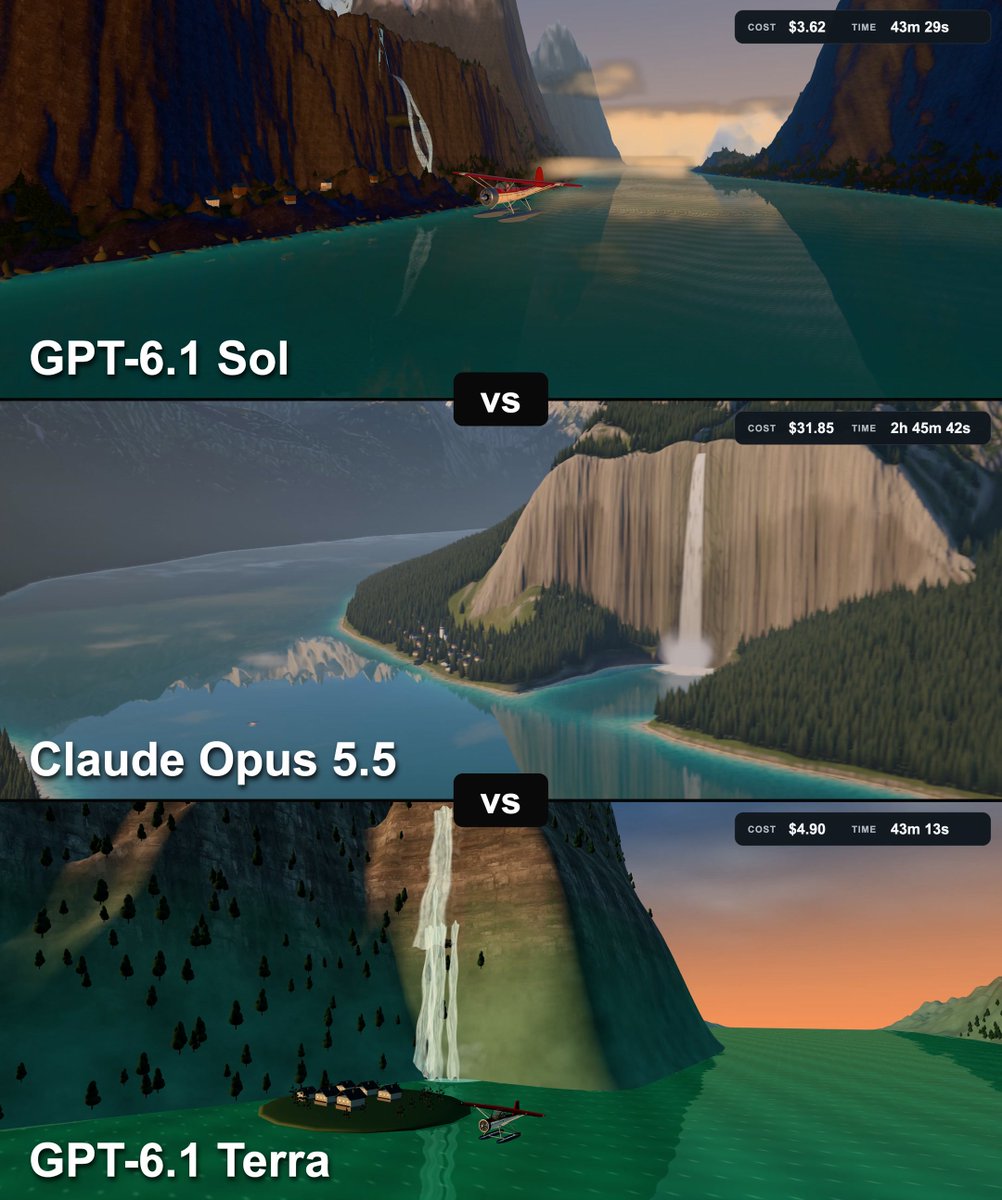
The Alpine Gold report lists Terra at $4.90 / 43 min versus Opus at $31.85 / 2 h 45 min; Sol costs $3.62 / 43 min. The courtyard test costs Terra $1.23 versus Opus $14.17, while its author prefers Opus visually. Lower cost alone does not establish better output. View community test
Community tests: same task, visible differences
| Task | GPT-6.1 Terra | Other model / baseline | What changes | Evidence |
|---|---|---|---|---|
| Pixel-art table-tennis courtyard Single-file 3D scene with physics and moving characters. | $1.23. Author describes pale colors and awkward motion. | Opus 5.5: $14.17. Author favors its lighting, colors and detail. | Terra costs about 91% less; visual preference goes to Opus. See the video for the actual outputs. | Results / demo @vib3coded |
| Alpine Gold scene Same scene prompt across three models. | $4.90 · 43 min | Sol: $3.62 · 43 min; Opus 5.5: $31.85 · 2 h 45 min. | About 85% cheaper than Opus. Sol is cheaper than Terra; the author prefers Opus reflections and forest detail. | Results / demo @EnvolDev |
| Find and fix replanted bugs Two repositories, 105 replanted bugs. | max: 40.7; xhigh: 11.3; high: 9.7. | GPT-5.6 Terra: max 32; xhigh 20; high 18. | Author-reported scores: max improves by 8.7; lower settings regress. Units and complete rubric are not established by this post. | Results / demo @PawelHuryn |
| 3D house demolition Same 3D simulation prompt. | 7.5/10 · 6m20s · $0.24 | Muse Spark 1.3: 8.7/10 · 6m31s · $0.16; DeepSeek V4.1 Flash: 6.3/10 · 10m49s · $0.06. | Terra finishes 11 seconds before Muse; Muse scores 1.2 higher and costs $0.08 less. Author scores, not a standardized benchmark. | Results / demo @LatentOperatorX |
| Pelican cycling Generate a cycling pelican. | Foot motion failed. | No paired model output published in this post. | A failure example: check whether feet, pedals and wheels actually move together. It cannot establish a model ranking. | Results / demo @xmglab |
USD, timings, scores and visual judgments above are the authors’ reports, not QVeris charges or our reruns. Links open the original results and account. No invented before/after images are used; a missing comparator stays missing.
Usage notes and FAQ
How are answers evaluated?
Your run shows response time, average throughput, input and output tokens, returned model identity and settled Credits. The X-inspired creative tasks need human review; they do not receive a made-up accuracy score. Original authors’ reports below remain separate from your live results.
Why can one panel succeed while the other fails?
Calls execute independently. Balance, availability, output limits and upstream errors can affect one side. Successful and partial answers are retained without automatic retries. A request failure is not a zero capability score.
Can I compare images or tool use?
This version compares text answers only. A catalog vision capability does not mean image upload is implemented here. Tool use and very long contexts require separate validation.
Official sources and related guides
- OpenAI: GPT-6.1 Terra release and evaluations
- OpenAI: GPT-5.6 family positioning
- Qwen: exact Plus model description
- Moonshot: Kimi K3 technical release and case studies
- Artificial Analysis: Terra Max, Index v5.0.1
- Artificial Analysis: previous Terra Max
- Artificial Analysis: Qwen3.7 Plus
- Artificial Analysis: Kimi K3 Max
- Arena: Agent leaderboard snapshot
- Arena: evaluation methodology
- OpenAI Terra specifications and pricing
- OpenRouter exact model and routing information
- QVeris Terra model details
Related guides: Gemini 4 Carbon · Kimi K3.1 Pro · All models.