
Gross Margin vs Operating Margin
Formula, Differences & Uses毛利率与营业利润率
公式、差异与分析方法
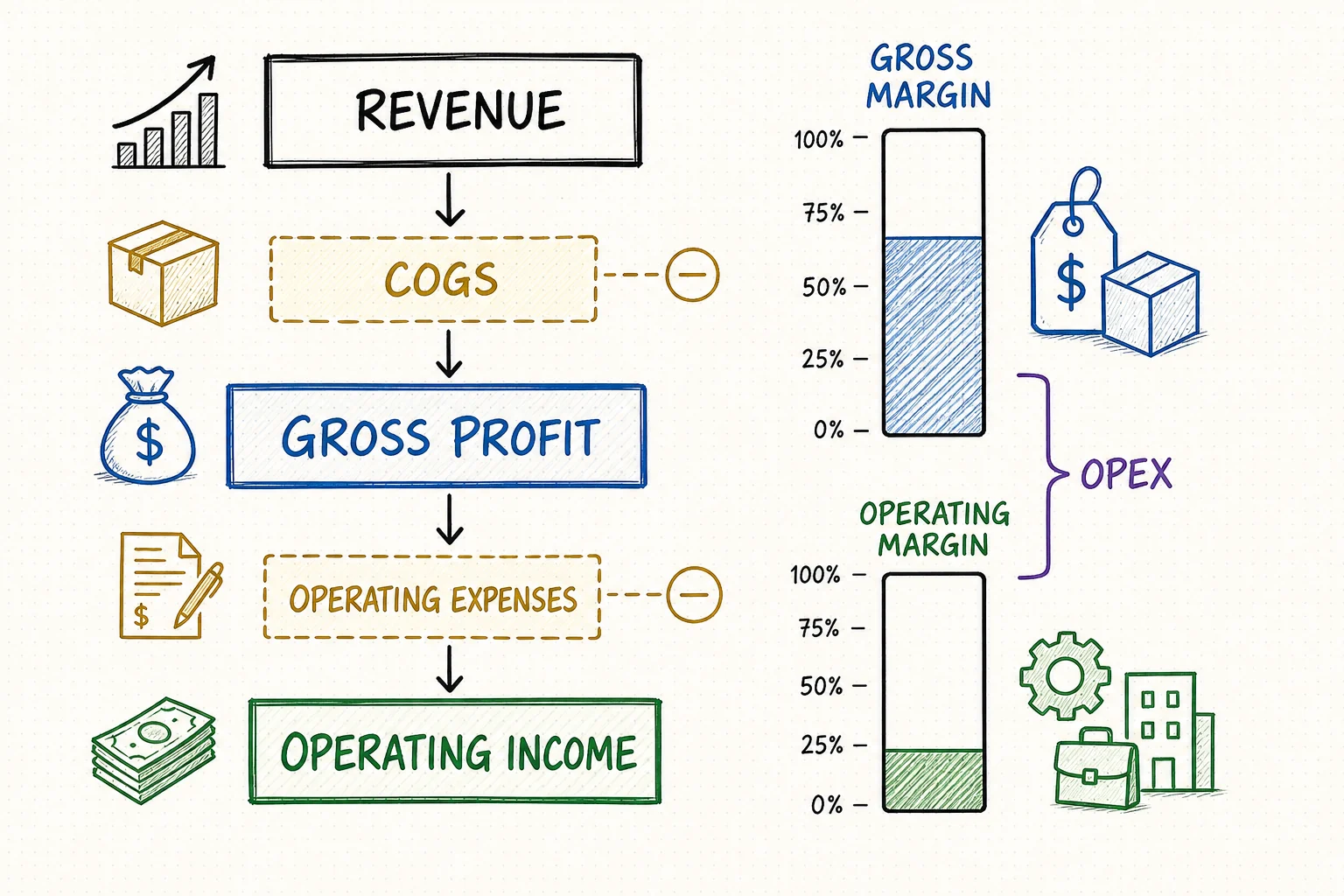
Gross margin vs operating margin compares product-level economics with the profitability left after the broader cost of running the business.
毛利率和营业利润率的区别,在于一个观察产品或服务的直接经济性,另一个衡量承担完整经营费用后的核心盈利能力。
TL;DR
Different profit layers
Gross margin stops after revenue and cost of goods sold. Operating margin goes further and includes the operating expenses required to run the whole business.
Direct mathematical bridge
Operating margin normally equals gross margin minus operating expenses as a percentage of revenue, subject to the company’s presentation and other operating items.
The gap is diagnostic
A wide spread can reflect R&D, sales, marketing, administration, depreciation, or deliberate investment—not automatically waste or weak economics.
Context before conclusions
Compare the same company over time and close peers using consistent periods, definitions, currency, units, and reported-versus-adjusted bases.
利润表层级不同
毛利率止步于收入减销售成本;营业利润率还要扣除维持整个企业经营所需的营业费用。
可以直接桥接
在常规口径下,营业利润率约等于毛利率减去营业费用占收入的比例,但还要检查其他营业收益和公司的列报方式。
差额本身有诊断价值
较大的差额可能来自研发、销售、营销、管理费用、折旧摊销或主动增长投入,并不自动代表浪费。
先统一口径再下结论
比较时应对齐公司、期间、币种、单位、会计定义,以及报告口径和调整后口径。
What gross margin and operating margin actually measure毛利率与营业利润率分别衡量什么
Both ratios divide a level of profit by revenue, but they stop at different points in the income statement. That difference changes the business question each ratio can answer.
两个指标都用某一层利润除以收入,但它们停留在利润表的不同位置,因此回答的是不同的经营问题。
Gross margin: product or service economics
Gross margin = (Revenue − COGS) ÷ Revenue × 100. Cost of goods sold—or cost of revenue—normally contains direct costs associated with producing or delivering the sold product or service. Gross margin asks how much of each revenue dollar remains after those direct costs.
Operating margin: full core-business efficiency
Operating margin = Operating income ÷ Revenue × 100. Operating income generally starts with gross profit and subtracts operating expenses such as R&D, sales and marketing, general and administrative expense, and depreciation or amortization classified within operations.
Gross profit and operating profit are dollar amounts
Gross profit and operating income are amounts. Gross margin and operating margin are percentages. Keeping amount and ratio terminology separate prevents a common analytical error when businesses have different revenue scales.
毛利率:产品或服务的直接经济性
毛利率 =(营业收入 − 销售成本)÷ 营业收入 × 100%。销售成本或收入成本通常包括与生产产品、交付服务直接相关的成本。毛利率回答的是:每一元收入在承担直接成本后还剩多少。
营业利润率:完整核心经营效率
营业利润率 = 营业利润 ÷ 营业收入 × 100%。营业利润通常从毛利润继续扣除研发、销售与营销、管理费用,以及归入经营活动的折旧摊销等项目。
毛利润和营业利润是金额
毛利润、营业利润是金额;毛利率、营业利润率是百分比。比较不同收入规模的公司时,必须区分利润金额和利润率。
The U.S. SEC’s income-statement guide illustrates the same waterfall: revenue, cost of goods sold, gross profit, operating expenses, operating profit, then interest, tax, and net income.
美国SEC的利润表指南采用相同的瀑布结构:收入、销售成本、毛利润、营业费用、营业利润,随后才是利息、所得税和净利润。
Gross margin vs operating margin: side-by-side differences毛利率和营业利润率的区别:逐项对比
| Dimension维度 | Gross margin毛利率 | Operating margin营业利润率 |
|---|---|---|
| Numerator分子 | Gross profit毛利润 | Operating income or operating profit营业利润 |
| Direct costs直接成本 | Included through COGS or cost of revenue通过销售成本或收入成本扣除 | Already included已经包含 |
| R&D, sales and G&A研发、销售与管理费用 | Usually excluded通常不扣除 | Usually included通常扣除 |
| Interest and income tax利息和所得税 | Excluded不包含 | Excluded不包含 |
| Primary question核心问题 | Does the product or service have attractive unit economics?产品或服务的直接经济性是否健康? | Can the whole core business generate operating profit?完整核心业务能否产生营业利润? |
| Common drivers常见驱动因素 | Pricing, product mix, materials, direct labor, hosting, fulfillment定价、产品组合、原材料、直接人工、云成本、履约成本 | Gross margin plus headcount, R&D, marketing, rent, administration毛利率加人员、研发、营销、租金和管理效率 |
| Best comparison适合比较 | Products, segments, pricing power, direct-cost trends产品、业务分部、定价能力和直接成本趋势 | Whole-business operating efficiency and operating leverage整体经营效率与经营杠杆 |
| Main limitation主要局限 | Ignores the cost of running the organization忽略维持组织运转的费用 | Still does not measure cash flow, financing cost, or tax仍不等于现金流,也不包含融资成本和所得税 |
Gross margin vs operating margin example: a complete calculation毛利率和营业利润率计算案例:完整利润表桥接
Consider a fictional company with $1,000 of revenue. The example is intentionally simple so the calculation boundary remains visible; it is not a claim about any customer, industry benchmark, or real company.
下面使用一家虚构公司,收入为1,000美元。案例故意保持简洁,以便看清计算边界;它不代表任何客户、行业基准或真实公司。
| Income-statement item利润表项目 | Amount金额 | Running result计算结果 |
|---|---|---|
| Revenue营业收入 | $1,000 | $1,000 |
| Cost of goods sold销售成本 | ($400) | Gross profit $600毛利润$600 |
| Research and development研发费用 | ($120) | $480 |
| Sales and marketing销售与营销费用 | ($160) | $320 |
| General and administrative管理费用 | ($100) | $220 |
| Depreciation and amortization in operations经营费用中的折旧摊销 | ($40) | Operating income $180营业利润$180 |
Step 1: calculate gross margin
($1,000 revenue − $400 COGS) ÷ $1,000 = 60% gross margin. The business retains 60 cents per revenue dollar before its broader operating expenses.
Step 2: calculate operating margin
($600 gross profit − $420 operating expenses) ÷ $1,000 = 18% operating margin. The company retains 18 cents per revenue dollar after the illustrated operating cost base.
Step 3: explain the 42-point spread
60% gross margin − 18% operating margin = 42 percentage points. That exactly matches $420 of operating expenses divided by $1,000 of revenue in this simplified example.
步骤1:计算毛利率
(1,000美元收入 − 400美元销售成本)÷ 1,000美元 = 60%毛利率。也就是每一元收入在承担直接成本后剩下0.60元。
步骤2:计算营业利润率
(600美元毛利润 − 420美元营业费用)÷ 1,000美元 = 18%营业利润率。承担案例中的完整营业费用后,每一元收入剩下0.18元营业利润。
步骤3:解释42个百分点差额
60%毛利率 − 18%营业利润率 = 42个百分点,正好对应420美元营业费用除以1,000美元收入。
Use percentage points—not percent—to describe the direct difference between two margin percentages. The move from 60% to 18% is a 42-point gap, while the relative decline is 70%.
描述两个利润率之间的直接差额时应使用“百分点”。从60%到18%相差42个百分点;如果计算相对下降幅度,则是70%,两种说法含义不同。
What the gross-to-operating margin spread reveals毛利率与营业利润率差额能说明什么
The spread is an operating-expense intensity signal. It helps separate product economics from the cost of turning those products into a scaled company. The interpretation depends on what creates the gap and whether that spending produces durable growth.
两者差额可以看作营业费用强度信号,帮助分析者区分产品经济性和把产品经营成规模化企业所需的成本。重点不只是差额大小,而是差额由什么构成、投入是否产生可持续增长。
R&D intensity
A software or pharmaceutical company may preserve strong gross margin while funding product development aggressively. The gap can represent investment in future products rather than current product weakness.
Sales and marketing
Customer acquisition, channel incentives, advertising, and sales headcount can widen the spread. Check whether revenue retention and growth justify the cost.
Administrative scale
G&A that grows slower than revenue can create operating leverage. G&A rising faster than revenue can signal integration costs, complexity, or weak cost control.
Cost classification
Moving a cost between cost of revenue and operating expense changes gross margin but may leave operating margin unchanged. Read accounting policies before comparing peers.
研发投入强度
软件或医药公司可能保持较高毛利率,同时大规模投入产品研发。差额可能代表未来产品投资,而不是当前产品经济性差。
销售与营销投入
获客、渠道激励、广告和销售人员会扩大差额,需要结合留存、增长和获客效率判断投入是否合理。
管理费用规模效应
管理费用增速低于收入会形成经营杠杆;若管理费用长期快于收入,可能意味着整合成本、组织复杂度或成本控制不足。
成本分类影响
把同一成本在收入成本和营业费用之间重新分类,会改变毛利率,却可能不改变营业利润率。跨公司比较前必须阅读会计政策。
How to read gross margin and operating margin trends together如何组合解读毛利率与营业利润率趋势
| Pattern趋势组合 | Possible interpretation可能解释 | What to verify next下一步核查 |
|---|---|---|
| Gross ↑ / Operating ↑毛利率↑ / 营业利润率↑ | Better pricing or mix plus operating leverage.定价或产品组合改善,同时释放经营杠杆。 | Volume, pricing, product mix, OpEx growth, recurring versus one-time effects.销量、价格、产品组合、营业费用增速以及一次性影响。 |
| Gross ↑ / Operating ↓毛利率↑ / 营业利润率↓ | Stronger product economics offset by heavier R&D, sales, G&A, or restructuring.产品经济性改善,但被研发、销售、管理或重组支出抵消。 | Whether spending is temporary and whether it creates future revenue.投入是否暂时,以及能否转化为未来收入。 |
| Gross ↓ / Operating flat毛利率↓ / 营业利润率持平 | Direct-cost pressure countered by lower overhead or better scale below gross profit.直接成本承压,但通过降低费用或规模效应保持营业利润率。 | Whether expense cuts are sustainable or reduce future competitiveness.费用削减是否可持续,是否损害未来竞争力。 |
| Gross flat / Operating ↑毛利率持平 / 营业利润率↑ | Classic operating leverage: revenue grows faster than R&D, sales, or administration.典型经营杠杆:收入增速快于研发、销售或管理费用。 | Headcount, stock-based compensation, marketing efficiency, and expense capitalization.人员、股权激励、营销效率和费用资本化。 |
| Both ↓两者同时下降 | Pricing pressure, unfavorable mix, input inflation, and weak overhead absorption may be combining.定价压力、不利产品组合、投入成本上涨和费用吸收不足可能同时发生。 | Segment trends, competitors, unit volumes, supplier costs, and management commentary.分部趋势、竞争对手、销量、供应商成本和管理层说明。 |
Can operating margin be higher than gross margin?营业利润率可以高于毛利率吗
Under a conventional multi-step income statement with non-negative operating expenses, operating margin should be lower than or equal to gross margin. Operating income is reached only after subtracting operating expenses from gross profit.
在采用常规多步式利润表、营业费用为非负数时,营业利润率应低于或等于毛利率,因为营业利润是在毛利润基础上继续扣除营业费用后得到的。
Why an apparent inversion can occur
Other operating income, large reversals, cost reimbursements, gains classified within operations, inconsistent denominators, different periods, or mixing adjusted and reported figures can create an apparent inversion. A data error is also possible.
Positive gross margin and negative operating margin
This is common when the product sells above direct cost but R&D, sales, administration, or launch expenses exceed gross profit. It can be temporary for a growth company or structural if scale never closes the gap.
Industries without a meaningful gross-profit subtotal
Banks, some insurers, and businesses with unusual expense presentation may not provide a comparable gross margin. Do not force a manufacturing-style formula onto a sector whose income statement is organized differently.
为什么数据上可能出现“倒挂”
其他营业收益、费用转回、成本补偿、归入经营活动的一次性收益、分母不一致、期间错配,或混用调整后和报告口径,都可能造成表面倒挂,也可能只是数据错误。
毛利率为正、营业利润率为负
这说明产品售价高于直接成本,但研发、销售、管理或上市投入超过了毛利润。成长公司可能暂时如此;如果规模扩大后差额仍无法收窄,则可能是结构性问题。
并非所有行业都适合计算毛利率
银行、部分保险公司以及费用列报特殊的企业,可能没有可比的毛利润小计。不能把制造业式公式强行套用到利润表结构不同的行业。
What is a good gross margin or operating margin?多少毛利率或营业利润率才算好
There is no universal “good” percentage. Normal margins differ sharply by industry, business model, product mix, geography, accounting policy, and company maturity. A useful benchmark is a carefully selected peer group on the same basis, supported by the company’s own multi-year trend.
不存在适用于所有公司的“好利润率”。行业、商业模式、产品组合、地区、会计政策和发展阶段都会造成巨大差异。更可靠的方法,是选择口径一致的可比公司,并结合企业自身多年趋势。
- Compare software with similar software delivery models—not with grocery, manufacturing, or banking.
- Use the same reported or adjusted basis. Stock-based compensation and restructuring exclusions can materially change operating margin.
- Separate structural margin improvement from temporary price increases, cost deferrals, inventory effects, or one-time reversals.
- Pair margins with revenue growth, customer retention, working capital, capital expenditure, and cash flow.
- 软件公司应与交付模式相近的软件公司比较,而不是直接与零售、制造或银行比较。
- 必须统一报告口径或调整后口径;剔除股权激励和重组费用会显著改变营业利润率。
- 区分结构性改善与临时涨价、延迟支出、库存影响或一次性费用转回。
- 利润率还应结合收入增长、客户留存、营运资本、资本开支和现金流判断。
How to calculate both margins from financial-statement data如何从财务报表数据计算毛利率和营业利润率
1. Match company, scope, and period
Confirm entity, consolidated or segment scope, fiscal period, annual versus quarterly basis, continuing operations, and whether the values are reported or adjusted. Never combine a quarterly numerator with annual revenue.
2. Normalize revenue, currency, and scale
Check whether the source uses revenue, net sales, or total operating revenue; record the currency and whether figures are stated in units, thousands, or millions. Do not divide across different scales.
3. Map COGS or cost of revenue
Product, service, subscription, and segment costs may be separate. Read the schema and footnotes before summing fields, and document whether depreciation, fulfillment, hosting, or support sits above or below gross profit.
4. Select the correct operating-income field
Prefer the company’s reported operating income when the definition matches the task. Do not silently substitute EBITDA, adjusted operating income, income before tax, or net income.
5. Calculate and reconcile
Calculate gross profit, gross margin, operating margin, and their spread. Reconcile computed gross profit and operating income to the filing, then investigate rounding, sign conventions, other operating income, and reclassifications.
6. Build a comparable time series
Store source URL, filing date, period, currency, unit, formula version, and any adjustments alongside the result. Restatements and taxonomy changes should be visible rather than overwritten.
1. 对齐公司、范围和期间
确认主体、合并或分部范围、财政期间、年度或季度、持续经营范围,以及报告口径或调整后口径。绝不能把季度利润分子除以年度收入。
2. 统一收入、币种和单位
确认数据字段是营业收入、净销售额还是总经营收入,并记录币种及单位、千、百万等缩放方式,不能跨单位直接相除。
3. 映射销售成本或收入成本
产品、服务、订阅和分部成本可能分开列示。汇总前先阅读字段模式和附注,并记录折旧、履约、云成本或支持费用位于毛利润之上还是之下。
4. 选择正确的营业利润字段
定义符合任务时,优先使用公司报告的营业利润。不能悄悄用EBITDA、调整后营业利润、税前利润或净利润替代。
5. 计算并调节核对
计算毛利润、毛利率、营业利润率和二者差额,再与原始申报文件核对;重点排查四舍五入、正负号、其他营业收益和重分类。
6. 建立可比时间序列
结果旁边保存来源URL、申报日期、期间、币种、单位、公式版本和调整项。出现重述或字段变化时应明确记录,而不是覆盖历史。
Cost classification, reporting frameworks, and limitations成本分类、报告准则与指标局限
COGS is not identical across companies
A SaaS company may put hosting and customer support in cost of revenue, while another may classify some support expense below gross profit. Manufacturers, retailers, marketplaces, and service companies also draw the direct-cost boundary differently.
Operating profit presentation is evolving under IFRS
The IASB notes that operating profit calculations have varied between companies. IFRS 18 introduces defined categories and required operating-profit subtotals for annual periods beginning on or after January 1, 2027, with earlier application permitted.
Neither margin is cash flow
Both ratios are accrual-accounting measures. They do not by themselves capture working-capital movements, capital expenditure, debt service, or the timing of cash collections and payments.
One period is not a trend
Seasonality, inventory accounting, promotions, acquisitions, restructuring, impairment, and product launches can distort a single quarter. Use multiple periods and read the filing notes.
不同公司的销售成本边界不完全一致
SaaS公司可能把云托管和客户支持归入收入成本,另一家公司则可能把部分支持费用列在毛利润之后。制造、零售、平台和服务企业的直接成本边界也不同。
IFRS下的营业利润列报正在变化
国际会计准则理事会指出,公司之间的营业利润计算方式过去存在差异。IFRS 18为2027年1月1日或之后开始的年度期间引入定义类别和营业利润小计,也允许提前采用。
两个利润率都不等于现金流
它们都是权责发生制会计指标,不能单独反映营运资本变化、资本开支、偿债或现金收付时点。
单个季度不能代表趋势
季节性、存货会计、促销、并购、重组、减值和新品发布都可能扭曲单期数据,应观察多个期间并阅读财报附注。
How QVeris supports a gross margin vs operating margin workflowQVeris如何支持毛利率与营业利润率分析工作流
QVeris can support the capability-access layer around the analysis: finding an appropriate financial-statement data capability, inspecting its schema, calling it through a controlled interface, and keeping evidence for the fields used. The analyst or application still owns accounting policy, formula choice, peer selection, and investment judgment.
QVeris可以支持分析所需的能力访问层:寻找合适的财务报表数据能力、检查字段模式、通过受控接口调用,并保留所使用字段的证据。会计政策判断、公式选择、可比公司筛选和投资结论仍由分析者或应用负责。
Discover a relevant statement-data capability
Start from the requested company, period, and statement fields rather than a vendor name. The objective is to find a capability that exposes revenue, COGS or cost of revenue, gross profit, operating expenses, and operating income with usable provenance.
Inspect schemas before field mapping
Verify field names, units, currency, period type, consolidated scope, sign conventions, null behavior, and source metadata. Similar field labels do not guarantee identical accounting meaning.
Call through a deterministic calculation boundary
Let the data capability return source facts, then calculate margins with explicit formulas in code or a controlled workflow. Do not ask a language model to infer missing numbers or silently repair mismatched periods.
Audit the bridge, not only the ratio
Store the raw revenue, cost, profit, and operating-expense fields with the final percentages. A reviewer should be able to reproduce the result and identify which classification created the spread.
发现合适的财务报表数据能力
从公司、期间和所需报表字段出发,而不是先限定某个供应商。目标是找到能提供收入、销售成本或收入成本、毛利润、营业费用和营业利润,并带有来源信息的能力。
字段映射前检查数据模式
核对字段名称、单位、币种、期间类型、合并范围、正负号、空值处理和来源元数据。名称相似的字段不一定具有相同会计含义。
通过确定性计算边界调用
让数据能力返回带来源的事实,再用明确公式在代码或受控流程中计算利润率。不要让语言模型猜测缺失数字,也不要静默修复期间错配。
审计计算桥,而不只是最终比例
在最终百分比旁保存原始收入、成本、利润和营业费用字段,使复核者能够重算结果,并定位差额来自哪种成本分类。
Continue with the financial statements API for AI agents guide or review the Financial Modeling Prep API guide. QVeris does not guarantee the completeness of a third-party data source or provide investment advice.
可以继续阅读面向AI智能体的财务报表API指南或Financial Modeling Prep API指南。QVeris不保证第三方数据源的完整性,也不提供投资建议。
FAQ
What is the difference between gross margin and operating margin?
Gross margin subtracts only COGS or cost of revenue from revenue. Operating margin uses operating income after COGS and the broader operating expenses required to run the business.
Is operating margin the same as gross margin?
No. Both are profitability ratios, but operating margin includes more expense categories and therefore normally sits below gross margin.
Why is operating margin lower than gross margin?
Because operating income is calculated after subtracting R&D, sales, marketing, G&A, and other operating expenses from gross profit.
Can operating margin be higher than gross margin?
Not under a conventional presentation with non-negative operating expenses. If it appears higher, inspect other operating income, reversals, cost classification, periods, denominators, adjusted metrics, and data quality.
What does high gross margin but low operating margin mean?
The product or service may have attractive direct economics, while the company spends heavily on R&D, customer acquisition, administration, or other operating costs. Whether that is healthy depends on the return from the spending.
Which margin matters more?
Neither replaces the other. Gross margin diagnoses product economics and pricing power; operating margin tests whether the full core business can turn those economics into operating profit.
What is a good gross margin or operating margin?
A useful margin is one compared with close peers and the company’s own history on a consistent basis. Universal thresholds are unreliable across different industries and business models.
毛利率和营业利润率有什么区别?
毛利率只从收入中扣除销售成本或收入成本;营业利润率使用扣除销售成本及维持企业经营所需营业费用后的营业利润。
营业利润率和毛利率一样吗?
不一样。两者都是盈利能力比例,但营业利润率包含更多费用类别,因此通常低于毛利率。
为什么营业利润率低于毛利率?
因为营业利润还要从毛利润中扣除研发、销售、营销、管理及其他营业费用。
营业利润率能高于毛利率吗?
在常规列报且营业费用非负时不应如此。如果出现倒挂,应检查其他营业收益、费用转回、成本分类、期间、分母、调整后指标和数据质量。
毛利率高但营业利润率低说明什么?
产品或服务的直接经济性可能较好,但公司在研发、获客、管理或其他经营项目上投入较大。是否健康要看这些投入产生的回报。
哪个利润率更重要?
两者不能互相替代。毛利率诊断产品经济性和定价能力;营业利润率检验完整核心业务能否把这些经济性转化为营业利润。
多少毛利率或营业利润率算好?
应在统一口径下与接近的同行和公司自身历史比较。跨行业、跨商业模式使用统一阈值通常会误导。