
Helicone vs Langfuse
Gateway Visibility or Evaluation Laboratory?
Helicone 与 Langfuse:网关可见性,还是评估实验室?
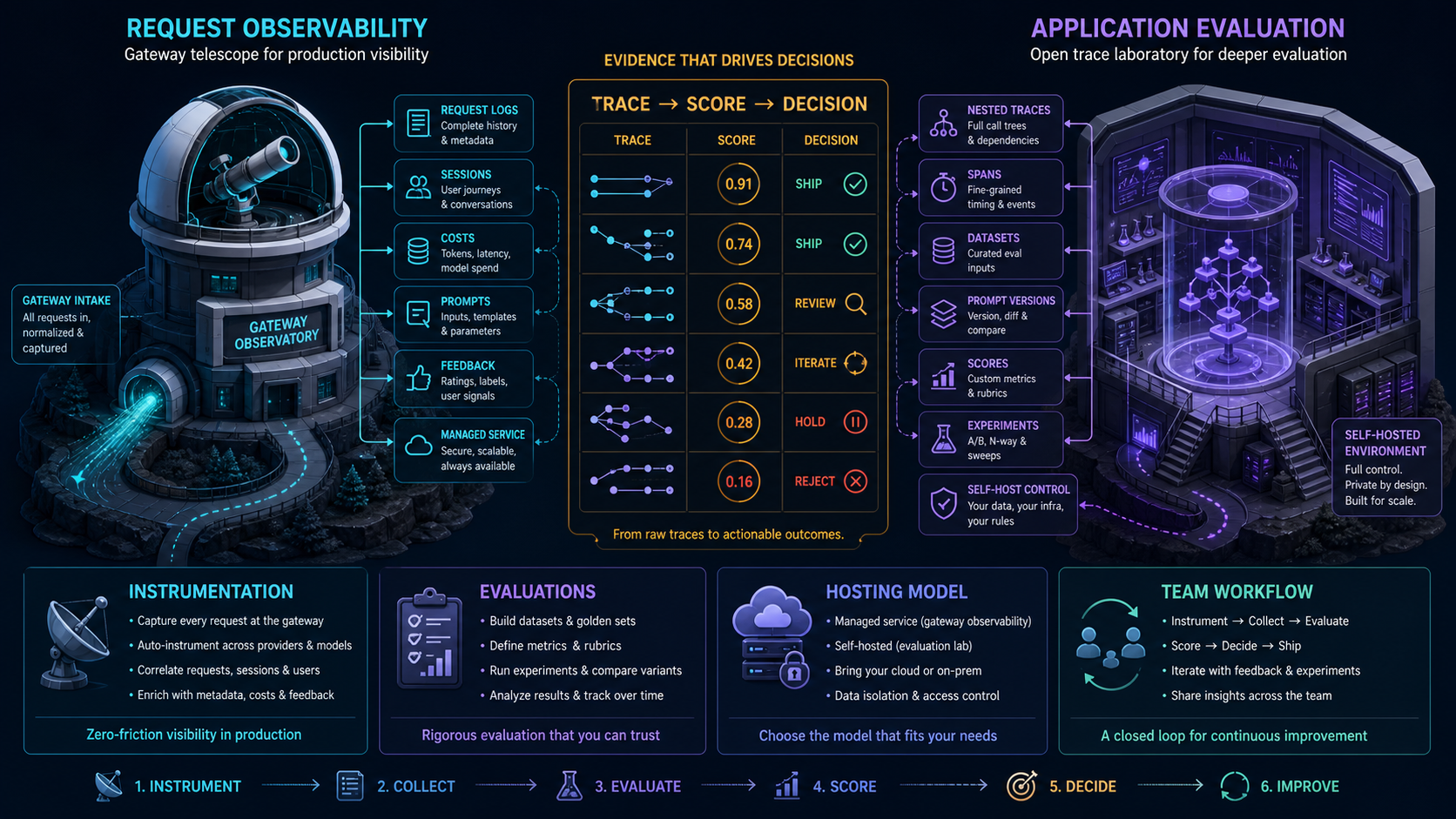
Helicone emphasizes low-friction request capture through gateway and observability workflows. Langfuse emphasizes open application tracing, nested spans, prompts, datasets, scores, evaluations and experiments. Both can close the loop, but instrumentation ownership and evaluation depth differ.
Helicone 强调通过网关与可观测工作流低摩擦采集请求;Langfuse 强调开放应用追踪、嵌套追踪片段、提示词、数据集、评分、评估与实验。两者都能闭环,但埋点所有权与评估深度不同。
TL;DR
Choose it when gateway capture, request logs, sessions, costs, prompts, feedback and managed access must become useful quickly.
Choose it when nested spans, tools, retrieval, datasets, scores, prompt versions, evaluations, experiments and self-host control are central.
A gateway sees model traffic reliably; an application tracer can see orchestration and tools. Neither automatically captures every business outcome.
Logs explain what happened. Evaluations decide whether it was good enough. Production teams need trace-to-score-to-decision continuity.
当网关采集、请求日志、会话、成本、提示词、反馈与托管访问需要快速产生价值时更合适。
当嵌套追踪片段、工具、检索、数据集、评分、提示词版本、评估、实验与自托管控制是核心时更合适。
网关能可靠看到模型流量;应用追踪能看到编排与工具。两者都不会自动捕捉全部业务结果。
日志解释发生了什么;评估判断结果是否足够好。生产团队需要调用链→Score→Decision 连续性。
Choose where evidence enters the system 选择证据进入系统的位置
Helicone's natural intake is the gateway request. Official documentation combines AI Gateway access with requests, traces, sessions, costs, errors, prompts, caching, rate limits and feedback. Sessions group multi-step agent and conversation activity around production calls.
Helicone 的自然入口是网关请求。官方文档把 AI 网关访问与请求、追踪、会话、成本、错误、提示词、缓存、限流和反馈结合;会话围绕生产调用聚合多步智能体与会话活动。
Langfuse's natural intake is application instrumentation. Official documentation centers traces, sessions and nested observations across LLM calls, retrieval, tools and custom logic, then links prompts, costs, datasets, scores, evaluations, experiments, dashboards and self-host deployment.
Langfuse 的自然入口是应用埋点。官方文档以调用链、会话和嵌套 Observation 为中心,覆盖 LLM、检索、工具与自定义逻辑,再连接提示词、成本、数据集、评分、评估、实验、仪表盘与自托管部署。
Helicone vs Langfuse side by side Helicone 与 Langfuse 并排比较
| Decision surface 决策面 | Helicone | Langfuse |
|---|---|---|
| Primary intake 主要入口 | Gateway and model request capture 网关与模型请求采集 | Application SDK, OpenTelemetry and framework instrumentation 应用 SDK、OpenTelemetry 与框架埋点 |
| Trace scope 追踪范围 | Requests, traces and sessions around model/agent traffic 围绕模型/智能体流量的请求、追踪与会话 | Nested observations across model, retrieval, tool and custom spans 跨模型、检索、工具与自定义追踪片段的嵌套 Observation |
| Evaluation loop 评估闭环 | Feedback and request evidence with evaluation-related workflows 反馈与请求证据及相关评估流程 | Scores, datasets, evaluators, experiments and prompt-linked metrics 评分、数据集、Evaluator、实验与提示词关联指标 |
| Prompt workflow 提示词流程 | Prompt visibility and management tied to requests 与请求绑定的提示词可见性与管理 | Versioned prompt management linked to traces, metrics and evaluations 与调用链、指标和评估绑定的版本化提示词管理 |
| Hosting model 托管模式 | Managed gateway/observability with documented self-host options 托管网关/可观测性及文档化自托管选项 | Cloud and open-source self-host deployment with explicit infrastructure ownership Cloud 与开源自托管,基础设施责任明确 |
| Best fit 最佳适配 | Fast production request visibility and gateway-centered teams 快速生产请求可见性与网关中心团队 | Evaluation-heavy AI engineering and application-wide tracing 评估密集型 AI 工程与应用全链路追踪 |
Choose the evidence loop your team will operate 选择团队真正会运营的证据闭环
The shortest path to value is capturing model requests, sessions, costs, prompts and feedback through a gateway-centered production workflow.
The application needs nested orchestration traces, open instrumentation, datasets, scoring, prompt-linked evaluation, experiments and self-host control.
If gateway intake and application evaluation are separated, establish stable trace/span IDs, ownership, sampling, retention and duplicate-cost rules.
最短价值路径是通过网关中心生产流程采集模型请求、会话、成本、提示词与反馈。
应用需要嵌套编排追踪、开放埋点、数据集、评分、提示词关联评估、实验与自托管控制。
若分离网关采集与应用评估,应建立稳定调用链/追踪片段 ID、所有权、采样、保留与去重成本规则。
Design trace-to-score-to-decision continuity 设计调用链→Score→Decision 连续性
Every production workflow should link user, session, trace, span, prompt version, model, provider, tool calls, retrieval, usage, cost, latency, errors, feedback, evaluator version, score and release decision. Define which fields are captured at the gateway and which inside the application. Use deterministic IDs and explicit sampling so a score can always resolve to the exact production behavior it evaluates.
每个生产工作流应关联用户、会话、调用链、追踪片段、提示词版本、模型、供应商、工具调用、检索、用量、成本、延迟、错误、反馈、Evaluator 版本、评分和发布决策。明确哪些字段由网关采集、哪些由应用采集;使用确定性 ID 与显式采样,使评分始终能回到被评估的具体生产行为。
Architecture rule: a dashboard metric is not actionable unless it resolves to trace evidence and a versioned change decision.
架构规则:只有当仪表盘指标能回到调用链证据与版本化变更决策时,它才可执行。
An observability-to-evaluation proof 从可观测到评估的验证
- Instrument one agent flow with model calls, retrieval, tools, retries, fallback and a final user-visible outcome.
- Break one prompt, one tool, one provider and one parser; measure time to find the trace and explain the failure.
- Build a labeled dataset, run deterministic and model-based scores, and link results to prompt and release versions.
- Compare ingestion loss, trace completeness, tail latency impact, storage, retention, sampling and cost at production volume.
- Run one cloud or self-host upgrade, backup restore, data export and deletion request.
- 为一个包含模型调用、检索、工具、重试、回退和最终用户结果的智能体流程埋点。
- 分别破坏一个提示词、工具、供应商和 Parser,测量找到调用链并解释故障的时间。
- 建立标注数据集,运行确定性与模型评分,并把结果关联到提示词与发布版本。
- 在生产量级比较采集丢失、调用链完整性、尾延迟影响、存储、保留、采样与成本。
- 执行一次 Cloud/自托管升级、备份恢复、数据导出与删除请求。
Migrate trace identity and evaluation history first 先迁移追踪身份与评估历史
Export projects, users, sessions, traces, spans, prompts, versions, datasets, scores, feedback, costs, metadata and dashboards. Define a neutral event schema and stable IDs, then dual-write new traces. Recompute key metrics and evaluations on both systems, reconcile counts and costs, validate retention and deletion, and only then change the primary instrumentation path.
导出 Project、用户、会话、调用链、追踪片段、提示词、版本、数据集、评分、反馈、成本、元数据与仪表盘。定义中立事件结构定义和稳定 ID,再双写新调用链;在两系统重算关键指标与评估、核对数量与成本、验证保留与删除后,才切换主埋点路径。
Observe model calls and downstream capabilities together 共同观察模型调用与下游能力
Helicone or Langfuse captures and evaluates model/application behavior. QVeris complements the observability layer by helping agents discover and call external APIs, data and tools under governed contracts and credentials. Attach the same trace and span context so every external action can be evaluated with the model decision that caused it.
Helicone 或 Langfuse 采集并评估模型/应用行为;QVeris 作为可观测层的互补,帮助智能体在受治理契约与凭证下发现并调用外部 API、数据和工具。传递相同调用链/追踪片段上下文,才能把每个外部动作与触发它的模型决策共同评估。
A Production Decision Scorecard for Helicone vs LangfuseHelicone 与 Langfuse的生产决策评分卡
For Helicone vs Langfuse, the useful question is not which product has more checkmarks. It is which design gives the team the right boundary, evidence, operating model, and exit path for a defined workload.
针对“Helicone 与 Langfuse”,真正有价值的问题不是哪款产品拥有更多勾选项,而是哪种设计能为明确工作负载提供正确边界、证据、运营模式和退出路径。
Map gateway interception, tracing, prompt management, evaluation, self-hosting, data retention, and the identity model linking generations into sessions. Decide which component owns each decision, where policy is enforced, and whether the products are substitutes, complements, or overlapping layers.
梳理网关拦截、追踪、提示词管理、评估、自托管、数据留存,以及连接生成记录与会话的身份模型。明确每项决策由哪个组件负责、策略在哪里执行,以及两者究竟是替代、互补还是部分重叠。
To validate Helicone vs Langfuse, replay simple, long-context, streaming, structured-output, tool-calling, high-concurrency, and failure cases. Measure accepted-result quality, completion, p50 and tail latency, retries, trace completeness, and effective cost.
验证“Helicone 与 Langfuse”时,重放简单、长上下文、流式、结构化输出、工具调用、高并发和失败案例,衡量合格结果质量、完成率、常规与长尾延迟、重试、追踪完整性和实际成本。
When evaluating Helicone vs Langfuse, include hosting, regional capacity, data retention, identity integration, policy maintenance, upgrades, incident response, support, compliance evidence, and the custom adapters the team must keep current.
评估“Helicone 与 Langfuse”时,纳入托管、区域容量、数据留存、身份集成、策略维护、升级、事故响应、支持、合规证据,以及团队必须持续维护的自定义适配器。
Before rolling out Helicone vs Langfuse, version a neutral request and evidence envelope, shadow traffic, classify semantic differences, preserve trace identity, and prove a staged rollback. Prefer the option that keeps policy and workload contracts portable.
上线“Helicone 与 Langfuse”前,版本化中立请求与证据封装,运行影子流量,分类语义差异,保留追踪身份,并证明可分阶段回滚。优先选择能让策略和工作负载契约保持可迁移的方案。
FAQ
No. Its documented platform includes observability, traces, sessions, prompts, costs, errors, feedback and other production workflows alongside gateway access.
No. Its official surface includes prompt management, datasets, scores, evaluations, experiments, metrics and self-host deployment in addition to tracing.
Gateway capture and asynchronous SDK export have different paths. Measure production p99, batching, backpressure and failure behavior with required fields enabled.
No. LLM observability should connect to product, business, security and infrastructure outcomes rather than replace them.
不是。其文档平台除网关访问外,还包含可观测性、追踪、会话、提示词、成本、错误、反馈等生产流程。
不是。除追踪外,其官方产品面还包含提示词管理、数据集、评分、评估、实验、指标与自托管部署。
网关采集与异步 SDK 导出路径不同。应开启必要字段后测量生产 p99、批处理、背压与故障行为。
不能。LLM 可观测性应连接产品、业务、安全与基础设施结果,而不是替代它们。