
Historical Exchange Rate API Free
Developer Guide免费历史汇率 API
开发者完整指南
Find a free historical exchange rate API for a date or date range, compare the limits that matter, and integrate validated JSON data without confusing history with live conversion.
查找支持指定日期或日期区间的免费历史汇率接口,比较真正影响接入的限制,并在不混淆实时换算与历史数据的前提下校验 JSON 结果。
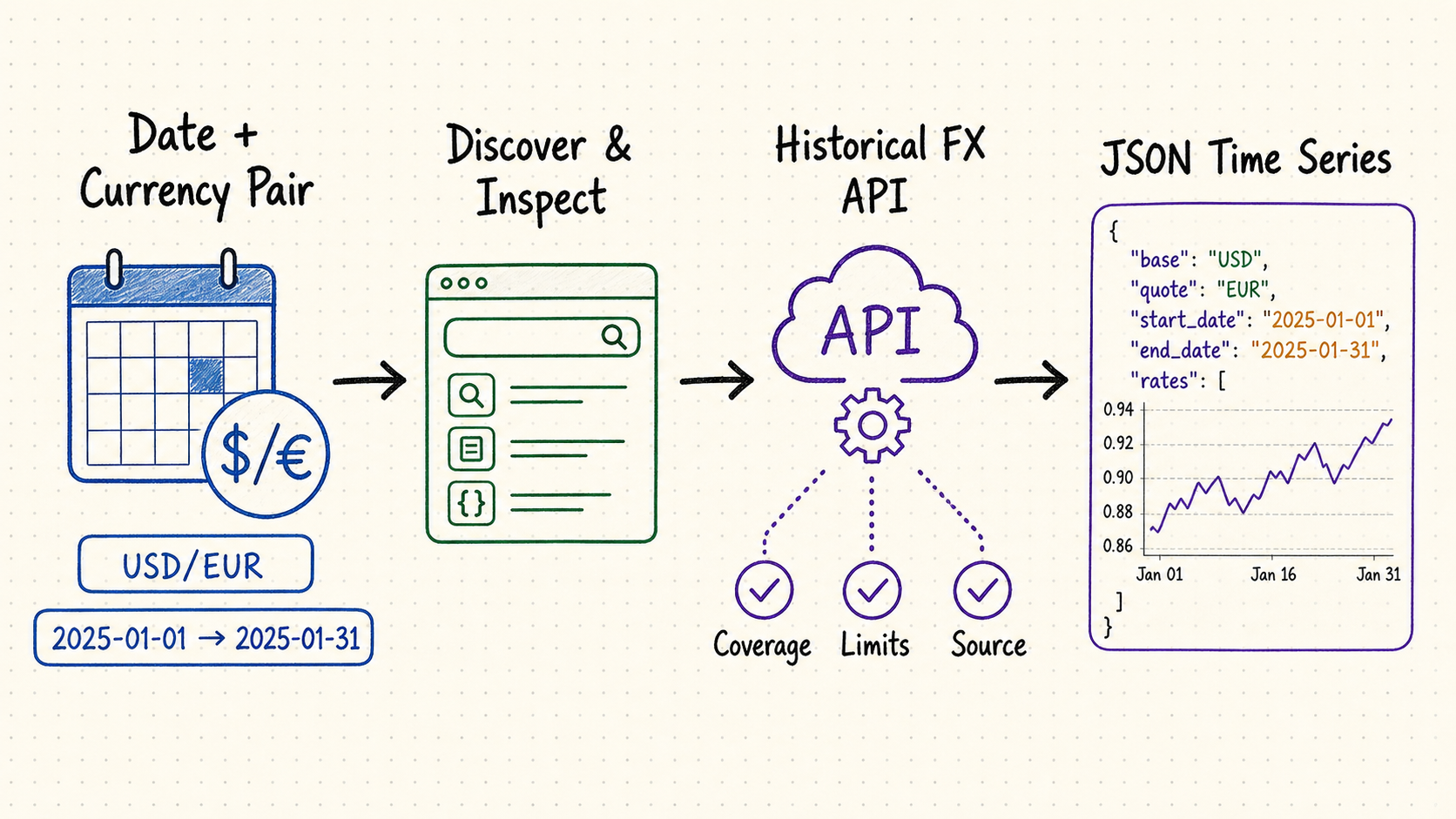
Historical exchange rate API free: quick answer免费历史汇率 API:快速结论
A useful free historical currency API returns rates for a specified date or range, identifies the base and quote currencies, and documents its source, coverage, update schedule, limits, and licensing. “Free” may mean a public endpoint, a quota-limited plan, or a trial—verify the current terms rather than relying on the label.
有用的免费历史汇率接口应能按指定日期或区间返回数据,明确基准币与目标币,并说明数据来源、覆盖范围、更新频率、限额和许可。“免费”可能是公共端点、限额套餐或试用,不能只看宣传标签。
| Need需求 | Check检查项 | Why it matters原因 |
|---|---|---|
| Single date指定日期 | YYYY-MM-DD endpoint or parameter | Accounting and invoice conversion会计与发票折算 |
| Date range日期区间 | from, to, pagination | Charts and time-series analysis图表与时间序列分析 |
| Free access免费访问 | Key, quota, attribution, CORS密钥、额度、署名与 CORS | Determines production fit决定能否用于生产 |
What developers want from a free historical exchange rate API开发者需要免费历史汇率接口完成什么任务
Query a historical exchange rate by date按日期查询历史汇率
The central task is to supply a base currency such as USD, one or more quote currencies such as EUR or CNY, and a past date. The response should identify the observation date because weekends and holidays may use the previous available fixing.
核心任务是传入美元等基准币、欧元或人民币等目标币,以及过去的日期。响应必须标明实际观测日期,因为周末和节假日可能返回前一个可用定盘日。
Request a historical exchange rate date range查询历史汇率日期区间
For charting, reconciliation, and research, users want daily observations between two dates. Check maximum range per request, result ordering, pagination, grouping, and whether missing days are omitted or filled.
用于制图、对账和研究时,用户需要两个日期之间的每日观测值。应检查单次最大区间、排序、分页、聚合方式,以及缺失日期是省略还是填充。
Receive a consistent historical exchange rates JSON API response获得结构一致的历史汇率 JSON 接口响应
A dependable response model should represent ISO 4217 currency codes, base and quote currencies, daily reference rates, observation timestamps, time-series dates, quota metadata, and source attribution consistently. Normalize these fields before storing data from more than one provider.
可靠的响应模型应以一致方式表示 ISO 4217 币种代码、基准币和目标币、每日参考汇率、观测时间、时间序列日期、额度信息与数据来源。接入多个供应商时,应先统一这些字段再入库。
Understand historical exchange rate data before choosing an API选择历史汇率 API 前先理解数据语义
Two APIs can return different values for the same currency pair and date without either response being technically broken. The difference may come from the source, fixing time, market convention, base-currency rule, calculation method, or later revision. Define the rate you need before comparing endpoint features.
两个接口对同一币种对和日期返回不同数值,不一定意味着其中一个出错。差异可能来自数据源、定盘时间、市场惯例、基准币规则、计算方法或后续修订。比较端点功能前,应先定义业务需要的汇率口径。
Base currency, quote currency, and inversion基准币、目标币与倒数换算
A USD/EUR rate commonly means the number of euros for one US dollar, but naming conventions vary. Store the base, quote, value, and provider convention together. If you invert a rate, retain enough decimal precision and record that the value was derived rather than supplied directly.
USD/EUR 通常表示一美元对应多少欧元,但不同接口的命名习惯可能不同。应同时保存基准币、目标币、数值和供应商口径。如果通过倒数换算,应保留足够精度,并记录该值是推导结果而非直接返回。
Reference rates vs market rates参考汇率与市场汇率
Official daily reference rates are designed for statistical or reporting use. Market feeds may expose bid, ask, midpoint, open, high, low, or close at a specific timestamp. Neither should be presented as the other, and neither automatically includes bank spreads or card fees.
官方每日参考汇率通常用于统计或报表;市场数据可能包含特定时刻的买价、卖价、中间价、开盘、最高、最低或收盘。两者不能互相冒充,也通常不包含银行点差或银行卡费用。
Weekends, holidays, time zones, and revisions周末、节假日、时区与历史修订
Daily series often omit non-business days or carry the previous observation forward. Providers can also revise past values. Decide whether your system should preserve gaps, use the previous fixing, or reject a missing date, and keep both the requested date and the actual observation date.
日频序列常会省略非工作日,或沿用前一个观测值;供应商也可能修订历史数据。系统应明确选择保留缺口、使用前一日定盘值还是拒绝缺失日期,并同时保存请求日期与实际观测日期。
Worked non-business-day example: requested date is not observation date非工作日示例:请求日期不等于实际观测日期
Suppose an application requests USD/EUR for Sunday, 2025-01-05, and the provider returns 0.9700 using the last published fixing from Friday, 2025-01-03. Converting a $10,000 invoice under an approved “previous business-day fixing” policy gives €9,700, but the record must still say requested_date=2025-01-05, observed_date=2025-01-03, and fill_method=previous_fixing. Labeling 0.9700 as a Sunday observation invents a market data point that the source never published.
The same input should produce different storage behavior by use case. An accounting report may carry Friday’s fixing forward when its policy requires a rate for every calendar date. A market-return series should normally keep Saturday and Sunday missing, then join the next genuine observation, because copied values create artificial zero-return days and distort volatility or correlation. Preserve the source publication time and dataset version as well: if Friday’s fixing is later revised to 0.9698, append or version the correction and identify which conversions need recomputation rather than silently changing an audited result.
非工作日示例:请求日期不等于实际观测日期
假设应用查询 2025 年 1 月 5 日(周日)的 USD/EUR,供应商按照最近一次已发布的定盘值,返回 2025 年 1 月 3 日(周五)的 0.9700。若书面政策规定“非工作日采用上一工作日定盘值”,10,000 美元发票可以换算为 9,700 欧元;但记录中仍必须明确保存 requested_date=2025-01-05、observed_date=2025-01-03 和 fill_method=previous_fixing。把 0.9700 标记为周日观测值,会凭空制造一条来源从未发布的市场数据。
同一输入在不同场景下应采用不同的存储方式。会计报表如果要求每个自然日都有汇率,可以依据既定政策沿用周五定盘值;市场收益序列通常应保留周六、周日缺口,再连接下一条真实观测,因为复制数值会人为增加零收益日,进而扭曲波动率或相关性。还应保存来源发布时间和数据集版本:如果周五定盘值后来被修订为 0.9698,应追加或版本化更正,并标明哪些换算需要重算,不能静默改变已经审计的结果。
Currency lifecycle, redenomination, and predecessor codes货币生命周期、重新计价与前身代码
Long histories can cross a currency launch, redenomination, peg change, or withdrawal. Confirm whether the API preserves obsolete ISO codes, maps them into a successor currency, or truncates the series. Store the original code and conversion rule; silently rewriting a predecessor currency into its successor creates a false historical comparison.
较长历史区间可能跨越新货币启用、重新计价、汇率制度变化或货币退出。需要确认接口是保留已停用的 ISO 代码、映射到后继货币,还是直接截断序列。应保存原始代码和换算规则;若把前身货币静默改写成后继货币,会制造并不存在的历史可比性。
Define the legally or operationally accepted source, date rule, rounding policy, and audit fields.
Prefer a documented time series with stable dates, consistent units, and an explicit missing-value policy.
Use market-appropriate data and prevent look-ahead, revised-history, timezone, and survivorship errors.
Historical reference data does not represent the final executable price, spread, fee, or settlement amount.
明确可接受的数据源、日期规则、舍入方式和审计字段。
优先选择日期稳定、单位一致并明确缺失值政策的时间序列。
使用符合市场场景的数据,并避免未来函数、历史修订、时区和幸存者偏差。
历史参考价不等于最终成交价、点差、手续费或结算金额。
How to compare free historical currency API options如何比较免费历史汇率 API
| Criterion维度 | Questions to ask要问的问题 | Risk风险 |
|---|---|---|
| History历史深度 | Earliest date? Daily or intraday? Range endpoint?最早日期?日频还是盘中?支持区间吗? | Free tier may expose only recent dates免费层可能只开放近期数据 |
| Coverage币种覆盖 | Which fiat currencies and base currencies?支持哪些法币和基准币? | Cross rates may be derived交叉汇率可能是推导值 |
| Source数据来源 | Central-bank reference, market feed, or aggregate?央行参考价、市场数据还是聚合价? | Rates can differ by methodology不同方法会产生不同结果 |
| Free terms免费条款 | Requests, key, attribution, caching, commercial use?额度、密钥、署名、缓存、商用? | Trial access may expire试用权限可能到期 |
| Operations运行要求 | Status, retries, versioning, error schema?状态、重试、版本与错误结构? | Silent gaps can corrupt reports静默缺口会破坏报表 |
Do not mix reference rates, executable FX prices, and converters不要混淆参考汇率、可成交价格与换算器
A central-bank daily reference rate is suitable for many reporting tasks but is not an executable bid or ask. A currency converter may calculate an amount without exposing a historical time series. Keep these intents separate when evaluating APIs.
央行每日参考汇率适合许多报表场景,但不是可成交的买价或卖价。货币换算器可能只计算金额,不提供历史时间序列。评估接口时应把这些需求分开。
A practical free-tier checklist实用的免费层检查清单
- Confirm historical endpoints are included in the free tier, not only latest rates.
- Record request quotas, rate limits, attribution, caching, and commercial-use terms.
- Check the earliest available date, supported base currencies, and missing-day policy.
- Test error responses for invalid dates, unsupported codes, and quota exhaustion.
- 确认免费层开放历史端点,而不只是最新汇率。
- 记录请求额度、限频、署名、缓存与商用条款。
- 检查最早日期、支持的基准币与缺失日处理方式。
- 测试无效日期、不支持币种和额度耗尽时的错误响应。
Choose the source category before the provider先选择数据源类别,再选择供应商
| Source type来源类型 | Strength优势 | Typical limitation常见限制 | Good fit适合场景 |
|---|---|---|---|
| Central-bank or public statistics央行或公共统计 | Documented official reference series有说明的官方参考序列 | Limited currencies, frequencies, or base conventions币种、频率或基准币规则有限 | Reporting and research报表与研究 |
| Commercial API free tier商业 API 免费层 | Developer-friendly JSON, SDKs, supportJSON、SDK 与开发体验完善 | Quota, key, history, or feature restrictions额度、密钥、历史或功能限制 | Apps and prototypes应用与原型 |
| Market-data feed市场数据源 | Timestamps and richer price fields时间戳与更丰富价格字段 | Licensing, redistribution, and higher cost许可、再分发与成本要求 | Trading and valuation交易与估值 |
| Aggregator聚合服务 | Broad coverage and normalized schemas覆盖广、结构统一 | Methodology and provenance need inspection需要核查方法和来源链 | Multi-region products多地区产品 |
How to get historical exchange rates via API如何通过 API 获取历史汇率
Provider-neutral REST request for USD/EUR history与供应商无关的美元/欧元历史汇率 REST 请求
GET /historical?base=USD&symbols=EUR&from=2025-01-01&to=2025-01-31
Accept: application/json

{
  "base": "USD",
  "start_date": "2025-01-01",
  "end_date": "2025-01-31",
  "rates": {
    "2025-01-02": { "EUR": 0.00 }
  }
}
The path and field names are illustrative, not a claim about a specific provider. Do not copy the placeholder rate into production. Adapt the request to the selected API documentation and validate the returned value and observation date.
以上路径和字段仅作结构示例,不代表特定供应商,也不要把占位汇率用于生产。请按选定接口文档调整请求,并校验返回数值和实际观测日期。
Validate before storing a daily historical exchange rate保存每日历史汇率前先校验
- Validate ISO 4217 currency codes and the requested date order.
- Confirm whether the rate means quote units per one base unit.
- Preserve the provider, source date, retrieval time, and raw response.
- Handle weekends, holidays, nulls, duplicates, retries, and pagination explicitly.
- 校验 ISO 4217 币种代码与日期先后顺序。
- 确认汇率是否表示一单位基准币对应多少目标币。
- 保留供应商、来源日期、抓取时间和原始响应。
- 显式处理周末、节假日、空值、重复、重试和分页。
A production-safe Python ingestion pattern更适合生产环境的 Python 接入模式
from decimal import Decimal
from datetime import date
import requests

params = {
    "base": "USD",
    "symbols": "EUR",
    "from": "2025-01-01",
    "to": "2025-01-31",
}
response = requests.get(API_URL, params=params, timeout=20)
response.raise_for_status()
payload = response.json()

for observed_on, values in payload["rates"].items():
    rate = Decimal(str(values["EUR"]))
    assert rate > 0
    save_rate(
        base="USD",
        quote="EUR",
        observed_on=date.fromisoformat(observed_on),
        value=rate,
        provider=PROVIDER_NAME,
        retrieved_at_utc=RETRIEVED_AT,
    )
The field names remain illustrative. Use decimal arithmetic for stored financial values, set explicit timeouts, reject malformed payloads, and make writes idempotent so retries do not create duplicate observations.
字段名仍是结构示例。存储金融数值时应使用十进制运算,设置明确超时,拒绝异常响应,并让写入具备幂等性,避免重试产生重复记录。
Pagination, caching, and retry behavior分页、缓存与重试策略
- Split long ranges into documented windows and checkpoint the last completed date.
- Use exponential backoff with jitter for retryable responses; do not retry invalid parameters.
- Cache immutable historical observations only after checking whether the provider revises history.
- Store the response version or checksum so changed historical values can be detected.
- 按接口允许的窗口拆分长区间,并记录最后成功日期。
- 对可重试响应使用带随机抖动的指数退避,无效参数不要盲目重试。
- 确认供应商是否修订历史后,再决定历史观测值是否可长期缓存。
- 保存响应版本或校验值,以便发现历史数值变化。
Historical FX data quality and production checks历史外汇数据质量与生产检查
Validate completeness and continuity检查完整性与连续性
Build an expected business-day calendar for each series, then classify every gap as an expected holiday, an unavailable fixing, a provider failure, or a processing error. Do not silently turn missing observations into zero.
为每条序列建立预期工作日历,再把缺口分类为正常节假日、无可用定盘值、供应商故障或处理错误。不要把缺失观测静默填成零。
Detect outliers without inventing replacement rates检测异常值,但不要虚构替代汇率
Flag impossible values, non-positive rates, abrupt changes, duplicate dates, and inconsistent reciprocal pairs. An alert should trigger review or a second-source comparison; it should not automatically manufacture a replacement value.
标记不可能数值、非正数、突变、重复日期和倒数关系异常。告警应触发人工复核或第二数据源对照,而不应自动创造替代汇率。
Preserve provenance for audit and reconciliation为审计与对账保留来源链
| Store保存字段 | Purpose用途 |
|---|---|
| Provider and endpoint version供应商与端点版本 | Reproduce the retrieval path复现获取路径 |
| Requested and observed dates请求日期与观测日期 | Explain weekend or holiday fallback解释周末或节假日回退 |
| Base, quote, rate, and precision基准币、目标币、汇率与精度 | Prevent inversion and rounding mistakes防止方向与舍入错误 |
| Source timestamp and retrieval time来源时间与抓取时间 | Separate data age from ingestion delay区分数据时效与接入延迟 |
| Raw payload checksum原始响应校验值 | Detect revisions and duplicate processing发现修订与重复处理 |
Monitor the free tier as an external dependency把免费层当作外部依赖监控
Track success rate, latency, quota headers, schema changes, stale observations, and license updates. Keep a documented fallback or a recovery export for critical workflows because free access, quotas, and endpoints can change.
监控成功率、延迟、额度响应头、结构变化、数据陈旧和许可更新。关键流程应准备有文档的备用源或恢复导出,因为免费权限、额度和端点都可能变化。
How QVeris helps with historical forex rates API discoveryQVeris 如何帮助发现历史外汇数据 API
QVeris helps developers and agents discover and inspect callable capabilities. Start with the QVeris tool details, inspect a candidate capability’s inputs and outputs, then follow the QVeris documentation to connect it. This reduces discovery and schema-inspection work; it does not change a provider’s data, limits, license, or service level.
QVeris 帮助开发者和 Agent 发现并检查可调用能力。可先使用 QVeris 工具详情,核对候选能力的输入输出,再按 QVeris 文档完成接入。它能减少发现与结构检查工作,但不会改变供应商的数据、额度、许可或服务水平。
Free historical exchange rate API FAQ免费历史汇率 API 常见问题
Yes. Public endpoints and free tiers exist, but historical depth, currencies, attribution, authentication, and quotas differ.
Send a base currency, targets, and a date or range, then validate the source date, units, timezone, and missing observations.
Several commercial APIs and public reference-rate services do. Choose by history, coverage, source methodology, license, and operational limits.
Yes when the provider exposes a historical endpoint. Confirm its date format and how it handles weekends and holidays.
Some do; others are keyless but may require attribution or impose rate limits. Check the current documentation and terms.
Check source, history, currencies, base rules, frequency, gaps, quotas, authentication, attribution, caching, licensing, errors, and status visibility.
Many daily reference series publish only on business days. Decide whether to keep the gap or use the previous available observation according to your business rule.
They may use different sources, fixing times, market conventions, aggregation methods, rounding, or historical revisions.
Often yes, subject to the provider’s license and revision policy. Retain provenance and a checksum so revisions remain detectable.
Not by default. A daily reference rate is not an executable bid or ask and does not include spread, fees, or slippage.
有,但不同公共端点和免费层的历史深度、币种、署名、认证和额度并不相同。
传入基准币、目标币和日期或区间,再校验来源日期、单位、时区与缺失观测值。
商业 API 与公共参考汇率服务都可能提供。应根据历史深度、覆盖范围、来源方法、许可与运行限制选择。
部分接口支持。需要确认最大区间、分页、排序、聚合粒度以及周末和节假日处理。
有些需要;无密钥端点也可能要求署名或限频,应核对最新文档和条款。
检查来源、历史深度、币种、基准币规则、频率、缺口、额度、认证、许可、错误结构与服务状态。
许多每日参考序列只在工作日发布。应根据业务规则决定保留缺口,还是使用前一个可用观测值。
它们可能采用不同来源、定盘时间、市场惯例、聚合方法、舍入方式或历史修订策略。
通常可以,但必须遵守供应商许可和修订政策,并保留来源信息与校验值。
不能默认适用。每日参考汇率不是可成交买价或卖价,也不包含点差、手续费与滑点。