
Investment Risk Analysis
Map Uncertainty Before You Decide投资风险分析
在决策前看清不确定性
Investment risk analysis identifies what can break an investment thesis, maps each exposure to financial outcomes, and tests the decision under sensitivity, scenario, and stress assumptions.
投资风险分析用于识别可能破坏投资逻辑的因素,把每项风险暴露映射到财务结果,并通过敏感性、情景与压力假设检验决策韧性。
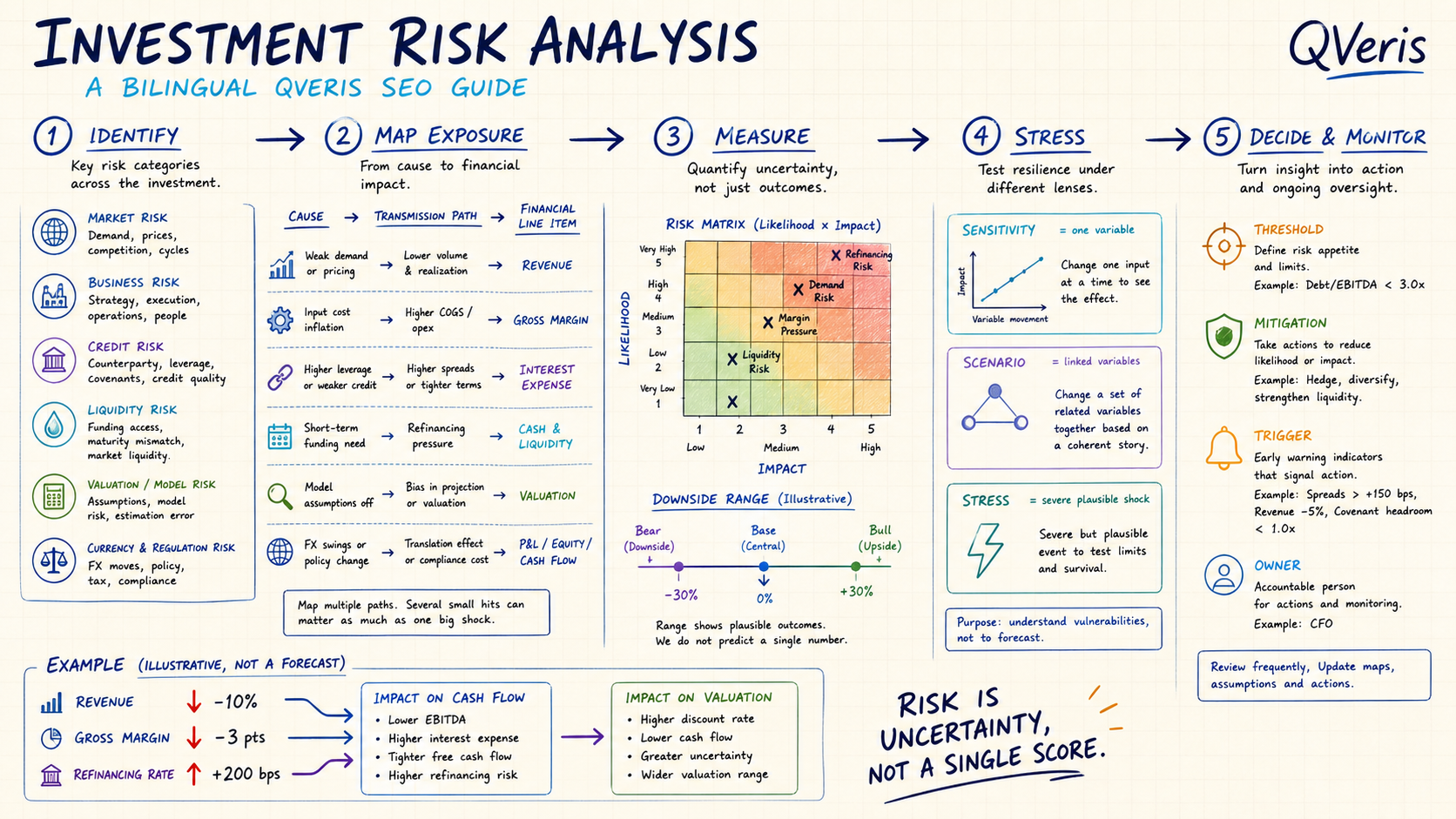
Investment risk analysis: meaning and objective投资风险分析:定义与目标
Investment risk is the uncertainty and potential financial loss attached to an investment decision. Investment risk analysis turns that broad idea into a reviewable record: what could happen, why the investment is exposed, which financial variables would move, how severe the effect could be, and what evidence would change the decision.
投资风险是投资决策中固有的不确定性与潜在财务损失。投资风险分析把这个宽泛概念转化为可复核记录:什么可能发生、投资为何暴露于该风险、哪些财务变量会变化、影响可能多大,以及哪些证据会改变决策。
The objective is not to predict one precise loss or remove uncertainty. It is to expose fragile assumptions, compare downside with the expected benefit, and define thresholds before new information arrives. A good analysis is explicit about time horizon, asset type, position size, currency, data date, and whose decision is being evaluated.
目标不是预测一个精确损失数字,也不是消除不确定性,而是暴露脆弱假设、比较下行风险与预期收益,并在新信息出现前定义阈值。高质量分析必须明确期限、资产类型、头寸规模、币种、数据日期以及所评估的决策主体。
Investment risk analysis vs portfolio risk analysis投资风险分析与投资组合风险分析的区别
These topics overlap but answer different questions. This page focuses on the vulnerabilities of one investment thesis or capital-allocation decision. Portfolio analysis focuses on how multiple holdings interact through weights, covariance, concentration, and aggregate loss limits.
两者有所重叠,但回答的问题不同。本页聚焦单项投资逻辑或资本配置决策的脆弱点;投资组合分析则研究多个持仓如何通过权重、协方差、集中度与整体损失限额相互作用。
Single-investment dossier单项投资风险档案
- Thesis assumptions and failure modes投资逻辑假设及失效方式
- Business, credit, liquidity, valuation and event exposure经营、信用、流动性、估值与事件风险
- Sensitivity, scenario and stress tests敏感性、情景与压力测试
Portfolio-level system组合层面风险系统
- Weights, correlations and factor exposures权重、相关性与因子暴露
- Concentration, diversification and liquidity across holdings跨持仓集中度、分散化与流动性
- Portfolio VaR, drawdown and aggregate limits组合VaR、回撤与整体限额
Read the separate portfolio risk analysis guide查看独立的投资组合风险分析指南.
Types of investment risk to place in the ledger应纳入风险台账的投资风险类型
Market and macro risk市场与宏观风险
Demand, prices, rates, inflation, industry cycles, and broad repricing can affect revenue, margins, discount rates, or exit multiples.
需求、价格、利率、通胀、行业周期与整体重估可能影响收入、利润率、贴现率或退出倍数。
Business and execution risk经营与执行风险
Competition, customer concentration, supplier dependence, product delays, governance, and operating failures can weaken the original thesis.
竞争、客户集中、供应商依赖、产品延期、治理与运营失误可能削弱最初投资逻辑。
Credit and financing risk信用与融资风险
Leverage, covenant headroom, refinancing dates, counterparties, and variable-rate debt determine whether a shock becomes a solvency problem.
杠杆、契约余量、再融资日期、交易对手和浮息债务决定一次冲击是否会演变为偿付问题。
Liquidity risk流动性风险
An investment may be hard to sell without a price concession, while the issuer may also lack cash or funding access when obligations fall due.
投资者可能无法在不大幅让价的情况下卖出资产,发行人也可能在债务到期时缺少现金或融资渠道。
Valuation and model risk估值与模型风险
Forecast errors, stale comparables, terminal-value dependence, accounting adjustments, and omitted variables can create false precision.
预测误差、过时可比公司、对终值的依赖、会计调整与遗漏变量都可能造成虚假的精确感。
Currency, regulatory and event risk汇率、监管与事件风险
Foreign exchange, taxes, policy, litigation, geopolitical events, and operational incidents can alter cash flows or the ability to operate.
汇率、税收、政策、诉讼、地缘事件与运营事故可能改变现金流或持续经营能力。
How to analyze investment risk step by step如何逐步进行投资风险分析
1. Define the decision and the loss that matters第一步:定义决策与真正重要的损失
State whether the decision is to initiate, add, hold, refinance, or exit. Define the horizon and loss concept: temporary mark-to-market decline, permanent capital impairment, missed cash-flow target, covenant breach, or inability to exit.
明确决策是新建、增持、持有、再融资还是退出,并定义期限与损失概念:短期市值下跌、永久性资本损失、现金流目标未达成、违反债务契约,或无法退出。
2. Convert the thesis into testable assumptions第二步:把投资逻辑转化为可检验假设
Write down the few assumptions that make the investment work—volume, price, margin, reinvestment, funding cost, dilution, and valuation. An assumption without a measurable indicator cannot be monitored reliably.
写出决定投资成立的少数关键假设,例如销量、价格、利润率、再投资、融资成本、稀释和估值。没有可衡量指标的假设无法可靠监控。
3. Map cause to transmission path and financial line item第三步:映射原因、传导路径与财务科目
4. Attach evidence, thresholds, actions, and an owner第四步:连接证据、阈值、行动与责任人
For every material risk, record the source, latest observation, warning threshold, mitigation, review frequency, and accountable owner. This turns a static list into an investment risk management process.
针对每项重大风险,记录来源、最新观测、预警阈值、缓释措施、复核频率与责任人。这样才能把静态清单变成投资风险管理流程。
Qualitative and quantitative investment risk assessment定性与定量投资风险评估
Qualitative judgment asks whether the exposure exists, how credible the causal path is, and whether controls are effective. Quantitative analysis estimates how much a defined output changes. Neither should replace the other: a precise model built on an incomplete risk map can be less useful than a transparent range.
定性判断关注风险是否存在、因果路径是否可信、控制措施是否有效;定量分析则估计某个明确输出会变化多少。两者不能相互替代:建立在不完整风险地图上的精确模型,可能不如透明的结果区间有用。
Define the scales first先定义尺度
- Likelihood over the stated horizon在指定期限内的发生可能性
- Impact on the chosen decision metric对所选决策指标的影响
- Confidence in evidence and model对证据和模型的信心
- Velocity and reversibility of loss损失发生速度与可逆性
Useful quantitative measures depend on the asset and question: revenue or margin sensitivity, interest coverage, leverage, maturity schedule, cash runway, duration, beta, drawdown, trading liquidity, downside valuation range, or probability-weighted scenarios. Do not combine incomparable measures into an unexplained composite score.
合适的定量指标取决于资产与问题,包括收入或利润率敏感度、利息覆盖、杠杆、到期结构、现金续航、久期、Beta、回撤、交易流动性、下行估值区间或概率加权情景。不要把不可比指标合成一个无法解释的总分。
Sensitivity, scenario, and stress testing methods敏感性分析、情景分析与压力测试方法
Sensitivity analysis敏感性分析
Change one input at a time—such as revenue growth, margin, interest rate, or valuation multiple—to identify which assumption most influences the output. It isolates a driver but may ignore relationships among variables.
一次只改变一个输入,例如收入增长、利润率、利率或估值倍数,以识别对结果影响最大的假设。它便于隔离驱动因素,但可能忽略变量之间的关系。
Scenario analysis情景分析
Change a coherent set of linked assumptions together. A downside scenario might combine weaker demand, lower pricing, margin pressure, and a higher discount rate. The story and transmission path should remain internally consistent.
同时改变一组逻辑相关的假设。下行情景可能把需求走弱、价格下降、利润率承压与更高贴现率组合起来,情景叙事及传导路径必须内部一致。
Stress testing压力测试
Apply a severe but plausible shock to test survival, covenant headroom, funding access, or the maximum tolerable loss. Stress testing is about vulnerability and limits, not a claim that the shock will occur.
施加严重但合理的冲击,以检验生存能力、债务契约余量、融资渠道或最大可承受损失。压力测试关注脆弱性与极限,并不声称该冲击一定发生。
Investment risk analysis example: a fictional issuer投资风险分析案例:一家虚构发行人
Assume an analyst is reviewing a fictional company whose thesis depends on moderate revenue growth, stable gross margin, and refinancing at a manageable rate. The analyst does not assign these shocks as forecasts; they are diagnostic inputs used to expose the decision’s weak points.
假设分析师正在研究一家虚构公司,其投资逻辑依赖适度收入增长、稳定毛利率以及以可承受利率完成再融资。分析师并未把下列冲击当作预测,而是用诊断输入暴露决策弱点。
Shock inputs冲击输入
- Revenue −10%收入下降10%
- Gross margin −3 points毛利率下降3个百分点
- Refinancing rate +200 bps再融资利率上升200个基点
Transmission传导路径
- Lower gross profit毛利润下降
- Higher interest expense利息费用增加
- Tighter free cash flow自由现金流收紧
Decision questions决策问题
- Does liquidity remain adequate?流动性是否仍然充足?
- Is covenant headroom preserved?债务契约余量是否保留?
- What valuation range survives?什么估值区间仍然成立?
The next step is not to average these risks into one score. Recalculate income, cash flow, coverage, leverage, and valuation under the linked assumptions; compare the output with predefined limits; then record whether the response is to proceed, reduce exposure, require a margin of safety, seek protection, or reject the investment.
下一步不是把这些风险平均成一个分数,而是在联动假设下重新计算利润、现金流、覆盖倍数、杠杆与估值,把结果与预设限额比较,再记录应当继续、降低暴露、要求更大安全边际、采取保护措施,还是放弃投资。
A reviewable investment risk workflow with QVeris and FMP使用QVeris与FMP建立可复核的投资风险流程
QVeris can help an analyst discover and call relevant FMP capabilities for financial statements, key metrics, historical prices, estimates, transcripts, and filings. The useful output is not merely a number: it is a package containing the capability, endpoint, symbol, period, units, retrieval time, source fields, transformations, assumptions, and test results.
QVeris可帮助分析师发现并调用FMP相关能力,以获取财务报表、关键指标、历史价格、分析师预期、电话会文本与监管文件。有价值的输出不只是一个数字,而是一套包含能力、接口、代码、期间、单位、获取时间、来源字段、转换过程、假设与测试结果的记录。
| Risk风险 | Evidence证据 | Threshold阈值 | Response响应 | Review复核 |
|---|---|---|---|---|
| Demand需求 | Revenue, units, guidance收入、销量、指引 | Thesis-specific variance相对投资逻辑的偏差 | Re-run scenario重跑情景 | Each filing每次财报 |
| Financing融资 | Debt, interest, maturity债务、利息、到期日 | Coverage / covenant limit覆盖倍数/契约限额 | Reduce or hedge exposure降低或对冲暴露 | Quarterly + event季度及事件触发 |
| Valuation估值 | Cash flow, multiples, rates现金流、倍数、利率 | Required margin of safety所需安全边际 | Change entry or exit rule调整进入或退出规则 | When inputs move输入变化时 |
The analyst remains responsible for data quality, model design, interpretation, and the investment decision. QVeris and FMP do not eliminate investment risk or guarantee outcomes.
分析师仍须对数据质量、模型设计、解释与投资决策负责。QVeris与FMP不能消除投资风险,也不保证结果。
Use FMP financial statements through QVeris通过QVeris使用FMP财务报表 · Build a stock fundamental analysis建立股票基本面分析 · Read QVeris documentation阅读QVeris文档
Common investment risk assessment mistakes常见投资风险评估错误
Treating volatility as every kind of risk把波动率当成全部风险
Price variation does not fully capture permanent loss, fraud, refinancing failure, illiquidity, or model error.
价格变化无法完整反映永久性损失、欺诈、再融资失败、流动性枯竭或模型误差。
Using arbitrary shocks使用任意冲击幅度
Document why a shock is plausible, which history or exposure supports it, and whether linked variables move consistently.
说明冲击为何合理、哪些历史或暴露支持该幅度,以及关联变量是否一致变化。
Ignoring data dates and units忽略数据日期与单位
Mixing filing periods, currencies, adjusted fields, or stale market data can invalidate the result before modeling begins.
混用报告期、币种、调整字段或过时市场数据,可能在建模开始前就使结果失效。
No action tied to the result结果没有连接行动
A red risk label without a threshold, owner, mitigation, or review date is description—not risk management.
只有红色风险标签,却没有阈值、责任人、缓释措施或复核日期,这只是描述,并非风险管理。
Investment risk analysis FAQ投资风险分析常见问题
What is investment risk analysis?什么是投资风险分析?
It is a structured process for identifying uncertainties, mapping their financial transmission, estimating likelihood and impact, testing downside conditions, and defining actions and monitoring triggers.
它是识别不确定性、映射财务传导、评估可能性与影响、测试下行情形并定义行动和监控触发器的结构化过程。
How do you assess investment risk?如何评估投资风险?
Define the decision, inventory material risks, link each risk to evidence and financial outputs, score likelihood and impact using stated scales, run sensitivity and scenario tests, and compare results with limits.
先定义决策,列出重大风险,把风险连接到证据与财务结果,按明确尺度评估可能性和影响,再运行敏感性与情景测试,并与限额比较。
What are the main types of investment risk?主要投资风险类型有哪些?
Common categories include market, business, credit, liquidity, valuation or model, currency, regulatory, and event risk. The relevant set depends on the asset and decision.
常见类别包括市场、经营、信用、流动性、估值或模型、汇率、监管与事件风险;具体集合取决于资产和决策。
What is the difference between sensitivity and scenario analysis?敏感性分析与情景分析有什么区别?
Sensitivity analysis changes one input to isolate its effect. Scenario analysis changes a coherent set of related inputs to test a complete story.
敏感性分析改变单一输入以隔离其影响;情景分析则同时改变一组逻辑相关的输入,以测试一个完整故事。
Can investment risk be eliminated?投资风险可以被消除吗?
No. Some risks can be reduced, transferred, diversified, hedged, or avoided, but uncertainty and potential loss remain part of investing.
不能。部分风险可以降低、转移、分散、对冲或规避,但不确定性与潜在损失始终是投资的一部分。
How often should a risk analysis be updated?投资风险分析多久更新一次?
Update it at scheduled reviews and whenever a trigger changes the thesis, evidence, financing, liquidity, valuation, or risk limit. The cadence should match the risk’s velocity.
应在计划复核时更新,也应在触发事件改变投资逻辑、证据、融资、流动性、估值或风险限额时更新;频率要匹配风险变化速度。
Authoritative references and methodology sources权威参考资料与方法来源
- Investor.gov — What is risk?
- FINRA — Risk and investing basics
- CFI — Scenario analysis vs sensitivity analysis
- FMP — Financial data API documentation
Educational content only; not investment advice. Examples are fictional, and no method can guarantee performance or prevent loss.本文仅供教育用途,不构成投资建议。案例均为虚构,任何方法都不能保证表现或避免损失。