
COMPETITOR COMPARISON
LangDB Alternatives
Evaluate LangDB for routing control, compatibility, observability, and operating cost.
TL;DR
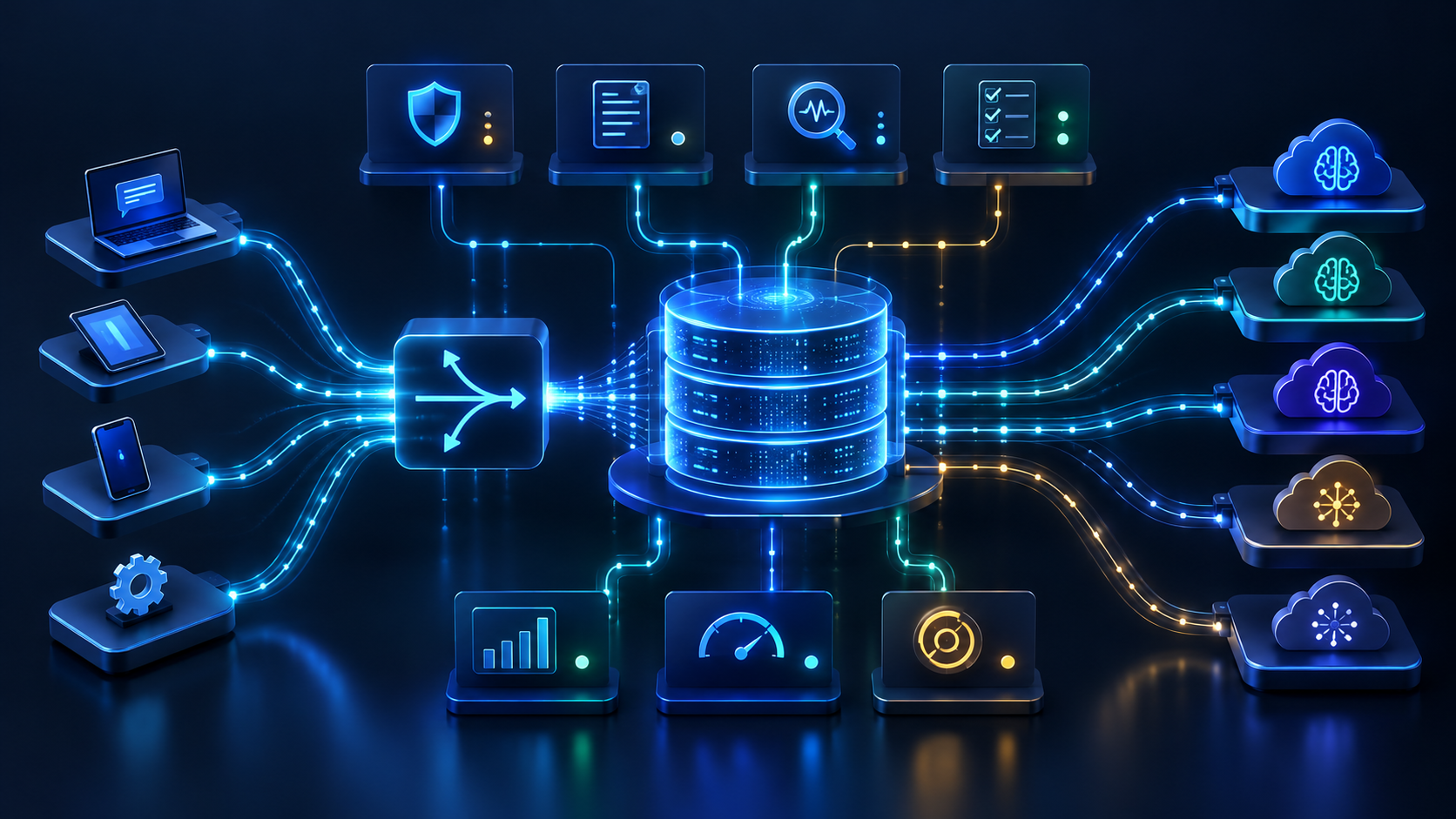
Current documentation describes an OpenAI-compatible gateway for 250+ models with routing, tracing, usage, analytics, guardrails, projects, roles, MCP, and hosted or self-hosted deployment.
One data model can connect request policy, routing decisions, traces, costs, and evaluation. The trade-off is broader platform dependence.
A focused gateway plus OpenTelemetry and a separate evaluation platform can fit existing standards, but your team owns correlation and upgrades.
It complements model traffic and LLMOps by giving agents discoverable, auditable data and tool access.
Map the six planes before comparing tools
Provider credentials, virtual keys, projects, tenants, roles, regions, budgets, and audit boundaries.
Provider normalization, model aliases, automatic routing, fallback, rate limits, caching, and error semantics.
Request, agent, and tool spans; token and price attribution; export; retention; and incident investigation.
Datasets, graders, regressions, policy checks, prompt versions, approvals, and runtime enforcement.
Server registry, tool trust, authorization, credentials, call evidence, and trace correlation.
Hosted or self-hosted data plane, upgrades, capacity, dependencies, backup, support, and recovery.
Eight LangDB alternatives by control-plane shape
| Option | Strongest fit | Architecture trade-off |
|---|---|---|
| Portkey | Managed gateway, guardrails, and observability | Broad platform and commercial evaluation |
| TrueFoundry | Enterprise LLM and MCP governance | Control-plane breadth and deployment |
| Helicone | Gateway plus developer-focused observability | Enterprise policy and evaluation depth |
| MLflow AI Gateway | Gateway inside an open AI lifecycle platform | MLOps platform scope |
| LiteLLM + Langfuse | Composable open-source gateway and observability | Integration, correlation, and operations |
| Kong AI Gateway + OTel | Reuse enterprise API governance | Platform weight and AI evaluation assembly |
| Cloud-native gateway stack | Cloud identity, regions, private network, and contracts | Cloud portability |
| Custom OTel platform | Existing internal telemetry and policy standards | Highest engineering ownership |
Integrated platform, composable stack, or self-host
If teams cannot connect a bad outcome to its prompt, route, model, cost, policy, and user, one shared data model has compounding value.
If identity, OTel, SIEM, evaluation, and gateway operations are mature, smaller replaceable components may fit better.
Data locality, private networking, regulated evidence, custom policy, or platform independence can justify operations—not self-hosting as a reflex.
Without an owner for upgrades, data quality, pricing tables, evaluation sets, incidents, and capacity, choose a managed path.
A trace-to-decision architecture proof
- Replay one multi-agent workflow with model calls, retries, tool calls, structured output, and a forced provider outage.
- Start at a failed business outcome and find tenant, prompt version, route, model, policy decision, cost, latency, and tool evidence.
- Enforce a project budget and model allowlist, rotate a key, redact sensitive fields, and export traces to the existing SIEM.
- Change a routing rule and grader, then prove configuration, trace, evaluation result, and rollback are version-linked.
Migrate the telemetry graph before the traffic
Inventory project and user identifiers, model aliases, routing rules, virtual keys, budgets, traces, properties, price tables, prompt versions, datasets, graders, guardrails, MCP servers, retention, and exports. Define a canonical trace and cost schema independent of either platform. Dual-write telemetry, reconcile counts and costs, then canary traffic after investigations work in both systems.
Connect LLMOps evidence to capability evidence
A LangDB alternative can explain which model ran, why it was routed, what it cost, and how it scored. QVeris explains which external capability the agent discovered and called under which contract and credentials. One trace context should connect both evidence chains.
FAQ
No. Current documentation also covers tracing, automatic routing, usage, analytics, guardrails, projects, roles, MCP support, and hosted or self-hosted operation.
Portkey and TrueFoundry are broad comparisons; Helicone is compelling when gateway and developer observability are the primary combined job.
It can cover gateway and routing work, but a composable deployment may need separate tracing, evaluation, guardrails, and operating workflows.
No. It complements LLMOps with governed external capability access.