
LiteLLM Alternatives:
8 LLM Gateways ComparedLiteLLM 替代方案:
8 个 LLM 网关对比
LiteLLM is a strong default for teams that want an OpenAI-compatible, self-hosted gateway. The question is not whether LiteLLM is good. The question is whether your team wants to operate that layer, or whether managed routing, observability, governance, or agent capabilities matter more.
LiteLLM 是自托管 OpenAI 兼容网关的强默认选项。问题不是 LiteLLM 好不好,而是你的团队是否想自己运维这一层,还是更需要托管路由、可观测性、治理或 Agent 能力。
TL;DR
Best when self-hosting, provider control, and virtual keys are central.
Best when the team wants managed model breadth and less infrastructure work.
Best when gateway observability, guardrails, and prompt operations are the pain.
Best when LiteLLM handles model routing but agents still need verified tools and data.
当自托管、供应商控制和虚拟 Key 是核心时,LiteLLM 仍然很合适。
当团队需要托管模型覆盖、减少基础设施工作时,OpenRouter 更合适。
当痛点是网关可观测性、护栏和 Prompt 运维时,Portkey 更合适。
当 LiteLLM 负责模型路由,但 Agent 仍需要可信工具和数据时,QVeris 更合适。
Guide and search intent正文指南与搜索意图
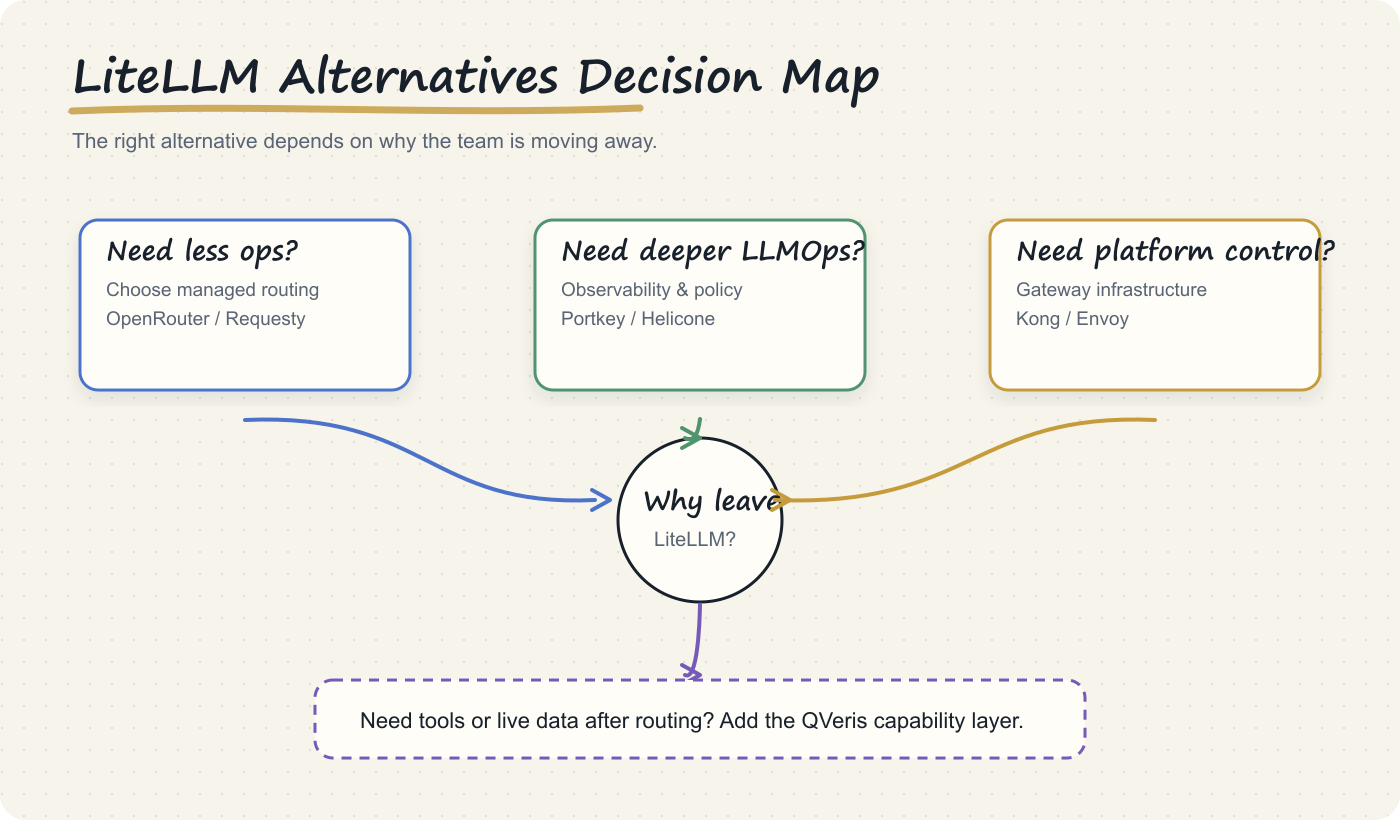
Most LiteLLM alternative searches come from one of four moments: the team does not want to self-host, the gateway has become an operations burden, observability is not deep enough, or the product is becoming an agent that needs more than model calls.
OpenRouter and similar managed routers reduce setup time. They are appealing when the main goal is to test many models, ship quickly, or avoid managing provider accounts and routing infrastructure.
Portkey and observability-focused tools become more attractive when teams care about tracing, logs, guardrails, prompt versions, evaluations, and policy. They are less about raw model breadth and more about production control.
For QVeris, the best SEO angle is not “QVeris replaces LiteLLM.” A stronger angle is “LiteLLM routes model calls; QVeris routes capabilities.” That lets the article rank for LiteLLM alternatives without making an inaccurate product claim.
大多数 LiteLLM alternatives 搜索来自四种时刻:团队不想自托管、网关运维变重、可观测性不够深,或者产品变成了需要超越模型调用的 Agent。
OpenRouter 这类托管路由可以降低接入时间。它适合快速测试多模型、快速上线,或不想管理供应商账号和路由基础设施的团队。
当团队关注 tracing、日志、护栏、Prompt 版本、评估和策略时,Portkey 这类工具更有吸引力。它们不只是模型覆盖,更偏生产控制。
对 QVeris 来说,最好的 SEO 角度不是“QVeris 替代 LiteLLM”,而是“LiteLLM 路由模型调用,QVeris 路由能力”。这样既能承接 LiteLLM alternatives,又不会造成错误定位。
Comparison table对比表
| Option | Category | Best for | How to read it |
|---|---|---|---|
| OpenRouter | Managed routing | Avoid running the gateway | Good for fast model coverage. |
| Portkey | LLMOps gateway | Need logs and guardrails | Good for production operations. |
| TrueFoundry | Enterprise AI platform | Need VPC and governance | Good for platform teams. |
| QVeris | Capability layer | Need tools and live data | Good with LiteLLM, not only instead of it. |
| 方案 | 类别 | 最适合 | 解读 |
|---|---|---|---|
| OpenRouter | 托管路由 | 避免自行运维网关 | 适合快速获得模型覆盖。 |
| Portkey | LLMOps 网关 | 需要日志与护栏 | 适合生产运维。 |
| TrueFoundry | 企业 AI 平台 | 需要 VPC 与治理 | 适合平台团队。 |
| QVeris | 能力层 | 需要工具与实时数据 | 可与 LiteLLM 配合使用,而不只是替代它。 |
Implementation playbook落地打法
A LiteLLM alternatives page should not simply list competitors. It should organize alternatives by why a team is looking: less infrastructure, more observability, stronger enterprise support, simpler model discovery, or better agent capability access. That makes the article more useful and less like programmatic SEO.
Readers comparing alternatives usually worry about model aliases, virtual keys, request logs, retry behavior, provider credentials, and compatibility with existing OpenAI-style code. Covering those migration concerns makes the page feel practical and gives it more depth than a basic feature matrix.
The strongest QVeris angle is to say that LiteLLM can remain the model gateway while QVeris adds the capability network for agents. This is more credible than claiming every LiteLLM user should replace the gateway. It also creates a better conversion path for teams that already like LiteLLM but need tools and live data.
LiteLLM alternatives 页面不应该只是列竞品,而应该按用户为什么要找替代方案来组织:减少基础设施、增强可观测性、更强企业支持、更简单模型发现,或更好的 Agent 能力访问。这样文章更有用,也不像纯 pSEO。
比较替代方案的读者通常会关心模型别名、虚拟 Key、请求日志、重试行为、供应商凭证,以及和现有 OpenAI 风格代码的兼容性。覆盖这些迁移问题,页面会比基础功能矩阵更像真实指南。
最强的 QVeris 角度是:LiteLLM 可以继续做模型网关,QVeris 添加 Agent 所需的能力网络。这比声称所有 LiteLLM 用户都要替换网关更可信,也能承接已经喜欢 LiteLLM 但需要工具和实时数据的团队。
Decision framework选择框架
- Choose LiteLLM if ownership and self-hosting are requirements, not burdens.
- Choose OpenRouter if operational simplicity is more valuable than controlling every routing detail.
- Choose Portkey if the real pain is production management rather than provider access.
- Add QVeris when the agent needs a verified capability after the model response.
- 如果基础设施所有权和自托管是硬性要求,而不是负担,可继续选择 LiteLLM。
- 如果简化运维比控制每个路由细节更重要,可选择 OpenRouter。
- 如果核心痛点是生产管理而非模型供应商接入,可选择 Portkey。
- 当 Agent 在模型响应后还需要经过验证的外部能力时,可加入 QVeris。
Where QVeris fitsQVeris 应该放在哪里
Model gateways solve model access. QVeris solves the next step: how an agent finds, inspects, and calls real-world capabilities such as financial data APIs, external tools, and auditable workflow actions.
模型网关解决模型访问。QVeris 解决下一步:Agent 如何发现、检查和调用真实世界能力,例如金融数据 API、外部工具和可审计工作流动作。
Best LiteLLM alternatives by job to be done按任务选择 LiteLLM 替代品
OpenRouter is the fastest LiteLLM alternative when the team wants managed access to many models without running its own proxy. It is best for exploration, demos, and early product experiments where setup speed matters more than infrastructure ownership.
Portkey is a stronger alternative when the problem is not only model routing but LLMOps governance. Teams evaluate it for observability, guardrails, prompt workflows, evaluations, and production policy controls.
Helicone is not always a direct gateway replacement, but it is a common LiteLLM alternative or companion for teams that mainly need logs, traces, cost analytics, and debugging across model calls.
Kong AI Gateway fits platform teams that already operate API gateway infrastructure and want AI traffic to follow the same governance, security, and traffic policy model.
Envoy AI Gateway patterns fit teams with deep infrastructure ownership. It can be powerful for cloud-native traffic control, but it is heavier than a simple LiteLLM proxy.
QVeris is not a one-for-one LiteLLM replacement. It complements LiteLLM or its alternatives by handling verified capability access after the model needs live data, tools, financial APIs, or auditable actions.
如果团队想快速托管接入大量模型、不想自己跑代理,OpenRouter 是最直接的 LiteLLM 替代方案。适合探索、Demo 和早期产品实验。
当问题不只是模型路由,而是生产治理时,Portkey 更适合。它的重点是可观测性、护栏、Prompt 流程、评测和策略控制。
Helicone 不一定是完全替代网关,但常被当作 LiteLLM 替代或补充,用来做日志、链路、成本分析和模型调用调试。
适合已经有 API Gateway 基础设施的平台团队,把 AI 流量纳入相同的治理、安全和流量策略。
适合基础设施能力很强的团队,能做云原生流量控制,但比简单的 LiteLLM 代理更重。
QVeris 不是一比一替代 LiteLLM,而是补充模型网关:当模型需要实时数据、工具、金融 API 或可审计动作时,负责能力调用层。
When teams switch away from LiteLLM团队为什么会从 LiteLLM 切换
LiteLLM is attractive because it is open and controllable, but the team still owns hosting, upgrades, monitoring, incidents, and provider changes. Managed alternatives reduce that burden.
If the buying discussion is about logs, guardrails, prompt lifecycle, evaluation, policy enforcement, and team-level review, a broader LLMOps platform may be a better fit.
Some organizations do not want a separate LLM proxy. They want model traffic to fit existing API gateway, service mesh, security, and compliance standards.
LiteLLM can route model calls, but it does not solve capability discovery and audited tool execution. That is where QVeris becomes relevant.
LiteLLM 的优势是开放和可控,但团队仍要负责托管、升级、监控、事故和供应商变化。托管替代品能减轻这部分负担。
如果选型讨论集中在日志、护栏、Prompt 生命周期、评测、策略执行和团队审查,LLMOps 平台可能比单纯代理更适合。
有些组织不想再维护一个独立 LLM 代理,而是希望模型流量进入已有 API Gateway、服务网格、安全和合规标准。
LiteLLM 可以路由模型调用,但不解决能力发现和可审计工具执行。这个位置更适合引出 QVeris。
Migration checklist from LiteLLM从 LiteLLM 迁移的检查清单
List every LiteLLM alias in use and map it to the new routing layer. Keep product code pointed at stable business-level names while the infrastructure changes underneath.
Before moving traffic, confirm that request metadata, user identifiers, project tags, and cost reporting survive the migration. Losing attribution makes the new gateway hard to trust.
Mirror a small amount of traffic through the alternative gateway before cutting over. Compare latency, error rate, output quality, fallback behavior, and spend.
Do not bundle model routing migration with external tool migration. Keep the model gateway change focused, then add QVeris for financial data, APIs, and auditable capabilities.
列出所有正在使用的 LiteLLM alias,并映射到新路由层。产品代码继续使用稳定业务名,底层基础设施再逐步替换。
迁移前确认请求元数据、用户 ID、项目标签和成本报表不会丢。归因丢了,新网关很难被信任。
正式切换前,把少量流量镜像到替代网关,对比延迟、错误率、输出质量、回退行为和成本。
不要把模型路由迁移和外部工具迁移绑在一起。模型网关先稳定,再用 QVeris 接金融数据、API 和可审计能力。
More LiteLLM alternatives questions更多 LiteLLM 替代品问题
It depends on the reason for switching. OpenRouter is strong for managed model access, Portkey for LLMOps governance, Kong or Envoy for platform teams, and QVeris for agent capability access.
Many teams should add to it first. LiteLLM can continue routing model calls while another layer handles observability, governance, or real-world capability access.
OpenRouter is usually easier to start with, while LiteLLM gives more self-hosted control. The better choice depends on whether speed or ownership matters more.
QVeris matters when the model response needs to become an action: call a data provider, inspect a capability, run a tool, or create an auditable workflow step.
取决于为什么要换。OpenRouter 适合托管模型访问,Portkey 适合 LLMOps 治理,Kong/Envoy 适合平台团队,QVeris 适合 Agent 能力调用。
很多团队应该先补充而不是替换。LiteLLM 继续做模型路由,其他层负责可观测性、治理或真实世界能力调用。
OpenRouter 通常更容易启动,LiteLLM 提供更强自托管控制。哪个更好取决于团队更看重速度还是所有权。
当模型回答需要变成动作时:调用数据供应商、检查能力、运行工具或创建可审计工作流步骤,QVeris 就重要。
Common mistakes to avoid常见错误
- Writing a thin list of competitors without explaining why teams leave LiteLLM.
- Positioning QVeris as another OpenAI-compatible proxy instead of a capability layer.
- Ignoring migration concerns such as keys, logs, model aliases, latency, and team ownership.
- 不要只罗列竞品,而不解释团队为何寻找 LiteLLM 替代方案。
- 不要把 QVeris 定位为另一个 OpenAI 兼容代理,它承担的是能力层角色。
- 不要忽略密钥、日志、模型别名、延迟和团队所有权等迁移问题。
External references外部参考链接
FAQ
OpenRouter is often best for managed access, Portkey for LLMOps, and QVeris as an added capability layer.
Yes. It remains strong when self-hosted model routing and provider control are important.
Yes. LiteLLM can handle model routing while QVeris handles external capabilities, data, and tool calls.