
LiteLLM vs Cloudflare AI Gateway: Own the Gateway or Use the Edge? LiteLLM 与 Cloudflare AI 网关:自主管理,还是使用边缘服务?
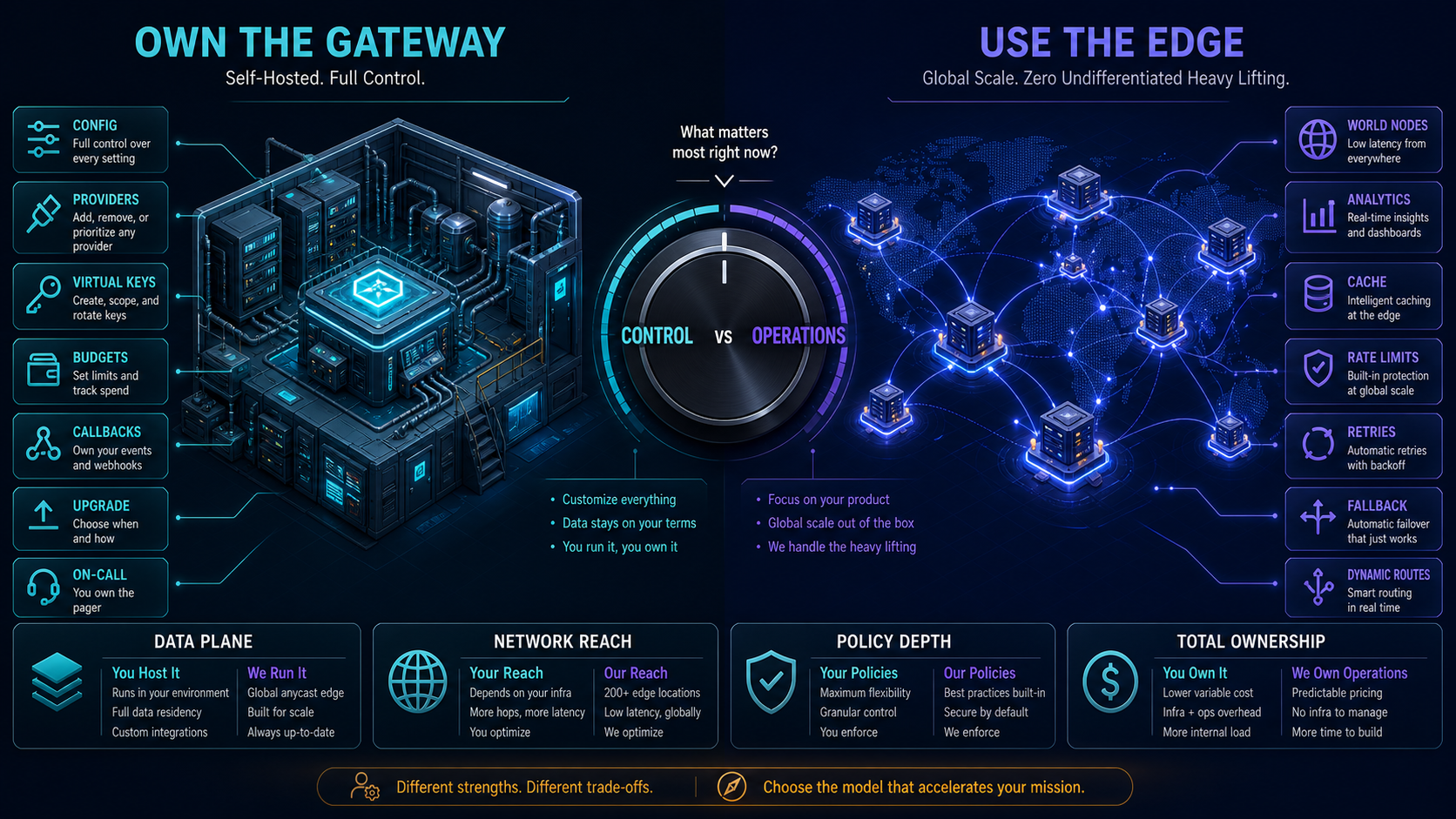
LiteLLM gives platform teams a configurable model gateway they operate. Cloudflare AI Gateway turns routing, analytics, cache, rate limits, retries, fallbacks and dynamic policy into an edge-managed service. The decision is control versus operational transfer, not open source versus cloud in the abstract.
LiteLLM 为平台团队提供自主运营的可配置模型网关;Cloudflare AI 网关把路由、分析、缓存、限流、重试、回退和动态策略变成边缘托管服务。真正决策是控制权与运营转移,而不是抽象的开源与云之争。
TL;DR
Choose it for self-host topology, broad provider normalization, virtual keys, budgets, callbacks, custom integrations, and direct configuration ownership.
Choose it for managed global reach, integrated analytics and logs, cache, limits, retries, fallback, and versioned dynamic routes.
Self-hosting includes instances, stores, scaling, upgrades, certificates, secrets, observability, backups, on-call and recovery exercises.
Verify current provider and protocol support, routing semantics, data path, logs, retention, account limits, pricing and failure behavior.
适合自托管拓扑、广泛供应商标准化、虚拟密钥、预算、回调、自定义集成和直接配置所有权。
适合托管全球覆盖、集成分析与日志、缓存、限额、重试、回退和版本化动态路由。
自托管包括实例、存储、扩缩容、升级、证书、密钥、可观测性、备份、值班和恢复演练。
应验证当前供应商与协议支持、路由语义、数据路径、日志、保留、账户限额、定价和故障行为。
Choose who operates the data plane 选择谁来运营数据平面
LiteLLM is an operator-owned gateway. Official documentation exposes SDK and proxy paths with normalized providers, virtual keys, budgets, routing, fallbacks, caching, guardrails, spend tracking and callbacks. The team chooses topology and owns day-2 reliability.
LiteLLM 是运营方自有网关。官方文档提供 SDK 与代理路径,以及供应商标准化、虚拟密钥、预算、路由、回退、缓存、护栏、支出追踪和回调;团队选择拓扑并负责 Day-2 可靠性。
Cloudflare AI Gateway is an edge-managed service. Current documentation offers analytics, logging, caching, rate limiting, retries, fallback and dynamic routes with conditions, percentages, budgets, limits, versions and rollback on Cloudflare's network.
Cloudflare AI 网关是边缘托管服务。当前文档在 Cloudflare 网络上提供分析、日志、缓存、限流、重试、回退和动态路由;动态路由包含条件、百分比、预算、限额、版本和回滚。
LiteLLM vs Cloudflare AI Gateway side by side LiteLLM 与 Cloudflare AI 网关并排比较
| Decision surface 决策面 | LiteLLM | Cloudflare AI Gateway |
|---|---|---|
| Data-plane owner 数据面负责人 | Your platform team and hosting environment 平台团队与自有托管环境 | Cloudflare edge service Cloudflare 边缘服务 |
| Configuration 配置 | Proxy config, database/state, virtual keys, callbacks and integrations 代理配置、数据库/状态、虚拟密钥、回调与集成 | Dashboard/API gateway settings and versioned dynamic-route flows Dashboard/API 网关设置与版本化动态路由流 |
| Network reach 网络覆盖 | Depends on regions, load balancers and deployment design 取决于区域、负载均衡与部署设计 | Managed global network footprint 托管全球网络覆盖 |
| Governance 治理 | Virtual keys, teams, budgets, model/provider policy and guardrails 虚拟密钥、团队、预算、模型/供应商策略与护栏 | Gateway auth, limits, budgets, conditions, routing and account controls 网关认证、限额、预算、条件、路由与账户控制 |
| Extensibility 扩展性 | Callbacks, custom integrations and self-host access 回调、自定义集成与自托管访问 | Platform APIs and Cloudflare ecosystem integrations 平台 API 与 Cloudflare 生态集成 |
| Cost center 成本中心 | Infrastructure and operator time plus model usage 基础设施与运营时间加模型用量 | Gateway/platform terms, logs and model usage plus coupling 网关/平台条款、日志和模型用量加耦合成本 |
Trade control for operations consciously 有意识地用控制权交换运营
Topology, data path, custom providers, callbacks, virtual-key governance and policy extensibility must remain under direct platform control.
Managed edge reach, cache and traffic controls, existing Cloudflare operations, faster day-2 management and lower infrastructure burden dominate.
One layer has a unique role—such as enterprise normalization behind an edge ingress—and retries, cache, IDs, policy and cost attribution are not duplicated.
拓扑、数据路径、自定义供应商、回调、虚拟密钥治理与策略扩展必须由平台直接控制。
托管边缘覆盖、缓存与流量控制、现有 Cloudflare 运营、更快 Day-2 管理和更低基础设施负担占主导。
一层有唯一角色,例如边缘入口后的企业标准化,并且重试、缓存、ID、策略和成本归因不重复。
Model the ownership ledger 建立所有权账本
For ingress, TLS, authentication, provider keys, virtual keys, routing, budgets, rate limits, retries, fallbacks, cache, guardrails, logs, traces, storage, scaling, upgrades, backups and incident response, record one authority and one recovery owner. Attach monthly infrastructure, platform and labor cost. A managed service transfers some rows; it does not remove ownership of application behavior.
对入口、TLS、认证、供应商密钥、虚拟密钥、路由、预算、限流、重试、回退、缓存、护栏、日志、追踪、存储、扩容、升级、备份和事故响应,分别记录唯一权威与恢复负责人,并附上月度基础设施、平台和人力成本。托管服务会转移部分责任,但不会消除应用行为责任。
Architecture rule: a layer that can retry, cache or reroute must appear in both the latency budget and the incident runbook.
架构规则:任何能重试、缓存或改路由的层都必须出现在延迟预算和事故 Runbook 中。
A control-versus-operations proof 控制与运营验证
- Deploy LiteLLM in the intended regions and configure the matching Cloudflare gateway, providers, policies and logging.
- Replay short, long, streaming, tool, structured-output and multimodal requests with identical upstream keys.
- Measure client latency by region, first-token and total latency, cache effects, p99, errors and duplicate upstream calls.
- Force 429, 5xx, timeout, config error and regional outage; verify fallback, rollback, logs, request IDs and costs.
- Complete one upgrade, key rotation, backup restore and incident drill, then price operator minutes.
- 在目标区域部署 LiteLLM,并配置匹配的 Cloudflare 网关、供应商、策略与日志。
- 使用相同上游密钥回放短、长、流式、工具、结构化输出和多模态请求。
- 按区域测量客户端延迟、首 Token/总延迟、缓存影响、p99、错误和重复上游调用。
- 强制 429、5xx、超时、配置错误与区域故障,验证回退、回滚、日志、请求 ID 与成本。
- 完成一次升级、密钥轮换、备份恢复与事故演练,并计价运营时间。
Make policy portable before changing the data plane 更换数据面前先让策略可移植
Express models, providers, aliases, routing, budgets, rate limits, retries, fallback, cache, guardrails, metadata, trace IDs and error taxonomy in a neutral policy specification. Implement it in both systems, mirror representative traffic, compare provider selection, response semantics, logs and bills, then canary applications with a tested base-URL rollback.
用中立策略规范表达模型、供应商、别名、路由、预算、限流、重试、回退、缓存、护栏、元数据、调用链 ID 与错误分类。在两系统中实现并镜像代表性流量,比较供应商选择、响应语义、日志和账单,再按应用灰度并保留已验证基础地址(Base URL)回滚。
Gateway ownership does not replace capability governance 网关所有权不替代能力治理
LiteLLM or Cloudflare governs model inference traffic. QVeris complements the gateway by helping agents discover and invoke external APIs, data and tools under controlled contracts and credentials. Carry the chosen trace ID and tenant policy into every downstream action.
LiteLLM 或 Cloudflare 治理模型推理流量;QVeris 作为网关的互补层,帮助智能体在受控契约与凭证下发现并调用外部 API、数据与工具。每次下游动作都应携带所选调用链 ID 与租户策略。
A Production Decision Scorecard for LiteLLM vs Cloudflare AI GatewayLiteLLM 与 Cloudflare AI Gateway的生产决策评分卡
For LiteLLM vs Cloudflare AI Gateway, the useful question is not which product has more checkmarks. It is which design gives the team the right boundary, evidence, operating model, and exit path for a defined workload.
针对“LiteLLM 与 Cloudflare AI 网关”,真正有价值的问题不是哪款产品拥有更多勾选项,而是哪种设计能为明确工作负载提供正确边界、证据、运营模式和退出路径。
Map self-managed portability versus managed edge integration, provider adapters, caching, policy, regional reach, and infrastructure ownership. Decide which component owns each decision, where policy is enforced, and whether the products are substitutes, complements, or overlapping layers.
梳理自主管理的可移植性与托管边缘集成、供应商适配、缓存、策略、区域覆盖和基础设施责任。明确每项决策由哪个组件负责、策略在哪里执行,以及两者究竟是替代、互补还是部分重叠。
To validate LiteLLM vs Cloudflare AI Gateway, replay simple, long-context, streaming, structured-output, tool-calling, high-concurrency, and failure cases. Measure accepted-result quality, completion, p50 and tail latency, retries, trace completeness, and effective cost.
验证“LiteLLM 与 Cloudflare AI 网关”时,重放简单、长上下文、流式、结构化输出、工具调用、高并发和失败案例,衡量合格结果质量、完成率、常规与长尾延迟、重试、追踪完整性和实际成本。
When evaluating LiteLLM vs Cloudflare AI Gateway, include hosting, regional capacity, data retention, identity integration, policy maintenance, upgrades, incident response, support, compliance evidence, and the custom adapters the team must keep current.
评估“LiteLLM 与 Cloudflare AI 网关”时,纳入托管、区域容量、数据留存、身份集成、策略维护、升级、事故响应、支持、合规证据,以及团队必须持续维护的自定义适配器。
Before rolling out LiteLLM vs Cloudflare AI Gateway, version a neutral request and evidence envelope, shadow traffic, classify semantic differences, preserve trace identity, and prove a staged rollback. Prefer the option that keeps policy and workload contracts portable.
上线“LiteLLM 与 Cloudflare AI 网关”前,版本化中立请求与证据封装,运行影子流量,分类语义差异,保留追踪身份,并证明可分阶段回滚。优先选择能让策略和工作负载契约保持可迁移的方案。
FAQ
No. Current documentation includes cache, rate limits, retries, fallback and dynamic routing in addition to analytics and logs.
Its core proxy is commonly self-operated, while surrounding commercial and managed offerings may change; validate the exact deployment contract required.
No. Client-to-edge may improve, but provider region, queueing, routing, streaming and extra hops determine end-to-end latency.
Compare gateway/platform fees with instances, databases, logs, egress, on-call, upgrades, incidents and developer time at real traffic.
不是。当前文档除分析与日志外,还包括缓存、限流、重试、回退和动态路由。
其核心代理通常由团队自主运营,周边商业与托管方案可能变化;应核对所需的准确部署契约。
不一定。客户端到边缘可能改善,但供应商区域、排队、路由、流式和额外跳点共同决定端到端延迟。
应在真实流量下比较网关/平台费与实例、数据库、日志、出口、值班、升级、事故和开发者时间。