
LiteLLM vs Helicone
Operate the Route or Explain It?
LiteLLM 与 Helicone:掌控路由,还是解释调用?
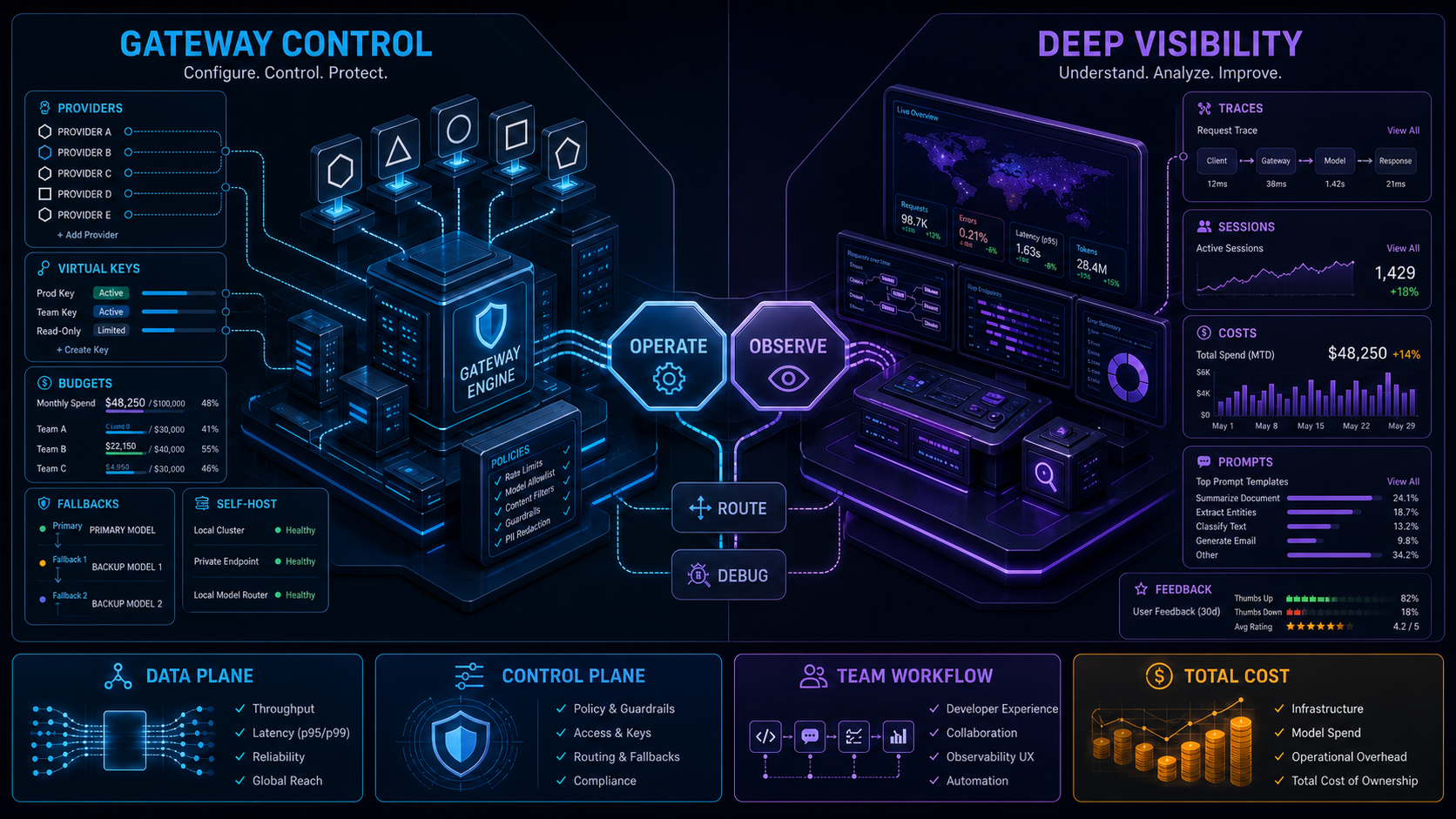
Choose LiteLLM when your platform team wants to own an OpenAI-compatible proxy, routing, virtual keys, budgets, and provider failover. Choose Helicone when the primary gap is managed request, session, cost, prompt, and feedback visibility. If both sit in the request path, assign one traffic authority.
当平台团队要自主掌控 OpenAI 兼容代理、路由、虚拟密钥、预算与供应商故障切换时,优先选择 LiteLLM;当主要缺口是托管式请求、会话、成本、提示词与反馈可见性时,优先选择 Helicone。若两者同时位于请求路径,必须指定唯一流量权威。
TL;DR
Use LiteLLM when a platform team can operate the proxy, database, upgrades, scaling, secrets, provider adapters, routing, fallbacks, virtual keys, and budgets.
Use Helicone when developers need managed request and session traces, cost and error analysis, prompt workflows, feedback, and a shorter path from incident to explanation.
Compare the traffic owner, deployment model, trace fidelity, retry authority, data retention, rollback path, and weekly operating labor—not the number of checkmarks.
A layered design works only when one system owns authentication, routing, retries, caching, and provider attribution; otherwise latency and incident ambiguity compound.
当平台团队能够运营代理、数据库、升级、扩缩容、密钥、供应商适配器、路由、回退、虚拟密钥和预算时,选择 LiteLLM。
当开发者需要托管式请求与会话追踪、成本和错误分析、提示词工作流、反馈,以及更短的事故解释路径时,选择 Helicone。
应比较流量归属、部署模式、追踪完整性、重试权威、数据留存、回滚路径和每周运营工时,而不是功能勾选数量。
只有一个系统负责鉴权、路由、重试、缓存和供应商归因时,分层才有效;否则延迟与事故归因歧义会同时放大。
Start with the job, not the category label 从实际任务出发,而不是产品类别
LiteLLM's center of gravity is the runtime gateway. Its official documentation presents a Python SDK and Proxy Gateway that translate a common OpenAI-style interface across many model providers, with centralized authentication and authorization, virtual keys, budgets, routing, fallbacks, caching, guardrails, and spend tracking. The trade is operational ownership: configuration, upgrades, scaling, secrets, storage, and failure handling remain part of your platform work.
LiteLLM 的重心是运行时网关。官方文档把它描述为 Python SDK 与代理网关:通过统一的 OpenAI 风格接口连接众多模型供应商,并提供集中认证授权、虚拟密钥、预算、路由、回退、缓存、护栏和支出追踪。代价是运营责任:配置、升级、扩缩容、密钥、存储和故障处理仍属于平台团队。
Helicone's center of gravity is understanding LLM behavior. Its platform overview emphasizes an AI Gateway plus observability for requests, traces, sessions, cost, errors, prompts, caching, rate limits, and feedback. It offers managed and self-host-oriented paths, but the buying question is usually whether developers get a faster evidence loop from production behavior to a reproducible fix.
Helicone 的重心是理解 LLM 行为。其平台概览强调 AI 网关与可观测性组合,覆盖请求、追踪、会话、成本、错误、提示词、缓存、限流和反馈。它提供托管与自托管相关路径,但真正的采购问题通常是:开发者能否更快地把线上行为变成可复现的修复证据。
LiteLLM vs Helicone side by side LiteLLM 与 Helicone 并排比较
| Decision surface 决策面 | LiteLLM | Helicone |
|---|---|---|
| Primary operating job 主要运营任务 | Normalize, route, govern, and meter model traffic 标准化、路由、治理和计量模型流量 | Observe, debug, analyze, and improve LLM behavior, with gateway access 观察、调试、分析和改进 LLM 行为,并提供网关访问 |
| Deployment responsibility 部署责任 | Strong self-host/operator orientation; team owns more infrastructure 偏向自托管与自主运营;团队承担更多基础设施 | Managed experience is central; self-host requirements need edition-level validation 托管体验更核心;自托管要求需按版本验证 |
| Routing and access control 路由与访问控制 | Virtual keys, budgets, teams, provider routing, fallbacks, policy 虚拟密钥、预算、团队、供应商路由、回退与策略 | Gateway routing, BYOK, caching, rate limits, and request controls 网关路由、BYOK、缓存、限流与请求控制 |
| Debugging model 调试模型 | Gateway logs, callbacks, spend records, and integrations assembled by operators 由运营方组合网关日志、回调、支出记录和集成 | First-class request, trace, session, prompt, cost, error, and feedback views 一等公民式的请求、追踪、会话、提示词、成本、错误与反馈视图 |
| Best internal owner 最佳内部负责人 | Platform engineering or AI infrastructure 平台工程或 AI 基础设施团队 | AI application, product engineering, or developer platform AI 应用、产品工程或开发者平台团队 |
| Cost to model 需要建模的成本 | Infrastructure, on-call, upgrades, storage, and policy maintenance 基础设施、值班、升级、存储与策略维护 | Subscription or usage, data retention, gateway path, and enterprise controls 订阅或用量、数据保留、网关路径与企业控制 |
Choose according to the bottleneck you own 根据你真正负责的瓶颈选择
You need a self-operated model access layer; multiple teams require virtual keys and budgets; provider portability and explicit routing policy matter; engineers can own proxy reliability; and observability can come from existing telemetry or a separate tool.
Production debugging is slow; session-level behavior matters; prompt and model experiments need shared evidence; product teams need usable traces without building a data pipeline; and a managed gateway plus visibility is acceptable.
Your critical protocol features have not been tested, data residency is unclear, the pricing model cannot be mapped to real traffic, or the team has not assigned one owner for retries, caching, rate limits, and incident response.
需要自主运营模型访问层;多团队需要虚拟密钥和预算;重视供应商可移植性与显式路由策略;工程团队能负责代理可靠性;可观测性可由现有遥测或独立工具承担。
线上调试很慢;需要会话级行为;提示词和模型实验需要共享证据;产品团队不想自建数据管道;并且可以接受托管网关与可见性组合。
关键协议功能尚未测试、数据驻留不清楚、定价无法映射真实流量,或团队没有为重试、缓存、限流和事故响应指定唯一负责人。
If you use both, keep one traffic authority 如果两者都用,只保留一个流量权威
A defensible layered design makes LiteLLM the traffic authority and exports telemetry to Helicone or another analysis layer without placing a second retrying proxy in the synchronous path. If traffic must traverse both, document the exact order and assign one system to own authentication, rate limits, retries, fallbacks, caching, request IDs, and cost attribution. Disable duplicate behavior in the other layer.
合理的分层设计可以让 LiteLLM 成为流量权威,并把遥测导出到 Helicone 或其他分析层,而不是在同步路径中再放一个会重试的代理。如果流量必须穿过两层,应记录精确顺序,并只指定一个系统负责认证、限流、重试、回退、缓存、请求 ID 和成本归因;另一层关闭重复行为。
Failure rule: for every timeout, answer which layer retries, which layer records the final model and provider, and which request ID the incident review starts from. If the answer is “both,” simplify the path.
故障规则:对每次超时,都要能回答哪一层重试、哪一层记录最终模型与供应商、事故复盘从哪个请求 ID 开始。如果答案是“两层都做”,就应简化链路。
A two-week proof based on evidence 基于证据的两周验证
- Replay a fixed task set with tools, structured output, streaming, long context, multimodal inputs, and forced provider errors.
- Measure p50/p95/p99 added latency, correct-model rate, fallback correctness, duplicate-call rate, cache behavior, and cost reconciliation.
- Give five developers the same broken session. Record time to find the request, reconstruct context, identify the provider and model, and ship a verified fix.
- Run one key rotation, budget breach, provider outage, upgrade, and rollback. Count operator minutes and ambiguous ownership handoffs.
- Price the result as software plus infrastructure, storage, data egress, maintenance, on-call, and developer debugging time.
- 用固定任务集回放工具调用、结构化输出、流式、长上下文、多模态输入和强制供应商错误。
- 测量新增 p50/p95/p99 延迟、正确模型率、回退正确率、重复调用率、缓存行为和成本对账。
- 让五名开发者处理同一个故障会话,记录定位请求、重建上下文、识别供应商与模型、提交并验证修复的时间。
- 执行一次密钥轮换、预算超限、供应商中断、升级和回滚,统计运营时间与责任不清的交接。
- 把总成本计算为软件、基础设施、存储、数据出口、维护、值班和开发者调试时间之和。
Migrate the evidence contract before traffic 先迁移证据契约,再迁移流量
Define a vendor-neutral request envelope with a stable trace ID, application and tenant identity, prompt or workflow version, selected model, attempted providers, policy decision, retry count, cache status, usage, price, and error taxonomy. Export a representative history before changing the gateway. Dual-write telemetry, compare cost totals and trace completeness, then canary traffic by application. Keep the previous path until rollback works without losing attribution.
先定义厂商中立的请求信封:稳定调用链 ID、应用与租户身份、提示词或工作流版本、所选模型、尝试过的供应商、策略决策、重试次数、缓存状态、用量、价格和错误分类。更换网关前导出代表性历史;双写遥测并比较成本总额与追踪完整性,再按应用灰度流量。在回滚不丢失归因证据之前,不要撤掉旧链路。
Model traffic control and external capability control 模型流量控制与外部能力控制
Let LiteLLM or Helicone own the inference span and preserve its request ID, selected model, provider, retries, token usage, latency, and cost. Start a separate QVeris capability span only when the agent discovers or invokes an external API, data source, or tool. Carry the same workflow and tenant IDs across both spans without sharing provider credentials or retry policy.
由 LiteLLM 或 Helicone 负责推理链路,并保留请求 ID、所选模型、供应商、重试、Token 用量、延迟与成本。只有当智能体发现或调用外部 API、数据源或工具时,才启动独立的 QVeris 能力链路。两条链路传递相同工作流与租户 ID,但不共享供应商凭证或重试策略。
A Production Decision Scorecard for LiteLLM vs HeliconeLiteLLM 与 Helicone 的生产决策评分卡
Score the products against one production-shaped workload and one ownership model. LiteLLM should prove traffic control and recoverability; Helicone should prove trace completeness and debugging speed. A combined design must prove that the second hop adds more evidence than latency or ambiguity.
应使用同一份生产形态工作负载和同一套责任模型评分。LiteLLM 需要证明流量控制与恢复能力;Helicone 需要证明追踪完整性与调试速度;组合方案则必须证明第二跳带来的证据价值大于新增延迟与归因歧义。
Map provider abstraction, routing and fallback, gateway capture, analytics, evaluations, prompt operations, and whether control or evidence is the primary gap. Decide which component owns each decision, where policy is enforced, and whether the products are substitutes, complements, or overlapping layers.
梳理供应商抽象、路由与故障切换、网关采集、分析、评估、提示词运营,以及主要缺口究竟是控制还是证据。明确每项决策由哪个组件负责、策略在哪里执行,以及两者究竟是替代、互补还是部分重叠。
Replay simple, long-context, streaming, structured-output, tool-calling, high-concurrency, and failure cases. Measure accepted-result quality, completion, p50 and tail latency, retries, trace completeness, and effective cost.
重放简单、长上下文、流式、结构化输出、工具调用、高并发和失败案例,衡量合格结果质量、完成率、常规与长尾延迟、重试、追踪完整性和实际成本。
Include hosting, regional capacity, data retention, identity integration, policy maintenance, upgrades, incident response, support, compliance evidence, and the custom adapters the team must keep current.
纳入托管、区域容量、数据留存、身份集成、策略维护、升级、事故响应、支持、合规证据,以及团队必须持续维护的自定义适配器。
Version a neutral request and evidence envelope, shadow traffic, classify semantic differences, preserve trace identity, and prove a staged rollback. Prefer the option that keeps policy and workload contracts portable.
版本化中立请求与证据封装,运行影子流量,分类语义差异,保留追踪身份,并证明可分阶段回滚。优先选择能让策略和工作负载契约保持可迁移的方案。
FAQ
Sometimes, when a managed gateway plus observability satisfies the routing and policy requirements. For deep self-operated gateway control, they are not identical substitutes.
It exposes logs, callbacks, spend tracking, and integrations. The decision is whether those surfaces provide the session and developer workflow your team needs without substantial assembly.
Yes, but designate one traffic authority and test latency, retries, caching, IDs, provider attribution, and cost reconciliation end to end.
There is no universal winner. Compare subscription or usage fees with infrastructure, storage, operations, incidents, and developer debugging time at your traffic shape.
有时可以,前提是托管网关加可观测性已经满足路由和策略要求;若需要深度自主运营网关控制,两者并非相同替代品。
它提供日志、回调、支出追踪和集成。关键是这些界面能否在不进行大量组装的情况下满足团队的会话与开发者工作流。
可以,但应指定一个流量权威,并端到端验证延迟、重试、缓存、ID、供应商归因和成本对账。
没有通用答案。应按真实流量形态,把订阅或用量费与基础设施、存储、运营、事故和开发者调试时间一起比较。