Get Started
QVeris · Market Data API Provider Comparison

Market Data API for AI Agents: 7 Best Providers (2026)

A technical comparison of 7 market data API providers — Polygon.io, Alpaca, Finnhub, Alpha Vantage, Twelve Data, Bloomberg, and Databento — covering equities, crypto, forex, and options data for AI agent integration.

7
Providers Compared
4
Asset Classes Covered
10,000+
Unified Capabilities
97M+
MCP SDK Downloads
TL;DR
Problem: AI agents need market data across multiple asset classes — equities, crypto, forex, and options — but each provider covers different assets, uses different authentication methods, and returns data in different formats, creating integration overhead that slows agent development.
Solution: Compare 7 market data API providers on coverage, latency, free tier limits, and AI agent compatibility — then use a unified capability routing layer to access all providers through a single interface.
Result: Your AI agent gets structured market data across all asset classes without managing multiple API keys, rate limits, or response format differences.

What is a Market Data API for AI Agents?

A market data API is a service that provides programmatic access to financial market information — stock quotes, cryptocurrency prices, forex rates, options chains, and macroeconomic indicators. For AI agents, these APIs serve as the data layer that feeds structured, machine-readable market information into agent reasoning loops.

The core workflow: your AI agent sends a query (a ticker symbol, asset pair, or data type), and the API returns structured market data — current price, volume, historical OHLCV, bid-ask spread, and additional metadata. The critical differentiators for AI agent use cases are WebSocket support (persistent streaming connections), asset class breadth (how many markets one API covers), and free tier generosity (how much data you can access before paying).

Market data APIs serve two distinct populations: human-facing financial applications (trading dashboards, portfolio trackers) and AI agent pipelines (autonomous systems that consume data, evaluate conditions, and trigger actions). This comparison focuses on the AI agent use case — where multi-provider integration complexity, response format normalization, and rate limit management are the real bottlenecks.

7 Market Data APIs Compared (2026)

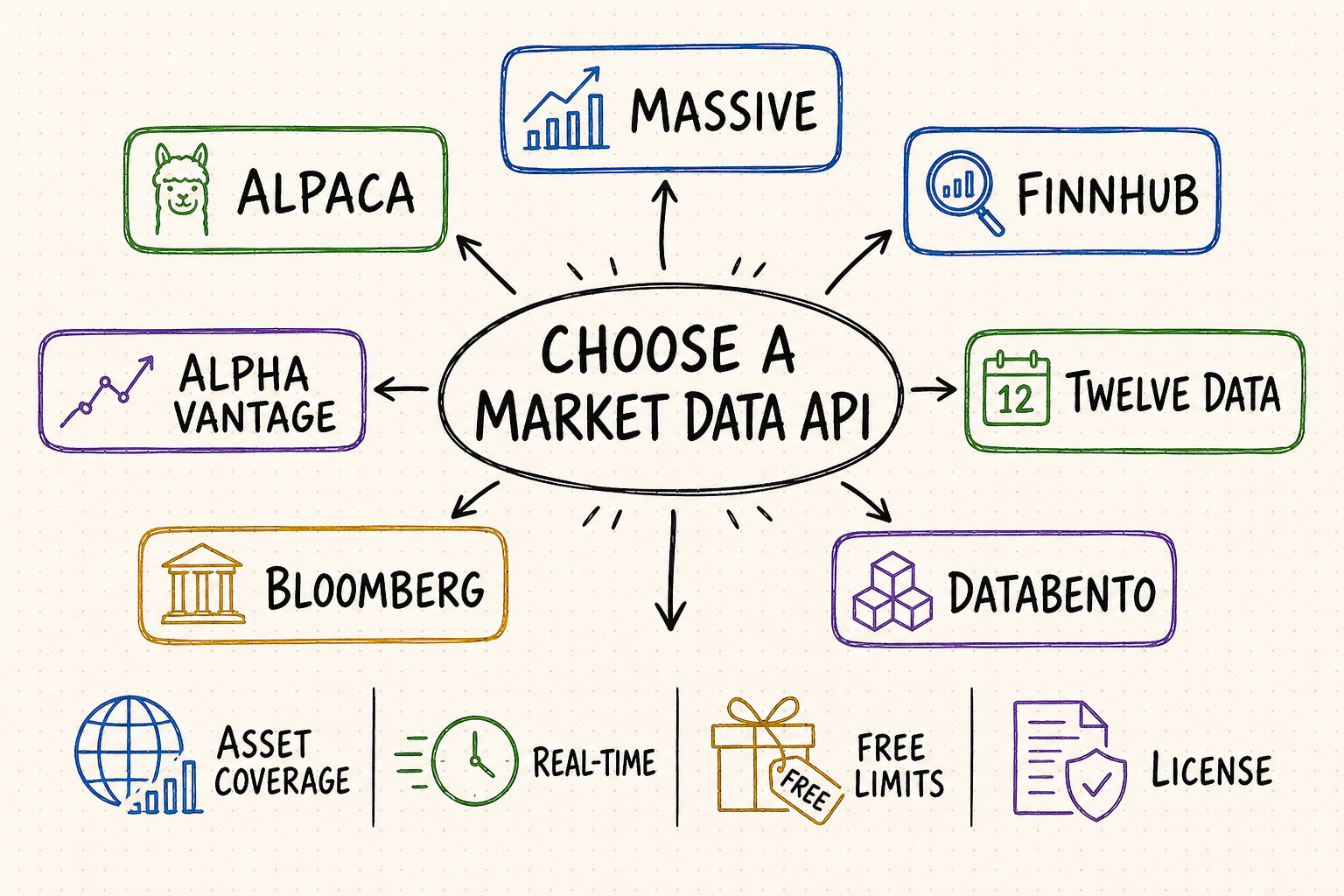
The seven providers below span from free developer tiers to enterprise institutional feeds. The comparison focuses on dimensions that matter for AI agent integration: asset class coverage, free tier limits, real-time latency, WebSocket availability, and AI agent SDK support.

Market Data API Comparison — Coverage, Latency, Free Tier, AI Agent Compatibility. Updated June 2026.
Provider Asset Classes Free Tier Real-Time Latency WebSocket AI Agent SDK Starting Price
Polygon.io Stocks, Options, Forex, Crypto Paid Only <10ms (paid) Yes (paid) REST/WebSocket $29/mo
Alpaca Stocks, Crypto Genuinely Free Real-time (US stocks) Yes Python, JS Free
Finnhub Stocks, Forex, Crypto Limited Free (300/day) Real-time (limited) Yes (basic) REST Free
Alpha Vantage Stocks, Forex, Crypto, Macro Limited Free (25/day) Delayed 15min No REST Free
Twelve Data Stocks, Forex, Crypto, ETFs Limited Free (800/day) Delayed (free) No (paid) Python, JS Free
Bloomberg Stocks, Bonds, Forex, Commodities None <1ms Yes B-PIPE $2,000+/mo
Databento Stocks, Options, Futures Limited Free (250K msg/mo) Real-time Yes Python, Rust Free
Legend: Genuinely Free — usable in production without payment. Limited Free — free tier exists but with significant daily/monthly caps. Paid Only — no free tier; payment required from day one.

The comparison reveals a clear market structure. Alpaca and Finnhub lead for free-tier development with WebSocket support. Polygon.io delivers the broadest professional-grade coverage across four asset classes. Databento brings institutional data quality with a generous free message allowance. Bloomberg remains the enterprise benchmark but is cost-prohibitive for most AI agent teams. For agents needing multi-asset-class coverage on a budget, combining Alpaca (equities) + Finnhub (crypto/forex) is a common starting pattern — but the integration overhead of managing two providers is real, which is where unified capability routing becomes valuable.

Market Data API Provider Landscape — AI Agent Compatibility vs Free Tier Generosity

Provider Deep Dives

1. Polygon.io — The Professional Standard

Best for: Production AI agents needing multi-asset real-time data with mature WebSocket infrastructure
✓ Strengths
  • Industry-leading WebSocket streaming with trade ticks, quotes, and aggregates across 200,000+ tickers
  • Four asset classes covered: stocks, options, forex, crypto — the broadest single-provider coverage
  • Clean REST API with excellent documentation and official client libraries
✗ Limitations
  • No free tier — paid-only starting at $29/month, which may be steep for hobbyist AI agent developers
  • Real-time WebSocket data requires the paid plan; free tier is delayed data only

2. Alpaca — Best Free Tier for Equities

Best for: AI agents focused on US equities that need genuinely free real-time data
✓ Strengths
  • Genuinely free tier with real-time US stock data — no credit card required, production use allowed
  • Native Python and JavaScript SDKs simplify AI agent integration
  • WebSocket streaming included on the free tier for US equities and crypto
✗ Limitations
  • Limited to stocks and crypto — no forex, options, or macro data
  • US-centric coverage; international equity data is limited compared to Polygon.io or Twelve Data

3. Finnhub — WebSocket on Free Tier

Best for: AI agents that need WebSocket streaming across multiple asset classes without upfront cost
✓ Strengths
  • WebSocket support included on the free tier — one of very few providers offering this
  • Covers stocks, forex, and crypto with real-time quotes on free tier
  • 60 API calls per minute on free tier, generous for real-time use cases
✗ Limitations
  • Free tier limited to 300 API calls per day for most endpoints; premium data requires paid plans
  • REST-only for most endpoints; WebSocket limited to trades and news on free tier

4. Alpha Vantage — The Accessible Entry Point

Best for: AI agent prototyping and low-frequency data needs with broad asset class coverage
✓ Strengths
  • Broadest free asset coverage: stocks, forex, crypto, and macroeconomic indicators in one API key
  • 50+ technical indicators included — SMA, EMA, RSI, MACD, Bollinger Bands, and more
  • Simple REST API with excellent getting-started documentation
✗ Limitations
  • Severely rate-limited free tier: only 25 requests per day — insufficient for production AI agents
  • No WebSocket support; all data is REST-based with 15-minute delay on free tier

5. Twelve Data — Broadest Free Coverage

Best for: AI agents that need diverse asset class data with the highest free daily request allowance
✓ Strengths
  • 800 requests/day on free tier — the highest daily limit among free REST APIs
  • Covers stocks, forex, crypto, and ETFs across 50+ exchanges worldwide
  • 130+ technical indicators accessible via API; Python and JavaScript SDKs available
✗ Limitations
  • WebSocket streaming is paid-only; free tier is REST with delayed data
  • Real-time data requires a paid plan starting at $8/month

6. Bloomberg — Enterprise Benchmark

Best for: Institutional AI agent deployments where sub-millisecond latency and comprehensive coverage are non-negotiable
✓ Strengths
  • Sub-millisecond latency with B-PIPE — the gold standard for institutional market data
  • Comprehensive coverage: stocks, bonds, forex, commodities, derivatives, and macroeconomic data
  • Industry-standard data quality with full audit trail and compliance support
✗ Limitations
  • $2,000+/month starting price — cost-prohibitive for individual developers and startups
  • B-PIPE API requires specialized knowledge; not designed for casual AI agent integration

7. Databento — Best for Institutional Data

Best for: AI agents that need institutional-grade historical and real-time data with usage-based pricing
✓ Strengths
  • 250,000 free messages per month — generous allowance for testing and low-volume production
  • Python and Rust SDKs with modern API design and excellent documentation
  • Real-time and historical data with WebSocket streaming across stocks, options, and futures
✗ Limitations
  • No forex or crypto data; focused on traditional exchange-traded instruments
  • Usage-based pricing can be unpredictable for high-volume AI agent workloads

Asset Class Coverage Breakdown

Different AI agent use cases require different asset classes. Here is which provider leads for each asset class, with both free and paid recommendations.

Asset Class Best Free Option Best Paid Option QVeris Coverage
US Equities Alpaca Polygon.io
Crypto Finnhub Databento
Forex Alpha Vantage Polygon.io
Options Databento Polygon.io
Macro/Economic Alpha Vantage Bloomberg
ETFs Twelve Data Polygon.io

No single provider leads across all asset classes — which is why AI agent teams often end up managing multiple API keys. A unified capability routing layer abstracts away this multi-provider complexity, letting your agent query market data without knowing which underlying provider serves each asset class.

Free Tier Comparison for AI Agent Development

Free tiers are critical for AI agent prototyping. Here is how the providers stack up on daily limits, real-time access, and commercial use terms — the three dimensions that matter most when you are building an agent before paying for data.

Provider Daily Limit Rate Limit Real-Time on Free? Credit Card Required? Commercial Use?
Alpaca Unlimited (fair use) 5 req/sec Yes No Yes
Finnhub 300 calls/day 60/min Yes (limited) No Personal only
Twelve Data 800 calls/day 8/min No (15min delay) No Personal only
Alpha Vantage 25 calls/day 5/min No (15min delay) No Personal only
Databento 250K msg/month N/A (msg-based) Yes Yes Yes (with license)
Polygon.io None (paid only) N/A No (paid only) Required Yes (paid plans)
Bloomberg None (paid only) N/A Yes (paid) Required Yes (paid plans)

Key takeaway: Alpaca is the only provider with a genuinely unrestricted free tier suitable for production AI agents. Finnhub and Twelve Data offer the best free REST options if you can stay within daily limits. Databento's message-based model is innovative but requires a credit card to start. For most AI agent developers, the free tier journey starts with Alpaca (US equities) and expands to paid tiers as asset class needs grow.

Latency and Real-Time Data for AI Agents

For AI agents that make time-sensitive decisions — price alerts, arbitrage detection, or earnings-triggered workflows — data latency is a critical factor. Here is how the providers compare on real-time data delivery:

Sub-Millisecond Tier

Bloomberg B-PIPE delivers <1ms latency through direct exchange colocation and proprietary network infrastructure. This is institutional-grade performance designed for high-frequency trading desks, not typical AI agent workloads. For most agent use cases, this level of latency is overkill — your LLM reasoning loop adds far more latency than the data feed.

🔌

WebSocket Streaming Tier

Polygon.io (~10ms), Alpaca (real-time US), Finnhub (real-time), and Databento (real-time) all provide WebSocket streaming suitable for AI agent use cases. These providers push data to your agent as events happen, eliminating the latency and API budget cost of continuous REST polling.

📡

REST Polling Tier

Twelve Data (delayed free, real-time paid) and Alpha Vantage (15min delayed free) are REST-only on free tiers. For AI agents that poll on a schedule — hourly portfolio checks, daily screener runs — REST polling is sufficient and simpler to implement than persistent WebSocket connections.

🧠

AI Agent Latency Reality Check

The dominant latency source in most AI agent pipelines is the LLM inference step (500ms–5s), not the market data feed. For agents using QVeris CLI, data calls execute as subprocess invocations that bypass the LLM context window entirely — the routing layer returns structured data directly without injecting tool schemas into every prompt.

Why AI Agents Need a Unified Market Data Layer

The multi-provider problem is real. Each market data API has its own authentication method (API key in header vs query param vs OAuth), its own response format (different JSON field names for the same data), and its own rate limit window (per-minute vs per-day vs per-month). For an AI agent that needs data across equities, crypto, and forex, the integration overhead compounds quickly.

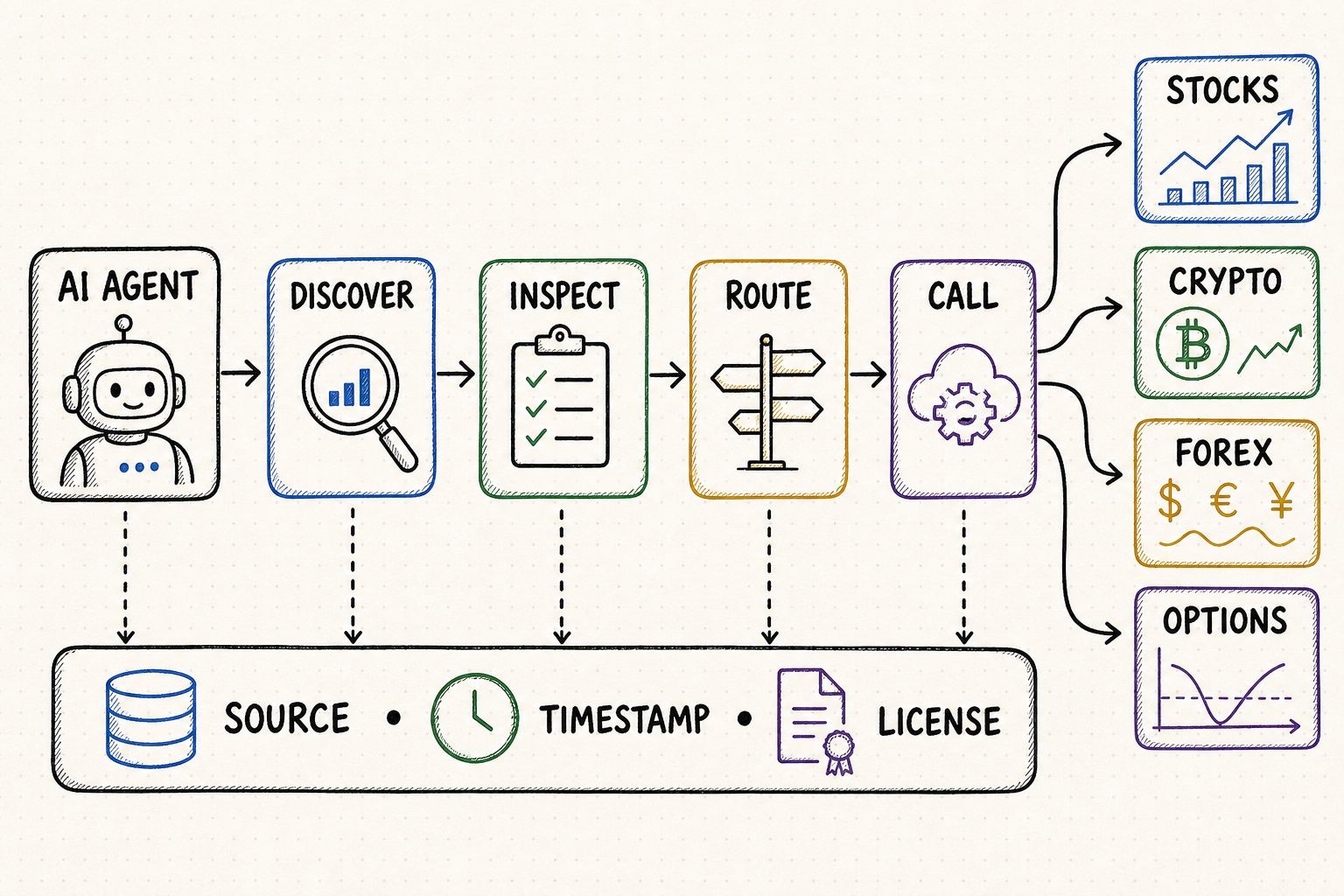
The capability routing pattern solves this by presenting a unified interface to your AI agent. You write one integration; the routing layer handles multi-provider discovery, connection management, and response normalization. Here is what that looks like in practice with QVeris:

qveris_market_data.py — Terminal
# Unified market data access for AI agents via QVeris CLI # One API key. All providers. No per-provider connection code. # Docs: https://qveris.ai/docs # Step 1: Discover available market data capabilities $ qveris discover "market data API equities crypto forex" # Returns capabilities across all 7 providers: # polygon_quotes Polygon.io — WebSocket real-time, stocks/options/forex/crypto # alpaca_quotes Alpaca — Free real-time US equities + crypto # finnhub_quotes Finnhub — WebSocket + REST, global coverage # twelvedata_quotes Twelve Data — 50+ exchanges, 130+ indicators # alphavantage_data Alpha Vantage — Stocks, forex, crypto, macro # databento_stream Databento — Institutional tick data, 250K msg/mo free # Step 2: Call any capability through the unified interface $ qveris call polygon_quotes --symbols "AAPL,MSFT,GOOGL" --format json # Step 3: Wire into your AI agent's function-calling loop import subprocess, json def get_market_data(symbols): result = subprocess.run( ["qveris", "call", "polygon_quotes", "--symbols", symbols, "--format", "json"], capture_output=True, text=True ) return json.loads(result.stdout) # 10,000+ financial capabilities, one API key # No WebSocket management. No rate limit tracking. No format parsing.

The routing layer knows which providers support WebSocket streaming, what their rate limits are, and how to normalize response formats. Your agent code stays clean — it calls one interface and gets back structured data regardless of which provider ultimately answered. For AI agents using the function-calling pattern, QVeris integrates directly into the tool-calling loop via subprocess execution — zero MCP schema injection overhead.
Get started with QVeris → or view pricing.

Unified Market Data Access Architecture — AI Agent → QVeris → Multiple Providers

Getting Started Checklist

Ready to integrate market data into your AI agent? Here is a practical checklist to go from evaluation to production:

Choose your primary asset class (equities, crypto, forex, options)
Evaluate free tier limits against your agent's query volume
Check WebSocket support if you need real-time streaming
Verify commercial use terms before production deployment
Consider a unified routing layer if you need multiple asset classes
Start with QVeris free tier: 1,000 credits on signup + 100 daily
Start Building with QVeris →

QVeris provides a capability routing layer. Underlying market data comes from third-party providers. Verify data quality and terms before production use.

Give Your AI Agent Unified Market Data Access

QVeris handles multi-provider discovery, WebSocket management, rate limiting, and response normalization — so your agent gets structured market data without per-provider integration code. 10,000+ financial capabilities, one API key.

Real-Time Stock Price API for AI Agents →

Compare 6 real-time stock price APIs with WebSocket support and AI agent integration patterns.

Stock API Free Comparison →

Every free stock API compared — Alpha Vantage, Finnhub, Alpaca, Twelve Data, and more.

Frequently Asked Questions

What is the best free market data API for AI agents?
Alpaca offers the most generous free tier for US equities — genuinely free with real-time data, WebSocket streaming, and no credit card required. Finnhub provides 60 API calls/minute free with WebSocket support across stocks, forex, and crypto. Twelve Data offers 800 requests/day free (the highest daily REST limit) covering stocks, forex, crypto, and ETFs. For crypto-focused agents, Finnhub and Databento (250K free messages/month) are the best free starting points. The best choice depends on your asset class needs and expected query volume.
Do market data APIs support WebSocket for AI agents?
Polygon.io, Alpaca, Finnhub, and Databento all support WebSocket streaming for real-time market data. Polygon.io offers the most mature WebSocket implementation with trade ticks, quotes, and aggregated trades across 200,000+ tickers. Alpaca provides free WebSocket access for US stocks and crypto. Finnhub includes basic WebSocket on its free tier for trades and news. Twelve Data and Alpha Vantage are primarily REST-based on free tiers, with WebSocket available on paid plans for Twelve Data. For AI agents that need continuous price monitoring rather than periodic polling, WebSocket-native providers (Polygon.io, Alpaca, Finnhub, Databento) are the strongest candidates.
How do AI agents handle multiple market data providers?
Most developers eventually use a capability routing layer like QVeris to abstract away multi-provider complexity. The manual alternative — writing separate WebSocket connection managers, rate limit trackers, and response format normalizers for each provider — creates significant maintenance overhead. With a unified routing layer, your agent discovers available capabilities, inspects schemas and costs, and calls data through a single interface. The routing layer handles provider selection, authentication, rate limiting, and response normalization behind the scenes. See the Unified Market Data Access section above for a code example.
What market data API works best for crypto AI agents?
Finnhub and Databento offer the best free crypto data for AI agents. Finnhub provides real-time cryptocurrency quotes via WebSocket on its free tier, covering major pairs like BTC/USD and ETH/USD. Databento offers institutional-grade crypto tick data with 250,000 free messages per month — ideal for agents that need historical order book depth. For paid options, Polygon.io covers major crypto pairs alongside equities, forex, and options in a single API. If your agent needs both crypto and traditional asset data, Polygon.io or a unified routing approach (combining Alpaca for equities + Finnhub for crypto) provides the best coverage.
Is Bloomberg API available for individual developers?
Bloomberg B-PIPE starts at $2,000+/month and is designed for institutional users — individual developers, startups, and AI agent hobbyists will find it prohibitively expensive. The API requires specialized knowledge of Bloomberg's data model and network infrastructure. For most AI agent use cases, Polygon.io (from $29/month) or Alpaca (free tier available) provide sufficient coverage at a fraction of the cost. Bloomberg is the right choice only for institutional deployments where sub-millisecond latency, comprehensive bond/derivatives coverage, and regulatory compliance audit trails are non-negotiable requirements.

References & Sources

  1. Polygon.io Pricing — polygon.io/pricing
  2. Alpaca Markets Documentation — docs.alpaca.markets
  3. Finnhub Documentation — finnhub.io/docs
  4. Alpha Vantage Documentation — alphavantage.co/documentation
  5. Twelve Data Documentation — twelvedata.com/docs
  6. Bloomberg Terminal Pricing — bloomberg.com/professional
  7. Databento Pricing — databento.com/pricing