A technical comparison of 7 market data API providers — Polygon.io, Alpaca, Finnhub, Alpha Vantage, Twelve Data, Bloomberg, and Databento — covering equities, crypto, forex, and options data for AI agent integration.
A market data API is a service that provides programmatic access to financial market information — stock quotes, cryptocurrency prices, forex rates, options chains, and macroeconomic indicators. For AI agents, these APIs serve as the data layer that feeds structured, machine-readable market information into agent reasoning loops.
The core workflow: your AI agent sends a query (a ticker symbol, asset pair, or data type), and the API returns structured market data — current price, volume, historical OHLCV, bid-ask spread, and additional metadata. The critical differentiators for AI agent use cases are WebSocket support (persistent streaming connections), asset class breadth (how many markets one API covers), and free tier generosity (how much data you can access before paying).
Market data APIs serve two distinct populations: human-facing financial applications (trading dashboards, portfolio trackers) and AI agent pipelines (autonomous systems that consume data, evaluate conditions, and trigger actions). This comparison focuses on the AI agent use case — where multi-provider integration complexity, response format normalization, and rate limit management are the real bottlenecks.
The seven providers below span from free developer tiers to enterprise institutional feeds. The comparison focuses on dimensions that matter for AI agent integration: asset class coverage, free tier limits, real-time latency, WebSocket availability, and AI agent SDK support.
| Provider | Asset Classes | Free Tier | Real-Time Latency | WebSocket | AI Agent SDK | Starting Price |
|---|---|---|---|---|---|---|
| Massive (formerly Polygon.io) | Stocks, Options, Forex, Crypto | Free Basic (EOD) | Delayed or real-time by plan | Yes (paid) | REST/WebSocket | Free; paid from $29/mo |
| Alpaca | Stocks, Crypto | Genuinely Free | Real-time (US stocks) | Yes | Python, JS | Free |
| Finnhub | Stocks, Forex, Crypto | Free access (limits vary) | Real-time (limited) | Yes (basic) | REST | Free |
| Alpha Vantage | Stocks, Forex, Crypto, Macro | Limited Free (25/day) | Delayed 15min | No | REST | Free |
| Twelve Data | Stocks, Forex, Crypto, ETFs | Limited Free (800/day) | Delayed (free) | No (paid) | Python, JS | Free |
| Bloomberg | Stocks, Bonds, Forex, Commodities | None | <1ms | Yes | B-PIPE | Enterprise quote |
| Databento | Stocks, Options, Futures | $125 trial credits | Real-time | Yes | Python, Rust | Free |
The comparison reveals a clear market structure. Alpaca offers useful free IEX-based US equity access, while Finnhub provides broad developer-oriented endpoints with account- and endpoint-specific limits. Massive (formerly Polygon.io) spans four asset classes, with free end-of-day access and delayed or real-time data on paid plans. Databento brings institutional data quality through usage-based pricing and trial credits. Bloomberg B-PIPE remains an enterprise option sold by quote. If an agent combines providers, it must preserve venue, timestamp, entitlement and fallback semantics rather than treating every quote as interchangeable. See the market data architecture guide for that integration layer.
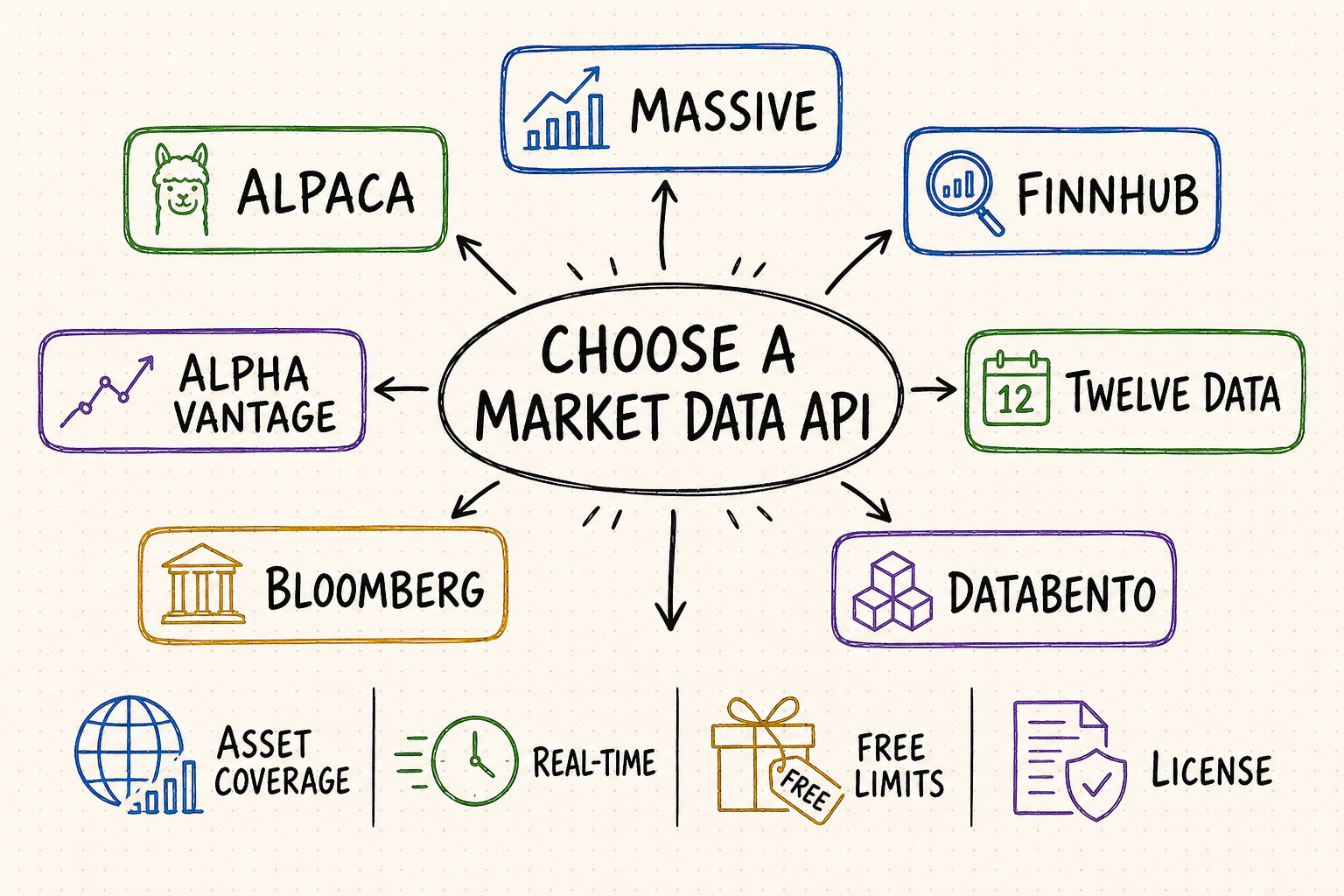
Different AI agent use cases require different asset classes. Here is which provider leads for each asset class, with both free and paid recommendations.
| Asset Class | Best Free Option | Best Paid Option | QVeris Coverage |
|---|---|---|---|
| US Equities | Alpaca | Polygon.io | ✓ |
| Crypto | Finnhub | Databento | ✓ |
| Forex | Alpha Vantage | Polygon.io | ✓ |
| Options | Databento | Polygon.io | ✓ |
| Macro/Economic | Alpha Vantage | Bloomberg | ✓ |
| ETFs | Twelve Data | Polygon.io | ✓ |
No single provider leads across all asset classes — which is why AI agent teams often end up managing multiple API keys. A unified capability routing layer abstracts away this multi-provider complexity, letting your agent query market data without knowing which underlying provider serves each asset class.
Free tiers are critical for AI agent prototyping. Here is how the providers stack up on daily limits, real-time access, and commercial use terms — the three dimensions that matter most when you are building an agent before paying for data.
| Provider | Daily Limit | Rate Limit | Real-Time on Free? | Credit Card Required? | Commercial Use? |
|---|---|---|---|---|---|
| Alpaca | No daily quota stated | 200 req/min | Yes — IEX subset | No | Yes |
| Finnhub | Varies by account/endpoint | Check dashboard and headers | Dataset-dependent | No | Personal only |
| Twelve Data | 800 calls/day | 8/min | No (15min delay) | No | Personal only |
| Alpha Vantage | 25 calls/day | 5/min | No (15min delay) | No | Personal only |
| Databento | $125 historical credits | Usage-based | Trial/entitlement-dependent | Yes | Yes (with license) |
| Massive (formerly Polygon.io) | Free Basic: 5 req/min | 5/min on Basic | No — EOD on Basic | No for Basic | Yes (paid plans) |
| Bloomberg | None (paid only) | N/A | Yes (paid) | Required | Yes (paid plans) |
Key takeaway: Alpaca is the only provider with a genuinely unrestricted free tier suitable for production AI agents. Finnhub and Twelve Data offer the best free REST options if you can stay within daily limits. Databento's message-based model is innovative but requires a credit card to start. For most AI agent developers, the free tier journey starts with Alpaca (US equities) and expands to paid tiers as asset class needs grow.
For AI agents that make time-sensitive decisions — price alerts, arbitrage detection, or earnings-triggered workflows — data latency is a critical factor. Here is how the providers compare on real-time data delivery:
Bloomberg B-PIPE delivers <1ms latency through direct exchange colocation and proprietary network infrastructure. This is institutional-grade performance designed for high-frequency trading desks, not typical AI agent workloads. For most agent use cases, this level of latency is overkill — your LLM reasoning loop adds far more latency than the data feed.
Polygon.io (~10ms), Alpaca (real-time US), Finnhub (real-time), and Databento (real-time) all provide WebSocket streaming suitable for AI agent use cases. These providers push data to your agent as events happen, eliminating the latency and API budget cost of continuous REST polling.
Twelve Data (delayed free, real-time paid) and Alpha Vantage (15min delayed free) are REST-only on free tiers. For AI agents that poll on a schedule — hourly portfolio checks, daily screener runs — REST polling is sufficient and simpler to implement than persistent WebSocket connections.
The dominant latency source in most AI agent pipelines is the LLM inference step (500ms–5s), not the market data feed. For agents using QVeris CLI, data calls execute as subprocess invocations that bypass the LLM context window entirely — the routing layer returns structured data directly without injecting tool schemas into every prompt.
The multi-provider problem is real. Each market data API has its own authentication method (API key in header vs query param vs OAuth), its own response format (different JSON field names for the same data), and its own rate limit window (per-minute vs per-day vs per-month). For an AI agent that needs data across equities, crypto, and forex, the integration overhead compounds quickly.
The capability routing pattern solves this by presenting a unified interface to your AI agent. You write one integration; the routing layer handles multi-provider discovery, connection management, and response normalization. Here is what that looks like in practice with QVeris:
The routing layer knows which providers support WebSocket streaming, what their rate limits are, and how to normalize response formats. Your agent code stays clean — it calls one interface and gets back structured data regardless of which provider ultimately answered. For AI agents using the function-calling pattern, QVeris integrates directly into the tool-calling loop via subprocess execution — zero MCP schema injection overhead.
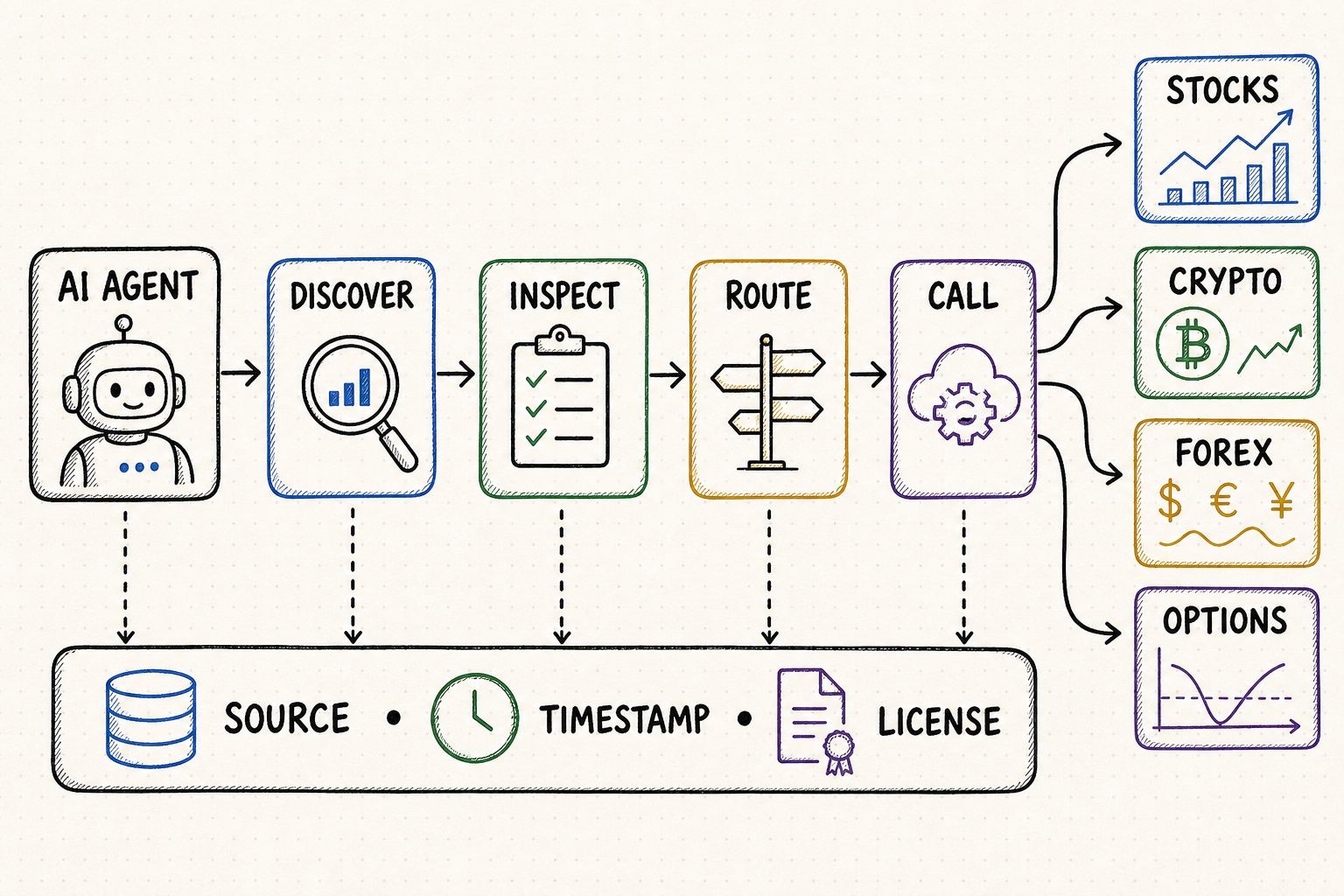
Ready to integrate market data into your AI agent? Here is a practical checklist to go from evaluation to production:
QVeris provides a capability routing layer. Underlying market data comes from third-party providers. Verify data quality and terms before production use.
QVeris handles multi-provider discovery, WebSocket management, rate limiting, and response normalization — so your agent gets structured market data without per-provider integration code. 10,000+ financial capabilities, one API key.
