
COMPETITOR COMPARISON
8 Best Martian LLM Router Alternatives in 2026
Screen Martian LLM Router options by routing control, compatibility, observability, and operating cost.
Published: · By the QVeris Team
TL;DR
Martian currently presents Model Router and Gateway capabilities, provider metrics, and integrations for agent coding tools. Do not base a migration on the old inactive-page assumption.
For managed, quality-aware model selection, Not Diamond is the most direct functional comparison. RouteLLM is the stronger open implementation starting point.
OpenRouter, Portkey, Requesty, Vercel AI Gateway, LiteLLM, and Bifrost emphasize access, policy, fallback, or operations to different degrees.
Test task success, cost at fixed quality, latency, fallback behavior, data controls, and operator effort before moving production traffic.
Start with Martian's current routing baseline
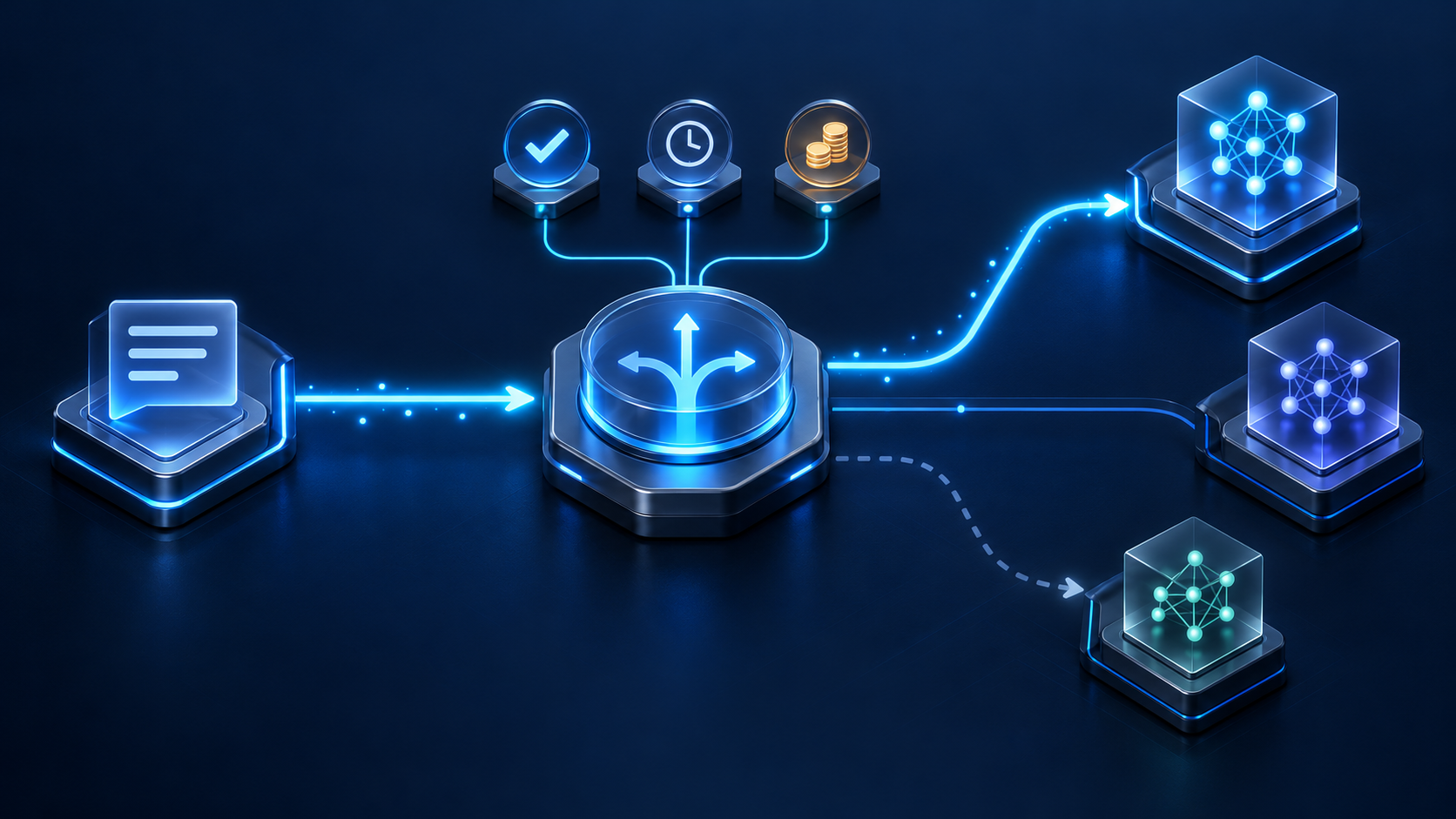
Martian's current official materials describe a Model Router that chooses models by prompt, plus a Gateway that provides access to more than 200 models through one API key. Its provider leaderboard tracks cost, rate limits, throughput, and time to first token, while official integrations cover Cursor, Cline, Windsurf, and related agent workflows. A real alternative must replace the specific parts you use—not merely offer an OpenAI-compatible base URL.
Define the replacement boundary. Record whether you need predictive model selection, provider failover, one billing account, self-hosting, data residency, prompt logging, or all of them.
Match the Martian alternative to the actual job
Choose Not Diamond for a managed pre-trained or custom router; choose RouteLLM when you want to operate and evaluate an open routing implementation yourself.
Choose OpenRouter or Requesty when one API, broad model access, fallback, and faster onboarding matter more than custom predictive routing.
Choose Portkey or Vercel AI Gateway when policy, observability, budgets, application integration, and managed operations dominate the decision.
Choose LiteLLM or Bifrost when your team can own deployment, credentials, upgrades, telemetry, failure recovery, and routing rules.
Eight Martian LLM Router alternatives compared
| Option | Routing approach | Best fit |
|---|---|---|
| Not Diamond | Managed pre-trained and custom quality-aware routing | Closest intelligent-router replacement |
| OpenRouter | Broad model access with provider selection and fallbacks | Fast hosted multi-model access |
| Portkey | Policy-driven gateway with observability and controls | Enterprise governance and operations |
| Requesty | Hosted routing, provider fallback, caching, and analytics | Managed gateway with low setup effort |
| Vercel AI Gateway | Application-focused model access, routing, and fallbacks | Teams already building on Vercel |
| LiteLLM | Self-hosted OpenAI-compatible proxy and routing rules | Maximum provider and deployment control |
| Bifrost | High-throughput self-hosted multi-provider data plane | Performance-sensitive infrastructure teams |
| RouteLLM | Open routing framework with calibration and evaluation | Research, customization, and self-operated routing |
How to benchmark a Martian alternative
Build a hidden evaluation set from real prompts and split it by task, tenant, risk, and time. Enforce hard constraints first—region, model allowlist, modality, context size, tool support, privacy, and maximum latency—then compare task success, cost, time to first token, total latency, routing stability, and fallback behavior. Always include three simple baselines: one strong model, one cheap model, and deterministic rules.
- Report quality at a fixed cost and cost at a fixed quality; a blended score can hide an unacceptable trade-off.
- Test provider outages, rate limits, malformed streaming responses, long contexts, tool calls, and structured-output failures.
- Measure operator work: deployment, model onboarding, key rotation, audit export, policy changes, and incident recovery.
- Re-run after model releases, price changes, routing-policy updates, or meaningful shifts in prompt distribution.
Migrate the decision policy, not just the endpoint
Inventory Martian model aliases, provider preferences, quality thresholds, cost weights, latency ceilings, fallbacks, tenant policies, evaluation datasets, graders, and decision logs. Map each item to the candidate, replay historical traffic offline, and compare both routing decisions and final answers. Then shadow live traffic, canary a bounded tenant or percentage, define rollback thresholds, and keep Martian available until quality, cost, streaming, tool calls, and gateway reliability reconcile.
Model routing and capability routing solve different jobs
Martian and the eight alternatives on this page decide which LLM or provider should handle inference. QVeris operates after or alongside that decision: it helps an agent discover, inspect, and call external APIs, data sources, and tools. QVeris is therefore not a Martian replacement. A complete agent stack can use an LLM router for inference and QVeris for downstream capability execution, joined by one trace ID for cost, evidence, and incident review.
Continue with related implementation guides
Use these adjacent guides to compare router categories, implementation boundaries, and operating controls without restarting the research.
FAQ
Not Diamond is the closest managed option for quality-aware model selection. RouteLLM is the strongest open starting point, while gateways such as Portkey, OpenRouter, Requesty, and LiteLLM fit different operational requirements.
Yes. Martian's current site and documentation describe Model Router and Gateway products, a provider leaderboard, and integrations for Cursor, Cline, Windsurf, and other agent tools.
Only if deterministic rules, provider fallback, or manual model selection are sufficient. A gateway does not automatically predict which model will produce the best answer for each prompt.
Yes. LiteLLM and Bifrost provide self-hosted gateway paths, while RouteLLM provides an open model-routing framework. Your team must own reliability, security, upgrades, evaluation, and incident response.