
MCP Registry vs Smithery vs Glama:
Which Should You Use?MCP Registry、Smithery 与 Glama:
应该选择哪个?
Compare discovery, metadata, verification, managed connections, runtime calls, and security—without treating every MCP platform as the same layer.
比较发现、元数据、验证、托管连接、运行时调用与安全能力,不再把所有 MCP 平台误认为同一层。
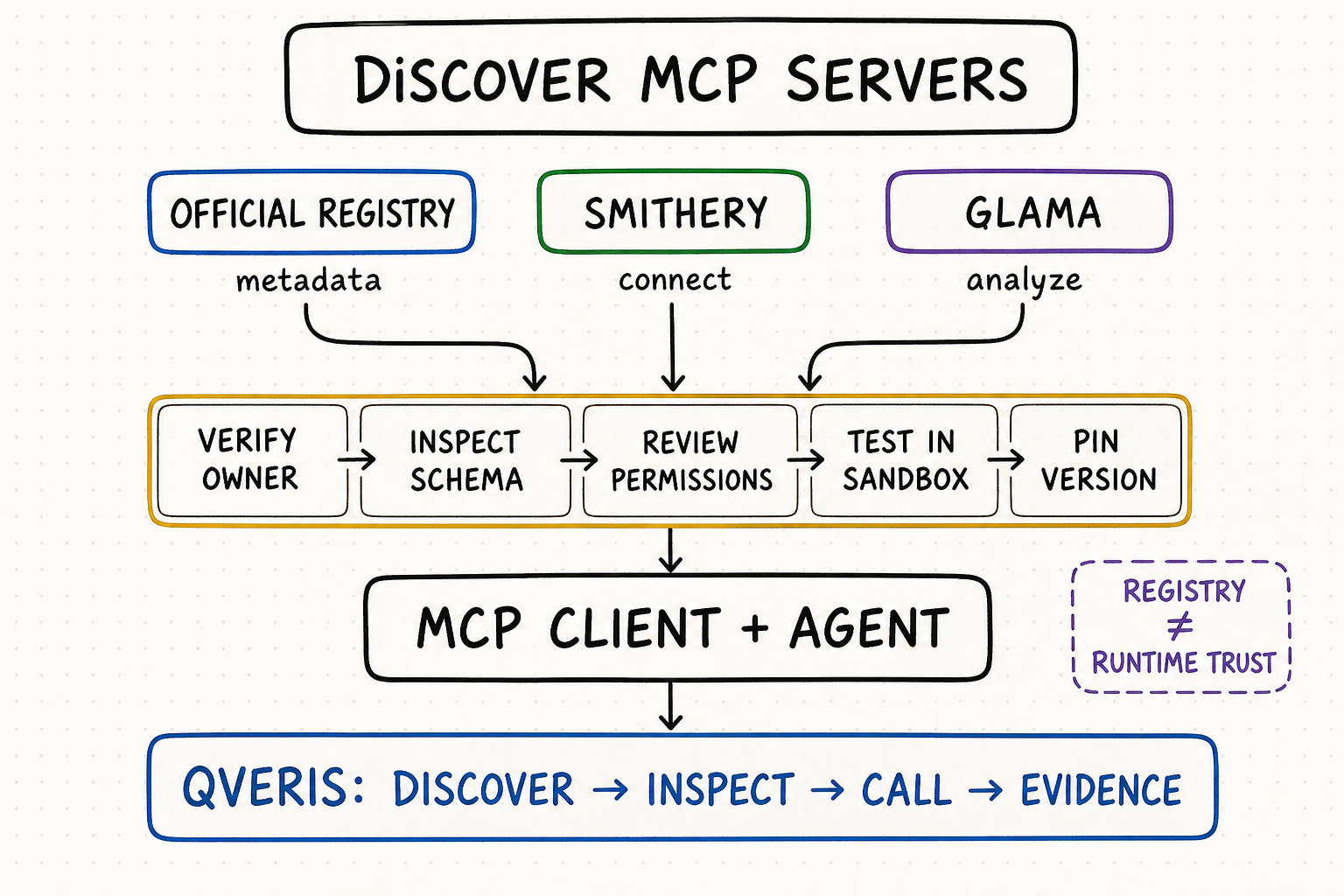
Decision brief
TL;DR
It standardizes public server identity, versions, packages, transports, and installation metadata. It is intentionally unopinionated and designed mainly for downstream aggregators.
Smithery combines registry search and publishing with connection lifecycle, OAuth, credential storage, scoped tokens, CLI workflows, and runtime tool calls.
Glama layers builds, live introspection, behavioral observation, quality scoring, freshness, and schema or behavior change history on top of registry metadata.
QVeris is not the official MCP metadata registry. It exposes Discover, Inspect, Probe, Call, usage audit, and credit-ledger workflows across callable capabilities.
它统一公开 Server 的身份、版本、包、Transport 与安装信息,保持中立,主要供下游聚合器消费。
Smithery 把搜索、发布与连接生命周期、OAuth、凭证存储、作用域 Token、CLI 和运行时调用结合起来。
Glama 在 Registry 元数据之上补充构建、实际探测、行为观察、质量评分、数据新鲜度以及 Schema/行为变更历史。
QVeris 不是官方 MCP 元数据注册表,而是通过 Discover、Inspect、Probe、Call、用量审计和积分账本组织可调用能力。
Who this MCP registry comparison is for这份 MCP Registry 对比适合谁
This guide is for developers choosing where to discover MCP servers, platform teams building an internal catalog, server authors choosing distribution channels, and security teams deciding what evidence is required before a server reaches production.
这份指南适合选择 MCP Server 发现渠道的开发者、建设内部目录的平台团队、选择分发渠道的 Server 作者,以及决定 Server 进入生产前需要哪些证据的安全团队。
Registry vs directory vs marketplace vs runtimeRegistry、Directory、Marketplace 与 Runtime 的区别
Most bad comparisons begin by treating four different jobs as interchangeable. A registry is a machine-readable metadata system. A directory is a browsing experience. A marketplace adds distribution or commercial workflows. A managed connection layer handles credentials and sessions. A runtime capability layer helps an agent inspect and execute tools.
多数错误对比都源于把不同工作混为一谈:Registry 是机器可读元数据系统;Directory 提供人工浏览;Marketplace 增加分发或商业流程;托管连接层处理凭证与会话;运行时能力层帮助 Agent 检查并执行工具。
| Layer层级 | Primary question核心问题 | Typical output典型输出 | Does not prove不能证明 |
|---|---|---|---|
| Registry | What public servers and versions exist?有哪些公开 Server 与版本? | Structured server metadata结构化 Server 元数据 | Runtime safety运行时安全 |
| Directory | What can a person browse?用户能浏览哪些内容? | Search results and listing pages搜索结果与详情页 | Machine-ready installation可机器执行的安装 |
| Marketplace | How is a server distributed or connected?Server 如何分发或连接? | Publishing, install, OAuth, hosting发布、安装、OAuth、托管 | Business fitness for your workflow是否适合你的业务 |
| Runtime layer | Which capability should the agent call now?Agent 现在应该调用哪个能力? | Inspected schema, execution, evidenceSchema、执行结果与证据 | That every upstream source is trustworthy所有上游来源都可信 |
Official MCP Registry vs Smithery vs Glama vs QVerisOfficial MCP Registry、Smithery、Glama 与 QVeris 对比
| Capability能力 | Official Registry | Smithery | Glama | QVeris |
|---|---|---|---|---|
| Primary role主要角色 | Canonical public metadata官方公开元数据 | Discovery, publishing, connection发现、发布、连接 | Enriched registry and analysis增强 Registry 与分析 | Capability discovery and execution能力发现与执行 |
| Search/API搜索/API | Read-only REST API只读 REST API | Full-text/semantic search and API全文/语义搜索与 API | Public enriched registry API公开增强 Registry API | Natural-language capability discovery自然语言能力发现 |
| Publisher identity发布者身份 | Namespace ownership verificationNamespace 所有权验证 | Publisher and listing metadata发布者与列表元数据 | Maintainer verification plus analysis维护者验证加分析 | Provider/tool identity in capability catalog能力目录中的供应商/工具身份 |
| Code/behavior analysis代码/行为分析 | Delegated downstream交由下游 | Connection and usage tooling连接与使用工具 | Build, inspect, observe, score, track drift构建、探测、观察、评分、漂移记录 | Inspect parameters, examples, stats; probe before call检查参数、示例、统计;调用前 Probe |
| OAuth / credentials | No managed connection layer不提供托管连接层 | Managed OAuth, credentials, scoped tokens托管 OAuth、凭证与作用域 Token | Depends on connector/runtime path取决于 Connector/Runtime 路径 | QVeris key and provider-side execution boundaryQVeris Key 与服务商执行边界 |
| Runtime call运行时调用 | No否 | Yes, through managed connections是,通过托管连接 | Connector-dependent取决于 Connector | Yes, through Call after discovery/inspection是,发现/检查后通过 Call 执行 |
| Best fit适合场景 | Aggregators and public metadata ingestion聚合器与公开元数据同步 | Connect and operate MCP integrations连接和运行 MCP 集成 | Compare quality and monitor change比较质量并监控变化 | Route agent tasks to callable capabilities把 Agent 任务路由到可调用能力 |
Important: a check mark in one layer is not a substitute for another. Metadata authenticity, code scanning, permission review, successful connection, and safe runtime behavior are separate controls.
重要:某一层通过检查不能替代其他层。元数据真实性、代码扫描、权限审查、连接成功和安全运行行为,是彼此独立的控制项。
The four platforms, without false equivalence四个平台的真实边界
The official registry is currently in preview. It accepts metadata for publicly accessible servers, verifies namespace ownership, standardizes server.json, and exposes a read-only REST API. It does not host packages, support private servers, or claim to security-scan all server code.
Smithery supports server search, publishing, CLI installation, managed connections, OAuth state, write-only credential storage, scoped service tokens, tool listing, and tool calls. It is useful when connection operations matter as much as discovery.
Glama describes itself as a superset of the official registry. Its methodology adds schema capture, tool-quality scoring, sandbox or scheduled behavioral observation, change history, and last-scanned timestamps.
QVeris exposes six canonical MCP tools: Discover, Inspect, Probe, Call, Usage History, and Credits Ledger. It helps agents move from an intent to an inspected, quoted, executed, and auditable capability; it is not a replacement for the official registry metadata standard.
官方 Registry 目前仍处于 Preview。它接收公开 Server 元数据、验证 Namespace 所有权、统一 server.json,并提供只读 REST API;它不托管软件包、不支持私有 Server,也不宣称扫描所有 Server 代码。
Smithery 支持 Server 搜索、发布、CLI 安装、托管连接、OAuth 状态、只写凭证存储、作用域 Service Token、工具列表和工具调用,适合连接运维与发现同样重要的场景。
Glama 将自己定位为官方 Registry 的超集,其方法增加 Schema 捕获、工具质量评分、沙箱或定期行为观察、变更历史与最近扫描时间。
QVeris 提供六个标准 MCP 工具:Discover、Inspect、Probe、Call、Usage History 和 Credits Ledger,帮助 Agent 从意图走向已检查、已报价、已执行且可审计的能力,但不替代官方 Registry 元数据标准。
Production workflow: discover, verify, then connect生产流程:先发现和验证,再连接
A registry result is a candidate, not an approval. Put every server through the same gated workflow before exposing its tools to an agent.
Registry 结果只是候选项,不是批准结论。在把工具暴露给 Agent 前,每个 Server 都应通过同一套门控流程。
Search by task, protocol transport, language, package type, deployment model, and authentication requirements. Keep the raw listing URL and registry source.
Confirm namespace ownership, repository identity, release tags, package publisher, remote endpoint domain, license, and maintenance activity.
Connect in an isolated environment and record tools/list. Compare names, descriptions, input schemas, annotations, and permissions with the registry listing.
Test invalid arguments, oversized output, timeouts, authentication expiry, prompt injection inside tool output, duplicate calls, and attempts to reach resources outside the expected scope.
Pin a version or immutable artifact, keep an allowlist, capture a schema hash, and alert when package, endpoint, tool list, permissions, or behavior changes.
按任务、Transport、语言、包类型、部署方式和鉴权要求搜索,并保存原始列表 URL 与 Registry 来源。
核对 Namespace、代码仓库、Release Tag、软件包发布者、远程 Endpoint 域名、许可证和维护活跃度。
在隔离环境连接并记录 tools/list,把名称、描述、输入 Schema、Annotation 和权限与 Registry 列表逐项比较。
覆盖非法参数、超大输出、超时、鉴权过期、工具结果中的 Prompt Injection、重复调用和越权资源访问。
固定版本或不可变 Artifact,维护 Allowlist,保存 Schema Hash,并在软件包、Endpoint、工具列表、权限或行为变化时告警。
Hands-on registry and connection examplesRegistry 与连接实操示例
Use APIs for inventory and synchronization, then use a client or managed connection layer for runtime verification. Never execute a newly discovered server directly in a privileged production environment.
API 适合资产清单和同步;运行时验证应使用客户端或托管连接层。不要把刚发现的 Server 直接放入高权限生产环境执行。
curl "https://registry.modelcontextprotocol.io/v0.1/servers?limit=100"curl "https://registry.modelcontextprotocol.io/v0.1/servers?updated_since=2026-07-01T00:00:00.000Z"smithery mcp search "github issues"
smithery mcp add github --id team-github
smithery tool list team-github
smithery tool call team-github search_repositories '{"query":"mcp"}'qveris discover "SEC filing retrieval with source URLs"
qveris inspect 1
qveris probe 1 --params '{"ticker":"NVDA","form_type":"10-K"}'
qveris call 1 --params '{"ticker":"NVDA","form_type":"10-K"}'What to verify before trusting an MCP server信任 MCP Server 前应该验证什么
Security: registry verification is not runtime trust安全:Registry 验证不等于运行时可信
The official registry verifies that a publisher controls a namespace; its documentation explicitly delegates code scanning to package registries and downstream aggregators. That is valuable identity evidence, but it does not prove that the code is vulnerability-free, the requested permissions are appropriate, the remote endpoint is unchanged, or every tool result is safe for an LLM.
官方 Registry 验证发布者是否控制 Namespace,并明确把代码扫描交给软件包 Registry 与下游聚合器。这是有价值的身份依据,但不能证明代码没有漏洞、权限合理、远程 Endpoint 未改变,或每条工具结果都能安全交给 LLM。
- Run untrusted local servers in an isolated user, container, or sandbox with minimal filesystem and network access.
- Use separate credentials per server, environment, user, and tenant; avoid broad shared tokens.
- Do not rely on tool descriptions as policy. Enforce authorization outside the model.
- Treat tool output as untrusted content and preserve its source boundary to reduce indirect prompt injection risk.
- Require human approval for destructive, financial, administrative, or externally visible actions.
- Re-verify after every version, endpoint, dependency, schema, or permission change.
- 用隔离用户、容器或沙箱运行不可信本地 Server,并把文件系统和网络权限降到最低。
- 按 Server、环境、用户和租户分离凭证,避免共享高权限 Token。
- 不要把工具描述当作安全策略;授权必须在模型外强制执行。
- 把工具输出视为不可信内容并保留来源边界,降低间接 Prompt Injection 风险。
- 破坏性、金融、管理或对外可见动作必须要求人工批准。
- 版本、Endpoint、依赖、Schema 或权限变化后重新验证。
Common MCP registry failure modes常见 MCP Registry 失败模式
| Symptom现象 | Root cause根因 | Production fix生产修复 |
|---|---|---|
| Listing exists, install fails有列表但安装失败 | Stale package, missing runtime, unsupported transport软件包过期、Runtime 缺失、Transport 不支持 | Resolve the exact artifact and test install in CI解析精确 Artifact 并在 CI 测试安装 |
| Tools appear, calls fail能看到工具但调用失败 | Missing config, expired OAuth, bad scope, schema drift配置缺失、OAuth 过期、Scope 错误、Schema 漂移 | Model connection states and probe before live calls管理连接状态并在真实调用前 Probe |
| “Verified” server causes unsafe action“已验证” Server 执行危险动作 | Ownership verification mistaken for authorization把所有权验证误当成授权 | Apply allowlists, least privilege, policy, and approval使用 Allowlist、最小权限、策略和审批 |
| Private server is missing找不到私有 Server | Official public registry does not support private servers官方公开 Registry 不支持私有 Server | Maintain a private registry or internal overlay建设私有 Registry 或内部覆盖层 |
| Agent context becomes hugeAgent Context 过大 | Every discovered tool schema injected at once一次注入所有候选工具 Schema | Search by intent, shortlist, inspect, then expose only selected tools按意图搜索、缩小候选、检查后只暴露选中工具 |
Which MCP platform should you choose?应该选择哪个 MCP 平台?
Start with the Official MCP Registry REST API, persist the data, follow cursor pagination and status changes, then add your own enrichment.
Evaluate Smithery when OAuth, credential storage, namespaces, service tokens, CLI setup, and runtime calls are central requirements.
Evaluate Glama when schema capture, behavioral observation, tool-quality scoring, and historical drift matter to selection.
Evaluate QVeris when an agent must discover by intent, inspect candidates, probe parameters and price, call, then audit usage and settlement.
Build or buy a private registry overlay with an allowlist, approval state, schema hash, owner, evidence, environment, and expiration.
Use multiple layers: official metadata ingestion, enriched discovery, private approval, isolated runtime, and centralized audit.
从 Official MCP Registry REST API 开始,持久化数据,处理游标分页和状态变化,再增加自己的增强数据。
如果 OAuth、凭证存储、Namespace、Service Token、CLI 配置和运行时调用是重点,评估 Smithery。
如果 Schema 捕获、行为观察、工具质量评分和历史漂移很重要,评估 Glama。
如果 Agent 需要按意图发现、检查候选、Probe 参数和报价、执行调用并审计用量与结算,评估 QVeris。
建设或采购带 Allowlist、审批状态、Schema Hash、Owner、证据、环境和过期时间的私有覆盖层。
组合多层:官方元数据同步、增强发现、私有审批、隔离运行时与集中审计。
Migration and adoption checklist迁移与采用清单
- Inventory every server, version, package, transport, endpoint, tool, owner, and credential.
- Separate discovery metadata from approval state and runtime connection state.
- Map provider-specific listing fields into one internal server record; preserve raw metadata for audit.
- Re-run
tools/listand compare schema hashes before moving traffic. - Move read-only, low-risk tools first; keep write and privileged tools behind explicit approval.
- Canary a small user group and measure connection success, call success, latency, error class, and schema drift.
- Keep rollback instructions and old connections until audit evidence confirms the new path.
- 盘点每个 Server、版本、软件包、Transport、Endpoint、工具、Owner 和凭证。
- 把发现元数据、审批状态和运行时连接状态分开存储。
- 把平台私有字段映射到统一 Server 记录,并保留原始元数据用于审计。
- 迁移流量前重新运行
tools/list并比较 Schema Hash。 - 先迁移只读、低风险工具;写操作和高权限工具继续要求明确审批。
- 先对小用户群灰度,测量连接成功率、调用成功率、延迟、错误类型和 Schema 漂移。
- 保留回滚说明和旧连接,直到审计证据确认新路径稳定。
QVeris implementation pattern: Discover → Inspect → Probe → CallQVeris 实现模式:Discover → Inspect → Probe → Call
Use QVeris after the user intent is known but before the final capability is executed. Discover returns candidates; Inspect exposes parameters, examples, success rate, latency, and price information where available; Probe validates parameters and quotes without execution; Call runs the selected capability. Usage History and Credits Ledger provide operational and settlement follow-up.
在用户意图已经明确、最终能力尚未执行时使用 QVeris:Discover 返回候选;Inspect 查看参数、示例以及可用的成功率、延迟和价格信息;Probe 在不执行的情况下校验参数和报价;Call 执行选定能力;Usage History 与 Credits Ledger 提供运维和结算追踪。
Boundary: keep registry evidence and runtime evidence separate. A discovery result explains why a candidate was selected; an execution record explains what actually ran, when, with which inputs, and what it returned.
边界:Registry 证据与 Runtime 证据应分开。发现结果解释为什么选择该候选项;执行记录解释实际运行了什么、何时运行、输入是什么以及返回了什么。
Continue with the MCP Registry guide, the MCP Server Directory guide, the MCP Tool Discovery guide, or the QVeris MCP documentation.
继续阅读 MCP Registry 指南、MCP Server Directory 指南、MCP 工具发现指南或 QVeris MCP 文档。
FAQ
It is the official centralized metadata repository for publicly accessible MCP servers, with standardized metadata and a read-only discovery API.
No. A registry provides structured metadata and APIs; a directory focuses on browsing. Marketplaces and connection platforms add more operational features.
No. It verifies namespaces and hosts metadata, while package registries and downstream aggregators may add code or security scanning.
Smithery emphasizes discovery, publishing, connections, OAuth, credentials, and calls. Glama emphasizes enrichment, introspection, behavior, scoring, and change history.
No. Verify what the label covers. Publisher ownership, code security, permission fitness, and runtime behavior are different claims.
Yes. A common architecture uses official metadata, an enriched downstream source, and a private production allowlist.
QVeris is a capability routing layer with Discover, Inspect, Probe, Call, usage audit, and credit-ledger workflows—not the official metadata registry.
Choose by the job you need: metadata ingestion, human discovery, managed authentication, server analysis, private governance, or runtime capability routing.
它是公开 MCP Server 的官方集中式元数据仓库,提供标准元数据与只读发现 API。
不一样。Registry 提供结构化元数据和 API;Directory 侧重人工浏览;Marketplace 与连接平台还会增加运维能力。
不会。它验证 Namespace 并托管元数据;代码或安全扫描由软件包 Registry 和下游聚合器补充。
Smithery 更重视发现、发布、连接、OAuth、凭证和调用;Glama 更重视增强、探测、行为、评分和变更历史。
不代表。发布者身份、代码安全、权限合理性和运行时行为是不同的证明。
可以。常见架构组合官方元数据、增强型下游来源与私有生产 Allowlist。
QVeris 是包含 Discover、Inspect、Probe、Call、用量审计和积分账本的能力路由层,不是官方元数据 Registry。
根据实际任务选择:元数据同步、人工发现、托管鉴权、Server 分析、私有治理或运行时能力路由。