
QVeris

QVeris MCP Server Tester

Capability Routing Network for AI Agents

💡 This is a demo. Connect MCP servers via CLI for full testing.
Install CLI: npx @qverisai/mcp 📋
Testing connection...
📊 Test Results
TEST HISTORY
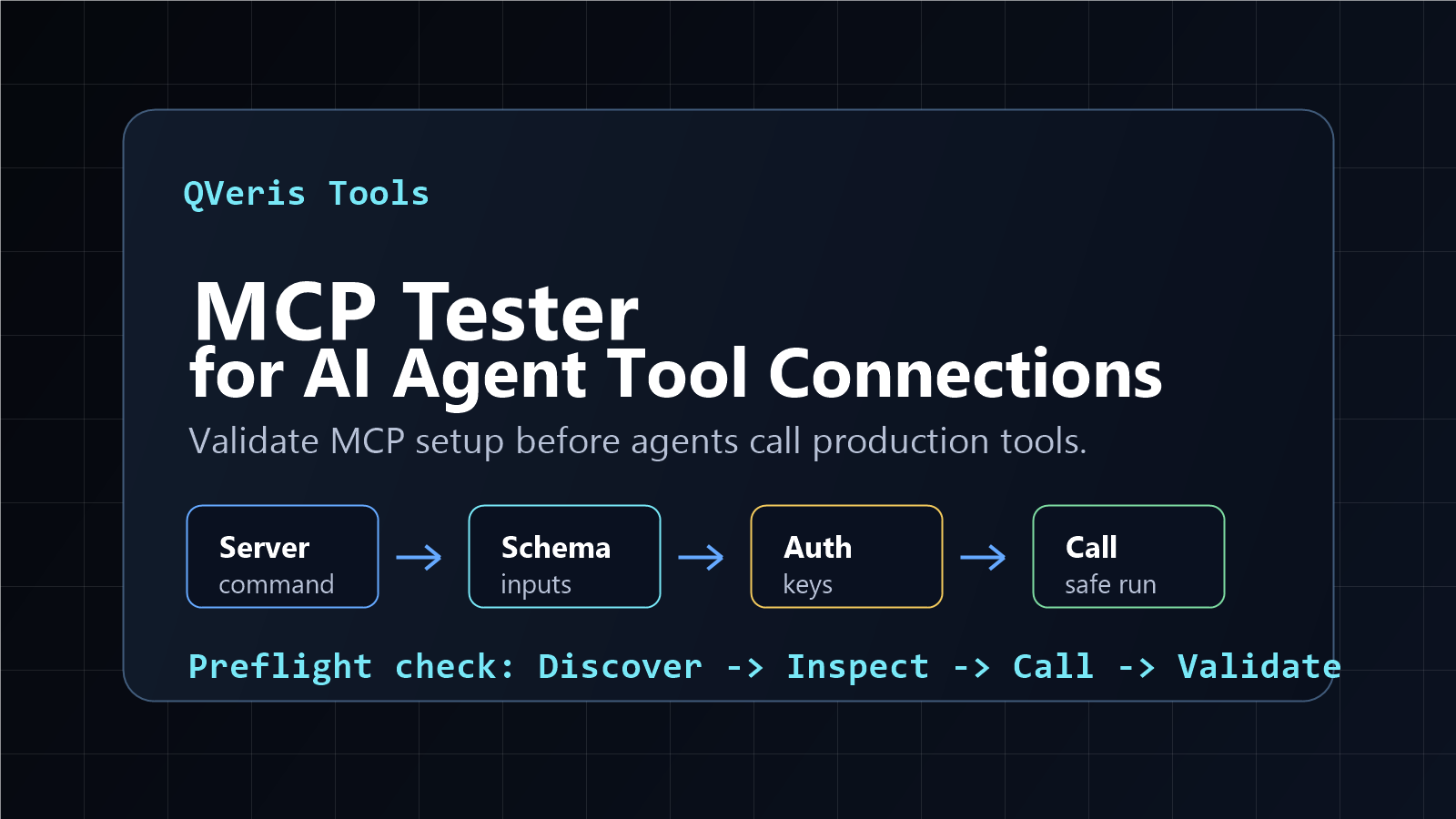
MCP server preflight testing workflow

Test the MCP contract before an agent touches production

A green connection light is only the first checkpoint. A production-ready MCP integration must prove that the client can discover the intended tools, understand their schemas, supply authorized arguments, interpret structured results, and fail safely when the server or upstream provider is unavailable.

🔌

Connection and initialization

Verify the transport, server command or endpoint, protocol version, environment variables, authentication, and initialization response. Record startup time and distinguish a server failure from a provider failure behind the server.

🧭

Tool discovery

Inspect tool names, descriptions, input schemas, required fields, enums, defaults, and output shapes. Descriptions should be specific enough for an agent to choose the correct capability without guessing between near-duplicates.

🧾

Safe sample call

Begin with a read-only, low-impact request. Confirm that entity identifiers, time ranges, units, and destinations remain unchanged and that secrets never appear in logs, model context, or user-facing output.

🧯

Failure interpretation

Exercise invalid arguments, missing credentials, rate limits, timeouts, malformed provider data, and unavailable tools. The client should know when to retry, clarify, choose an approved fallback, or stop.

Evidence a useful test report should retain

  • Server identity and version, transport, initialization result, discovered tool count, and schema snapshot.
  • Exact test arguments with secrets redacted, response status, latency, source timestamp, and validation outcome.
  • Permission scope, side-effect classification, approval requirement, retry policy, and fallback decision.
  • A reproducible failure trace that separates MCP protocol errors from upstream API or data-quality errors.

Production gate: do not approve a server because discovery succeeds once. Save a known-good contract, rerun it after server or provider changes, and require human review for tools with external side effects.

在 Agent 接触生产环境前验证 MCP 契约

连接成功只是第一道检查。可用于生产的 MCP 集成还必须证明:客户端能发现正确工具、理解 Schema、提交经过授权的参数、解释结构化结果,并在服务端或上游数据源不可用时安全失败。

🔌

连接与初始化

核对传输方式、服务端命令或地址、协议版本、环境变量、认证和初始化响应,并记录启动耗时,区分 MCP 服务自身故障与其后方服务商故障。

🧭

工具发现

检查工具名称、描述、输入 Schema、必填字段、枚举值、默认值和输出结构。描述必须足够具体,避免 Agent 在近似能力之间依靠猜测做选择。

🧾

安全样例调用

先用只读、低影响请求测试,确认实体标识、时间范围、单位和目标位置未被改变,同时保证密钥不会进入日志、模型上下文或用户可见结果。

🧯

解释失败

主动测试无效参数、凭证缺失、限流、超时、上游数据异常和工具不可用,确保客户端知道何时重试、追问、使用已批准的回退方案或停止执行。

测试报告应保留的证据

  • 服务端身份与版本、传输方式、初始化结果、发现的工具数量和 Schema 快照。
  • 脱敏后的完整测试参数、响应状态、延迟、来源时间和字段校验结果。
  • 权限范围、副作用分级、审批要求、重试规则和回退决策。
  • 可复现的失败链路,并明确区分 MCP 协议错误与上游 API 或数据质量错误。

生产准入原则:不能因为一次发现成功就批准服务。应保存已验证契约,在服务端或供应商变更后重新测试;任何具有外部副作用的工具都应保留人工复核。