
NanoGPT Alternatives
From Personal Access to Production
NanoGPT 替代方案:从个人访问走向生产
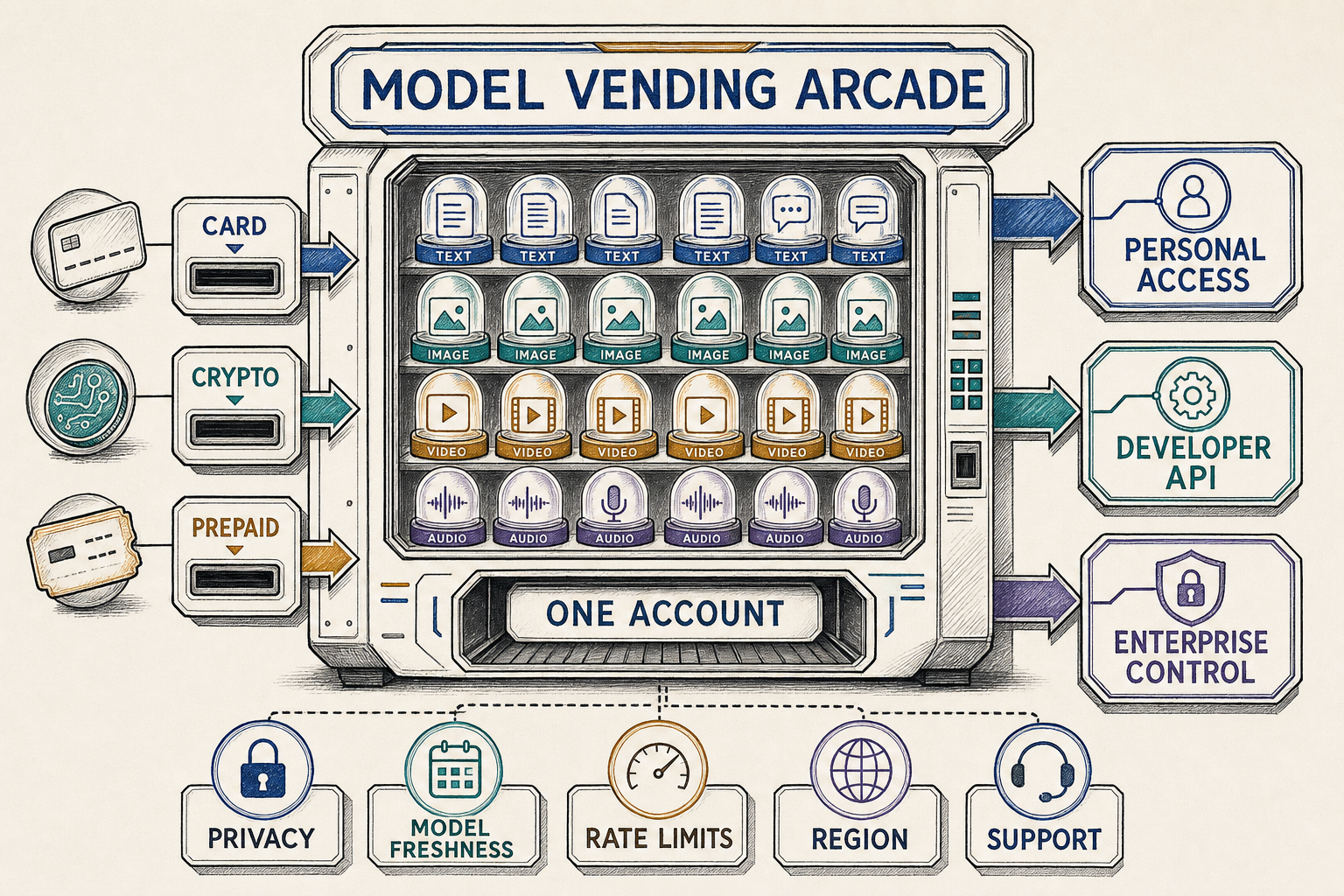
One account can simplify access to many text, image, video, and audio models. Production selection still requires evidence for model freshness, key custody, data paths, limits, support, and recovery.
一个账户能简化文本、图像、视频和音频模型访问,但生产选型仍需证明模型新鲜度、密钥托管、数据路径、限额、支持与恢复能力。
TL;DR
Its current API documentation exposes text plus separate image, video, and audio model listings behind a single service.
Flexible signup and payment can be useful, but teams still need contractual, security, data, audit, and support evidence.
Verify the exact model ID, version, provider path, parameter coverage, price, limits, and retirement policy your workload needs.
It complements model access when an agent must discover and call real data sources, APIs, and tools.
其当前 API 文档在同一服务下提供文本模型,以及独立的图像、视频与音频模型列表。
灵活注册与支付很有价值,但团队仍需合同、安全、数据、审计与支持证据。
验证工作负载需要的精确模型 ID、版本、供应商路径、参数、价格、限额与下线策略。
当智能体必须发现并调用真实数据源、API 与工具时,它与模型访问层互补。
Where NanoGPT's access model is strongest NanoGPT 访问模式最适合什么场景
NanoGPT is most compelling when an individual developer or small team wants to test many models without creating many provider accounts, and values prepaid or alternative payment methods. The same design can also power an application through an OpenAI-style API. The fit weakens when procurement demands direct provider contracts, guaranteed regional processing, private networking, detailed enterprise identity, formal support, or negotiated capacity.
当个人开发者或小团队希望无需创建多家供应商账户即可测试大量模型,并重视预付或其他支付方式时,NanoGPT 的吸引力最强;同一模式也可通过 OpenAI 风格 API 支撑应用。当采购要求直接供应商合同、明确区域处理、私网、详细企业身份、正式支持或协商容量时,适配度会下降。
Prioritize catalog breadth, payment accessibility, privacy expectations, and a fast path from web chat to API.
Prioritize SDK compatibility, stable model IDs, parameter fidelity, rate limits, error semantics, and exportable usage.
Prioritize identity, key custody, regions, retention, audit, support, capacity, incident communication, and exit rights.
优先目录广度、支付可达性、隐私预期,以及从网页聊天到 API 的快速路径。
优先 SDK 兼容、稳定模型 ID、参数保真、限流、错误语义与可导出用量。
优先身份、密钥托管、区域、保留、审计、支持、容量、事故沟通与退出权。
Eight alternatives by access and control model 按访问与控制模式划分的 8 个替代方案
| Option 选项 | Strongest fit 最强适配 | Validate first 优先验证 |
|---|---|---|
| OpenRouter | Broad LLM access and provider routing 广泛 LLM 访问与供应商路由 | Multimodal breadth and procurement terms 多模态广度与采购条款 |
| ZenMux | Unified LLM access with several native protocols 通过多种原生协议统一访问 LLM | Regional, commercial, and support requirements 区域、商业与支持要求 |
| APIpie | OpenAI-style multi-model aggregation OpenAI 风格多模型聚合 | Current documentation and feature depth 当前文档与功能深度 |
| AIMLAPI | Broad text, image, video, voice, music, and 3D catalog 广泛文本、图像、视频、语音、音乐与 3D 目录 | Model-native parity and data paths 模型原生一致性与数据路径 |
| WaveSpeedAI | Large generative media catalog and asynchronous jobs 大型生成媒体目录与异步任务 | LLM governance and specialist parameters LLM 治理与专用参数 |
| Replicate | Versioned hosted open models 版本化托管开源模型 | Cold starts and hardware economics 冷启动与硬件经济性 |
| Direct provider APIs | Native features, contracts, and regional control 原生功能、合同与区域控制 | Integration and reliability duplication 集成与可靠性重复 |
| Self-hosted open models | Maximum infrastructure and data control 最大基础设施与数据控制 | Capacity, upgrades, security, and operator cost 容量、升级、安全与运维成本 |
A due-diligence ladder for low-friction access 低门槛访问的尽调阶梯
Who is the contracting entity, how funds are held, which payment methods are reversible, and what happens to unused balance?
Which upstream actually serves each model, in which region, under which retention and training terms, and through how many processors?
What limits apply, how failures and retries are charged, whether alternate upstreams exist, and how incidents are communicated?
Can you export usage, costs, request IDs, model versions, and invoices, then migrate without losing prepaid funds or history?
签约主体是谁、资金如何保管、哪些支付方式可撤销、未使用余额如何处理?
每个模型实际由哪个上游、在哪个区域、按何种保留与训练条款、经过多少处理方?
有哪些限额、故障与重试如何计费、是否有替代上游、事故如何沟通?
能否导出用量、成本、请求 ID、模型版本与账单,并在不损失余额或历史的情况下迁移?
Prove the API with production-shaped requests 用接近生产的请求验证 API
- List models programmatically and snapshot exact IDs, capabilities, prices, and generated time.
- Test streaming, structured output, tool calls, image input, large files, asynchronous media jobs, and cancellation.
- Force 401, 429, provider 5xx, malformed output, timeout, and partial stream failures; reconcile billed units.
- Rotate a key, set a low budget, export usage, and reproduce one request from its trace and upstream model version.
- 通过 API 列出模型,并快照精确 ID、能力、价格与生成时间。
- 测试流式、结构化输出、工具调用、图像输入、大文件、异步媒体任务与取消。
- 主动触发 401、429、供应商 5xx、异常输出、超时与部分流式失败,并核对计费单位。
- 轮换密钥、设置低预算、导出用量,并从调用链和上游模型版本复现一次请求。
Keep the aggregator replaceable 让聚合器保持可替换
Store internal model aliases separately from vendor IDs. Put normalized requests behind a small adapter and expose provider-native features explicitly. Log the requested alias, resolved model and upstream, capability version, price snapshot, request ID, and billed units. Maintain a direct-provider escape path for critical workloads and dual-run it before a platform change.
将内部模型别名与供应商 ID 分开保存;把标准化请求放在小型适配器后面,并显式暴露供应商原生功能。记录请求别名、解析后的模型与上游、能力版本、价格快照、请求 ID 和计费单位。关键工作负载保留直接供应商逃生路径,并在平台切换前双轨运行。
Add governed capabilities beyond model access 在模型访问之外加入受治理能力
NanoGPT or another aggregator gives an application model inference and generation. QVeris gives an agent discoverable, auditable access to external data, APIs, and tools. Use shared identity and trace context to connect the generated decision with the action it triggers.
NanoGPT 或其他聚合器向应用提供模型推理与生成;QVeris 向智能体提供可发现、可审计的外部数据、API 与工具。使用共享身份与调用链上下文连接生成的决策和它触发的动作。
A Production Evaluation Plan for NanoGPT alternativesNanoGPT 替代方案的生产评估方案
A feature table can identify candidates, but it cannot prove operational fit. Evaluate NanoGPT alternatives with the workloads, policies, failure conditions, and evidence requirements that the team will actually own after migration.
功能表可以帮助筛选候选方案,却无法证明生产适配性。评估NanoGPT 替代方案时,应使用团队迁移后真正需要承担的工作负载、策略、失败条件和证据要求。
Inventory representative requests and record model catalog depth, payment and credit model, API compatibility, provider transparency, latency, support, and account portability. Include volumes, tail latency, quality thresholds, regulated data, operator steps, monthly spend, and the incidents the current system already knows how to handle.
盘点有代表性的请求,并记录模型目录深度、支付与额度模式、API 兼容性、供应商透明度、延迟、支持和账户可迁移性。同时纳入流量、长尾延迟、质量门槛、受监管数据、人工步骤、月度支出,以及现有系统已经能够处理的事故类型。
To validate NanoGPT Alternatives, replay saved cases against each candidate. Compare accepted parameters, streaming events, structured output, tool calls, error classes, usage accounting, and source metadata. Mark every difference as required, adaptable, or a migration blocker.
验证“NanoGPT 替代方案”时,用保存的案例重放每个候选方案,比较参数、流式事件、结构化输出、工具调用、错误类别、用量计量和来源元数据,并将差异标记为必须保留、可以适配或阻断迁移。
To validate NanoGPT Alternatives, measure end-to-end task completion, output quality, p50 and tail latency, availability, retry amplification, fallback behavior, and accepted-result cost. Include rate limits, malformed responses, regional loss, schema drift, and provider outages.
验证“NanoGPT 替代方案”时,衡量端到端任务完成率、输出质量、常规与长尾延迟、可用性、重试放大、故障切换行为和合格结果成本,并加入限流、畸形响应、区域丢失、Schema 漂移与供应商中断。
Before rolling out NanoGPT Alternatives, version routing and policy outside the vendor, preserve trace identifiers, stage read-only traffic first, define rollback signals, and retain a direct-provider or previous-platform path until evidence meets the acceptance threshold.
上线“NanoGPT 替代方案”前,在供应商之外版本化路由与策略,保留追踪标识,先迁移只读流量,定义回滚信号,并在证据达到验收门槛前保留直连供应商或原平台路径。
FAQ
No. This page concerns the multi-model access service and API at nano-gpt.com, not the educational language-model training repository.
OpenRouter, ZenMux, and APIpie are relevant comparisons. For broad media generation, compare AIMLAPI and WaveSpeedAI.
No. Payment method is only one part of privacy. Verify account data, request logging, upstream processors, regions, retention, and legal terms.
No. It complements model access with governed external capabilities.
不同。本页讨论 nano-gpt.com 的多模型访问服务与 API,不是教育用途的语言模型训练仓库。
OpenRouter、ZenMux 与 APIpie 值得比较;广泛媒体生成可比较 AIMLAPI 与 WaveSpeedAI。
不保证。支付方式只是隐私的一部分,还要验证账户数据、请求日志、上游处理方、区域、保留与法律条款。
不会。它以受治理的外部能力补充模型访问。