
How to Use an Open Financial Data API
in Production如何在生产环境使用
开放金融数据 API
Find credible open sources, verify their rights and provenance, normalize responses, and build a reliable financial data layer.
寻找可信开放数据源,核验许可与来源,统一响应结构,
构建可靠的生产级金融数据层。
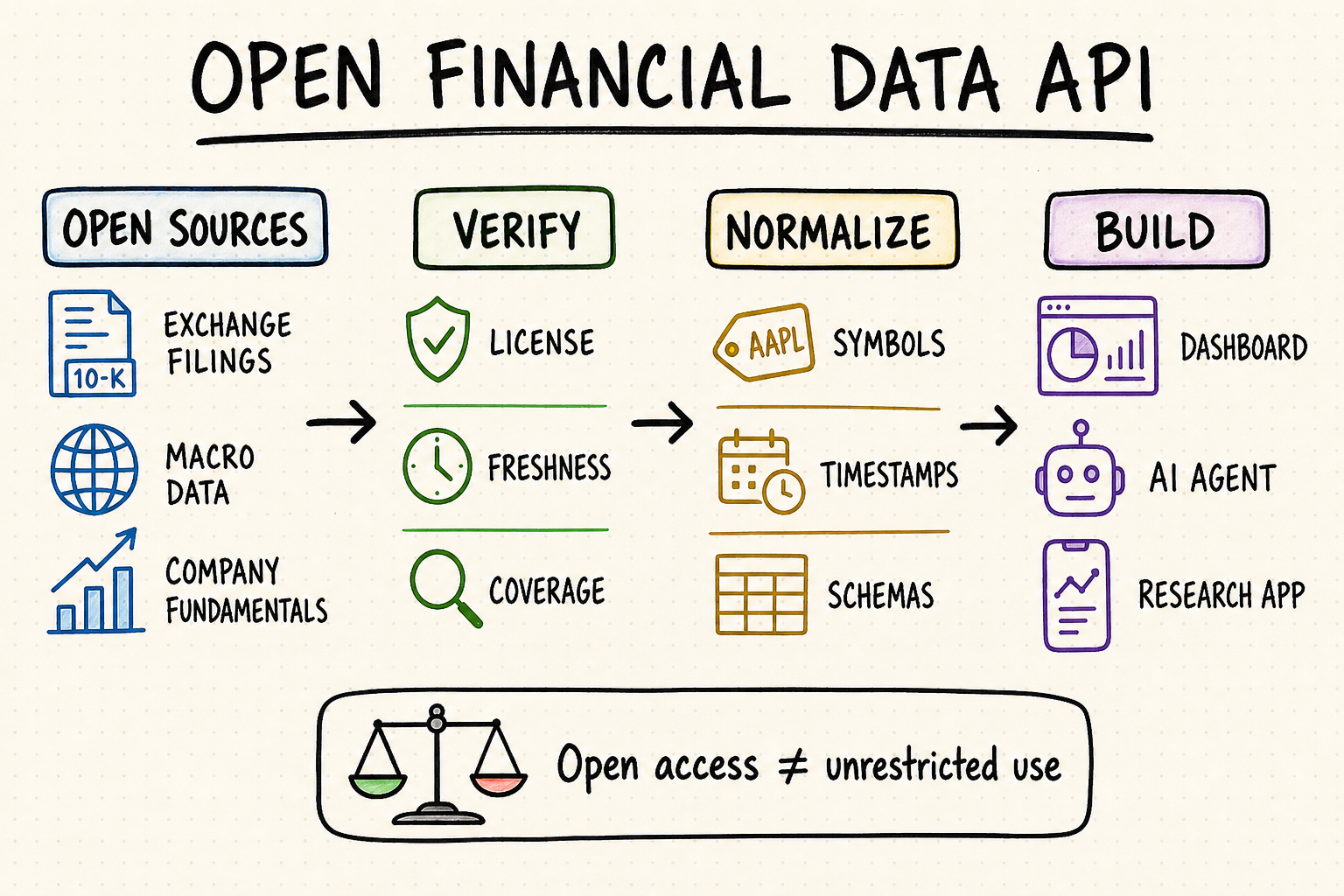
Open financial data API: the short answer开放金融数据 API:先看结论
Public access can still carry attribution, storage, redistribution, commercial-use, or rate-limit conditions.
Prefer APIs that expose upstream provenance, market timestamps, revision policies, and source documentation.
Check timestamps, adjustments, missing values, pagination, errors, and symbol conventions with real requests.
Map provider responses into an internal schema so applications do not inherit unstable vendor conventions.
公开访问仍可能附带署名、存储、再分发、商业使用或速率限制。
优先选择能提供上游来源、市场时间戳、修订政策与来源文档的接口。
用真实请求检查时间戳、复权、缺失值、分页、错误处理和标的代码规范。
将供应商响应映射到内部数据结构,避免产品依赖不稳定的外部字段约定。
What “open” should mean for a financial data API金融数据 API 所说的“开放”究竟是什么
Search results often mix three different ideas: an API that is free to try, an API whose documentation is public, and data released under an open license. They are not interchangeable. Before building, identify which layer is actually open—the interface, the software, the underlying dataset, or only the registration process.
搜索结果常把三件事混在一起:可以免费试用的 API、文档公开的 API,以及采用开放许可的数据。这三者并不等价。接入前要先问清楚,真正开放的是接口、软件、底层数据,还是仅仅开放注册。
| Claim常见说法 | What it really proves实际能证明什么 | What remains unproven仍然需要确认 |
|---|---|---|
| “Free API”“免费 API” | Some requests cost nothing under current limits.在当前额度内,部分请求不收费。 | Commercial rights, redistribution, permanence, bulk access and future pricing.商业使用、再分发、长期可用性、批量访问和未来定价。 |
| “Public API”“公开 API” | Endpoints or documentation are publicly reachable.接口或文档可以公开访问。 | Whether the data is openly licensed or may be stored and republished.数据是否采用开放许可,以及能否存储和再次发布。 |
| “Open data”“开放数据” | A stated license should permit use, reuse and redistribution, subject to limited conditions such as attribution.明确的许可应允许使用、再利用和再分发,通常只附带署名等有限条件。 | API uptime, rate limits, quality, point-in-time history and production support.接口稳定性、访问额度、数据质量、历史时点数据和生产支持。 |
| “Open source API”“开源 API” | Some implementation code is available under a software license.部分实现代码采用开源软件许可。 | Rights to the financial data delivered by that software.通过该软件获得的金融数据是否也拥有相应使用权。 |
The practical test: find a named license or a clear government/public-domain statement, identify the upstream owner, and confirm that your intended storage, display, redistribution, model training, and commercial use are covered. An API key with a zero-dollar price does not answer those questions.
实用判断方法:找到明确的许可证或政府公共领域声明,确认上游权利主体,再逐项核对存储、展示、再分发、模型训练和商业使用是否获准。API Key 价格为零,并不能替代这些判断。
What can an open financial data API cover?开放金融数据 API 可以覆盖什么?
“Financial data” can mean real-time quotes, end-of-day prices, company fundamentals, macroeconomic series, forex rates, crypto markets, options, news, or filings. Start with the exact instruments, geography, frequency, and history your product needs.
“金融数据”可能指实时行情、日线价格、公司基本面、宏观序列、外汇、加密市场、期权、新闻或监管文件。选型前先明确产品所需的资产、地区、频率和历史跨度。
Verify whether “real time” is truly live or delayed, which exchanges are included, and whether split- and dividend-adjusted series are available.
Check reporting periods, restatements, currency, point-in-time behavior, field definitions, and links back to source documents.
Confirm source venues, timezone and daily cut-off rules, quote conventions, revision policies, and weekend behavior.
Indicators and normalized metrics save time, but inspect their methodology before mixing them into research or decisions.
确认“实时”究竟是实时还是延迟,覆盖哪些交易所,以及是否提供拆股和分红复权序列。
检查报告期间、重述、币种、历史时点数据的准确性、字段定义,以及是否能回溯到原始文件。
确认来源交易场所、时区和日切规则、报价方向、修订政策,以及周末数据行为。
技术指标和标准化指标可以节省时间,但在用于研究或决策前要先检查计算方法。
Authoritative open and public financial data sources值得优先核对的官方开放与公共金融数据源
No official source covers every financial use case. Public agencies tend to be strongest where they are the original publisher—regulatory filings, macroeconomic releases, reference rates or development indicators—while exchange-grade real-time market data usually has separate rights and distribution constraints.
不存在覆盖全部金融场景的官方数据源。公共机构最有优势的通常是其直接发布的数据,例如监管申报、宏观统计、参考汇率或发展指标;交易所级实时行情则往往有单独的数据权利和分发限制。
| Source来源 | Good for适合用途 | Access model访问方式 | Important caveat重要提醒 |
|---|---|---|---|
| SEC EDGAR | US company submissions and structured XBRL facts美国公司申报与结构化 XBRL 财务事实 | No-key JSON endpoints plus nightly bulk archives无需 Key 的 JSON 接口与夜间批量归档 | Facts retain filing, period, unit and taxonomy context; browser-side calls are limited by CORS.使用数据时要保留申报表单、期间、单位和分类标准上下文;浏览器端直接调用还会受到 CORS 限制。 |
| FRED / ALFRED | Economic and financial time series, revisions and vintages经济金融时间序列、修订与历史版本 | Documented API and downloadable series有文档的 API 与序列下载 | Copyright and permitted uses can differ by series because many upstream sources contribute data.FRED 汇集多个上游来源,不同序列的版权与允许用途可能并不相同,不能按整个站点一概而论。 |
| World Bank Indicators | Cross-country development, macro and financial indicators跨国家的发展、宏观与金融指标 | No-key API with JSON, XML and bulk download options无需 Key 的 API,可返回 JSON、XML 或批量下载 | Indicator metadata, units and source notes are part of the dataset and should travel with values.指标元数据、单位和来源说明是数据的一部分,不能只取数值列。 |
| National statistics and central banks国家统计机构与央行 | Official releases, policy rates, balance sheets and national accounts官方统计发布、政策利率、资产负债表与国民账户 | Varies: REST, SDMX, CSV, spreadsheet or catalog APIs形式不一:REST、SDMX、CSV、电子表格或数据目录 API | Calendars, revisions, seasonal adjustment and local licenses differ by publisher.发布时间表、修订、季节调整和当地许可均因发布方而异。 |
For live equities, options, futures, consolidated quotes, or redistribution inside a customer-facing product, treat “open” claims with extra caution. The API operator may not own every underlying exchange right, and a developer plan may permit internal display without permitting onward distribution.
如果目标是实时股票、期权、期货、综合行情,或在面向客户的产品中再次分发数据,就要对“开放”说法格外谨慎。接口运营方未必拥有全部底层交易所权利,开发者套餐允许内部展示,也不一定允许向下游继续分发。
The criteria that separate a demo API from a dependable one区分演示接口与可靠接口的关键标准
| Criterion标准 | What to verify需要确认 | Common free-tier trade-off免费套餐的常见限制 | Test测试方法 |
|---|---|---|---|
| Coverage覆盖 | Assets, exchanges, regions, fields, and history.资产、交易所、地区、字段和历史深度。 | Narrow universe or short history.标的较少或历史较短。 | Query representative and delisted symbols.查询代表性标的和退市标的。 |
| Freshness时效性 | Timestamps, delays, update schedule, and revisions.时间戳、延迟、更新计划和修订规则。 | Delayed or end-of-day data.延迟或仅日终数据。 | Compare several updates with a primary source.将多次更新结果与第一手来源进行对比。 |
| Limits限额 | Per-minute, daily, concurrent, and endpoint quotas.分钟、每日、并发和单接口配额。 | Low burst capacity or hard daily caps.突发容量低或每日硬上限。 | Exercise 429 responses and retry headers.触发 429 并检查重试响应头。 |
| Rights许可与权利 | Commercial use, storage, attribution, and redistribution.商业使用、存储、署名和再分发。 | Personal or non-commercial use only.仅限个人或非商业用途。 | Read both API terms and upstream data rights.同时阅读接口条款与上游数据权利。 |
The API terms govern access to the service; source notes may govern individual series or fields. Keep both records in the review rather than assuming the platform’s general terms override an upstream owner.
Ask whether a past query returns what is known now or what was known then. Revisions, restatements and symbol changes can make a clean-looking history unsuitable for backtesting.
Count expected records across pages, test the final cursor, and compare a bulk archive with API totals. Silent truncation is more dangerous than an explicit error.
API 条款约束的是服务访问,具体序列或字段还可能受上游来源说明约束。审核时两者都要保留,不能默认平台通用条款覆盖上游权利。
要确认历史查询返回的是“今天看到的历史”,还是“当时实际可见的数据”。修订、重述和证券代码变更都可能让表面整洁的序列不适合回测。
跨页统计预期记录数,测试最后一个游标,并将批量归档总数与 API 结果对账。结果被截断却没有任何报错,往往比明确失败更危险。
A safer integration pattern for open financial data开放金融数据的稳健接入方法
Map provider-specific symbols, timestamps, fields, and errors into an internal model instead of leaking one response shape through the product.
Use different lifetimes for quotes, fundamentals, calendars, and static metadata. Respect terms that restrict storage or redistribution.
Record remaining quota, latency, errors, stale responses, and cache hit rate. Alert before a daily cap becomes a user-visible outage.
Store source, retrieval time, market timestamp, currency, adjustment method, and transformation version with important observations.
把供应商特有的代码、时间戳、字段和错误映射为内部数据模型,避免整个产品依赖某一种外部响应格式。
行情、基本面、交易日历与静态元数据应使用不同缓存周期,并遵守对存储或再分发的限制。
记录剩余配额、延迟、错误、过期响应和缓存命中率,在每日上限影响用户前告警。
为重要数据保留来源、抓取时间、市场时间戳、币种、复权方法和转换版本。
Operate an open financial data API without silent failure让开放金融数据 API 在运行中不悄悄出错
Production reliability is not just uptime. A request can return HTTP 200 while delivering stale data, fewer symbols, a changed unit, or a revised historical series. Monitor semantic health as well as network health.
生产可靠性不只是接口有没有宕机。请求即使返回 HTTP 200,也可能拿到过期数据、缺少部分证券、单位发生变化,或历史序列被修订。因此既要监控网络状态,也要监控数据语义是否正常。
Define the maximum acceptable age for each dataset and compare source timestamps—not only ingestion time—with that threshold.
Track expected entities, dates and fields. Alert on sudden drops, new null clusters, duplicate keys or disappearing history.
Validate types, units and enumerations before publishing. Quarantine unknown fields or values instead of coercing them silently.
Store the reviewed terms, upstream owner, attribution text, allowed uses and review date beside each dataset.
按数据集定义可接受的最大延迟,并用来源时间戳而不是入库时间进行判断。
持续记录预期实体、日期和字段;证券数量骤降、空值集中出现、主键重复或历史消失时应及时告警。
发布前验证类型、单位和枚举值。遇到未知字段或新取值时先隔离,不能在没有记录的情况下强制转换。
为每个数据集保存已审核条款、上游权利主体、署名文本、允许用途和复核日期。
| Failure异常 | Safe response稳妥处理 | Do not不要这样做 |
|---|---|---|
| 429 | Honor Retry-After, back off with jitter, serve a labeled cache when permitted, and reduce concurrency.遵守 Retry-After,采用带随机抖动的退避;条款允许时返回明确标注时间的缓存,并降低并发。 | Retry every request immediately.不要立即高频重试所有请求。 |
| 5xx / timeout | Retry only idempotent reads within a budget, preserve the last valid value, and expose stale status.只在预算内重试幂等读取,保留最近一次有效值,并向下游标记数据已过期。 | Replace missing data with zero.不要把缺失数据填成零。 |
| Schema drift结构漂移 | Fail validation, archive the raw response, compare versions and update the adapter deliberately.让验证失败,归档原始响应,对比版本后再有意识地更新适配层。 | Drop unknown fields without recording them.不要在没有记录的情况下丢弃未知字段。 |
| Stale but successful请求成功但数据过期 | Compare market/release timestamps with the expected calendar and block freshness-sensitive actions.依据市场或发布时间戳和预期日历判断,并阻止依赖时效性的操作。 | Treat HTTP 200 as proof of current data.不要把 HTTP 200 当作数据最新的证明。 |
Use QVeris to discover financial data capabilities用 QVeris 查找金融数据能力
Provider lists go stale and every API describes itself differently. QVeris helps developers and agents discover, inspect, and call relevant capabilities while keeping the evaluation criteria explicit.
供应商列表会过时,不同接口的描述方式也不一致。QVeris 帮助开发者和 Agent 查找、检查并调用相关能力,同时让选型标准保持清晰。
- Search by the capability you need—quotes, fundamentals, forex, macro data, filings, or crypto—not only by a vendor name.
- Inspect inputs, outputs, authentication, and constraints before wiring a capability into an automated workflow.
- Keep provider adapters and provenance in your application even when discovery and calling are streamlined.
- 按行情、基本面、外汇、宏观、监管文件或加密数据等能力搜索,而不只按供应商名称搜索。
- 接入自动化工作流前,先检查输入、输出、鉴权方式和限制条件。
- 即使查找和调用能力的流程得到简化,也应在应用中保留适配层和来源信息。
FAQ常见问题
It exposes market, company, filing, or macro data through documented endpoints with publicly inspectable access and usage terms.
Test representative symbols, timestamps, adjustments, missing values, pagination, error responses, and actual rate-limit behavior.
Yes, when its license, provenance, update policy, coverage, reliability, and operational limits fit the product.
Not always, but a provider-neutral data model makes it much easier to add coverage or recover from limits and outages later.
它通过有文档的接口提供市场、公司、监管文件或宏观数据,其访问与使用条款可公开查阅。
测试代表性标的、时间戳、复权、缺失值、分页、错误响应,以及实际的限流行为。
可以,但许可、来源、更新政策、覆盖范围、可靠性与运行限制必须符合产品要求。
不一定,但与供应商无关的数据模型能让后续扩展覆盖、应对配额变化或服务中断更容易。