
Open Source LLM Gateway:
Best Self-Hosted Options开源 LLM 网关:
最佳自托管方案对比
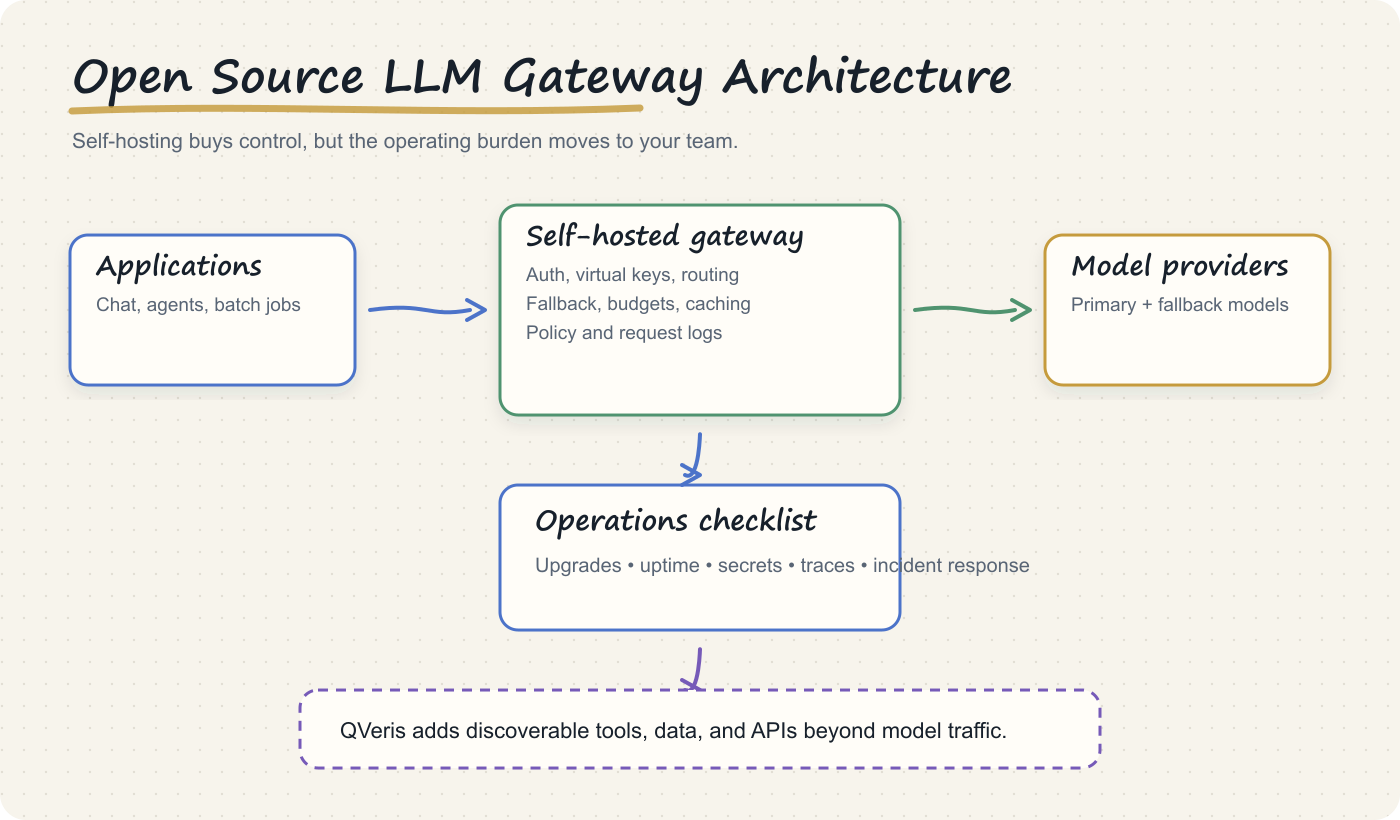
Open-source LLM gateways are attractive because they put routing logic, provider keys, logs, and policy under your control. They also make your team responsible for deployment, scaling, security, upgrades, and incident response.
开源 LLM 网关的吸引力在于:路由逻辑、供应商密钥、日志和策略都掌握在自己手里。但这也意味着部署、扩容、安全、升级和故障响应都由团队自己负责。
TL;DR
LiteLLM is the first open-source gateway many teams should evaluate.
Kong, Envoy, and custom gateway patterns fit teams with platform engineering capacity.
Self-hosting increases control but also increases operational responsibility.
QVeris can sit beside self-hosted gateways to provide agent capabilities without rebuilding every integration.
LiteLLM 是很多团队最应该先评估的开源网关。
Kong、Envoy 和自建网关模式适合有平台工程能力的团队。
自托管提高控制权,也提高运维责任。
QVeris 可以和自托管网关并列,为 Agent 提供能力层,避免每个集成都内部重建。
Guide and search intent正文指南与搜索意图
Teams choose open-source gateways when data residency, compliance, provider policy, credential control, or internal platform standards matter. It is also attractive when the model layer must be deeply integrated with existing infrastructure.
The keyword “open source LLM gateway” sounds free, but the real cost is operating the layer. Someone must own deployment, scaling, version upgrades, provider changes, security patches, incident response, and internal documentation.
LiteLLM is the most direct path for an OpenAI-compatible gateway. Portkey has open-source gateway components. Platform teams may extend Kong, Envoy, or an internal API gateway if they already have that stack.
A self-hosted model gateway does not automatically maintain hundreds of verified tool integrations. If agents need live financial data, web research, internal systems, or specialized APIs, QVeris can provide the capability layer while the model gateway remains self-hosted.
当数据驻留、合规、供应商策略、凭证控制或内部平台标准很重要时,团队会选择开源网关。如果模型层必须深度接入现有基础设施,开源也更有吸引力。
“open source LLM gateway” 听起来像免费,但真正成本是运维。团队必须有人负责部署、扩容、版本升级、供应商变化、安全补丁、故障响应和内部文档。
LiteLLM 是 OpenAI 兼容网关的最直接路径。Portkey 有开源网关组件。平台团队如果已有 Kong、Envoy 或内部 API Gateway,也可以在现有栈上扩展。
自托管模型网关不会自动维护大量可信工具集成。如果 Agent 需要实时金融数据、网页研究、内部系统或专业 API,QVeris 可以提供能力层,而模型网关继续保持自托管。
Comparison table对比表
| Option | Category | Best for | How to read it |
|---|---|---|---|
| LiteLLM | Open-source AI gateway | Fast self-hosted start | Best first evaluation. |
| Portkey Gateway | Open components | LLMOps-oriented teams | Good if observability matters. |
| Kong / Envoy | Infrastructure gateway | Platform engineering | Good if gateway stack already exists. |
| QVeris | Capability network | Tools and data for agents | Good beside self-hosted model routing. |
| 方案 | 类别 | 最适合 | 解读 |
|---|---|---|---|
| LiteLLM | 开源 AI 网关 | 快速开始自托管 | 适合作为首个评估对象。 |
| Portkey 开源组件 | 网关组件 | 偏向 LLMOps 的团队 | 适合重视可观测性的团队。 |
| Kong / Envoy | 基础设施网关 | 平台工程 | 适合已有网关技术栈的团队。 |
| QVeris | 能力网络 | Agent 的工具与数据 | 适合与自托管模型路由配合。 |
Implementation playbook落地打法
Open source is attractive because teams can inspect code, control deployment, and keep policy close to their infrastructure. But the team also owns uptime, upgrades, provider changes, security patches, and documentation. The page should make that trade-off explicit rather than treating open source as automatically cheaper.
A useful page should cover deployment target, secrets management, logging retention, rate limits, cost attribution, model aliases, fallback policy, compliance needs, and incident ownership. These checklist items match how infrastructure teams actually evaluate a gateway.
Even if the model gateway is open source, every tool integration still has to be discovered, authenticated, tested, monitored, and audited. That is where QVeris can be introduced as a way to avoid rebuilding every external capability while keeping the model layer self-hosted.
开源有吸引力,因为团队可以检查代码、控制部署,并让策略贴近自己的基础设施。但团队也要负责可用性、升级、供应商变化、安全补丁和文档。页面应该明确这个取舍,而不是把开源直接等同于更便宜。
有用的页面应该覆盖部署目标、密钥管理、日志留存、限流、成本归因、模型别名、失败回退策略、合规需求和事故归属。这些检查项更符合基础设施团队真实评估网关的方式。
即使模型网关是开源的,每个工具集成仍然要被发现、鉴权、测试、监控和审计。这里可以自然引出 QVeris:在保留自托管模型层的同时,避免每个外部能力都从零重建。
Decision framework选择框架
- Choose open source when governance and data control are more important than setup speed.
- Choose managed routing when model breadth and speed matter more than owning infrastructure.
- Use QVeris when the self-hosted stack still needs external capabilities without rebuilding every connector.
- 当治理和数据控制比部署速度更重要时,可选择开源方案。
- 当模型覆盖和上线速度比基础设施所有权更重要时,可选择托管路由。
- 当自托管技术栈仍需外部能力,又不想重建每个连接器时,可使用 QVeris。
Where QVeris fitsQVeris 应该放在哪里
Model gateways solve model access. QVeris solves the next step: how an agent finds, inspects, and calls real-world capabilities such as financial data APIs, external tools, and auditable workflow actions.
模型网关解决模型访问。QVeris 解决下一步:Agent 如何发现、检查和调用真实世界能力,例如金融数据 API、外部工具和可审计工作流动作。
Open-source LLM gateway evaluation criteria开源 LLM 网关评估标准
A useful open-source LLM gateway should let teams keep one application interface while changing providers behind the scenes. Compatibility reduces migration work and keeps product code from depending on one provider.
Open source is valuable only if routing behavior is explicit. Teams should be able to define aliases, fallback order, timeout rules, retry behavior, and provider-specific limits without rewriting application code.
The gateway should support virtual keys, per-team limits, usage attribution, and cost visibility. Without ownership controls, a shared gateway quickly becomes difficult to operate across multiple teams.
Production teams need request logs, latency, token usage, cost, model names, error rates, and fallback events. These signals are what make an open-source gateway operationally useful rather than just flexible.
Self-hosting creates control, but it also creates responsibility. Teams must plan upgrades, security patches, incident response, provider API changes, and internal documentation before calling open source the cheaper path.
有用的开源 LLM 网关应该让应用保持一个统一接口,同时在后面切换供应商。兼容性可以减少迁移工作,也避免产品代码绑定单一供应商。
开源的价值在于路由行为可控。团队应该能定义别名、回退顺序、超时规则、重试行为和供应商限制,而不用改应用代码。
网关应该支持虚拟 Key、团队限额、usage 归因和成本可见性。没有所有权控制,共享网关很快会难以跨团队运营。
生产团队需要请求日志、延迟、token 用量、成本、模型名、错误率和回退事件。这些信号决定开源网关是不是能真正运营。
自托管带来控制,也带来责任。团队要提前考虑升级、安全补丁、事故响应、供应商 API 变化和内部文档。
Open-source gateway options and where QVeris fits开源网关选择和 QVeris 的位置
A strong default for teams that want an OpenAI-compatible proxy, provider routing, virtual keys, and self-hosted control. It is often the first open-source gateway teams evaluate.
Best for organizations that already think in API gateway terms. It brings AI traffic closer to existing gateway governance, security, and traffic management practices.
Best for infrastructure-heavy teams that want cloud-native traffic control patterns extended to LLM workloads. It can be powerful, but the implementation effort is higher.
Sometimes the right answer is a thin internal layer around provider SDKs. This works when the team has narrow needs, but it becomes harder as routing, logging, budgets, and fallback grow.
QVeris should sit next to the open-source gateway, not replace it. The gateway routes model calls; QVeris helps agents discover, inspect, call, and audit real-world capabilities.
适合想要 OpenAI 兼容代理、供应商路由、虚拟 Key 和自托管控制的团队,通常是开源网关选型的第一个候选。
适合已经用 API Gateway 思维管理基础设施的组织,让 AI 流量更贴近现有网关治理、安全和流量管理方式。
适合基础设施能力强、想把云原生流量控制扩展到 LLM 工作负载的团队,能力强但实施投入也更高。
有时一个围绕供应商 SDK 的轻量内部层就够了。需求窄时可行,但路由、日志、预算、回退变复杂后会越来越难。
QVeris 应该放在开源网关旁边,而不是替代它。网关负责模型调用,QVeris 负责 Agent 发现、检查、调用和审计真实能力。
Risks to plan before self-hosting自托管前要规划的风险
The team still owns availability, upgrades, dependency security, provider API changes, and incident response. Treat the gateway as production infrastructure, not a library.
An agent that can call models still may not be able to safely call tools, financial data, internal systems, or external workflows. That gap should be addressed separately.
If logs, cost attribution, and fallback events are not captured from the start, teams will struggle to debug spend and reliability once usage grows.
Custom routing logic feels powerful early, but it can make migration and maintenance harder. Keep policies explicit and avoid one-off behavior hidden in application code.
团队仍然要负责可用性、升级、依赖安全、供应商 API 变化和事故响应。要把网关当生产基础设施,而不是普通库。
Agent 能调用模型,并不代表它能安全调用工具、金融数据、内部系统或外部工作流。这一层要单独解决。
如果一开始没有记录日志、成本归因和回退事件,流量增长后调试成本和可靠性会非常难看清。
自定义路由早期很爽,但会让迁移和维护变难。策略要显性化,避免把一次性逻辑藏在应用代码里。
More open-source LLM gateway questions更多开源 LLM 网关问题
LiteLLM is often the default starting point, but the best choice depends on whether the team needs a simple proxy, enterprise API gateway alignment, service mesh control, or a broader agent architecture.
It can be cheaper in vendor fees, but not automatically cheaper in total cost. Hosting, maintenance, monitoring, upgrades, and incident response still have engineering cost.
Yes. The open-source gateway can manage model access, while QVeris manages capability discovery, tool calls, financial data access, and auditable agent actions.
Self-hosting makes sense when compliance, control, data residency, or internal platform standards matter. If speed is the main requirement, a managed gateway may be faster.
LiteLLM 通常是默认起点,但最佳选择取决于团队需要简单代理、企业 API 网关对齐、服务网格控制,还是更完整的 Agent 架构。
供应商费用可能更低,但总成本不一定低。托管、维护、监控、升级和事故响应都需要工程成本。
可以。开源网关管理模型访问,QVeris 管理能力发现、工具调用、金融数据访问和可审计 Agent 动作。
当合规、控制、数据驻留或内部平台标准重要时,自托管合理。如果速度最重要,托管网关可能更快。
Common mistakes to avoid常见错误
- Calling open source cheaper without counting engineering time.
- Forgetting that model routing and tool routing are separate operational problems.
- Publishing only a list of GitHub projects instead of explaining self-hosting trade-offs.
- 不要在未计算工程时间的情况下直接断言开源方案成本更低。
- 不要忽略模型路由与工具路由是两个不同的运维问题。
- 不要只发布 GitHub 项目清单,还应说明自托管的实际取舍。
External references外部参考链接
FAQ
LiteLLM is often the first option because it is focused on OpenAI-compatible model gateway use cases.
No. It is better for control, but managed gateways can be better for speed and operational simplicity.
QVeris can provide verified capabilities and tool calls while the model gateway remains self-hosted.