
Options Data API
for Backtesting用于回测的
期权数据 API
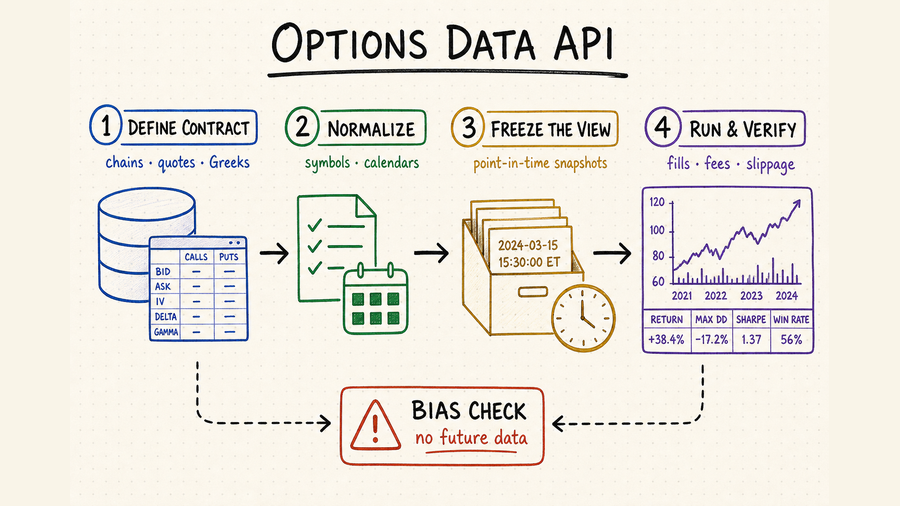
Choose historical option chains that preserve quotes, Greeks, contract identity, and the market view available at each test timestamp.
选择能够保留报价、希腊值、合约标识,
以及各回测时点市场视图的历史期权链。
TL;DR核心摘要
Require historical chains with bid, ask, last, volume, open interest, implied volatility, Greeks, and underlying prices.
Use point-in-time contract universes and snapshots; never rebuild yesterday's chain from contracts visible only today.
历史期权链应包含买卖报价、成交价、成交量、持仓量、隐含波动率、希腊值和标的资产价格。
使用历史时点的合约池和快照,不能用今天仍可见的合约重建过去的期权链。
What an options backtesting API must provide期权回测 API 必须提供哪些数据
An options data API for backtesting must reproduce the chain observable at each decision time, not a present-day reconstruction. Verify timestamps, condition codes, contract IDs, strike adjustments, expirations, and underlying-price joins.
用于回测的期权数据 API 必须还原每个决策时点实际可见的期权链,而不是基于当前信息重建历史。应核对时间戳、条件代码、合约标识、行权价调整、到期日和标的资产价格关联。
Confirm bid/ask sizes, trades, volume, open interest, implied volatility, and condition codes. Daily summaries cannot support intraday fills.
Track listing, expiration, exercise style, multiplier, deliverable, and OCC-style symbol changes. Splits and special distributions can turn a standard contract into a nonstandard deliverable.
Record whether Greeks are supplied or calculated, plus the model, rates, dividends, and timestamp.
Join the underlying quote, rate, dividend input, contract definition, and option quote available at the same decision time. Latest values from different clocks create hidden look-ahead.
Preserve style, settlement type, last-trading date, expiration time, deliverable, and exercise rules. Cash-settled and physically settled contracts require different terminal logic.
确认买卖盘口量、成交、持仓量、隐含波动率和条件代码。日终汇总数据无法支持盘中成交模型。
跟踪挂牌、到期、行权方式、合约乘数、交割物与合约代码变更。拆股和特别分配可能使标准合约变为非标准交割。
记录希腊值是直接提供还是自行计算,并保存定价模型、利率、股息和时间戳。
标的报价、利率、分红输入、合约定义和期权报价都必须来自同一决策时点可见的信息。把不同更新时间的“最新值”拼在一起,会形成隐蔽的未来数据偏差。
保留行权方式、结算类型、最后交易日、到期时间、交割物和行权规则。现金结算与实物交割需要不同的终止处理逻辑。
How to compare options data APIs for backtesting如何比较用于回测的期权数据 API
| Criterion标准 | What to verify检查内容 | Why it matters重要性 | Common risk常见风险 |
|---|---|---|---|
| History历史覆盖 | Expired contracts, full chains, snapshot frequency, and underlying bars.已到期合约、完整期权链、快照频率与标的 K 线。 | Reconstructing the tradable universe.还原当时可交易的合约池。 | Current-chain endpoints omit expired contracts.当前期权链端点通常不含已到期合约。 |
| Quote quality报价质量 | Bid/ask size, condition codes, crossed markets, and stale-quote policy.买卖盘口量、条件代码、交叉报价与陈旧报价规则。 | Realistic entry and exit prices.形成真实的开平仓价格。 | Using midpoint fills can exaggerate returns.始终按中间价成交会夸大收益。 |
| Contract mapping合约映射 | Stable IDs, roots, strikes, expirations, multipliers, and deliverables.稳定标识、根代码、行权价、到期日、乘数与交割物。 | Correct joins across corporate actions.确保公司行动前后正确关联。 | Adjusted contracts can look like missing data.调整后合约可能被误判为数据缺失。 |
| Access访问能力 | Bulk export, pagination, request frequency limits, compression, and licensing.批量导出、分页、请求频率限制、压缩与许可。 | Large chain scans and parameter sweeps.支持大规模期权链扫描和参数搜索。 | Per-contract calls multiply cost and runtime.逐合约请求会成倍增加成本和耗时。 |
A reproducible API-to-backtest workflow可复现的 API 回测流程
Define underlyings, expiration and strike filters, quote frequency, required fields, timezone, session policy, and whether Greeks must be supplied or recalculated.
Save raw responses and parameters. Test expirations, adjusted contracts, wide spreads, zero bids, crossed quotes, and gaps against an independent source.
Use only information available at decision time. Apply the current spread and size, then account for stale quotes, latency, fees, slippage, exercise, and assignment.
Store immutable partitions or checksums with strategy code. Record provider version, correction policy, calendars, assumptions, and license.
Form the contract choice from a completed snapshot, then execute at the next eligible quote or trade. Never fill at a midpoint that was not known when the signal was formed.
Handle expiration, early exercise assumptions, assignment, cash settlement, physical delivery, corporate actions, and forced closure when data ends.
Count missing chains, rejected crossed markets, stale quotes, zero bids, unpriced legs, and abandoned trades. Results without an exclusion ledger are hard to audit.
先定义标的、到期日与行权价筛选条件、报价频率、必需字段、时区、交易时段,以及希腊值是直接获取还是自行复算。
保存原始响应和请求参数,并用独立来源核对到期日、调整后合约、宽价差、零买价、交叉报价和数据缺口。
只能使用决策时点可得的信息。按当时的价差与盘口量模拟成交,并计入陈旧报价、延迟、费用、滑点、行权和指派。
将不可变数据分区或校验值与策略代码一并保存,并记录供应商版本、修订规则、交易日历、研究假设和数据许可。
先基于已经完成的快照选择合约,再按下一次符合条件的报价或成交执行。不能使用信号形成时尚不可知的中间价成交。
处理到期、提前行权假设、指派、现金结算、实物交割、公司行动,以及数据结束时的强制平仓。
统计缺失期权链、被拒绝的交叉报价、陈旧报价、零买价、无法定价的组合腿和放弃的交易。没有排除清单的结果很难审计。
Use QVeris to inspect market data capabilities使用 QVeris 检查市场数据能力
No verified QVeris result alone proves the historical point-in-time coverage required for backtesting. Use the QVeris documentation and Playground to inspect candidates, then verify expired contracts, quote frequency, corrections, and historical rights directly with the provider.
目前没有一个经过核实的 QVeris 结果,可以单独证明具备回测所需的历史时点覆盖。可以通过 QVeris 文档和 Playground 检查候选项,再向供应商核实已到期合约、报价频率、修订规则和历史数据权限。
FAQ常见问题
Most strategies need historical chains, bid/ask quotes and sizes, trades, open interest, contract reference data, corporate-action mappings, underlying prices, rates, and dividends. Greeks are useful, but reproducible raw inputs matter more.
Not by default. Use contemporaneous spread, displayed size, quote age, latency, fees, and a fill rule; illiquid multi-leg strategies need especially conservative assumptions.
Keep them missing, record the exclusion, and avoid selecting the contract with future knowledge. Model estimates must remain separate from observed quotes.
多数策略需要历史期权链、买卖报价与盘口量、成交、持仓量、合约参考数据、公司行动映射、标的资产价格、利率和股息。希腊值很有用,但可复算的原始输入更重要。
默认并不真实。应结合当时价差、盘口量、报价年龄、延迟、费用和成交规则;流动性差的多腿策略尤其需要保守假设。
保留缺失状态并记录排除原因,不能利用未来信息重新选择合约。模型估算值必须与真实观察报价分开。
References and next steps参考资料与下一步
Alpha Vantage options documentation
Massive options documentation
QVeris documentation
QVeris Playground