
Portkey vs Helicone
Control Traffic or Shorten the Debug Loop?
Portkey 与 Helicone:掌控流量,还是缩短调试闭环?
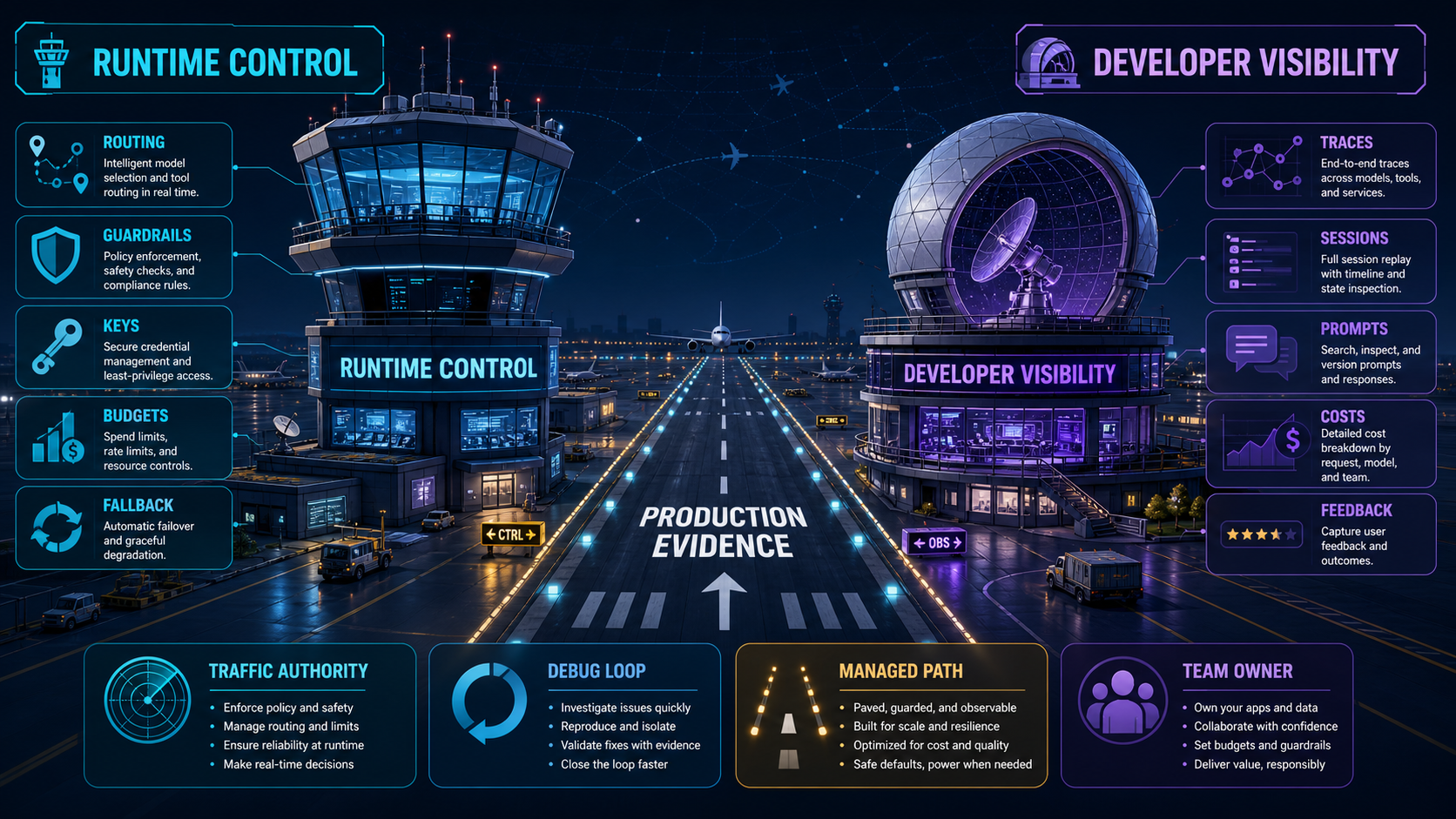
Portkey spans gateway orchestration, policy, guardrails, observability, and prompt operations. Helicone centers the developer evidence loop around gateway requests, traces, sessions, cost, prompts, and feedback. Choose the operating job that must become simpler.
Portkey 横跨网关编排、策略、护栏、可观测性与提示词运营;Helicone 以网关请求、追踪、会话、成本、提示词和反馈为中心构建开发者证据闭环。应选择最需要被简化的运营任务。
TL;DR
Choose it when routing policy, synchronous guardrails, budgets, administration, and observability should live in one governed gateway plane.
Choose it when request and session debugging, prompt visibility, feedback, and managed model access are the immediate bottleneck.
Both can sit in the request path. Decide which system owns keys, retries, fallbacks, caching, limits, and final cost attribution.
A feature exists only if the on-call engineer can explain one failed user session and recover it with the available evidence.
当路由策略、同步护栏、预算、管理和可观测性需要位于同一受治理网关平面时更合适。
当请求与会话调试、提示词可见性、反馈和托管模型访问是当前瓶颈时更合适。
两者都可进入请求路径,但密钥、重试、回退、缓存、限额和最终成本归因只能有清晰负责人。
只有值班工程师能用现有证据解释一个失败用户会话并完成恢复时,功能才真正存在。
The products overlap, but the operating center differs 两者有重叠,但运营重心不同
Portkey's center is governed runtime orchestration. Official documentation combines a universal gateway, configs for retries, fallbacks, load balancing and caching, real-time guardrails, budget and rate controls, logs, traces, analytics, prompt management, and administration.
Portkey 的中心是受治理的运行时编排。官方文档把通用网关、重试/回退/负载均衡/缓存配置、实时护栏、预算与限流、日志追踪分析、提示词管理和管理能力组合在一起。
Helicone's center is production understanding. Its documentation emphasizes gateway capture plus request observability, agent sessions, cost and error analysis, prompts, feedback, caching and limits. The selection turns on whether platform control or developer diagnosis is the expensive gap.
Helicone 的中心是理解生产行为。其文档强调网关采集、请求可观测性、智能体会话、成本与错误分析、提示词、反馈、缓存和限额。选型关键在于平台控制还是开发者诊断更昂贵。
Portkey vs Helicone side by side Portkey 与 Helicone 并排比较
| Decision surface 决策面 | Portkey | Helicone |
|---|---|---|
| Primary job 主要任务 | Govern and orchestrate model traffic 治理并编排模型流量 | Expose and explain model and agent behavior 呈现并解释模型与智能体行为 |
| Routing plane 路由平面 | Configs, retries, fallbacks, load balancing, cache, conditional policy Config、重试、回退、负载均衡、缓存与条件策略 | Gateway routing and model access with observability context 带可观测上下文的网关路由与模型访问 |
| Safety 安全 | Synchronous input/output guardrails and actions 同步输入/输出护栏与动作 | Request evidence, feedback, and integrations; validate enforcement needs 请求证据、反馈和集成;强制执行需单独验证 |
| Developer evidence 开发者证据 | Logs, traces, analytics, metadata, feedback 日志、追踪、分析、元数据与反馈 | Requests, traces, sessions, prompts, costs, errors, feedback 请求、追踪、会话、提示词、成本、错误与反馈 |
| Administration 管理 | Workspaces, keys, budgets, limits, org policy 工作区、密钥、预算、限额与组织策略 | Projects, access, gateway keys, usage controls 项目、访问、网关密钥与用量控制 |
| Best owner 最佳负责人 | Platform, security, or AI infrastructure 平台、安全或 AI 基础设施团队 | AI application and product engineering AI 应用与产品工程团队 |
Choose the bottleneck you can name 选择你能明确指出的瓶颈
Central policy, guardrails, budget enforcement, routing configuration, and enterprise administration must be standardized across teams.
Developers lose time reconstructing sessions, finding bad prompts, explaining cost, or connecting feedback to the exact production request.
No one owns the synchronous path, retention and residency are unclear, or pricing cannot be reconciled to a representative traffic export.
需要跨团队统一中央策略、护栏、预算执行、路由配置和企业管理。
开发者经常耗时重建会话、寻找坏提示词、解释成本,或无法把反馈关联到具体生产请求。
同步链路无人负责、数据保留与驻留不清楚,或无法用代表性流量导出完成价格对账。
Keep one authority in the synchronous request path 同步请求路径只保留一个权威
If the two platforms are combined, assign one to authenticate callers, apply rate limits, retry, fall back, cache, and record the final provider. Send telemetry to the second system asynchronously where possible. Propagate one trace ID and preserve the original request ID, selected config, model, provider, guardrail result, usage, and price.
若组合两者,应只指定一个系统负责调用方认证、限流、重试、回退、缓存和记录最终供应商;尽可能异步把遥测发送到第二个系统。传递同一个调用链 ID,并保留原始请求 ID、所选配置、模型、供应商、护栏结果、用量和价格。
Architecture rule: if both layers can retry or cache, the incident timeline and bill are no longer trustworthy.
架构规则:如果两层都能重试或缓存,事故时间线和账单就不再可信。
A production evidence proof 生产证据验证
- Replay tool calls, structured output, streaming, long sessions, and forced provider failures through both candidates.
- Measure added p95/p99 latency, correct fallback, duplicate calls, guardrail timing, and cost reconciliation.
- Give developers the same broken session and time request discovery, context reconstruction, root cause, and verified fix.
- Rotate one provider key, breach one budget, and change one routing rule with approval and rollback evidence.
- Model total cost as software, data retention, telemetry volume, platform labor, and debugging time.
- 通过两套候选方案回放工具调用、结构化输出、流式、长会话和强制供应商故障。
- 测量新增 p95/p99 延迟、正确回退、重复调用、护栏耗时和成本对账。
- 让开发者处理同一故障会话,计时请求发现、上下文重建、根因定位和修复验证。
- 轮换一个供应商密钥、触发一次预算超限,并用审批和回滚证据修改一条路由规则。
- 总成本应包含软件、数据保留、遥测量、平台人力和调试时间。
Migrate trace continuity before traffic 先迁移追踪连续性,再迁移流量
Export representative requests, prompts, sessions, scores, custom properties, routing configs, users, and cost records. Define a neutral evidence envelope and dual-write it before changing the proxy. Canary one application, reconcile request counts and spend, test rollback, then move the next workload.
导出代表性请求、提示词、会话、评分、自定义属性、路由配置、用户和成本记录。先定义中立证据信封并双写,再更换代理;按应用灰度,核对请求数与支出并测试回滚后,再迁移下一工作负载。
Model control and capability control are separate layers 模型控制与能力控制是不同层
Portkey or Helicone governs and explains the model call. QVeris governs the next boundary: how an agent discovers and invokes external APIs, data, and tools under controlled contracts and credentials. Shared trace context joins model evidence to downstream action evidence.
Portkey 或 Helicone 治理并解释模型调用;QVeris 治理下一层边界:智能体如何在受控契约与凭证下发现并调用外部 API、数据和工具。共享调用链上下文可连接模型证据与下游动作证据。
A Production Decision Scorecard for Portkey vs HeliconePortkey 与 Helicone的生产决策评分卡
For Portkey vs Helicone, the useful question is not which product has more checkmarks. It is which design gives the team the right boundary, evidence, operating model, and exit path for a defined workload.
针对“Portkey 与 Helicone”,真正有价值的问题不是哪款产品拥有更多勾选项,而是哪种设计能为明确工作负载提供正确边界、证据、运营模式和退出路径。
Map gateway routing and governance, request observability, prompt workflows, evaluations, caching, deployment, and historical trace continuity. Decide which component owns each decision, where policy is enforced, and whether the products are substitutes, complements, or overlapping layers.
梳理网关路由与治理、请求可观察性、提示词流程、评估、缓存、部署和历史追踪连续性。明确每项决策由哪个组件负责、策略在哪里执行,以及两者究竟是替代、互补还是部分重叠。
To validate Portkey vs Helicone, replay simple, long-context, streaming, structured-output, tool-calling, high-concurrency, and failure cases. Measure accepted-result quality, completion, p50 and tail latency, retries, trace completeness, and effective cost.
验证“Portkey 与 Helicone”时,重放简单、长上下文、流式、结构化输出、工具调用、高并发和失败案例,衡量合格结果质量、完成率、常规与长尾延迟、重试、追踪完整性和实际成本。
When evaluating Portkey vs Helicone, include hosting, regional capacity, data retention, identity integration, policy maintenance, upgrades, incident response, support, compliance evidence, and the custom adapters the team must keep current.
评估“Portkey 与 Helicone”时,纳入托管、区域容量、数据留存、身份集成、策略维护、升级、事故响应、支持、合规证据,以及团队必须持续维护的自定义适配器。
Before rolling out Portkey vs Helicone, version a neutral request and evidence envelope, shadow traffic, classify semantic differences, preserve trace identity, and prove a staged rollback. Prefer the option that keeps policy and workload contracts portable.
上线“Portkey 与 Helicone”前,版本化中立请求与证据封装,运行影子流量,分类语义差异,保留追踪身份,并证明可分阶段回滚。优先选择能让策略和工作负载契约保持可迁移的方案。
FAQ
No. Its official product surface includes observability, guardrails, prompt management, administration, and gateway orchestration.
No. It combines gateway access and controls with request, trace, session, prompt, cost, and feedback workflows.
Yes, if one system owns synchronous traffic behavior and the other consumes telemetry without duplicating retries or caching.
Compare the complete operating model at your retention, traffic, and team shape; list prices alone are not decisive.
不是。其官方产品面还包含可观测性、护栏、提示词管理、管理能力与网关编排。
不是。它把网关访问与控制同请求、追踪、会话、提示词、成本和反馈工作流组合起来。
可以,前提是一个系统负责同步流量行为,另一个消费遥测且不重复重试或缓存。
应按真实保留期、流量和团队形态比较完整运营模型,单看标价无法决定。