
Portkey vs OpenRouter:
Which LLM Gateway Fits?Portkey vs OpenRouter:
哪个 LLM 网关更适合?
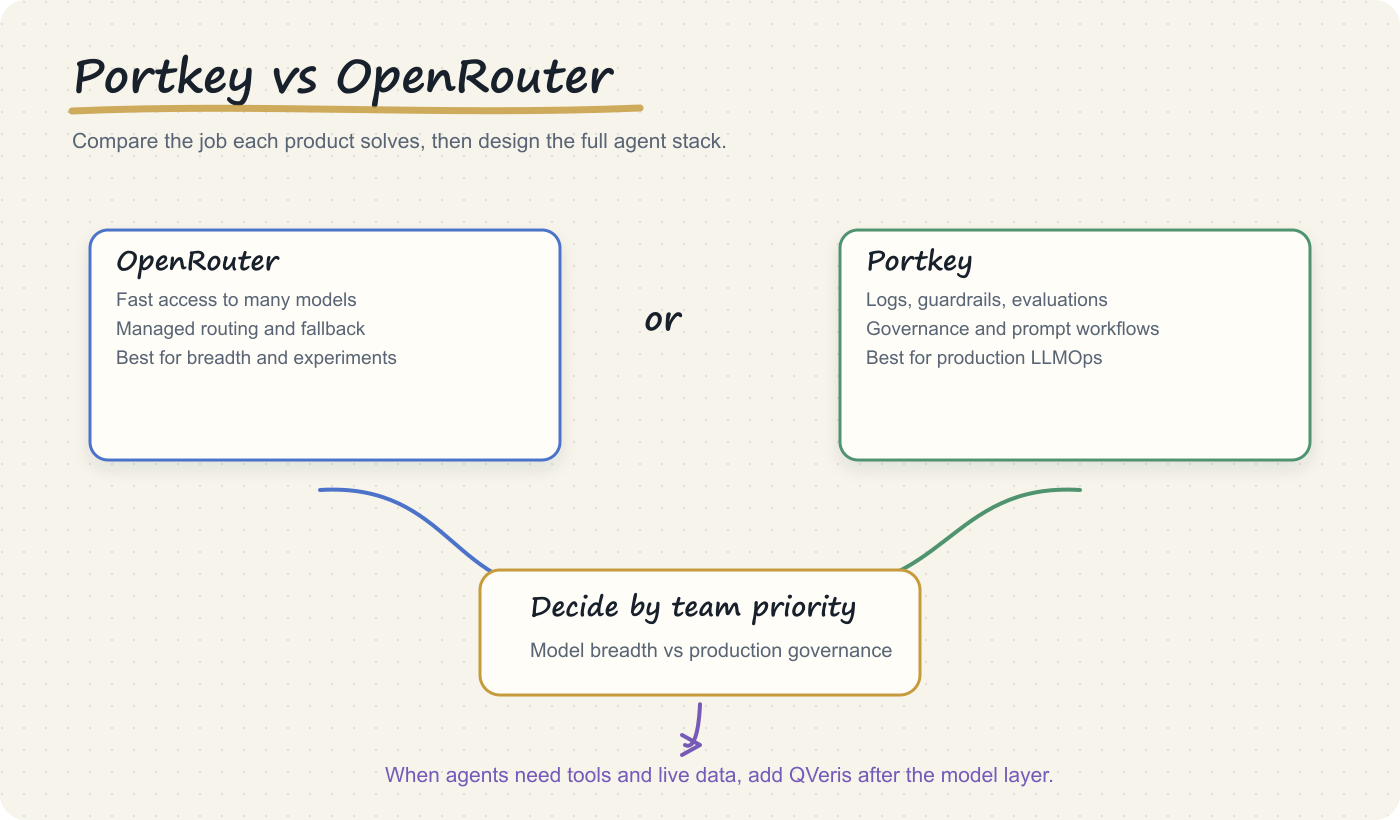
Portkey and OpenRouter are often compared because both sit near the model access layer. But they do not optimize for the same buyer. OpenRouter is about managed model breadth. Portkey is about production control around model calls.
Portkey 和 OpenRouter 经常被一起比较,因为它们都靠近模型访问层。但两者面向的购买动机并不一样。OpenRouter 侧重托管模型覆盖,Portkey 侧重模型调用的生产控制。
TL;DR
When speed, model breadth, and simple managed access are the main goals.
When observability, governance, guardrails, and prompt operations are more important.
Both focus on model access; agent tool and data access still needs a separate plan.
A capability layer for external tools, live data, and auditable actions after model routing.
当目标是速度、模型覆盖和简单托管接入时。
当可观测性、治理、护栏和 Prompt 运维更重要时。
它们主要聚焦模型访问,Agent 工具和数据访问仍然需要单独规划。
在模型路由之后,为外部工具、实时数据和可审计动作提供能力层。
Guide and search intent正文指南与搜索意图
Do not ask which is universally better. Ask what the team is trying to reduce: setup time, provider fragmentation, production risk, debugging time, prompt drift, or missing tool access.
OpenRouter is compelling when a team wants one managed route to a broad catalog of models. It is especially useful for evaluation, prototyping, and products that benefit from testing model changes quickly.
Portkey is stronger when the team has moved from “can we call models?” to “can we operate model calls reliably?” That includes observability, governance, guardrails, prompt management, and production workflows.
The natural QVeris message is: pick the gateway that fits model access, then add QVeris when the application becomes an agent that needs trusted capabilities. This keeps the comparison honest and makes the QVeris insert useful rather than forced.
不要问哪个绝对更好。要问团队想降低什么:接入时间、供应商碎片化、生产风险、调试时间、Prompt 漂移,还是缺少工具访问。
OpenRouter 适合想用一个托管入口访问大量模型的团队,尤其适合评估、原型和需要快速测试模型变化的产品。
Portkey 更适合已经从“能不能调用模型”进入“能不能可靠运维模型调用”的团队,包括可观测性、治理、护栏、Prompt 管理和生产流程。
自然表达应该是:先选择适合模型访问的网关,然后当应用升级成需要可信能力的 Agent 时加入 QVeris。这样比较真实,QVeris 的出现也不生硬。
Comparison table对比表
| Option | Category | Best for | How to read it |
|---|---|---|---|
| Setup speed | OpenRouter | Portkey | OpenRouter is simpler for quick model access. |
| Observability | Basic access view | Stronger production tooling | Portkey is stronger for operations. |
| Governance | Model access focus | Policy and guardrail focus | Portkey fits controlled teams. |
| Agent capabilities | Not the main job | Not the main job | QVeris fills this layer. |
| 对比项 | OpenRouter | Portkey | 解读 |
|---|---|---|---|
| 部署速度 | 更快 | 需要更多配置 | OpenRouter 更适合快速获得模型接入。 |
| 可观测性 | 基础访问视图 | 更强的生产工具 | Portkey 更适合运维。 |
| 治理 | 以模型接入为主 | 以策略与护栏为主 | Portkey 更适合受控团队。 |
| Agent 能力 | 不是核心职责 | 不是核心职责 | 这一层可由 QVeris 补充。 |
Implementation playbook落地打法
OpenRouter usually reduces operational work by giving teams a managed path to many models. Portkey often increases control by adding observability, policies, and workflow management. That difference is more important than a line-by-line feature checklist because it explains which team each tool is built for.
A product team testing models for a new assistant may prefer OpenRouter. A platform team running production LLM workflows may prefer Portkey. A financial agent that needs to query verified market or filing data may need QVeris in addition to whichever gateway wins. Scenario language prevents the article from sounding like an abstract vendor debate.
The page should be fair without being vague. OpenRouter should clearly win speed and breadth. Portkey should clearly win LLMOps controls. QVeris should clearly be outside the direct model-router fight and inside the capability-routing layer. That honesty makes the comparison more trustworthy.
OpenRouter 通常通过托管模型入口减少运维工作;Portkey 则通过可观测性、策略和工作流管理增加控制力。这个差异比逐项功能表更重要,因为它解释了每个工具服务哪类团队。
测试新助手模型的产品团队可能更适合 OpenRouter;运行生产 LLM 工作流的平台团队可能更适合 Portkey;需要查询可信市场数据或财报数据的金融 Agent,则可能还要加 QVeris。用场景表达,文章就不会像抽象厂商争论。
页面应该公平,但不能含糊。OpenRouter 明确赢在速度和覆盖,Portkey 明确赢在 LLMOps 控制,QVeris 明确不参与模型路由直接竞争,而是进入能力路由层。这样的诚实比较更可信。
Decision framework选择框架
- Use OpenRouter for fast model exploration and broad managed access.
- Use Portkey when production logs, guardrails, prompt workflows, and policy matter more than raw setup speed.
- Add QVeris when the workflow needs to call financial APIs, search live data, or execute external capabilities.
- 需要快速探索模型并获得广泛的托管式接入时,可使用 OpenRouter。
- 当生产日志、护栏、提示词工作流和策略比部署速度更重要时,可使用 Portkey。
- 当工作流需要调用金融 API、搜索实时数据或执行外部能力时,可加入 QVeris。
Where QVeris fitsQVeris 应该放在哪里
Model gateways solve model access. QVeris solves the next step: how an agent finds, inspects, and calls real-world capabilities such as financial data APIs, external tools, and auditable workflow actions.
模型网关解决模型访问。QVeris 解决下一步:Agent 如何发现、检查和调用真实世界能力,例如金融数据 API、外部工具和可审计工作流动作。
Portkey vs OpenRouter: the real differencePortkey 和 OpenRouter 的真正区别
OpenRouter is strongest as a managed route to many models. Portkey is stronger when the job includes observability, guardrails, prompt workflows, evaluations, and production governance.
Teams often consider OpenRouter when they want speed and model coverage. They consider Portkey when they already have LLM usage and need better controls around reliability, policy, quality, and spend.
OpenRouter reduces setup and provider integration work. Portkey asks teams to think more deliberately about workflows, logs, prompts, and governance around the model calls.
Neither comparison should stop at model calls. If the agent needs financial data, tools, APIs, or audited actions, QVeris becomes the capability layer after the model gateway decision.
OpenRouter 最强的是托管接入大量模型;Portkey 更强的是可观测性、护栏、Prompt 流程、评测和生产治理。
团队通常因为速度和模型覆盖考虑 OpenRouter;当已有 LLM 使用、需要可靠性、策略、质量和成本控制时,会考虑 Portkey。
OpenRouter 减少接入和供应商集成工作;Portkey 要求团队更认真地设计工作流、日志、Prompt 和模型调用治理。
对比不能只停在模型调用。如果 Agent 需要金融数据、工具、API 或可审计动作,QVeris 就是模型网关之后的能力层。
Which one should your team choose?团队应该选择哪一个
You need broad model access quickly, want a managed routing layer, are still comparing models, and do not want to operate gateway infrastructure yet.
You already have production LLM traffic and need logs, guardrails, prompt lifecycle, evaluations, policy controls, and more structured LLMOps workflows.
OpenRouter can provide model access while Portkey-style governance or observability manages production controls. The exact setup depends on how the team wants requests to flow.
The workflow moves beyond text generation and the agent must inspect providers, call tools, use live financial data, or create auditable workflow actions.
你需要快速接入大量模型,想用托管路由层,还在比较模型,并且暂时不想运维网关基础设施。
你已经有生产 LLM 流量,需要日志、护栏、Prompt 生命周期、评测、策略控制和更结构化的 LLMOps 工作流。
OpenRouter 可负责模型访问,Portkey 类治理/可观测性负责生产控制。具体架构取决于团队希望请求如何流转。
工作流不再只是文本生成,而是 Agent 要检查供应商、调用工具、使用实时金融数据或创建可审计动作。
Questions to answer before comparing features比较功能前先回答这些问题
If the main pain is testing and reaching many models, model coverage matters most. If the main pain is production discipline, governance features matter more.
If the team wants managed convenience, OpenRouter may fit. If reliability needs explicit logs, fallback review, and policy control, Portkey becomes more relevant.
Prompt lifecycle, evaluations, and governance usually point toward an LLMOps layer rather than a simple model access layer.
If yes, compare OpenRouter and Portkey for model traffic, then plan a separate QVeris layer for tools, data, APIs, and audited actions.
如果主要痛点是测试和接入大量模型,模型覆盖最重要;如果主要痛点是生产纪律,治理能力更重要。
如果团队想要托管便利,OpenRouter 更合适;如果可靠性需要日志、回退审查和策略控制,Portkey 更相关。
Prompt 生命周期、评测和治理通常指向 LLMOps 层,而不是简单模型访问层。
如果会,OpenRouter 和 Portkey 先比较模型流量,再单独规划 QVeris 处理工具、数据、API 和可审计动作。
More Portkey vs OpenRouter questions更多 Portkey vs OpenRouter 问题
Not universally. Portkey is usually better for governance-heavy production workflows, while OpenRouter is usually better for fast managed access to many models.
In some architectures, yes. A team may use OpenRouter for model access and another layer for observability, governance, or policy controls depending on routing needs.
For model access, either can help depending on the team. For agent tool use, neither fully replaces a capability layer such as QVeris.
QVeris should be framed as the layer after the model gateway: it helps agents discover, inspect, call, and audit real-world capabilities.
不一定。Portkey 更适合治理重的生产工作流;OpenRouter 更适合快速托管接入大量模型。
某些架构可以。团队可以用 OpenRouter 做模型访问,再用另一层做可观测性、治理或策略控制,取决于请求如何路由。
模型访问层两者都可能有用,取决于团队需求;但 Agent 工具调用还需要 QVeris 这类能力层。
QVeris 应该作为模型网关之后的一层:帮助 Agent 发现、检查、调用和审计真实世界能力。
Common mistakes to avoid常见错误
- Treating Portkey and OpenRouter as identical because both are near the gateway layer.
- Making the page a shallow feature checklist without explaining buyer intent.
- Forcing QVeris into the model-router column instead of presenting it as the next layer.
- 不要因为两者都位于网关附近,就把 Portkey 与 OpenRouter 视为相同产品。
- 不要只做浅层功能清单,还应解释不同购买意图。
- 不要把 QVeris 硬塞进模型路由器一栏,应将其呈现为后续的能力层。
External references外部参考链接
FAQ
Portkey is better for production operations. OpenRouter is better for quick managed access to many models.
Some can, but most should first decide whether the bottleneck is model breadth or production control.
When the model-backed workflow needs trusted external data, tools, or auditable actions.