
Quantitative Research Tools
for Financial Markets金融市场量化研究工具
从数据到可审计研究
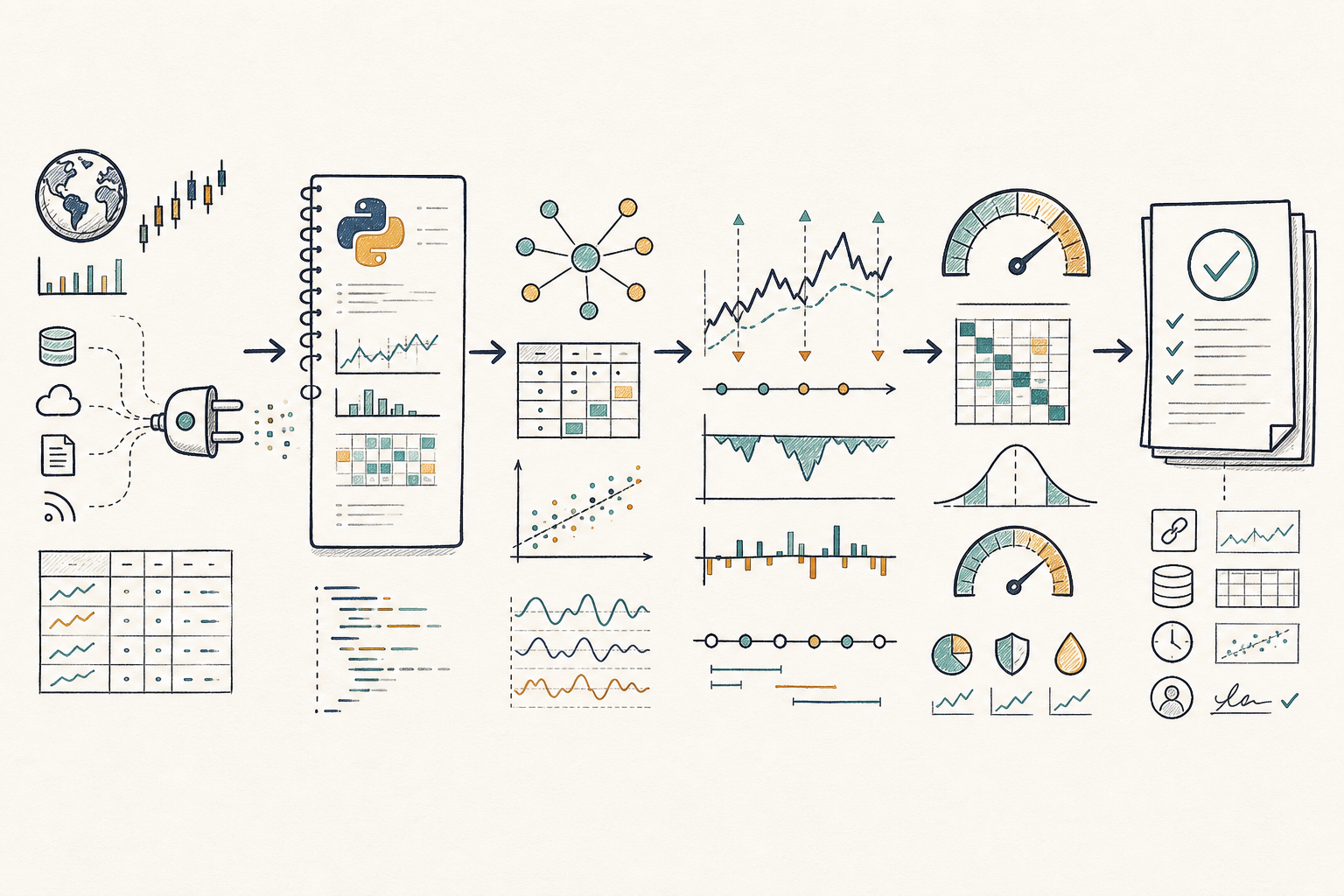
Quantitative research tools turn market data, code, factors, and backtests into evidence a team can inspect, reproduce, and challenge.
量化研究工具把金融数据、代码、因子与回测串成可检查、
可复现、可质疑的研究证据,而不只是生成一条漂亮曲线。
TL;DR
No single tool is the stack
A serious workflow combines data access, Python or another analytical environment, factor research, realistic backtesting, portfolio analytics, and reproducibility controls.
Data quality comes first
Point-in-time availability, corporate actions, delisted securities, universe history, and consistent identifiers matter before a model or backtester can produce trustworthy evidence.
Backtests are tests, not forecasts
Costs, slippage, liquidity, look-ahead bias, survivorship bias, parameter search, and out-of-sample validation determine whether a result deserves more investigation.
QVeris has a defined role
QVeris helps teams discover, inspect, call, and audit external capabilities. It complements data providers and research engines; it does not replace statistical validation or investment judgment.
没有一个工具能包办整个工具栈
完整流程通常同时需要数据访问、Python 或其他分析环境、因子研究、真实回测、组合分析和研究复现控制。
先验证数据,再讨论模型
数据是否按当时可得时间对齐、是否处理公司行动和退市证券、股票池是否保留历史成分、标识符是否一致,都会影响研究可信度。
回测是检验,不是预测
手续费、滑点、流动性、未来函数、幸存者偏差、参数搜索和样本外验证,决定一条回测曲线是否值得继续研究。
QVeris 的边界必须清晰
QVeris 帮助团队发现、检查、调用和审计外部能力,补充数据源与研究引擎,但不替代统计验证或投资判断。
How to choose quantitative research tools量化研究平台怎么选:五项核心标准
The best quantitative research tools for finance are the tools that fit your market, data rights, research method, validation standard, and deployment boundary. A popular library can still be the wrong choice if its data model or execution assumptions do not match the question.
适合金融研究的工具,不等于最流行的工具。选型要同时匹配市场范围、数据授权、研究方法、验证标准和上线边界;只要数据模型或成交假设不匹配,功能再多也可能得到错误结论。
1. Data coverage and point-in-time fitness
Check exchanges, asset classes, history depth, field definitions, update frequency, corporate-action treatment, filing timestamps, delisted instruments, and licensing. “Historical” does not automatically mean “known on that date.”
2. Research velocity and interoperability
Python tools for quantitative finance should work with your notebook, dataframe, storage, version-control, and scheduling choices. Exportable data and explicit schemas reduce lock-in more than a long feature checklist.
3. Backtest realism
A quantitative research platform for backtesting should model fees, spread, slippage, fill timing, liquidity, rejected orders, rebalance rules, and universe changes at the level your hypothesis requires.
4. Validation and risk analysis
Look for walk-forward or time-series validation, benchmark comparison, exposure analysis, drawdown, turnover, concentration, scenario tests, and enough raw output to challenge the headline metric.
5. Reproducibility, audit, and operating cost
Record code, environment, data version, parameters, tool inputs, tool outputs, and reviewer decisions. Include data subscriptions, compute, maintenance, and learning curve—not only the listed software price.
1. 数据覆盖与时点适用性
检查交易所、资产类别、历史深度、字段定义、更新频率、公司行动、财报发布时间、退市标的和授权范围。“历史数据”不等于“当时已经可得的数据”。
2. 研究效率与互操作性
Python 量化研究工具要能融入现有 Notebook、DataFrame、存储、版本控制与调度系统。可导出的数据和清晰 Schema,往往比冗长功能清单更能降低锁定风险。
3. 策略回测的真实程度
回测平台应按研究需要处理手续费、买卖价差、滑点、成交时点、流动性、拒单、调仓规则和股票池历史变化。
4. 验证能力与风险分析
检查是否支持滚动或时间序列验证、基准对比、风险暴露、回撤、换手率、集中度与情景测试,并保留足够原始结果供复核。
5. 可复现、可审计与总成本
保存代码、环境、数据版本、参数、工具输入输出和审核结论。成本也应包含数据订阅、算力、维护和学习成本,而不只是软件标价。
Quantitative research tools by workflow layer按研究流程拆解量化投研工具栈
A useful comparison separates jobs instead of forcing unlike products into one ranking. The examples below are representative, not endorsements, and availability, pricing, licensing, and features can change.
真正有用的比较应先按任务分层,而不是把不同类型产品硬塞进同一榜单。下列示例仅用于解释工具边界,不构成推荐;功能、授权与价格都可能变化。
| Workflow layer流程层 | Representative examples代表性示例 | What to evaluate重点检查 | Important boundary关键边界 |
|---|---|---|---|
| Market and fundamental data行情与基本面数据 | Financial Modeling Prep, exchange or specialist datasets, internal data lake | Point-in-time fields, identifiers, corporate actions, coverage, latency, rights时点字段、标识符、公司行动、覆盖、延迟与授权 | A financial data API supplies inputs; it does not validate a hypothesis.金融数据 API 提供输入,但不会替你验证假设。 |
| Notebook and analysisNotebook 与分析环境 | Jupyter, Python, pandas, NumPy, R | Package control, memory profile, dataframe semantics, visual diagnostics依赖控制、内存、数据框语义与可视化诊断 | Flexible code increases responsibility for tests and conventions.代码越灵活,测试和规范责任越大。 |
| Factor and machine learning research因子与机器学习研究 | Microsoft Qlib, statsmodels, scikit-learn, custom factor libraries | Feature timing, neutralization, labels, leakage controls, experiment tracking特征时点、中性化、标签、泄漏控制与实验跟踪 | A higher model score is not automatically an investable signal.更高模型分数不等于可投资信号。 |
| Backtesting策略回测 | QuantConnect LEAN, vectorbt, QF-Lib, Backtrader, internal engines | Event timing, fills, costs, universes, benchmark, reproducible configuration事件时点、成交、成本、股票池、基准与配置复现 | Engine assumptions must match the market and strategy horizon.引擎假设必须匹配市场和策略周期。 |
| Portfolio and risk analytics组合与风险分析 | PyPortfolioOpt, risk models, scenario engines, custom reporting | Exposure, turnover, capacity, concentration, drawdown, stress behavior暴露、换手、容量、集中度、回撤与压力表现 | Optimization inherits every upstream data and forecast error.优化会继承上游数据和预测误差。 |
| Evidence and capability access证据与能力调用 | Git, environment locks, experiment stores, QVeris | Schema inspection, call trace, data lineage, versioning, reviewer handoffSchema 检查、调用轨迹、数据血缘、版本与审核交接 | Auditability improves review; it does not prove economic validity.可审计性提升复核效率,但不证明策略经济有效。 |
Feature descriptions are grounded in the linked official documentation below. Verify current product scope and licensing before making a procurement or production decision.
功能描述依据下方官方文档整理。采购或上线前,请再次核对产品当前范围、数据授权和许可条件。
A quantitative research workflow from data to backtest从数据到回测的量化研究流程
Tools are easiest to evaluate against a repeatable workflow. Each stage should produce an artifact that the next stage—and a reviewer—can inspect.
把工具放进可重复流程里,才容易判断是否适合。每一步都应产生能被下一步和审核者检查的工件,而不是只保留最终结论。
1. State a falsifiable research question
Define the universe, signal, decision horizon, benchmark, constraints, and failure condition before exploring results. “Find a profitable factor” is too open-ended; “test whether twelve-month momentum survives costs in a defined liquid universe” is reviewable.
2. Build a data contract
List every field, source, timestamp meaning, adjustment rule, unit, identifier, missing-value policy, license, and expected refresh. Save the request and response schema for each financial data API.
3. Create features without future information
Lag fundamentals to their actual publication time, preserve universe history, fit transforms only on available samples, and separate exploratory code from the final reproducible feature pipeline.
4. Test the signal before the portfolio
Inspect distributions, missingness, stability, turnover, factor correlation, rank behavior, and results across time and market regimes. Weak inputs do not become robust because an optimizer is added.
5. Run a realistic backtest and risk review
Use time-ordered validation and include the execution frictions relevant to the strategy. Review exposure, concentration, drawdowns, capacity, regime dependence, and sensitivity to parameters—not only Sharpe ratio.
6. Package the evidence
Store the data snapshot or version, code commit, environment, parameters, outputs, failed experiments, charts, and reviewer notes. A result should be reproducible by someone who did not write the original notebook.
1. 写出可以被证伪的研究问题
在看结果前定义股票池、信号、决策周期、基准、约束和失败条件。“寻找赚钱因子”过于开放;“检验十二个月动量扣除成本后是否仍在指定流动性股票池有效”才可审核。
2. 建立数据契约
列清字段、来源、时间戳含义、复权规则、单位、标识符、缺失值政策、许可和刷新频率,并保存每个金融数据 API 的请求与响应 Schema。
3. 在不使用未来信息的前提下构造特征
按真实披露时间滞后财务数据,保留股票池历史,只用当时可得样本拟合变换,并把探索代码与最终可复现特征管线分开。
4. 先检查信号,再构建组合
分析分布、缺失、稳定性、换手、因子相关性、排序表现,以及不同时期和市场状态的结果。弱信号不会因为加入优化器就变可靠。
5. 运行真实回测并做风险复核
使用按时间排序的验证方式,纳入与策略相关的成交摩擦;检查暴露、集中度、回撤、容量、状态依赖和参数敏感度,而不只看夏普比率。
6. 封装研究证据
保存数据快照或版本、代码提交、环境、参数、输出、失败实验、图表和审核意见,让没有参与原始 Notebook 的人也能复现结果。
Data and backtesting risks the tools must expose量化研究数据质量检查与回测风险
A tool is useful when it makes hidden assumptions visible. The following checks are minimum review questions, not a complete model-risk framework.
好工具的重要价值,是把隐藏假设暴露出来。下面是最低限度的复核问题,不是完整的模型风险框架。
Look-ahead and publication lag
Could the model see a price, filing, index constituent, revised macro series, or transformed feature before it was available in reality? Validate timestamps field by field.
Survivorship and universe history
Does the dataset include delisted instruments and historical index membership? A present-day universe applied backward can remove past failures and inflate results.
Execution and transaction costs
Are fills based on prices available after the signal, and are spread, fees, market impact, borrow, turnover, and capacity treated consistently with the strategy?
Overfitting and repeated search
How many variants were tried before the reported result? Use predeclared hypotheses where possible, retain failed tests, and validate on untouched time periods.
Revisions and data lineage
Can you identify the exact source, query, response, transformation, and version behind each number? Revised values should not silently replace the historical view used by the model.
Operational and licensing boundaries
Confirm redistribution rights, rate limits, service availability, credential handling, retention rules, and fallback behavior before moving a research workflow into production.
未来函数与披露滞后
模型是否提前看到价格、财报、指数成分、修订后的宏观数据或处理后的特征?需要逐字段验证实际可得时间。
幸存者偏差与股票池历史
数据是否包含退市标的和历史指数成分?把今天的股票池直接向历史回填,会删除过去失败样本并夸大结果。
成交与交易成本
成交价格是否发生在信号之后?买卖价差、手续费、冲击成本、融券、换手率和容量是否与策略保持一致?
过拟合与重复搜索
报告结果之前测试过多少变体?尽量预先声明假设,保留失败实验,并在未参与开发的时间区间进行验证。
数据修订与血缘
能否定位每个数字对应的数据源、查询、响应、变换和版本?修订值不应悄悄替换模型当时看到的历史视图。
运营与授权边界
研究流程上线前,要确认再分发权、限流、服务可用性、凭证处理、保留政策和失败回退。
Where QVeris fits in a quantitative research tool stackQVeris 如何连接量化研究工具栈
QVeris is most relevant at the capability-access boundary: when a researcher or AI agent needs to find an appropriate financial-data or analysis capability, inspect its schema, make a controlled call, and retain evidence about what happened. Your notebook, factor library, backtester, and review process remain separate responsibilities.
QVeris 最适合能力调用边界:当研究者或 AI Agent 需要寻找合适的金融数据或分析能力、检查 Schema、受控调用并保留调用证据时使用。Notebook、因子库、回测引擎与审核流程仍由各自系统负责。
Discover the capability by task
Search for the business capability—such as historical prices, statements, filings, estimates, or market news—rather than hard-coding a provider-specific endpoint before requirements are understood.
Inspect the contract before calling
Review required parameters, field definitions, expected output, credential boundary, and usage constraints. Schema inspection reduces silent assumptions in agent-generated code.
Call with explicit inputs
Pass ticker, exchange, date range, frequency, currency, and adjustment choices explicitly. Save the inputs with the result so another researcher can reproduce the same request.
Audit the handoff to research code
Retain which capability ran, when it ran, what it returned, and which transformation consumed the result. Then apply your own point-in-time, statistical, risk, and licensing review.
按任务发现能力
先按历史价格、财务报表、SEC 文件、分析师预期或市场新闻等业务任务寻找能力,不要在需求未明确时先写死某家供应商端点。
调用前检查契约
核对必填参数、字段定义、预期输出、凭证边界和使用限制。Schema 检查能减少 Agent 生成代码中的隐含假设。
用明确输入发起调用
显式传入代码、交易所、日期范围、频率、币种和复权选择,并把输入与结果一起保存,让其他研究者能够复现请求。
审计数据进入研究代码的交接
记录调用了什么能力、何时调用、返回了什么,以及哪个变换消费了结果;随后仍要执行自己的时点、统计、风险和授权检查。
- Review the Financial Modeling Prep API guide when evaluating a source for fundamentals, prices, and market endpoints.
- See the AI agents for financial research guide for human-review and evidence boundaries in agent workflows.
- Use the quant stock screener page as an example of converting factor criteria into an inspectable workflow.
- 评估基本面、价格和市场端点时,可阅读 Financial Modeling Prep API 指南。
- 构建 Agent 研究流程时,可参考 金融研究 AI Agent 指南中的人工审核与证据边界。
- 量化股票筛选器页面展示了如何把因子条件转成可检查流程。
FAQ
What tools do quantitative researchers use?
Most stacks combine financial data, Python or R, notebooks, dataframe and statistics libraries, factor-analysis tools, a backtesting engine, portfolio and risk analytics, version control, and an evidence trail. The exact mix depends on market, horizon, team, and production needs.
What should a quantitative research platform include?
At minimum: appropriate point-in-time data, reproducible analysis, realistic execution assumptions, time-aware validation, risk diagnostics, exportable results, versioning, and clear licensing. An integrated UI is useful only if these foundations are visible.
Is Python enough for quantitative research?
Python is sufficient for many research workflows, but it is not the whole system. You still need licensed data, disciplined timestamps, tests, environment control, realistic backtesting, risk review, and a path to reproduce every external call.
How do you avoid look-ahead bias in backtesting?
Use point-in-time data, align records to when they were actually public, lag signals and fills correctly, preserve historical universes, fit transforms only on past samples, and audit the full lineage from source to order.
What data is needed for quantitative research?
It depends on the hypothesis. Common inputs include adjusted prices, volume, corporate actions, fundamentals, filings, estimates, macro series, events, classifications, and benchmarks. Field timing and rights matter as much as coverage.
How do you choose tools for quantitative finance?
Start from the decision you need to validate, then compare data fitness, interoperability, backtest realism, validation depth, auditability, operating cost, and production constraints. Run a small representative workflow before committing to a platform.
量化研究需要哪些工具?
通常包括金融数据、Python 或 R、Notebook、数据框与统计库、因子研究工具、回测引擎、组合与风险分析、版本控制和证据记录。具体组合取决于市场、周期、团队与上线需求。
量化研究平台应该具备哪些功能?
至少需要合适的时点数据、可复现分析、真实成交假设、时间序列验证、风险诊断、结果导出、版本控制和清晰授权。只有基础透明,集成界面才有价值。
Python 适合做量化研究吗?
Python 足以完成许多研究任务,但它不是完整系统。仍需数据许可、时间戳规范、测试、环境控制、真实回测、风险复核和外部调用复现。
策略回测如何避免未来数据?
使用 point-in-time 数据,按真实公开时间对齐记录,正确滞后信号与成交,保留历史股票池,只用过去样本拟合变换,并审计从数据源到订单的完整血缘。
如何选择金融数据 API?
先按研究问题确定市场、资产、字段、频率和历史深度,再核对时点语义、复权、退市标的、标识符、限流、许可、响应 Schema 和稳定性。
因子研究和策略回测有什么区别?
因子研究关注信号定义、统计性质、稳定性和相关性;策略回测把信号放进组合、调仓和成交规则中。两者相连,但不能用一条组合收益曲线替代信号诊断。
External references外部参考链接
Use primary documentation to verify current behavior. The links below support the data, research-pipeline, and backtesting concepts discussed in this guide.
请使用官方一手文档核对当前功能。以下链接支持本文涉及的数据、研究管线和回测概念。