OpenRouter helps your app reach models. QVeris helps your agent reach the world.
OpenRouter 帮应用访问模型。QVeris 帮 Agent 访问真实世界。
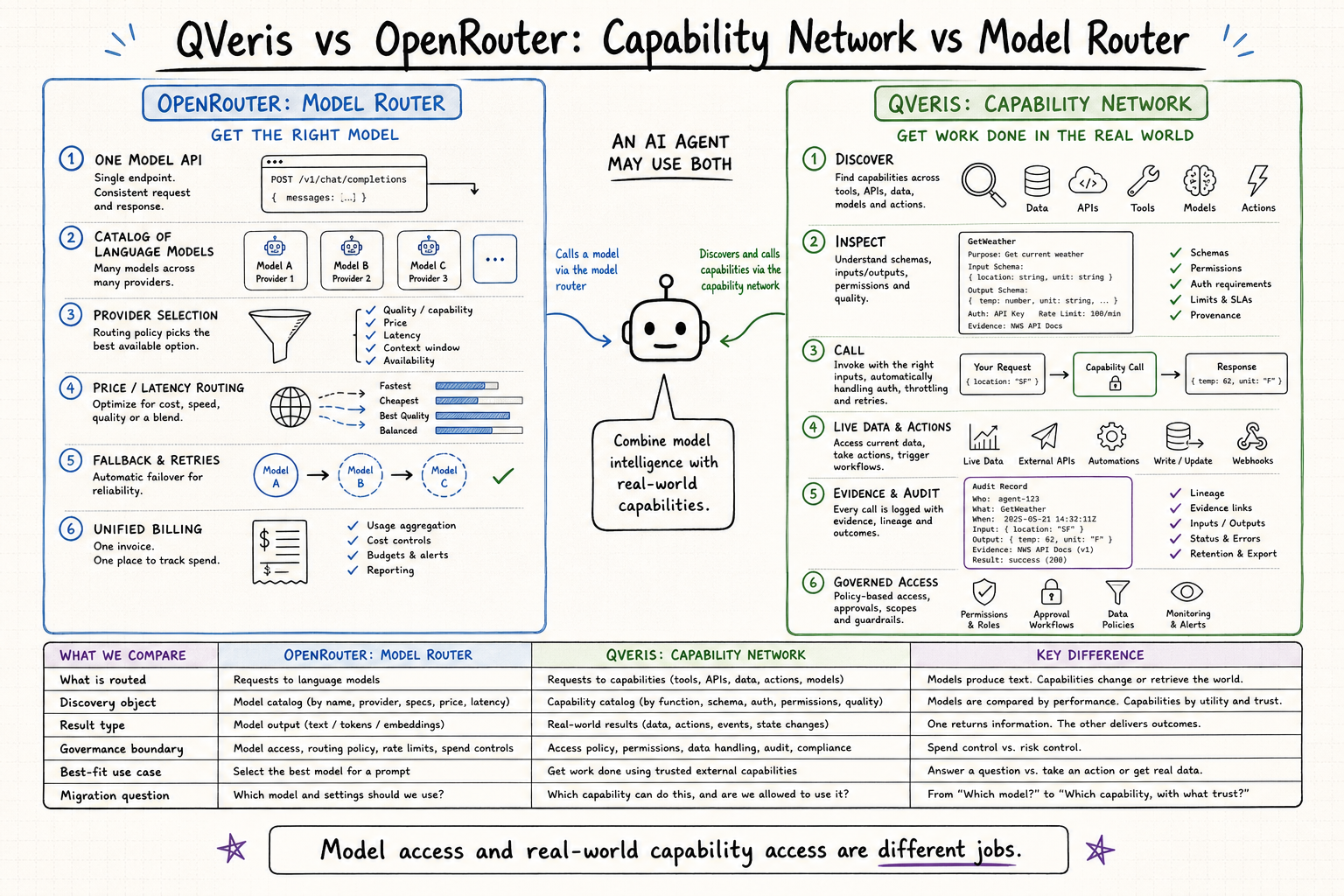
This is not a winner-takes-all comparison. Use OpenRouter when the bottleneck is model access. Add QVeris when the bottleneck is live data, verified tools, external services, and auditable agent execution.
这不是非此即彼的对比。瓶颈是模型接入时用 OpenRouter;瓶颈是实时数据、已验证工具、外部服务和可审计 Agent 执行时,加 QVeris。
Why This Page Exists
为什么需要这篇对比
Searches like “QVeris vs OpenRouter” can be misleading because both products appear in gateway and agent discussions. OpenRouter is a managed model aggregation and routing service. Its current official documentation covers one API for hundreds of models, provider ordering and filtering, throughput or latency preferences, model fallbacks, BYOK behavior, privacy constraints such as provider data collection or ZDR, and standardized tool-call messages.
“QVeris vs OpenRouter” 这类搜索容易误导,因为两个产品都出现在 Gateway 与 Agent 讨论中。OpenRouter 是托管式模型聚合与路由服务。其当前官方文档覆盖通过一个 API 访问数百个模型、Provider 排序与过滤、吞吐或延迟偏好、模型 Fallback、BYOK 行为、Provider 数据收集或 ZDR 等隐私约束,以及标准化 Tool Call Message。
QVeris routes a different kind of request. When an agent needs current, source-aware or executable capability—market data, filings, document parsing, compliance checks, search, or another external service—it can Discover candidates, Inspect schemas and operating evidence, then Call the selected capability for structured results.
QVeris 路由的是另一类请求。当 Agent 需要当前、可溯源或可执行的能力,例如市场数据、财报文件、文档解析、合规检查、搜索或其他外部服务时,可以先 Discover 候选,Inspect Schema 与运营证据,再 Call 所选能力获得结构化结果。
OpenRouter also standardizes tool-calling messages, but its documentation correctly describes the model as suggesting a tool while the application executes it. That execution boundary still needs schemas, credentials, permissions, idempotency and audit evidence. Production agent stacks often combine managed model routing with a separate capability layer for exactly this reason.
OpenRouter 也标准化 Tool Calling Message,但其官方文档明确说明:模型只是建议调用工具,真正执行仍由应用完成。执行边界仍需要 Schema、凭证、权限、幂等与审计证据。正因如此,生产 Agent 技术栈经常把托管模型路由与独立能力层组合使用。
What OpenRouter does well
OpenRouter 擅长什么
OpenRouter is useful when you want one managed interface for many model providers, consolidated usage, provider and model fallbacks, routing preferences, and rapid experiments across model families. Because it is a managed path, review provider selection, privacy controls, commercial terms, and the route evidence your workload requires.
当你需要一个托管接口连接多个模型供应商、集中用量、Provider 与模型 Fallback、路由偏好,以及跨模型家族快速实验时,OpenRouter 很有用。由于它是托管路径,还应审查 Provider Selection、隐私控制、商业条款与工作负载所需的路由证据。
- Managed model access and aggregation托管模型接入与聚合
- Provider routing, filters, and model fallbackProvider Routing、过滤与模型 Fallback
- Fast model comparison through one API通过一个 API 快速比较模型
- OpenRouter official documentationOpenRouter 官方文档
What QVeris does well
QVeris 擅长什么
QVeris is useful when an agent needs to discover and execute real-world capabilities, compare inspectable parameters and provider signals, receive structured results, and retain execution and billing evidence—not merely ask a model to generate another answer.
当 Agent 需要发现并执行真实世界能力、比较可检查参数与 Provider Signal、接收结构化结果并保留执行与计费证据,而不只是让模型再生成一个答案时,QVeris 很有用。
- Discover, Inspect, CallDiscover、Inspect、Call
- Live data, tools, documents, and services实时数据、工具、文档与服务
- Structured results and audit-friendly execution结构化结果与便于审计的执行
- QVeris official documentationQVeris 官方文档
Two Lanes in a Production Agent Stack
生产级 Agent 技术栈里的两条通道
The clean architecture is OpenRouter for managed model calls and QVeris for governed capability calls. Carry one parent trace across both lanes, while keeping credentials, permissions, retry budgets, freshness rules, and action IDs separate.
清晰架构是由 OpenRouter 处理托管模型调用,QVeris 处理治理化能力调用。一个父 Trace 可贯穿两条通道,但凭证、权限、重试预算、新鲜度规则与 Action ID 应分别维护。
When to Use Which
什么时候用哪个
Production Workflow Example
生产工作流示例
A finance agent might use OpenRouter for model reasoning and QVeris for live market context. The important control is not merely combining two APIs: the workflow must preserve the selected model route, capability evidence, data timestamp, approval state, and one parent deadline.
金融 Agent 可以用 OpenRouter 处理模型推理,用 QVeris 获取实时市场上下文。关键控制不只是组合两个 API;工作流还要保留所选模型路由、能力证据、数据时间戳、审批状态与一个父截止时间。
Decision Table
决策表
Choose by the request being routed and the evidence required after execution. The same agent can use both layers without combining their credentials or failure policies.
应根据被路由的请求类型与执行后所需证据选择。同一 Agent 可以同时使用两层,但不能合并其凭证或故障策略。
| If your team needs...如果团队需要…… | Choose...选择…… | Why原因 |
|---|---|---|
| One managed API for many model providers通过一个托管 API 接入多个模型供应商 | OpenRouter | This is its core model aggregation and routing use case.这是其核心模型聚合与路由场景。 |
| Provider preferences, privacy filters, and model fallbackProvider 偏好、隐私过滤与模型 Fallback | OpenRouter | These controls apply to the managed inference path.这些控制作用于托管推理路径。 |
| Live data, tools, documents, or external actions实时数据、工具、文档或外部动作 | QVeris | This requires capability discovery, inspection, execution, and evidence.这需要能力发现、检查、执行与证据。 |
| A production agent using models and real-world systems同时使用模型与真实系统的生产 Agent | Both两者 | Use one layer for managed inference and one for governed capabilities.一层负责托管推理,一层负责治理化能力。 |
Frequently Asked Questions
常见问题
Not directly. OpenRouter routes model calls. QVeris routes capability calls.
不是直接替代。OpenRouter 路由模型调用,QVeris 路由能力调用。
Yes. A production agent can use OpenRouter for model access and QVeris for tools, data, and external services.
可以。生产级 Agent 可以用 OpenRouter 做模型接入,用 QVeris 调工具、数据和外部服务。
Usually yes, if you want managed access to many models. QVeris does not replace the model layer.
如果你想托管访问多个模型,通常仍需要。QVeris 不替代模型层。
For simple chat apps, OpenRouter may be enough. For agents that need real-time data or actions, add QVeris.
简单聊天应用可能 OpenRouter 就够了。需要实时数据或动作的 Agent,应该加 QVeris。
Capability routing maps agent intent to verified tools, data sources, and services, then returns structured results.
能力路由把 Agent 意图映射到已验证工具、数据源和服务,并返回结构化结果。
It can cover model access, but production agents often need additional data, tools, observability, and execution controls.
它可以覆盖模型接入,但生产级 Agent 往往还需要数据、工具、观测和执行控制。
Production Checks Before You Ship
上线前的生产检查
A combined stack is reliable only when routing decisions are explainable after the fact. Test normal calls, provider fallback, privacy-constrained routing, stale capability data, malformed tool arguments, partial timeouts, and duplicate action requests before exposing the workflow to users.
只有在事后能够解释每次路由决策时,组合技术栈才算可靠。面向用户上线前,应测试正常调用、Provider Fallback、受隐私约束的路由、过期能力数据、错误工具参数、局部超时与重复动作请求。