
Financial News APIs
A fast headline feed is not automatically complete, licensed for display, or suitable for automated decisions. Compare the whole event pipeline.
TL;DR
Finnhub's free plan documents one year of company news plus new updates, while its real-time news WebSocket is premium.
Alpha Vantage combines news search with ticker/topic filters and sentiment, subject to free-key rate limits.
Webhook delivery reduces polling waste, but production systems still need signatures, retries, idempotency, and replay.
Compare event latency, source provenance, full-text rights, entity precision, archive depth, and delivery guarantees separately.
What “free” and “real-time” mean for this API
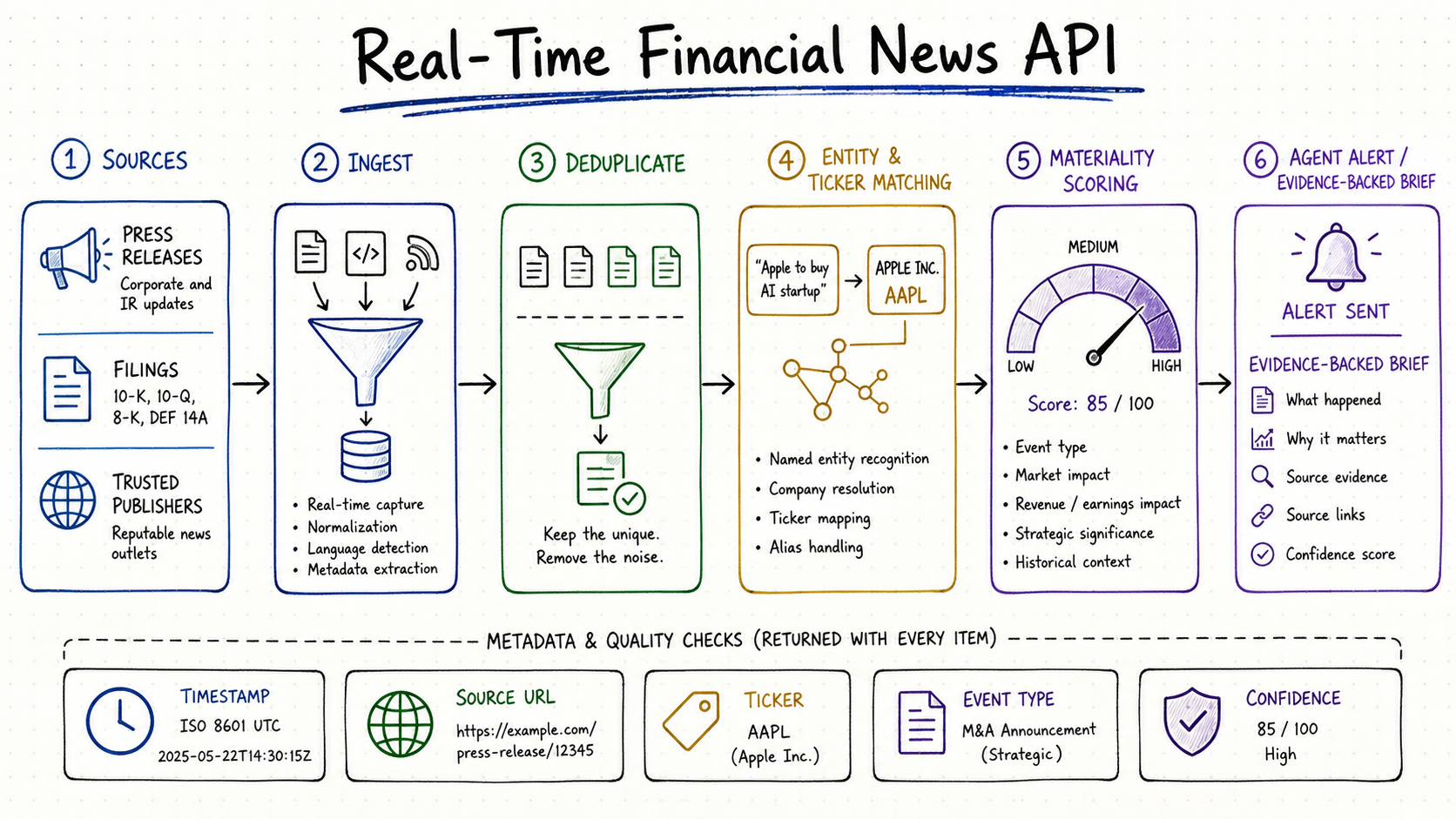
Real-time financial news is a pipeline, not a single timestamp. A company publishes a filing or press release, a source ingests it, the provider normalizes and tags it, the API delivers it, and your application processes it. Measuring only API response time ignores most of the delay.
Coverage also has layers: general market headlines, company news, regulatory filings, investor-relations releases, analyst actions, macro events, and licensed publisher content. A feed can be fast for press releases yet weak for editorial news, or broad in headlines while offering only links rather than licensed full text.
AI systems need more than sentiment. They need stable article IDs, canonical URLs, source and publication time, related tickers, duplicate clusters, corrected-story handling, and an evidence path back to the original item.
Provider comparison: access, fields, and limits
| Provider | Free entry | Delivery | Important boundary |
|---|---|---|---|
| Finnhub | Company news and market news endpoints | REST updates; premium WebSocket for real-time news | North American scope and plan-specific history |
| Alpha Vantage | Free API key | REST news and sentiment | Rate limits and licensed content fields vary |
| Finlight | Developer evaluation by current plan | REST plus documented webhooks | Confirm plan, source, and full-text rights |
| Twelve Data press releases | Basic plan and above | REST filtered by symbol, exchange, date, language | Press releases are not the same as editorial news |
Provider-by-provider notes: where the free tier stops
Finnhub's plan table and API documentation separate two useful concepts. Company-news REST access can include recent history and new updates on the free plan, while the low-latency news WebSocket is labeled premium. A polling prototype can therefore be free without being equivalent to a continuous premium stream.
Alpha Vantage is useful when a prototype needs ticker and topic filters plus provider-generated sentiment in one response. Validate article coverage, duplicate behavior, timestamps, and free-key throughput. Treat sentiment as enrichment and retain the source URL and original text evidence for any conclusion.
Finlight documents webhooks for event-driven delivery, which can be a better production pattern than aggressive polling. The engineering burden moves to signature verification, idempotent consumers, retries, dead-letter storage, and replay. Confirm which sources and fields are included in the current plan before promising real-time coverage.
Twelve Data's press-release endpoint is valuable for official corporate announcements filtered by symbol, exchange, date, or language. It should be classified as first-party event content rather than a complete editorial-news replacement. A robust research product often combines releases, filings, and licensed journalism.
The fields that decide whether the data is usable
Track source publication time, provider ingestion time, API availability time, and application processing time.
Retain publisher, canonical URL, document type, language, and whether content is original, syndicated, or a press release.
Ticker tagging must handle subsidiaries, competitors, ETFs, ambiguous names, and articles mentioning a company only in passing.
Polling, WebSocket, and webhooks have different failure modes. Define retry, ordering, replay, and duplicate behavior.
Which option fits your workload?
Free REST updates can work when a minute-scale poll is acceptable. Deduplicate stories and store the last successful cursor or publication time.
Prefer WebSocket or webhook delivery with measured source-to-application latency, reconnect or retry behavior, and a replay endpoint.
Keep article-level evidence and model version, cluster syndications, and show distribution rather than collapsing a day into one unexplained score.
Require source class, freshness, entity confidence, corroboration, policy approval, and risk limits. One headline or one sentiment score should never authorize an irreversible action.
A practical evaluation and implementation playbook
Use earnings, M&A rumors, regulatory filings, analyst actions, and corrected stories to measure recall, precision, and latency.
Syndicated stories and minor headline edits should cluster without hiding genuinely new facts.
Verify signatures, store delivery IDs, make consumers idempotent, retry with backoff, and provide a replay path.
Require source class, confidence, freshness, and corroboration rules before news triggers a trade or external action.
Common mistakes that make a free API expensive
A one-minute poll has a built-in delay even if the upstream item is available instantly.
A score should link to the article and model/version that produced it.
Receiving a headline and URL does not grant permission to store or republish the article body.
Ten syndications of one press release are one event, not ten independent confirmations.
Where QVeris fits in the workflow
QVeris is a capability discovery and routing layer for agents. It can help an agent find, inspect, and call financial capabilities, but it does not replace the underlying data provider's license, entitlement, or source-of-truth obligations.
- QVeris can expose news, filings, and market-data capabilities through a common discovery and inspection workflow for agents.
- Each answer should preserve article ID, source, canonical URL, publication time, retrieval time, related entities, and provider.
- Content licenses and automated-action policy remain separate controls; a capability route does not remove either obligation.
FAQ
There is no universal winner. Measure source-to-application latency for the event types and companies you care about.
Free REST updates exist, but low-latency WebSockets, premium publishers, full text, and commercial rights often require paid plans.
WebSocket fits continuous subscriptions; webhooks fit server-to-server events. Both need reconnect or retry and replay design.
Not from one score alone. Require provenance, freshness, entity checks, corroboration, risk limits, and human or policy approval.
Sources, methodology, and update policy
This guide compares public documentation and evaluates providers by workload, data freshness, structure, delivery, legal use, and upgrade path. It does not treat a marketing label as proof of real-time coverage.
Provider features and commercial terms can change. Official documentation linked below is the source of truth; run a representative data test and obtain appropriate rights before production deployment.