
Real-Time Stock API vs
Delayed Stock API实时股票 API 与
延迟股票 API 对比
Understand how data delay changes monitoring, research, alerting, cost, and source requirements for AI agent workflows.
了解数据延迟如何改变 AI Agent 的监控、研究、预警、成本和来源要求。
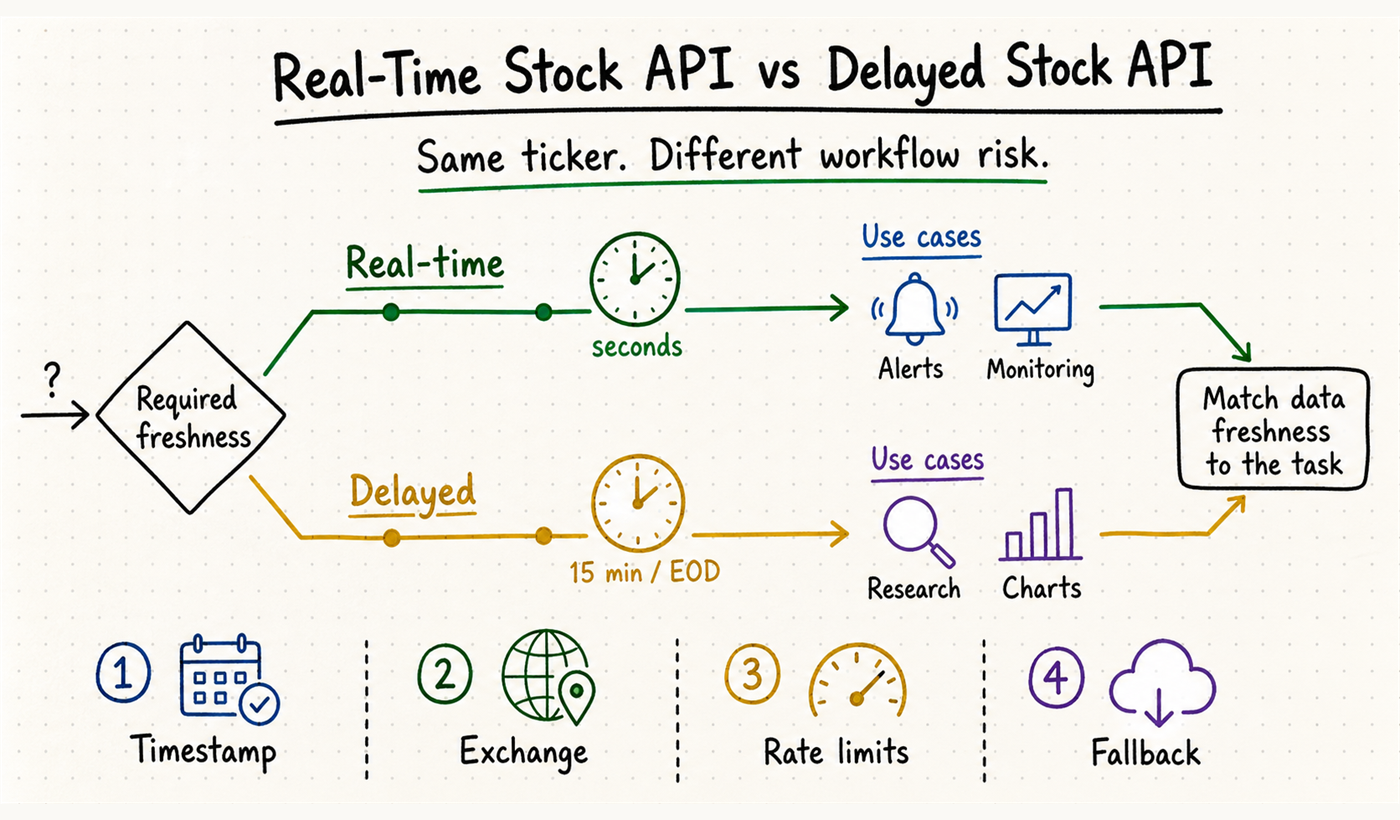
What Real-Time Stock API vs Delayed Stock API Means实时股票 API 与延迟股票 API 到底是什么意思
A real-time stock API returns prices, trades, or quotes close to the moment they occur. Depending on the provider and exchange, “real time” can mean live tick data, near-live snapshots, or rapid intraday updates. It is usually more expensive because exchange licensing and infrastructure costs are higher.实时股票 API 会返回接近事件发生时刻的价格、交易或报价。根据供应商和交易所规则,“实时”可能代表逐笔数据、接近实时快照,或快速盘中更新。它通常更贵,因为交易所授权和基础设施成本更高。
A delayed stock API returns market data after a lag, often 15 minutes, end-of-day, or another provider-specific delay. Delayed data is useful for research drafts, educational tools, prototypes, and charts where exact live pricing is not the product promise.延迟股票 API 会在一段时间后返回市场数据,常见是 15 分钟延迟、日终数据,或供应商自定义延迟。延迟数据适合研究草稿、教育工具、原型和不承诺实时价格的图表应用。
When You Need a Real-Time Stock API什么时候必须使用实时股票 API
If a user expects an alert when price, spread, or volume crosses a threshold, delayed data can make the signal late.如果用户希望价格、价差或成交量突破阈值时收到提醒,延迟数据会让信号滞后。
Customer-facing dashboards should clearly state whether data is live, delayed, or end-of-day.面向客户的仪表盘必须清楚说明数据是实时、延迟还是日终。
Agents monitoring unusual moves need fresh quotes, session status, volume, and timestamps.监控异常波动的 Agent 需要新鲜报价、交易时段状态、成交量和时间戳。
Any workflow near order routing, risk, or portfolio action needs strict freshness and compliance review.任何接近下单路由、风险或组合操作的流程,都需要严格的新鲜度和合规审查。
When the agent explains breaking news impact, stale prices can distort the narrative.当 Agent 解释突发新闻影响时,过期价格会扭曲叙事。
If reports imply current portfolio value, delayed data must be labeled or avoided.如果报告暗示当前组合价值,延迟数据必须标注或避免使用。
When a Delayed Stock API Is Enough什么时候延迟股票 API 已经够用
Delayed stock APIs are not bad. They are often the right choice when the user is learning, prototyping, researching, or comparing historical patterns. The problem starts when the product implies live decision-making but quietly uses delayed data.延迟股票 API 并不差。用户在学习、原型验证、研究或对比历史模式时,延迟数据往往就是正确选择。真正的问题是产品暗示实时决策,却悄悄使用延迟数据。
| Use case场景 | Delayed API fit延迟 API 是否适合 | Reason原因 |
|---|---|---|
| Education and demos教育和演示 | Usually enough通常足够 | The user needs structure and examples more than live execution.用户更需要结构和示例,而不是实时执行。 |
| Research drafts研究草稿 | Often enough通常可以 | Historical context, filings, and fundamentals matter more than a tick-by-tick quote.历史背景、文件和基本面比逐笔报价更重要。 |
| Backtesting回测 | Enough if history is clean历史数据干净就够 | Adjusted prices, splits, dividends, and survivorship handling matter most.复权、拆股、分红和生存者偏差处理更重要。 |
| Live alerts实时预警 | Usually not enough通常不够 | The alert can arrive after the market already moved.提醒可能在市场已经波动后才到达。 |
| Trading workflows交易工作流 | Not enough不够 | Latency, licensing, and compliance requirements are stricter.延迟、授权和合规要求更严格。 |
Why Free Stock APIs Are Often Delayed为什么免费股票 API 经常是延迟数据
Real-time market data is rarely free at scale because exchanges charge for redistribution, display, and commercial use. Providers also need infrastructure for low-latency ingestion, normalization, uptime, and burst traffic. A free stock API may therefore offer delayed quotes, limited symbols, end-of-day data, or strict rate limits.大规模实时市场数据很少真正免费,因为交易所会对再分发、展示和商业使用收费。供应商还需要低延迟采集、标准化、可用性和突发流量基础设施。因此免费股票 API 往往提供延迟报价、有限股票、日终数据或严格速率限制。
That does not make free APIs useless. It means developers must label data freshness and route important tasks to better sources when accuracy, timing, or customer trust matters.这并不代表免费 API 没用,而是开发者必须标注数据新鲜度,并在准确性、时效性或客户信任重要时,将关键任务路由到更好的来源。
Real-Time vs Delayed Stock API Comparison实时与延迟股票 API 对比表
| Dimension维度 | Real-time stock API实时股票 API | Delayed stock API延迟股票 API |
|---|---|---|
| Latency延迟 | Seconds, near-live, or exchange-defined real-time feed.秒级、接近实时,或交易所定义的实时数据。 | Often 15 minutes, end-of-day, or provider-specific delay.通常 15 分钟、日终,或供应商自定义延迟。 |
| Cost成本 | Higher due to exchange licensing, infrastructure, and commercial rights.由于交易所授权、基础设施和商业权利,成本更高。 | Lower and common in free tiers, demos, and prototype plans.成本更低,常见于免费层、演示和原型套餐。 |
| Best use适合用途 | Alerts, monitoring, live dashboards, risk checks, customer-facing updates.预警、监控、实时仪表盘、风险检查、面向客户的更新。 | Research drafts, education, historical charts, low-risk prototypes.研究草稿、教育、历史图表、低风险原型。 |
| Agent riskAgent 风险 | Higher cost if the agent over-calls without routing or caching.如果 Agent 没有路由或缓存,过度调用会导致成本高。 | Higher accuracy risk if the agent presents stale data as current.如果 Agent 把过期数据说成当前数据,准确性风险更高。 |
| Required metadata必要元数据 | Timestamp, exchange, session status, quote condition, source.时间戳、交易所、交易时段状态、报价条件、来源。 | Delay label, as-of time, source, and update frequency.延迟标签、截至时间、来源和更新频率。 |
How AI Agents Should Handle Stock API DelayAI Agent 应如何处理股票 API 延迟
Example: Routing Real-Time and Delayed Stock APIs示例:路由实时与延迟股票 API
A reliable agent does not treat every quote as equivalent. It checks the task first, then decides whether delayed data is acceptable.可靠的 Agent 不会把所有报价都当成等价数据。它会先检查任务,再判断延迟数据是否可以接受。
# Route by freshness requirement
task = "alert me if TSLA moves more than 3% intraday"

capabilities = qveris.discover("real-time stock quote with timestamp")
quote_tool = qveris.inspect("market.real_time_quote")

if quote_tool.delay_minutes > 0:
    quote_tool = qveris.discover("live stock price API fallback")[0]

quote = qveris.call(
    capability=quote_tool.id,
    params={"symbol": "TSLA", "include_timestamp": True}
)

agent.respond(
    data=quote,
    disclose_freshness=True,
    require_source=True
)
How QVeris Routes Real-Time and Delayed Stock DataQVeris 如何路由实时与延迟股票数据
QVeris helps agents treat data freshness as a routing signal. Instead of hardcoding one provider, an agent can discover available stock data capabilities, inspect latency and cost, and call the source that fits the task. A research summary can use delayed or lower-cost data; a live alert can route to a fresher source.QVeris 帮助 Agent 把数据新鲜度当作路由信号。Agent 不必硬编码一个供应商,而是可以发现可用股票数据能力,检查延迟和成本,并调用适合任务的来源。研究摘要可以使用延迟或低成本数据;实时预警可以路由到更新鲜的来源。
This is especially useful when building AI stock research agents, market monitoring agents, and developer tools that move from prototype to production. The same workflow can start with free or delayed data and upgrade only when the task requires it.这对 AI 股票研究 Agent、市场监控 Agent 和从原型走向生产的开发者工具尤其有用。同一个工作流可以从免费或延迟数据开始,只在任务需要时升级。
Real-Time Stock API vs Delayed Stock API FAQ实时股票 API 与延迟股票 API 常见问题
No. It is useful for research, education, prototypes, and historical analysis. It becomes risky when presented as live data.不是。它适合研究、教育、原型和历史分析。风险来自把它当作实时数据展示。
Many free stock APIs use 15-minute delay, end-of-day data, limited symbols, or plan-specific rules.很多免费股票 API 使用 15 分钟延迟、日终数据、有限股票,或按套餐定义的规则。
No. The need depends on task intent. Alerts and live monitoring need freshness; research drafts may not.不一定。取决于任务意图。预警和实时监控需要新鲜度,研究草稿未必需要。
At minimum: timestamp, exchange, delay status, source, currency, and update time.至少应包括时间戳、交易所、延迟状态、来源、币种和更新时间。
Exchange licensing, redistribution rights, infrastructure, uptime, and low-latency ingestion increase cost.交易所授权、再分发权、基础设施、可用性和低延迟采集都会提高成本。
QVeris lets agents inspect freshness, cost, schema, and provider fit before calling a market data capability.QVeris 让 Agent 在调用市场数据能力前检查新鲜度、成本、Schema 和供应商匹配度。