
Real-Time Stock Data API for AI Agents and Tools 面向 AI Agent 与工具的实时股票数据 API
AI agents need more than a last price. They need real-time quotes, movers, latency context, timestamps, source quality, and routing logic before they can monitor markets reliably.
AI Agent 需要的不只是最新价格。它还需要实时报价、市场异动、延迟背景、时间戳、来源质量和路由逻辑,才能可靠监控市场。
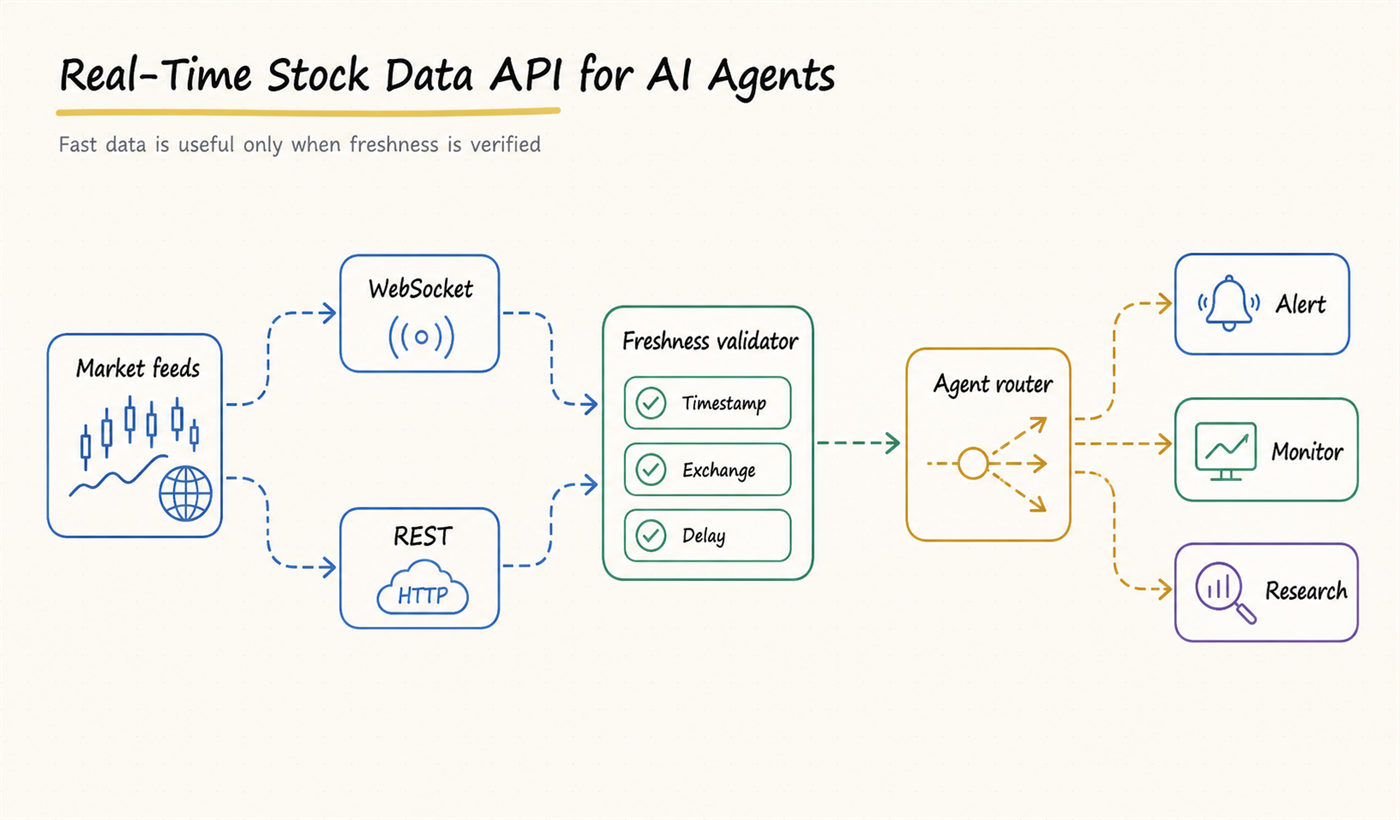
What Is a Real-Time Stock Data API for AI Agents? 什么是面向 AI Agent 的实时股票数据 API?
A real-time stock data API gives agents current market information: price, volume, market session, top movers, and source timestamps. For AI agents, the key issue is not only access. The agent must know whether the data is live, delayed, reliable, and appropriate for the task.
实时股票数据 API 为 Agent 提供当前市场信息:价格、成交量、交易时段、涨跌榜和来源时间戳。对 AI Agent 来说,关键不只是能访问数据,而是要知道数据是否实时、是否延迟、是否可靠、是否适合当前任务。
What Real-Time Stock Data Agents Actually Need 实时股票数据 Agent 真正需要什么
Current price, bid, ask, volume, change, exchange, currency, and timestamp.
当前价格、买价、卖价、成交量、涨跌幅、交易所、币种和时间戳。
Gainers, losers, unusual volume, gap moves, sector movement, and intraday momentum.
涨跌榜、异常成交量、跳空、板块变化和盘中动量。
News, filings, earnings, prior close, historical range, and alerts that explain the move.
新闻、公告、财报、前收盘价、历史区间和解释波动的预警。
What to Compare Before Choosing an API 选择 API 前应该比较什么
| Factor 维度 | Why it matters for agents 为什么对 Agent 重要 |
|---|---|
| Latency 延迟 | A market monitoring agent needs to know whether a quote is live, delayed, or end-of-day. 市场监控 Agent 必须知道报价是实时、延迟还是收盘数据。 |
| Source timestamp 来源时间戳 | Without timestamps, the agent cannot judge freshness or explain risk. 没有时间戳,Agent 无法判断新鲜度或解释风险。 |
| Schema consistency Schema 一致性 | Agents need stable fields for symbol, exchange, price, change, volume, and market status. Agent 需要稳定字段表示代码、交易所、价格、涨跌幅、成交量和市场状态。 |
| Fallback 备用路由 | When one source fails, the agent should route to another suitable capability. 当一个来源失败时,Agent 应路由到另一个合适能力。 |
Common API Options for Real-Time Stock Data 实时股票数据 API 的常见选项
Best for simple lookup workflows, watchlists, and lightweight research tools.
适合简单查询、观察列表和轻量研究工具。
Best for live dashboards, alert loops, and applications that react during a trading session.
适合实时看板、预警循环和交易时段内响应的应用。
Best for agents that need quotes, movers, news, filings, and fallback across tools.
适合需要报价、异动、新闻、公告和跨工具 fallback 的 Agent。
Why Real-Time Stock APIs Are Hard for AI Agents 为什么实时股票 API 对 AI Agent 很难
A human developer can read documentation and choose an endpoint. An AI agent needs runtime signals. It must know which tool supports real-time data, which parameter name to use, whether the market is open, whether the quote is delayed, and what to do when the call fails.
人类开发者可以读文档并选择端点。AI Agent 需要运行时信号。它必须知道哪个工具支持实时数据、该用哪个参数名、市场是否开盘、报价是否延迟,以及调用失败时该怎么办。
An agent should not describe a quote as live unless the source confirms freshness.
除非来源确认新鲜度,否则 Agent 不应把报价描述为实时。
One tool may expect ticker, another symbol, exchange, or composite identifiers.
一个工具可能需要 ticker,另一个可能需要 symbol、exchange 或复合标识。
Market movement often needs filings, earnings, news, and historical context.
市场波动通常还需要公告、财报、新闻和历史背景。
How QVeris Routes Real-Time Market Data Calls QVeris 如何路由实时市场数据调用
Search for real-time quote, market movers, volume spike, sector move, or stock news capabilities.
搜索实时报价、市场异动、异常成交量、板块异动或股票新闻能力。
free discoveryReview latency, timestamp fields, symbol inputs, exchange coverage, cost, and source quality.
检查延迟、时间戳字段、代码输入、交易所覆盖、成本和来源质量。
schema awareSend clean JSON to research agents, alert systems, dashboards, and market monitors.
把干净的 JSON 返回给研究 Agent、预警系统、看板和市场监控。
agent readyDecision Matrix for Real-Time Stock Data APIs 实时股票数据 API 决策矩阵
| If you need... 如果你需要... | Choose... 优先选择... |
|---|---|
| A simple price lookup 简单价格查询 | A stock quote API with clear timestamps 带清晰时间戳的股票报价 API |
| Live monitoring during market hours 交易时段实时监控 | Real-time stock data plus market movers 实时股票数据加市场异动 |
| Research reports with market context 带市场背景的研究报告 | Stock data plus filings, earnings, and news 股票数据加公告、财报和新闻 |
| Production AI agent workflows 生产级 AI Agent 工作流 | QVeris capability routing and fallback QVeris 能力路由和 fallback |
What “Real Time” Must Mean先说清楚什么才算“实时”
Real time can mean a live exchange feed, a consolidated stream, a vendor-normalized update, or a snapshot requested on demand. Choose an API only after defining what the agent actually needs.
“实时”可能指交易所原始数据、综合行情、供应商标准化数据流,也可能只是按需获取的快照。选 API 之前,应先明确 Agent 真正需要哪一种。
Return both the source timestamp and retrieval time so the agent can calculate age. Also state whether “price” means the latest trade, bid, ask, midpoint, previous close, or another field.
同时返回来源时间与获取时间,让 Agent 能计算数据年龄;还要说明“价格”究竟指最新成交、买价、卖价、中间价还是前收盘价。
Premarket, regular hours, after-hours, auctions, halts, and holidays behave differently. Include session status and market-calendar context so a quiet feed is not automatically treated as a failure.
盘前、常规交易、盘后、集合竞价、停牌和节假日的行为不同。应返回交易时段状态与市场日历,避免把正常的无更新误判成故障。
Tick data is detailed but expensive and difficult to order. For screening, charts, and monitoring, a well-defined second or minute aggregate often gives the agent more useful context.
逐笔数据很细,但成本高、排序复杂。对于筛选、图表和监控,定义清楚的秒级或分钟级聚合通常更适合 Agent 使用。
Confirm whether the data may be displayed, stored, analyzed, sent to a model, or redistributed in an agent response. A working API key does not prove that every planned use is permitted.
确认数据是否可以展示、存储、分析、发送给模型,或通过 Agent 响应再次分发。API Key 能调用,并不代表所有计划用途都获得许可。
Data Quality Agents Can Trust让 Agent 真正信得过的数据质量
Live feeds can be late, duplicated, out of order, or incomplete. Clean these problems in a deterministic data layer before the result reaches the language model.
实时数据可能延迟、重复、乱序或缺失。应在结果进入语言模型之前,由确定性数据层处理这些问题。
Validate schemas, reorder within a bounded window, remove duplicates, and detect sequence gaps. Keep raw references long enough to investigate unusual values.
验证 Schema、在有限窗口内重排、去重并检测序列缺口,同时保留原始引用,以便调查异常数值。
Splits, dividends, mergers, and symbol changes affect historical comparison. Return adjustment flags and event identifiers so a split does not look like a market collapse.
拆股、分红、合并和代码变化会影响历史可比性。返回复权标志与事件 ID,避免把拆股误判成价格崩跌。
Map vendor symbols to stable identifiers, exchanges, currencies, share classes, and active dates. Ask for clarification when one symbol could represent more than one instrument.
把供应商代码映射到稳定标识符、交易所、币种、股份类别和有效日期。一个代码对应多个证券时,应要求用户消歧。
For high-impact workflows, compare a sample with a secondary source. If values diverge beyond a defined tolerance, preserve both observations and mark the result for review instead of forcing the agent to choose.
对于影响较大的工作流,可以抽样与第二来源对账。偏差超过设定阈值时,应保留双方观察值并标记复核,而不是强迫 Agent 随意选择一个数字。
Reliable Alerts Without Alert Fatigue可靠预警,而不是更多噪音
A real-time agent should not call a language model for every tick. Let deterministic processing find candidate events, then use the model only where explanation and prioritization add value.
实时 Agent 不应为每个 Tick 都调用语言模型。先由确定性处理发现候选事件,再只在需要解释和判断优先级时使用模型。
Maintain state, calculate thresholds, detect anomalies, and suppress duplicates with reproducible rules. This controls cost and prevents market bursts from creating model-call bursts.
用可复现规则维护状态、计算阈值、发现异常并抑制重复,既控制成本,也避免市场突发流量变成模型调用洪峰。
Include triggering values, source timestamps, baseline, related news or filings, and alert status. The explanation should cite the same data that actually triggered the rule.
附上触发值、来源时间、比较基线、相关新闻或公告,以及预警状态。解释引用的数据必须与实际触发规则的数据一致。
Use bounded queues, quotas, and priorities. If explanation falls behind, send a basic deterministic alert and show feed health or last-good time rather than presenting cached data as live.
使用有界队列、配额和优先级。解释层处理不过来时,先发送基础预警,并显示数据源健康状态或最后正常时间,不能把缓存当成实时数据。
Replay openings, closings, halts, gaps, stale feeds, out-of-order events, and provider failover before launch. QVeris can route the quote, history, news, or filing capability for each stage while preserving the chosen source and fallback decision in the trace.
上线前应回放开盘、收盘、停牌、跳空、陈旧数据、事件乱序和供应商切换。QVeris 可以为每个阶段路由报价、历史、新闻或公告能力,并在追踪记录中保留来源与回退决策。
Real-Time Stock Data API FAQ实时股票数据 API 常见问题
Real-time data is delivered within the latency allowed by the feed and entitlement, while delayed data intentionally trails the market by a defined interval. Always check the source timestamp and session rather than relying only on a “real-time” label.
Use streaming for continuous monitoring and event detection. Use REST or snapshot calls for on-demand research, confirmation, and bounded historical windows. Many production systems combine both: deterministic streaming creates an event, then the agent calls other APIs for context.
No. A latest price lacks spread, liquidity, session, venue, freshness, and event context. Execution-sensitive workflows also need stricter validation, permissions, risk controls, and human or deterministic approval outside the language model.
At minimum: stable instrument identity, exchange or venue, source timestamp, retrieval timestamp, timezone, session status, currency, field definition, units, and freshness. Streaming responses should also expose sequence or gap information where available.
实时数据会在数据源与授权允许的延迟范围内交付,延迟数据则会有意落后市场一个明确时间。判断时要查看来源时间戳和交易时段,不能只看“实时”标签。
持续监控与事件发现更适合流式数据,按需研究、确认和有限历史窗口更适合 REST 或快照调用。生产系统常把两者结合:确定性流处理先发现事件,再由 Agent 调用其他 API 补充背景。
不可以。最新价缺少价差、流动性、交易时段、场所、新鲜度和事件背景。与执行相关的流程还需要更严格的验证、权限、风控,以及语言模型之外的人工或确定性审批。
至少应包含稳定证券身份、交易所或场所、来源时间、获取时间、时区、交易时段状态、币种、字段定义、单位与新鲜度。流式响应还应在可用时提供序列或缺口信息。
Build Real-Time Stock Workflows with QVeris 用 QVeris 构建实时股票工作流
Real-time stock APIs provide market data. QVeris helps agents discover the right capability, inspect freshness and schema, call the correct tool, and add filing or news context when price data alone is not enough. For broader comparison, see the QVeris stock API comparison guide, Polygon.io, Alpha Vantage docs, and official filings from SEC EDGAR.
实时股票 API 提供市场数据。QVeris 帮助 Agent 发现合适能力、检查新鲜度和 Schema、调用正确工具,并在单纯价格不够时补充公告或新闻背景。更完整的比较可参考 QVeris 的 股票 API 对比指南、Polygon.io、Alpha Vantage 文档 和 SEC EDGAR 官方公告。