
Requesty Alternatives
By Operating Responsibility
Requesty 替代方案:按运营责任选择
Managed routing removes infrastructure work, but the decision still hinges on provider economics, policy depth, telemetry ownership, and the cost of leaving the normalized API later.
托管路由减少基础设施工作,但最终选择仍取决于供应商经济性、策略深度、遥测归属,以及未来退出标准化 API 的成本。
TL;DR
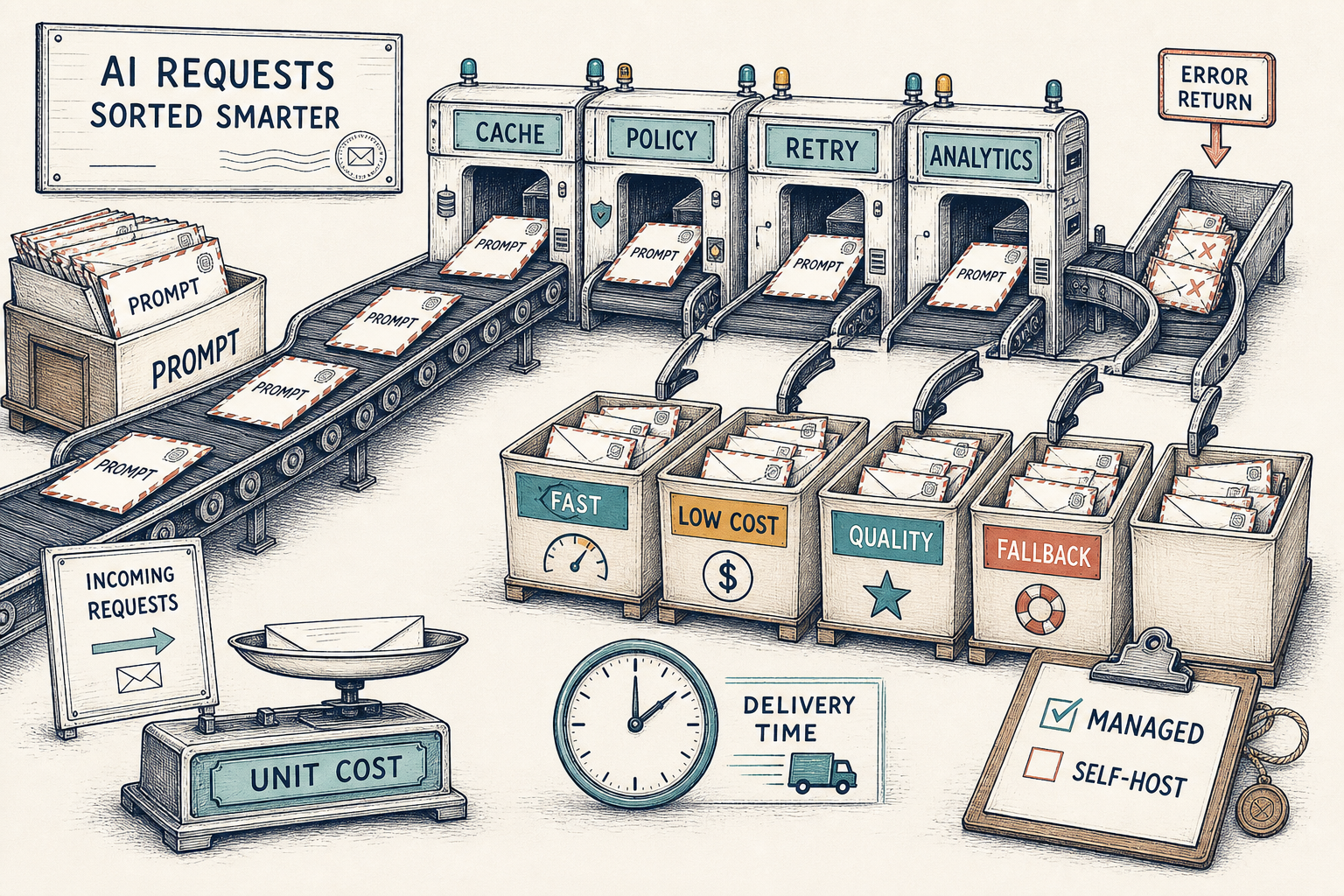
Its documentation highlights an OpenAI-compatible endpoint, hundreds of models, fallback, caching, analytics, load balancing, BYOK, guardrails, and access controls.
The service owns availability and upgrades; your team still owns routing intent, budget policy, provider contracts, and application failure behavior.
A common API speeds switching, but model-native capabilities and error semantics can still leak through the abstraction.
It complements an LLM router when agents must discover and invoke data sources and tools.
其文档强调 OpenAI 兼容端点、数百模型、回退、缓存、分析、负载均衡、BYOK、护栏与访问控制。
服务负责可用性与升级;团队仍需负责路由意图、预算策略、供应商合同和应用故障行为。
通用 API 加快切换,但模型原生能力与错误语义仍可能穿透抽象层。
当智能体需要发现并调用数据源与工具时,它与 LLM 路由器互补。
Define what “managed routing” must own 定义“托管路由”必须承担什么
Health checks, provider failover, retry safety, regional incidents, status communication, and recovery objectives.
Provider price, intermediary fees, caching savings, failed-request charges, commitments, budget enforcement, and invoice reconciliation.
Identity, tenant isolation, model allowlists, guardrails, key custody, audit exports, retention, and approval workflows.
Timeouts, idempotency, partial streaming, schema validation, fallbacks that change quality, and user-visible degradation.
健康检查、供应商回退、重试安全、区域事故、状态沟通与恢复目标。
供应商价格、中间层费用、缓存节省、失败请求费用、承诺、预算执行与账单核对。
身份、租户隔离、模型白名单、护栏、密钥托管、审计导出、保留与审批。
超时、幂等、部分流式、结构定义验证、改变质量的回退与用户可见降级。
Eight Requesty alternatives by ownership model 按责任模型划分的 8 个 Requesty 替代方案
| Option 选项 | Primary fit 主要适配 | Ownership shift 责任变化 |
|---|---|---|
| Portkey | Managed gateway with deep policy and observability 深度策略与可观测的托管网关 | Broader platform evaluation 需要评估更广平台范围 |
| Vercel AI Gateway | App teams using Vercel and AI SDK 使用 Vercel 与 AI SDK 的应用团队 | Closer platform affinity 更强平台亲和 |
| Cloudflare AI Gateway | Edge-native routing and analytics 边缘原生路由与分析 | Edge platform becomes control boundary 边缘平台成为控制边界 |
| OpenRouter | Model marketplace and broad LLM access 模型市场与广泛 LLM 访问 | Procurement model changes 采购模式发生变化 |
| LiteLLM | Self-hosted, configurable multi-provider proxy 自托管可配置多供应商代理 | Operations move to your team 运维转移给团队 |
| Bifrost | High-throughput focused data plane 高吞吐专用数据面 | Control-plane design moves to your team 控制面设计转移给团队 |
| Kong AI Gateway | Enterprise API platform reuse 复用企业 API 平台 | More platform administration 更多平台管理 |
| Direct provider APIs | Native features and direct contracts 原生功能与直接合同 | All routing and reliability return in-house 全部路由和可靠性回归内部 |
Calculate the cost of the whole request 计算完整请求成本
Model price is only one line. Add platform or plan fees, any intermediary charge, cache storage, data transfer, observability retention, support, failed and retried requests, and engineering time. Then subtract measured cache hits and operator hours avoided. Because published terms can change, attach a date and source to every price assumption rather than repeating an undated percentage.
模型价格只是其中一行。还要加入平台或套餐费、中间层费用、缓存存储、数据传输、可观测保留、支持、失败与重试请求、工程时间,再减去实测缓存命中和节省的运维工时。公开条款会变化,因此每个价格假设都应附日期和来源,不应重复无日期的比例。
A five-failure proof test 五类故障验证测试
- Throttle the primary provider and confirm route choice, retry count, latency ceiling, and budget impact.
- Break a streaming response after partial output and observe whether the client can recover safely.
- Return malformed structured output and verify validation, repair policy, and attribution.
- Rotate and revoke a provider key while active requests are running.
- Lose telemetry export and prove requests remain safe while evidence loss is alerted.
- 对主供应商限流,确认路由选择、重试次数、延迟上限与预算影响。
- 在部分流式输出后中断,观察客户端能否安全恢复。
- 返回异常结构化输出,验证校验、修复策略与归因。
- 在活动请求期间轮换并撤销供应商密钥。
- 中断遥测导出,证明请求仍安全且证据丢失能及时告警。
Pass condition: every failure has an expected owner, bounded user impact, traceable routing decision, and reconciled cost.
通过条件:每类故障都有明确负责人、受限用户影响、可追踪路由决策与可核对成本。
Migrate policies before endpoints 先迁移策略,再切端点
Export routes, weights, fallback order, cache rules, keys, model aliases, budgets, guardrails, tenant mappings, dashboards, and retention settings. Express them as a versioned traffic contract. Shadow requests to the candidate without serving output, compare model selection and telemetry, then canary one tenant. Keep an application-level bypass until provider errors and invoice totals reconcile.
导出路由、权重、回退顺序、缓存规则、密钥、模型别名、预算、护栏、租户映射、看板与保留设置,并写成版本化流量合同。先影子发送到候选方案而不返回输出,比较模型选择和遥测,再选择一个租户 Canary。供应商错误与账单总额核对前,保留应用级旁路。
Add a governed capability layer after routing 在路由之后加入受治理能力层
Requesty or another gateway selects and calls a model. QVeris helps the resulting agent discover a data source, API, or tool; inspect its contract; invoke it with controlled credentials; and preserve evidence. One trace context should span inference, routing, and tool execution.
Requesty 或其他网关选择并调用模型;QVeris 帮助生成的智能体发现数据源、API 或工具,检查契约,使用受控凭证调用并保留证据。一个调用链上下文应贯穿推理、路由与工具执行。
A Production Evaluation Plan for Requesty alternativesRequesty 替代方案的生产评估方案
A feature table can identify candidates, but it cannot prove operational fit. Evaluate Requesty alternatives with the workloads, policies, failure conditions, and evidence requirements that the team will actually own after migration.
功能表可以帮助筛选候选方案,却无法证明生产适配性。评估Requesty 替代方案时,应使用团队迁移后真正需要承担的工作负载、策略、失败条件和证据要求。
Inventory representative requests and record provider routing, request transformation, budget policy, caching, fallbacks, analytics, data residency, and team-level controls. Include volumes, tail latency, quality thresholds, regulated data, operator steps, monthly spend, and the incidents the current system already knows how to handle.
盘点有代表性的请求,并记录供应商路由、请求转换、预算策略、缓存、故障切换、分析、数据驻留和团队级控制。同时纳入流量、长尾延迟、质量门槛、受监管数据、人工步骤、月度支出,以及现有系统已经能够处理的事故类型。
To validate Requesty Alternatives, replay saved cases against each candidate. Compare accepted parameters, streaming events, structured output, tool calls, error classes, usage accounting, and source metadata. Mark every difference as required, adaptable, or a migration blocker.
验证“Requesty 替代方案”时,用保存的案例重放每个候选方案,比较参数、流式事件、结构化输出、工具调用、错误类别、用量计量和来源元数据,并将差异标记为必须保留、可以适配或阻断迁移。
To validate Requesty Alternatives, measure end-to-end task completion, output quality, p50 and tail latency, availability, retry amplification, fallback behavior, and accepted-result cost. Include rate limits, malformed responses, regional loss, schema drift, and provider outages.
验证“Requesty 替代方案”时,衡量端到端任务完成率、输出质量、常规与长尾延迟、可用性、重试放大、故障切换行为和合格结果成本,并加入限流、畸形响应、区域丢失、Schema 漂移与供应商中断。
Before rolling out Requesty Alternatives, version routing and policy outside the vendor, preserve trace identifiers, stage read-only traffic first, define rollback signals, and retain a direct-provider or previous-platform path until evidence meets the acceptance threshold.
上线“Requesty 替代方案”前,在供应商之外版本化路由与策略,保留追踪标识,先迁移只读流量,定义回滚信号,并在证据达到验收门槛前保留直连供应商或原平台路径。
FAQ
It provides broad model access, but evaluate whether your intended flow uses platform-provided access, BYOK, or direct provider contracts.
LiteLLM and Bifrost are focused candidates. Ease depends on identity, telemetry, upgrades, scaling, and incident ownership—not installation alone.
Yes for repeatable workloads, but measure semantic correctness, privacy boundaries, invalidation, storage, and cache fees.
No. QVeris is a complementary external capability layer, not a multi-model inference router.
它提供广泛模型访问,但应确认实际流程使用平台访问、BYOK 还是直接供应商合同。
LiteLLM 与 Bifrost 是专用候选。易用性取决于身份、遥测、升级、扩容和事故责任,而非仅安装。
可重复工作负载通常可以,但要评估语义正确性、隐私边界、失效策略、存储与缓存费用。
不会。QVeris 是互补的外部能力层,而非多模型推理路由器。