
Net profit margin销售净利率
Net income ÷ RevenueShows how much profit remains from each unit of revenue after expenses, interest, and taxes.
反映每单位收入扣除成本、费用、利息和税项后剩余多少利润。
Return on equity explained clearly: calculate ROE with average shareholders’ equity, decompose it with DuPont analysis, and test whether the result reflects operations or leverage.
净资产收益率ROE用于衡量企业以股东权益创造净利润的效率;正确分析需要使用平均股东权益、进行杜邦分解,并判断结果来自经营改善还是财务杠杆。
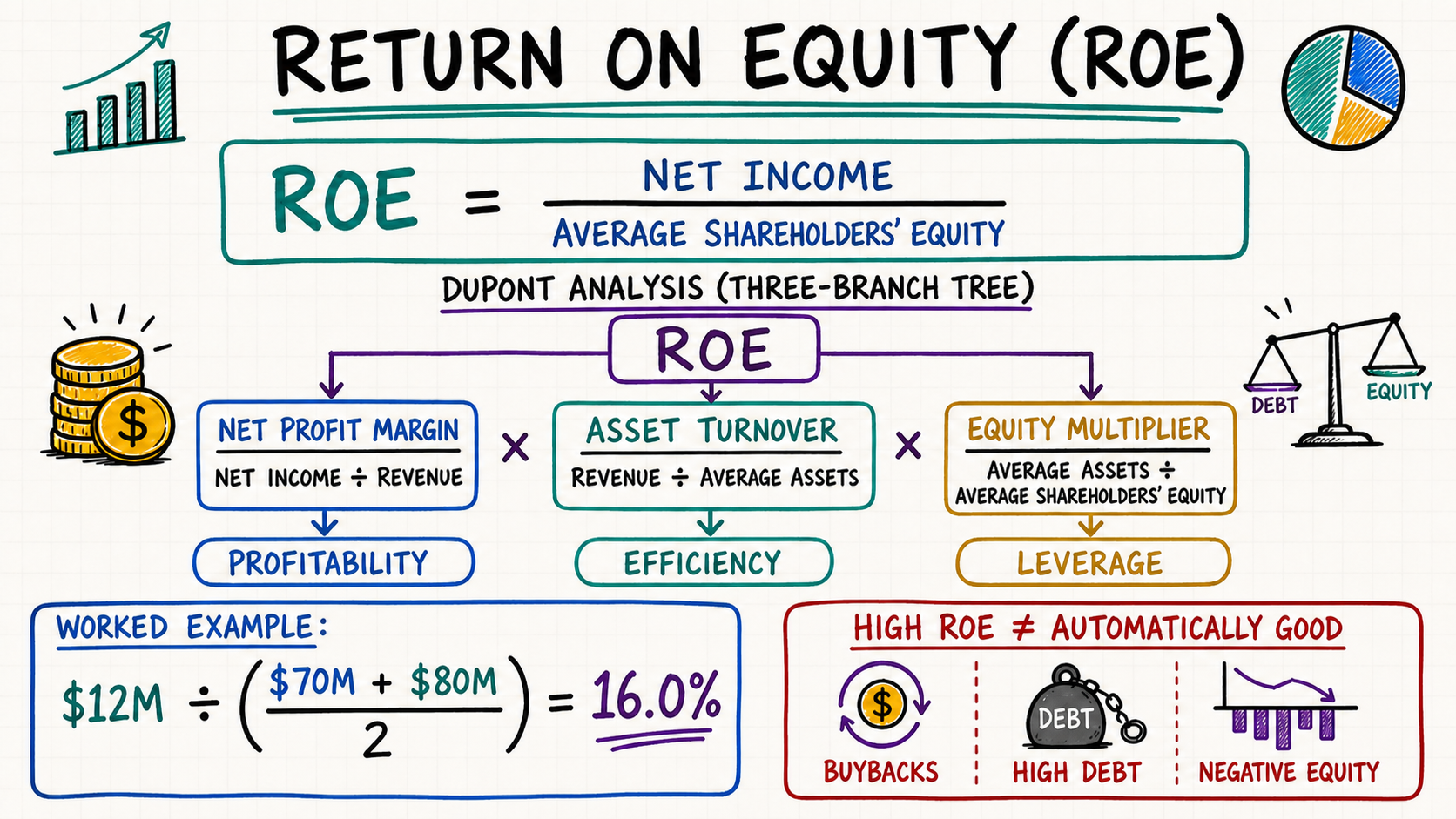
Return on equity (ROE) is a profitability ratio that compares net income attributable to common shareholders with the equity supporting that income. It answers a narrow but useful question: for each unit of average common equity recorded during the period, how much accounting profit was generated?
净资产收益率(ROE)是一项盈利能力比率,它把归属于普通股股东的净利润与支撑该利润的股东权益进行比较。它回答一个范围明确但很有用的问题:报告期内,每一单位平均普通股权益产生了多少会计利润?
ROE is not a shareholder’s realized investment return, a forecast, or a valuation by itself. Share prices, dividends, entry price, dilution, and holding period are outside the basic formula. Treat it as a diagnostic measure of accounting return on equity capital.
ROE并不是股东已经实现的投资收益率,也不是预测或完整估值。股价、股息、买入价格、股份稀释与持有期限都不在基础公式中。更准确的理解是:它是股东权益资本会计回报的诊断指标。
Net income accumulates over a period, while the balance sheet reports equity at a date. Using the average of beginning and ending equity better aligns a flow with the capital available through the period. A simple two-point average is common, but quarterly or monthly averages may be more representative after a large acquisition, share issuance, buyback, dividend, or impairment.
净利润是在一段期间内累积的流量,资产负债表中的权益则是某个时点的存量。用期初与期末权益平均值,可以更好地把期间利润与期间内可用资本相匹配。简单两点平均很常见,但若发生大型收购、增发、回购、特别股息或减值,季度或月度平均值可能更有代表性。
If the numerator is income available to common shareholders, exclude preferred equity from the denominator where appropriate. Use continuing or reported income consistently, document noncontrolling interests, and do not mix adjusted net income with unadjusted book equity without explaining the choice.
如果分子采用归属于普通股股东的利润,在适用时应从分母中排除优先股权益。持续经营利润或报告净利润的选择必须保持一致,并说明少数股东权益;不要在没有解释的情况下把调整后净利润与未调整账面权益混用。
Assume a fictional company reports $12 million of net income attributable to common shareholders. Common equity was $70 million at the start of the year and $80 million at the end.
假设一家虚构公司报告归属于普通股股东的净利润为1,200万美元,年初普通股权益为7,000万美元,年末为8,000万美元。
The result means the company generated $0.16 of accounting net income for each dollar of average common equity during that year. It does not show whether 16% is sustainable, whether the stock is attractively priced, or whether debt amplified the result. Those questions require the next layers.
该结果表示,公司在这一年中每使用1美元平均普通股权益,产生了0.16美元会计净利润。它不能单独说明16%是否可持续、股票价格是否合理,或债务是否放大了结果;这些问题需要继续分析。
The three-step DuPont identity decomposes ROE into net profit margin, asset turnover, and the equity multiplier. The multiplication cancels revenue and assets, returning to net income divided by equity. The value of the framework is interpretive: it separates operating profitability, asset-use efficiency, and financial leverage.
三因素杜邦恒等式把ROE拆为销售净利率、总资产周转率和权益乘数。三项相乘后,营业收入和总资产会相互约去,最终仍等于净利润除以股东权益。该框架的价值在于解释:它把经营盈利、资产使用效率和财务杠杆分开观察。
Net income ÷ RevenueShows how much profit remains from each unit of revenue after expenses, interest, and taxes.
反映每单位收入扣除成本、费用、利息和税项后剩余多少利润。
Revenue ÷ Average assetsShows how intensively the asset base produces revenue; normal levels vary substantially by industry.
反映资产基础产生收入的效率;不同行业的正常水平差异很大。
Average assets ÷ Average equityShows financial leverage. A higher multiplier can lift ROE while also increasing financing and downside risk.
反映财务杠杆。更高权益乘数可能提高ROE,也会增加融资压力与下行风险。
There is no universal good ROE. Compare a company with economically similar peers, its own history, its cost of equity, and the risks required to produce the return. Banks, software companies, utilities, retailers, and manufacturers operate with different balance sheets, regulation, capital intensity, and leverage.
不存在适用于所有公司的“良好ROE”。应把公司与经济特征相似的同行、自身历史、股权资本成本以及产生该回报所承担的风险进行比较。银行、软件、公共事业、零售和制造企业的资产负债表、监管、资本密集度与杠杆结构并不相同。
Check whether margins or efficiency improved, or whether buybacks, impairments, and leverage merely reduced the equity base.
核实是利润率或效率改善,还是回购、减值与杠杆缩小了权益分母。
Review whether the change is structural, cyclical recovery, or a temporary rebound from losses.
判断变化来自结构性改善、周期复苏,还是从亏损中暂时反弹。
A loss with positive equity produces negative ROE. Negative income divided by negative equity can produce a positive number that is economically misleading.
正权益企业亏损会产生负ROE;若净利润和权益同时为负,计算可能得到正数,但经济含义具有误导性。
Buybacks reduce book equity and may raise ROE even if net income is flat.
回购会减少账面权益,即使净利润不变也可能推高ROE。
Debt can shrink the equity-funded portion of assets and amplify both returns and losses.
债务会减少资产中由权益融资的部分,同时放大收益与损失。
The denominator can make ROE undefined, unstable, or counterintuitive.
分母可能使ROE失去意义、异常波动或产生反直觉结果。
Asset sales, tax benefits, impairments, or restructuring can distort the numerator.
资产出售、税收收益、减值或重组可能扭曲净利润分子。
Different capital needs and accounting models make raw rankings unreliable.
资本需求与会计模式不同,直接排名并不可靠。
Accounting return on book equity does not include purchase price or market-value changes.
账面权益回报不包含买入价格或市场价值变化。
| Metric指标 | Core denominator核心分母 | Primary question主要问题 | Key caution主要注意事项 |
|---|---|---|---|
| ROE | Average equity平均股东权益 | Return on shareholders’ book capital股东账面资本回报 | Sensitive to leverage and buybacks受杠杆和回购影响 |
| ROA | Average assets平均总资产 | Profit generated by the asset base资产基础产生利润的效率 | Affected by asset intensity and accounting受资产密集度与会计口径影响 |
| ROIC | Invested operating capital投入经营资本 | Operating return on debt and equity capital债务与权益投入资本的经营回报 | Definitions require careful normalization定义与调整口径需仔细统一 |
Specify common or total equity, reported or adjusted income, annual or trailing period, currency, and consolidation scope.
明确普通股或总权益、报告或调整后利润、年度或TTM期间、币种及合并范围。
Use consistent income statement and balance sheet periods; inspect restatements and filing dates.
使用一致的利润表和资产负债表期间,并检查重述与披露日期。
Compute average equity and ROE, then reconcile the result with provider-supplied key metrics.
计算平均权益与ROE,再与数据提供方的关键指标核对。
Calculate DuPont drivers across time and economically similar peers; investigate large changes.
对历史期间和经济特征相似的同行计算杜邦驱动因素,并调查重大变化。
Store capability, endpoint, parameters, timestamps, units, source fields, formulas, and adjustments.
保存能力、接口、参数、时间戳、单位、来源字段、公式与调整事项。
QVeris can help discover and call relevant FMP financial-statement and key-metric capabilities, then retain the inputs needed for review. It does not guarantee data completeness, investment performance, or the validity of an analyst’s assumptions.
QVeris可帮助发现并调用FMP财务报表与关键指标能力,并保留复核所需输入。它不保证数据绝对完整、投资表现或分析假设必然正确。
FMP financial statements through QVeris通过QVeris使用FMP财务报表 · Stock fundamental analysis framework股票基本面分析框架 · QVeris documentationQVeris文档
Divide net income attributable to common shareholders by average common shareholders’ equity, then multiply by 100%.
用归属于普通股股东的净利润除以平均普通股股东权益,再乘以100%。
It means the company generated $0.20 of accounting profit per dollar of average equity for that period; context determines quality and sustainability.
它表示报告期内每1单位平均权益产生0.20单位会计利润;质量与可持续性仍需结合背景判断。
No. High ROE can result from stronger operations, but also from high debt, buybacks, a small equity base, or one-time income.
不是。高ROE可能来自经营改善,也可能来自高负债、回购、较小权益分母或一次性利润。
Net income is earned across a period, so average equity better represents the capital available during that period than one ending balance.
净利润在一段期间内产生,平均权益比单一期末余额更能代表期间内可用资本。
Yes, if both net income and equity are negative, but the positive quotient is not a healthy profitability signal and should be marked not meaningful.
可能。如果净利润与权益同时为负,商数会为正,但它不代表健康盈利能力,应标记为缺乏正常经济含义。
Debt increases the equity multiplier and can amplify ROE when operating returns exceed financing costs, while also increasing downside and refinancing risk.
债务会提高权益乘数;当经营回报高于融资成本时可能放大ROE,同时也增加下行与再融资风险。
Educational content only. ROE is one accounting ratio and cannot establish intrinsic value or predict returns by itself.本文仅供教育用途。ROE只是单项会计比率,不能独立确定内在价值或预测收益。