
SEC Filing API:
EDGAR JSON, Examples and ValidationSEC Filing API 实战指南:
EDGAR JSON、代码示例与数据验证
Resolve CIKs, retrieve submissions and XBRL facts, reconstruct filing URLs, validate provenance, and produce source-backed agent answers.
解析 CIK、获取 Submissions 与 XBRL Facts、重建 Filing URL、验证来源,并生成有原始证据支持的 Agent 回答。
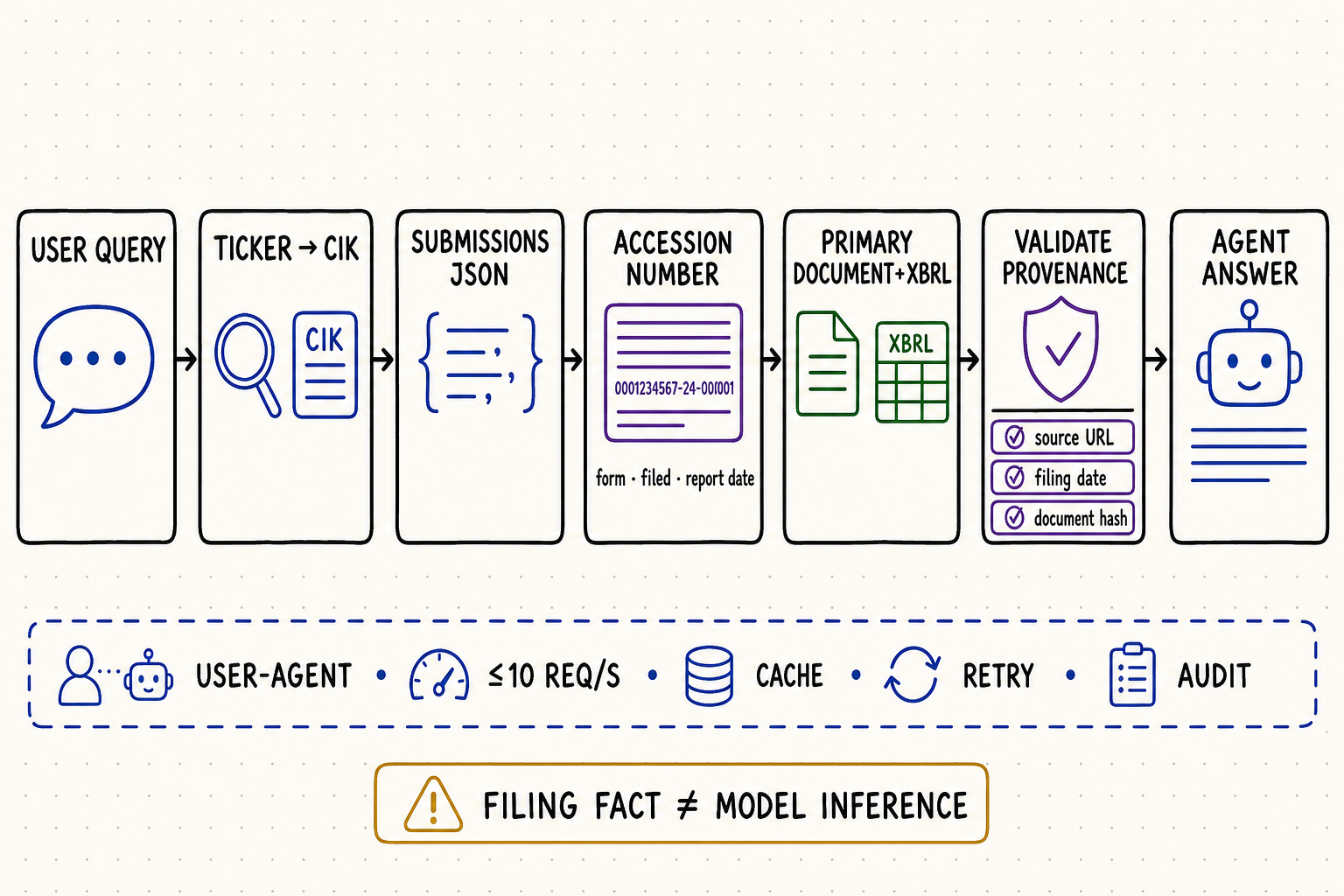
Decision brief
TL;DR
Resolve the company to a zero-padded CIK, then use the Submissions API for forms, accession numbers, filing dates, report dates, primary documents, and filing history.
The filing HTML, exhibits, and complete submission files provide narrative disclosures and the primary evidence an agent should cite.
Company Facts, Company Concept, and Frames make numeric disclosures easier to query, but units, periods, forms, and taxonomy context must remain attached.
Return accession, form, dates, source URL, and document hash with extracted evidence. Label summaries, comparisons, and risk conclusions as model inference.
先把公司解析为补足 10 位的 CIK,再用 Submissions API 获取 Form、Accession、Filing Date、Report Date、Primary Document 和历史记录。
Filing HTML、Exhibit 与完整 Submission 文件包含叙述性披露,也是 Agent 应引用的主要证据。
Company Facts、Company Concept 与 Frames 便于查询数值,但必须保留单位、期间、Form 与 Taxonomy 上下文。
随抽取证据返回 Accession、Form、日期、Source URL 和 Document Hash;摘要、比较和风险判断必须标为模型推断。
Who this guide is for and what you need适用对象与前置准备
This is for teams building filing research, risk-factor comparison, event monitoring, earnings preparation, financial extraction, or compliance assistants. It assumes a trusted backend, persistent storage, an HTML/XBRL parser, and a retrieval or citation layer.
适用于构建 Filing 研究、风险因素比较、事件监控、财报准备、财务抽取或合规助手的团队。默认你拥有可信后端、持久化存储、HTML/XBRL Parser 以及检索或引用层。
SEC EDGAR data sources: choose the right endpointSEC EDGAR 数据源:选择正确接口
| Source数据源 | Best for适合用途 | Key fields关键字段 | Main limitation主要限制 |
|---|---|---|---|
| company_tickers.json | Ticker/name to CIK resolutionTicker/公司名到 CIK | cik_str, ticker, title | Entity matching still needs validation仍需验证实体匹配 |
| Submissions API | Filing history and metadataFiling 历史与元数据 | form, accession, filed, reportDate, primaryDocument | Recent records are columnar; older history may be in extra files近期记录为列式结构,旧记录可能在附加文件 |
| Archives | Primary documents, exhibits, full submission text原始文档、Exhibit、完整 Submission | HTML, text, XML, XBRL artifacts | Parsing varies by filing and era解析方式因 Filing 与年代而异 |
| Company Facts | All normalized company concepts in one response一次获取公司标准化 Concepts | taxonomy, tag, label, units, facts | Not a substitute for narrative disclosure不能替代叙述性披露 |
| Company Concept | One concept across filings跨 Filing 查询单一 Concept | units, val, accn, fy, fp, form, filed, frame | Custom concepts may not be comparable自定义 Concept 可能不可比 |
| Frames | Cross-company facts aligned to a calendar frame按日历 Frame 跨公司比较 | taxonomy, tag, unit, period, entity facts | Fiscal calendars may not align exactly财年日历不一定完全对齐 |
Do not confuse APIs: public data retrieval on data.sec.gov is different from EDGAR Next filer APIs used to submit filings and manage filer accounts.
不要混淆:data.sec.gov 的公开数据读取接口,与用于提交 Filing 和管理 Filer Account 的 EDGAR Next API 并不是一回事。
Evidence-first filing agent architecture证据优先的 Filing Agent 架构
Keep acquisition, normalization, retrieval, and generation separate. The model should not invent URLs, accession numbers, dates, or units; those belong to deterministic services.
采集、标准化、检索和生成应分层。URL、Accession、日期与单位必须由确定性服务产生,而不是让模型猜测。
- Acquisition: polite HTTP client, cache, retry, conditional fetch, bulk downloads when appropriate.
- Raw evidence store: exact bytes, response headers, retrieval time, source URL, SHA-256 hash.
- Normalized filing record: CIK, accession, form, filing date, report date, primary document, amendment relationship.
- Document layer: cleaned sections, tables, exhibits, inline XBRL and character offsets back to source.
- Agent layer: retrieval filters, bounded context, citations, inference labels and refusal when evidence is insufficient.
- 采集层:礼貌 HTTP Client、缓存、重试、条件请求,并在适合时使用 Bulk Download。
- 原始证据库:原始字节、响应 Header、检索时间、Source URL 与 SHA-256 Hash。
- 标准化 Filing 记录:CIK、Accession、Form、Filing Date、Report Date、Primary Document 和 Amendment 关系。
- 文档层:清洗后的 Section、表格、Exhibit、Inline XBRL,以及返回源文档的字符位置。
- Agent 层:检索过滤、受控 Context、引用、推断标签,并在证据不足时拒绝作答。
Step 1: resolve ticker, company name, and CIK步骤一:解析 Ticker、公司名称与 CIK
EDGAR is organized around CIK, not ticker. Normalize the ticker, match it against the SEC mapping, confirm the legal entity name and exchange, and store the ten-digit zero-padded CIK for API requests. Never reuse a ticker mapping indefinitely: tickers and corporate identities can change.
EDGAR 以 CIK 而不是 Ticker 组织。先标准化 Ticker,与 SEC 映射匹配,核对 Legal Entity 与 Exchange,并保存补足 10 位的 CIK。不要永久复用映射,因为 Ticker 和公司身份可能变化。
import requests

HEADERS = {"User-Agent": "FilingAgent/1.0 research@example.com"}
rows = requests.get(
    "https://www.sec.gov/files/company_tickers.json",
    headers=HEADERS,
    timeout=20,
).json().values()

def resolve_ticker(symbol: str):
    symbol = symbol.upper().strip()
    row = next(x for x in rows if x["ticker"].upper() == symbol)
    return {
        "ticker": row["ticker"],
        "company": row["title"],
        "cik": str(row["cik_str"]).zfill(10),
    }
Step 2: query Submissions and select the filing步骤二:查询 Submissions 并选择 Filing
The recent filing arrays are columnar: values at the same index belong to one filing. Zip only known columns, filter by form and filing date, and retain both the filing date and report date. Include amendments deliberately instead of dropping every /A suffix.
近期 Filing 数组是列式结构:相同 Index 的值属于同一条 Filing。只 Zip 已知列,按 Form 与 Filing Date 过滤,同时保留 Filing Date 和 Report Date。Amendment 应显式处理,不要简单丢弃所有 /A。
def recent_filings(cik: str):
    url = f"https://data.sec.gov/submissions/CIK{cik}.json"
    payload = requests.get(url, headers=HEADERS, timeout=20).json()
    recent = payload["filings"]["recent"]
    keys = ["accessionNumber", "filingDate", "reportDate",
            "form", "primaryDocument", "primaryDocDescription"]
    return [dict(zip(keys, values)) for values in zip(*(recent[k] for k in keys))]

filing = next(
    f for f in recent_filings("0000320193")
    if f["form"] in {"10-K", "10-Q", "8-K"}
)
Step 3: reconstruct and preserve the filing document URL步骤三:重建并保存 Filing Document URL
An accession number identifies an accepted submission. Remove dashes only for the Archives directory, keep the original accession for citation, and combine it with the integer CIK and primary-document filename. Store the URL before parsing so every extracted passage can trace back to the exact document.
Accession Number 唯一标识一条已接受 Submission。只在 Archives 目录路径中移除横线,引用时保留原始 Accession,再与整数 CIK 和 Primary Document 文件名组合。解析前先保存 URL,确保每段抽取内容都能回到精确文档。
def filing_url(cik: str, filing: dict) -> str:
    cik_integer = str(int(cik))
    accession_path = filing["accessionNumber"].replace("-", "")
    document = filing["primaryDocument"]
    return (
        "https://www.sec.gov/Archives/edgar/data/"
        f"{cik_integer}/{accession_path}/{document}"
    )

source_url = filing_url("0000320193", filing)
Step 4: use XBRL facts without losing context步骤四:使用 XBRL Facts,但不丢失上下文
A numeric value is not meaningful by itself. Preserve taxonomy, concept, unit, start/end or instant date, fiscal year, fiscal period, form, filed date, accession, frame, and whether the fact was later repeated or amended. Prefer comparable standard-taxonomy facts, but fall back to the filing document for custom extensions and narrative context.
单独一个数值没有意义。必须保留 Taxonomy、Concept、Unit、Start/End 或 Instant Date、Fiscal Year、Fiscal Period、Form、Filed Date、Accession、Frame,以及该 Fact 是否后来被重复披露或修订。优先使用可比的标准 Taxonomy Fact;遇到自定义 Extension 与叙述上下文时回到 Filing 文档。
facts_url = "https://data.sec.gov/api/xbrl/companyfacts/CIK0000320193.json"
company_facts = requests.get(facts_url, headers=HEADERS, timeout=20).json()

revenue = company_facts["facts"]["us-gaap"]["RevenueFromContractWithCustomerExcludingAssessedTax"]
usd_facts = revenue["units"]["USD"]
annual = [x for x in usd_facts if x.get("form") == "10-K" and x.get("fp") == "FY"]

for fact in annual[-3:]:
    print(fact["val"], fact["fy"], fact["filed"], fact["accn"], fact.get("frame"))
End-to-end implementation pattern端到端实施模式
The production path should be deterministic until the evidence bundle is complete. Let the model choose a research intent or requested section, but keep identity resolution, filing selection, URL construction, parsing, hashing, and validation in code.
在证据包完成前,生产链路应保持确定性。模型可以判断研究意图或需要的 Section,但实体解析、Filing 选择、URL 构造、解析、Hash 与验证必须由代码完成。
| Stage阶段 | Deterministic service确定性服务 | Model role模型角色 | Stored evidence保存证据 |
|---|---|---|---|
| Resolve | Ticker/name to CIK mappingTicker/名称到 CIK | Clarify ambiguous entity澄清歧义实体 | CIK, company, mapping timestamp |
| Select | Form/date/accession filtersForm/日期/Accession 过滤 | Translate user intent into filters把用户意图转为过滤条件 | form, filed, report date, accession |
| Acquire | HTTP fetch, cache, hashHTTP 获取、缓存、Hash | None无 | URL, bytes, headers, retrievedAt, hash |
| Parse | DOM/XBRL/table parserDOM/XBRL/Table Parser | Optional section classification可选 Section 分类 | section, offsets, tables, concepts |
| Answer | Citation builder and policy checks引用生成与策略检查 | Summarize, compare, explain uncertainty总结、比较、解释不确定性 | claims, evidence IDs, prompt/model version |
Normalize one filing evidence contract统一 Filing Evidence Contract
{
  "entity": {"cik":"0000320193","ticker":"AAPL","name":"Apple Inc."},
  "filing": {
    "form":"10-K","accession":"0000320193-25-000079",
    "filed":"2025-10-31","report_date":"2025-09-27",
    "primary_document":"aapl-20250927.htm","source_url":"https://www.sec.gov/..."
  },
  "evidence": [{
    "section":"Risk Factors","text":"bounded extracted passage",
    "source_url":"https://www.sec.gov/...","document_sha256":"...",
    "retrieved_at":"2026-07-31T09:00:00Z"
  }],
  "answer_policy": {"cite_every_claim":true,"label_inference":true}
}
Keep the raw SEC field names in a source payload or provenance record even if your application uses normalized names. This makes audits and parser upgrades possible without re-downloading everything.
即使应用使用标准化字段名,也应在 Source Payload 或 Provenance Record 中保留 SEC 原始字段。这样才能审计和升级 Parser,而不必重新下载全部数据。
Validation checklist before the agent answersAgent 回答前的验证清单
Fair access, caching, cost, and latency controlsFair Access、缓存、成本与延迟控制
SEC guidance currently limits automated access to no more than ten requests per second in total and asks applications to identify themselves. Treat ten as a ceiling, not a target. Use a descriptive User-Agent, cache immutable filing documents, prefer bulk ZIP data for large backfills, use bounded concurrency, and implement exponential backoff for 403, 429, and transient 5xx responses.
SEC 当前指南把自动访问限制在总计不超过每秒 10 个请求,并要求应用声明身份。10 是上限,不是目标。使用可识别的 User-Agent;缓存不可变 Filing 文档;大规模回填优先使用 Bulk ZIP;限制并发;对 403、429 与临时 5xx 使用指数退避。
- Cache ticker mapping and Submissions responses briefly; cache accession documents by content hash for much longer.
- Poll filing metadata rather than repeatedly downloading the same full documents.
- Use nightly bulk archives for complete-history ingestion instead of millions of individual requests.
- Set connect/read timeouts, a retry budget, circuit breaking, and a dead-letter queue.
- Limit chunks, tables, exhibits, and XBRL facts sent to the model to control token cost and prompt-injection exposure.
- 短期缓存 Ticker Mapping 和 Submissions;按 Content Hash 长期缓存 Accession 文档。
- 轮询 Filing Metadata,不要反复下载相同完整文档。
- 完整历史回填使用每日 Bulk Archive,避免数百万次单独请求。
- 设置连接/读取超时、重试预算、熔断和 Dead-Letter Queue。
- 限制发送给模型的 Chunk、表格、Exhibit 与 XBRL Fact,控制 Token 成本和 Prompt Injection 暴露。
Common failure modes and troubleshooting常见失败模式与排错
| Symptom现象 | Likely cause常见原因 | Fix修复 |
|---|---|---|
| 403 or blocked requests403 或访问被阻止 | Missing User-Agent, excessive or bursty traffic缺少 User-Agent、请求过多或突发 | Identify the app, throttle globally, cache, back off声明应用、全局限流、缓存并退避 |
| Wrong company匹配到错误公司 | Ticker reuse, symbol normalization, name ambiguityTicker 复用、Symbol 标准化、名称歧义 | Confirm CIK and legal entity before retrieval检索前确认 CIK 与 Legal Entity |
| Missing older filings缺少较旧 Filing | Only recent columnar data was read只读取了 Recent 列式数据 | Follow additional files or ingest submissions.zip继续读取附加文件或导入 submissions.zip |
| Revenue values disagreeRevenue 数值不一致 | Different units, periods, forms, concepts, or amendmentsUnit、Period、Form、Concept 或 Amendment 不同 | Compare full XBRL context and accession比较完整 XBRL 上下文与 Accession |
| Risk section extraction is emptyRisk Section 抽取为空 | Heading variation, inline XBRL markup, document eraHeading 变化、Inline XBRL Markup、文档年代 | Use DOM-aware parsing, form templates, and fallback text使用 DOM-aware 解析、Form 模板与文本回退 |
| Agent cites the wrong periodAgent 引用了错误期间 | Filing date confused with report date or fiscal frameFiling Date、Report Date 或 Fiscal Frame 混淆 | Carry all dates through retrieval and answer templates在检索和回答模板中保留所有日期 |
How to evaluate a filing-aware AI agent如何评估 Filing-Aware AI Agent
Measure retrieval and evidence separately from writing quality. A fluent answer with the wrong accession or period is a failed answer.
检索与证据要和写作质量分开评估。即使语言流畅,只要 Accession 或期间错误,仍然是失败答案。
QVeris implementation pattern for filing researchQVeris Filing Research 实现模式
A QVeris-based agent can Discover filing or financial capabilities by intent, Inspect parameters and operational statistics, Probe candidate inputs and quote before execution, then Call the selected capability. Keep the SEC accession, source URL, filing dates, and extracted evidence in the application record; use SEC documents as the authoritative source for SEC filing claims.
基于 QVeris 的 Agent 可以按意图 Discover Filing 或金融能力,Inspect 参数与运维统计,在执行前 Probe 候选输入与报价,再 Call 选定能力。应用记录中仍应保存 SEC Accession、Source URL、Filing Date 与抽取证据;SEC 文档始终是 SEC Filing 结论的权威来源。
Recommended loop: Discover → Inspect → Probe → Call → validate accession/source → answer with citations → reconcile usage history.
推荐循环:Discover → Inspect → Probe → Call → 验证 Accession/Source → 带引用回答 → 核对 Usage History。
See the QVeris MCP documentation, SEC filings analysis agent guide, and SEC filing API comparison.
继续阅读 QVeris MCP 文档、SEC Filing Analysis Agent 指南与 SEC Filing API 对比。
FAQ
Public data.sec.gov submissions and XBRL APIs do not require a key. Automated access must still identify the application and follow SEC fair-access guidance.
Submissions provides filing identity and history. Company Facts provides normalized XBRL concepts and units across filings.
Resolve ticker to CIK, select an accession and primary document from Submissions, remove accession dashes for the Archives path, and retain the original accession for citation.
SEC guidance currently sets a total ceiling of ten requests per second. Run below that ceiling, cache aggressively, and back off on errors.
No. Numeric facts do not replace narrative disclosures, exhibits, custom taxonomy context, or the source filing.
Preserve form, accession, dates, amendment status, and original source. Never silently overwrite the original filing.
Require accession-linked evidence, validate dates and units, cite bounded passages, and label all model inference.
QVeris helps discover, inspect, probe, and call relevant capabilities; SEC documents remain authoritative for filing claims.
公开的 data.sec.gov Submissions 与 XBRL API 不需要 Key,但自动访问仍需声明应用身份并遵守 SEC Fair Access。
Submissions 提供 Filing 身份与历史;Company Facts 提供跨 Filing 的标准化 XBRL Concept 与 Unit。
先把 Ticker 解析到 CIK,从 Submissions 选择 Accession 与 Primary Document,在 Archives 路径中移除 Accession 横线,同时保留原始 Accession 用于引用。
SEC 当前指南把总请求上限设为每秒 10 次。实际应低于上限运行、积极缓存并在错误时退避。
不可以。数值 Fact 不能替代叙述性披露、Exhibit、自定义 Taxonomy 上下文和原始 Filing。
保留 Form、Accession、日期、Amendment 状态和原始来源,不能静默覆盖原 Filing。
强制使用 Accession 关联证据、校验日期和单位、引用受控段落,并标记所有模型推断。
QVeris 帮助发现、检查、Probe 和调用相关能力;SEC 文档仍是 Filing 结论的权威来源。