
Stock Market API for AI Agents:
2026 Guide
Evaluate stock market APIs for real-time prices, history, news, filings, fundamentals, and source-aware agent answers.
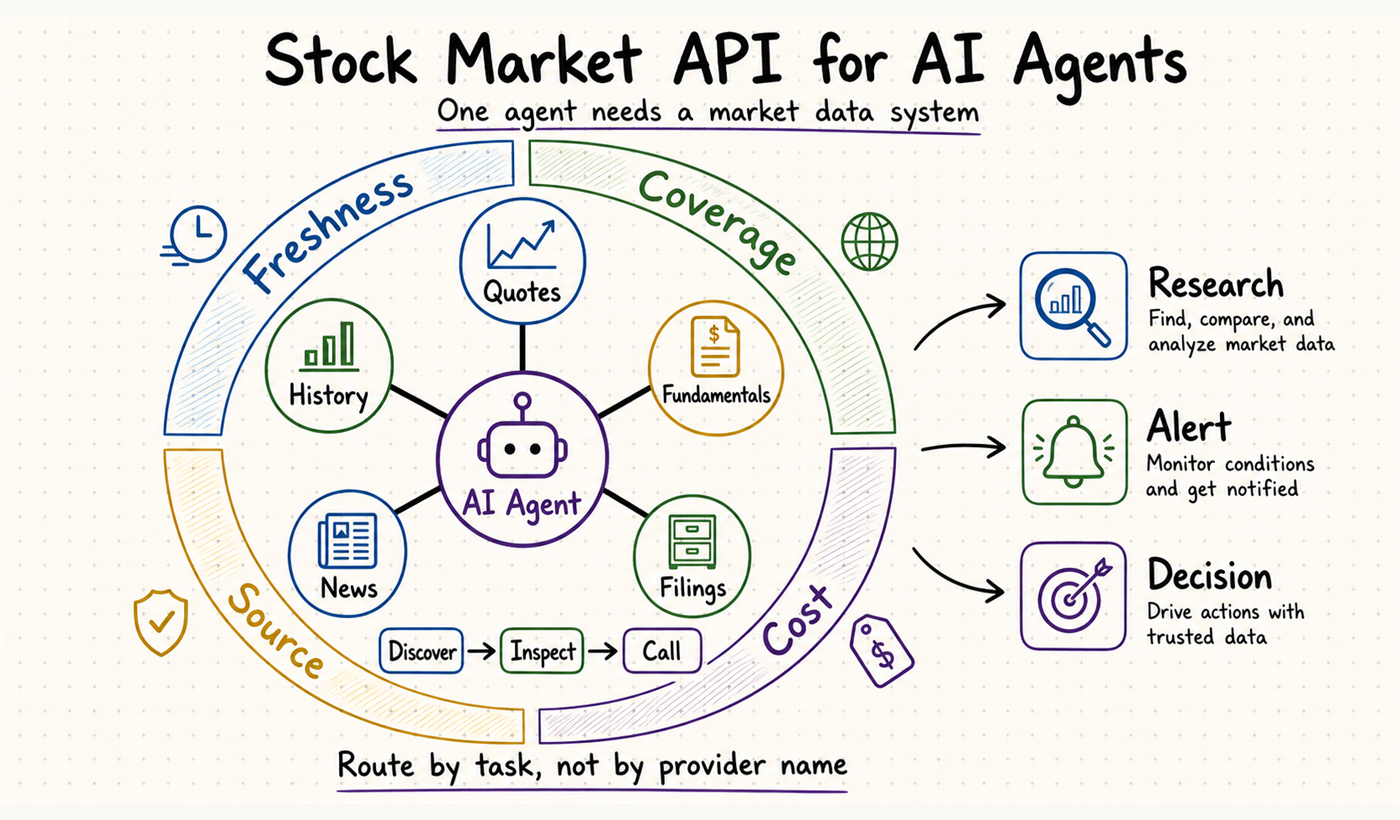
What Is a Stock Market API for AI Agents?
A stock market API exposes market data such as quotes, trades, candles, company fundamentals, analyst estimates, corporate events, and sometimes news. For traditional software, the developer picks a fixed endpoint and renders the result. For an AI agent, the API becomes part of a reasoning workflow.
That changes the selection criteria. The best stock market data API is not only the one with the most symbols. It is the one that helps the agent inspect schema, understand freshness, cite sources, decide whether more context is needed, and route around missing or delayed data.
Best Stock Market API Options for AI Agents
The right provider depends on the agent task. A market monitor needs freshness and alert reliability. A research assistant needs history, fundamentals, filings, and news. A trading support workflow needs low-latency data, but also strict guardrails.
| Provider | Strong fit | Agent consideration |
|---|---|---|
| Polygon.io | Real-time and historical market data, trades, aggregates, options, and production data workflows. | Agents still need news, filings, fundamentals, and cost-aware routing around the raw feed. |
| Financial Modeling Prep | Fundamentals, statements, ratios, company profiles, earnings, and broad financial datasets. | Good for research context, but an agent may need to combine it with price freshness and filings. |
| Alpha Vantage | Accessible market data experiments, indicators, time series, and developer prototypes. | Check rate limits, coverage, and whether the free tier can support multi-step agent calls. |
| Finnhub | Market data, company news, earnings, estimates, and sentiment-oriented prototypes. | Review field consistency, commercial terms, and citation needs before production use. |
| Twelve Data | Symbol coverage, time series, technical indicators, and cross-asset market data prototypes. | Agents should inspect intervals, delay rules, and historical depth before relying on output. |
| SEC EDGAR | Public company filings, 10-K, 10-Q, 8-K, risk factors, and source-backed research. | Not a quote API, but essential when an agent must explain company fundamentals with evidence. |
Stock Market Data API Requirements for AI Agents
Agents need clear timestamps, exchange coverage, delay rules, and session status before explaining price moves.
Historical stock market data helps agents compare volatility, volume, prior levels, dividends, and splits.
Financial statements, ratios, margins, cash flow, and valuation data turn a quote into research context.
A price move often needs earnings, analyst actions, macro releases, sector moves, or company news.
Source URLs, accession numbers, filing dates, and provider metadata make agent answers auditable.
When one provider fails or lacks a field, the agent needs a safe fallback instead of guessing.
Real-Time Stock Market API vs Historical Data API
A real-time stock market API answers what is happening now. It is useful for alerts, live dashboards, intraday monitoring, and market reaction agents. But it is not enough for explanation. Without history, a model may not know whether a 2% move is normal, unusual, or tied to a broader sector pattern.
A historical stock market data API answers what changed over time. It helps agents compare price ranges, volume baselines, volatility, technical levels, and prior reactions to similar events. Most production agents need both real-time and historical capabilities.
How to Choose a Stock Market API for Your Agent
How QVeris Works with Stock Market APIs
QVeris is not just another narrow stock quote endpoint. It helps agents discover, inspect, and call the right financial capability for the task. That means a single request can route toward real-time quotes, historical prices, company news, filings, fundamentals, or another provider when fallback is needed.
For developers, this changes the architecture. Instead of hardcoding one stock market data API into every agent workflow, teams can treat QVeris as the routing layer that evaluates freshness, schema, source quality, latency, cost, and availability before the call.
Example Stock Market API Agent Workflow
The agent should not simply fetch a quote and invent an explanation. A reliable workflow first discovers the needed capabilities, inspects parameters, calls the right data source, and returns a sourced answer.
# User asks: "Why did AAPL move today?"
task = "explain AAPL price move with sources"

capabilities = qveris.discover(
    "real-time stock quote, historical prices, company news, filings"
)

quote = qveris.call("market.real_time_quote", {"symbol": "AAPL"})
history = qveris.call("market.historical_prices", {"symbol": "AAPL", "range": "30d"})
news = qveris.call("news.company_events", {"symbol": "AAPL", "lookback": "24h"})

brief = agent.write_brief(
    data=[quote, history, news],
    require_sources=True,
    require_timestamps=True,
    include_uncertainty=True
)
Stock Market API Comparison Checklist
| Requirement | What to ask | Why agents care |
|---|---|---|
| Freshness | Is data real-time, delayed, end-of-day, or mixed by exchange? | A stale quote can create a confident but wrong answer. |
| Coverage | Which stocks, ETFs, exchanges, and asset classes are included? | Agents need to know when a missing symbol is a data gap, not a user error. |
| Context | Does the API include fundamentals, earnings, news, estimates, and filings? | Market explanations require more than the latest price. |
| Auditability | Are timestamps, source links, provider notes, and field definitions returned? | Analysts need to verify where the agent got its claims. |
| Cost control | Can low-value tasks use free or low-cost sources while high-value tasks upgrade? | Agents can multiply API calls quickly without routing rules. |
Stock Market API FAQ for AI Agents
There is no single best provider. The best stack depends on whether the agent needs real-time quotes, filings, fundamentals, news, or all of them with routing.
It can be enough for prototypes and low-volume tools. Production agents usually need better freshness, coverage, reliability, and usage rights.
Not always. Research drafts can use delayed data, but alerts, monitoring, and customer-facing market explanations often need fresher data.
A price move tells what happened. Filings and fundamentals help explain the company-specific reasons behind the move.
QVeris lets agents discover, inspect, and call capabilities through one routing layer instead of hardcoding every provider separately.
Usually not. Quotes, history, filings, and news often have different best-fit providers. Routing keeps the workflow flexible.