
Stock Price API with
Low Latency: 2026 Guide低延迟股票价格 API:
2026 指南
Compare streaming and request-based stock price APIs by latency, timestamps, exchange coverage, rate limits, and fallback design.
按延迟、时间戳、交易所覆盖、速率限制和回退设计比较流式与请求式股票价格 API。
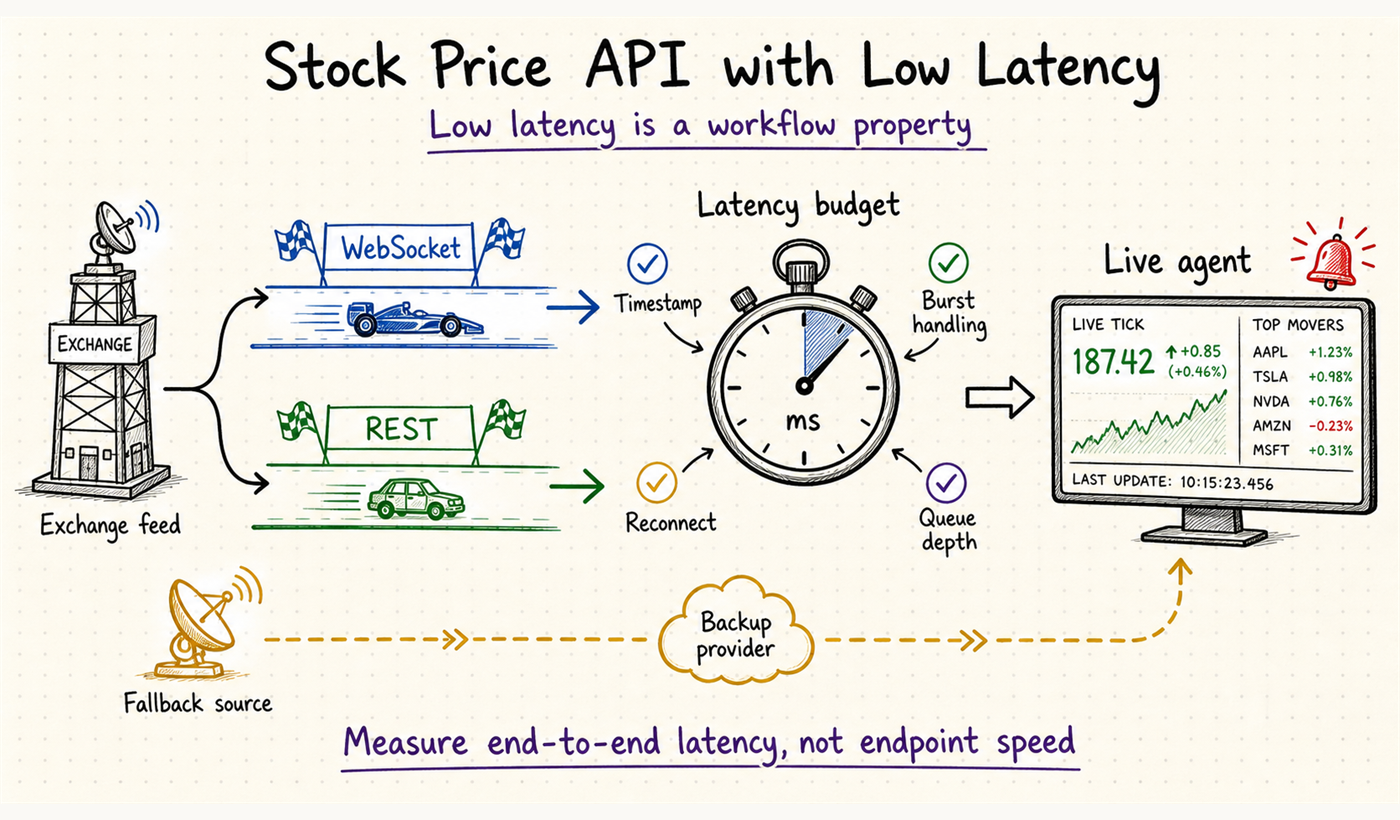
What Low Latency Means for a Stock Price API股票价格 API 的低延迟到底指什么
Low latency means the time between a market event and your application receiving usable data is short enough for the workflow. It is not a single number. It includes exchange feed delay, provider processing, network transit, API response time, client parsing, and how quickly your agent can act on the result.低延迟指市场事件发生到应用收到可用数据之间的时间,短到足以支撑该工作流。它不是单一数字,而包括交易所数据延迟、供应商处理、网络传输、API 响应、客户端解析,以及 Agent 使用结果的速度。
For a watchlist, a few seconds or even delayed data may be acceptable. For live alerts, intraday risk, or AI market monitoring, the stock price API must return clear timestamps and freshness metadata so the agent can avoid stale answers.对自选股列表来说,几秒甚至延迟数据可能可以接受。对实时预警、盘中风控或 AI 市场监控来说,股票价格 API 必须返回清楚的时间戳和新鲜度元数据,避免 Agent 输出过期答案。
Low Latency Stock Price API Requirements低延迟股票价格 API 的关键要求
Check whether quotes are live, near-live, delayed, end-of-day, or mixed by exchange and plan.检查报价是实时、近实时、延迟、日终,还是按交易所和套餐混合。
Every response should include an as-of time so agents can reason about whether data is safe to use.每个响应都应包含截至时间,让 Agent 判断数据是否安全可用。
WebSocket streams fit live monitoring; REST snapshots fit dashboards, research, and lower-frequency apps.WebSocket 适合实时监控;REST 快照适合仪表盘、研究和低频应用。
Market opens, earnings releases, and news shocks can create API spikes and retries.开盘、财报发布和新闻冲击会制造 API 峰值和重试。
Low latency feeds can become expensive when agents poll too often or monitor too many symbols.当 Agent 轮询过频或监控股票过多时,低延迟数据流会变得昂贵。
If the low-latency source fails, the agent should route or disclose limits instead of guessing.如果低延迟来源失败,Agent 应路由或披露限制,而不是猜测。
WebSocket vs REST for Low Latency Stock Prices低延迟股票价格:WebSocket 与 REST 如何选
| Transport传输方式 | Best fit适合场景 | Risk风险 |
|---|---|---|
| WebSocketWebSocket | Streaming quotes, market monitors, live alerts, and dashboards that update continuously.流式报价、市场监控、实时预警和持续更新仪表盘。 | Requires connection management, backpressure handling, reconnect logic, and cost controls.需要连接管理、背压处理、重连逻辑和成本控制。 |
| RESTREST | Snapshot quotes, research tasks, watchlists, user-triggered lookups, and lower-frequency jobs.快照报价、研究任务、自选股、用户触发查询和低频任务。 | Polling too often creates cost, rate-limit, and stale-response problems.过度轮询会带来成本、速率限制和过期响应问题。 |
| Hybrid混合 | Agents that stream watchlists but call REST for context, history, fundamentals, or filings.Agent 用流式数据监控自选股,同时用 REST 获取背景、历史、基本面或文件。 | Needs routing rules so the agent chooses the right path for each task.需要路由规则,让 Agent 为每个任务选择正确路径。 |
When Low Latency Actually Matters什么时候低延迟真正重要
Low latency matters when a user, system, or AI agent will act on the data quickly. Alerts, intraday monitoring, customer-facing dashboards, risk checks, and event-driven workflows all need tighter freshness guarantees than a research article or static chart.当用户、系统或 AI Agent 会快速基于数据行动时,低延迟才真正重要。预警、盘中监控、客户仪表盘、风险检查和事件驱动工作流,都比研究文章或静态图表更需要新鲜度保证。
Low latency does not matter equally for every task. If an agent is summarizing a company’s last quarter, historical data and filings are more important than sub-second quotes. If the agent is monitoring a price breakout, stale quotes can make the whole workflow misleading.低延迟并不是对所有任务都同等重要。如果 Agent 总结公司上一季度表现,历史数据和文件比亚秒级报价更重要;如果 Agent 监控价格突破,过期报价会让整个工作流失真。
Stock Price API Providers to Evaluate可评估的股票价格 API 提供方
Provider fit depends on exchange coverage, plan rules, real-time access, historical data, and how the API handles timestamps. Start with official documentation before committing a workflow.供应商是否适合,取决于交易所覆盖、套餐规则、实时访问、历史数据和 API 如何处理时间戳。上线工作流前应先看官方文档。
| Provider提供方 | What to check重点检查 | Agent noteAgent 注意点 |
|---|---|---|
| Polygon.io | Real-time plans, WebSocket support, aggregates, trades, and exchange coverage.实时套餐、WebSocket 支持、聚合数据、交易数据和交易所覆盖。 | Strong for market data, but agents still need routing to news, filings, and fundamentals.市场数据较强,但 Agent 仍需要路由到新闻、文件和基本面。 |
| Finnhub | Real-time quote endpoints, WebSocket availability, news, earnings, and plan limits.实时报价端点、WebSocket 可用性、新闻、财报和套餐限制。 | Useful for research context if the workflow checks freshness and source behavior.如果工作流检查新鲜度和来源表现,适合补充研究背景。 |
| Financial Modeling Prep | Quotes, fundamentals, statements, profiles, and plan-specific data timing.报价、基本面、报表、公司资料和套餐对应的数据时效。 | Often valuable for combining price data with company-level context.适合把价格数据与公司层面背景结合。 |
| Alpha Vantage | Intraday endpoints, rate limits, free tier restrictions, and update frequency.盘中端点、速率限制、免费层限制和更新频率。 | Good for prototypes, but production agents should inspect limits before scaling.适合原型,但生产 Agent 扩展前要检查限制。 |
| Twelve Data | Time series, technical indicators, WebSocket docs, and cross-asset coverage.时间序列、技术指标、WebSocket 文档和跨资产覆盖。 | Check latency, symbol coverage, and historical depth for agent workflows.为 Agent 工作流检查延迟、股票覆盖和历史深度。 |
How AI Agents Should Use Low Latency QuotesAI Agent 应如何使用低延迟报价
Example: Low Latency Stock Price Routing示例:低延迟股票价格路由
The agent should choose the data source based on the task, not simply use the fastest or cheapest API for everything.Agent 应根据任务选择数据源,而不是所有场景都用最快或最便宜的 API。
# Route low-latency quotes only when the task needs them
task = "monitor NVDA and alert on a 2% intraday move"

tools = qveris.discover("low latency stock price API with timestamp")
quote_tool = qveris.inspect("market.real_time_quote")

if quote_tool.latency_ms > 500 or quote_tool.delay_minutes > 0:
    quote_tool = qveris.discover("fallback live stock price feed")[0]

quote = qveris.call(
    capability=quote_tool.id,
    params={"symbol": "NVDA", "include_source": True}
)

agent.evaluate_alert(
    quote=quote,
    require_freshness=True,
    disclose_source=True
)
How QVeris Helps with Low Latency Stock APIsQVeris 如何帮助低延迟股票 API 工作流
QVeris helps agents treat latency as an inspectable signal. Before calling a stock price API, an agent can evaluate freshness, source quality, cost, provider notes, and fallback options. That makes it possible to use low latency data only where it matters.QVeris 帮助 Agent 把延迟当成可检查信号。在调用股票价格 API 前,Agent 可以评估新鲜度、来源质量、成本、供应商说明和备用选项,从而只在必要场景使用低延迟数据。
This avoids two common mistakes: overpaying for real-time feeds on low-risk tasks, and using delayed or stale quotes in workflows that need current data. QVeris provides the routing layer between the user’s intent and the data capability.这能避免两个常见错误:低风险任务过度支付实时数据费用,以及在需要当前数据的工作流中使用延迟或过期报价。QVeris 在用户意图和数据能力之间提供路由层。
Stock Price API with Low Latency FAQ低延迟股票价格 API 常见问题
It depends on the workflow. Live alerts may need seconds or less; research workflows may only need a clear timestamp.取决于工作流。实时预警可能需要秒级甚至更低;研究工作流可能只需要清晰时间戳。
No. WebSocket is better for streaming; REST is simpler for snapshots, user-triggered lookups, and lower-frequency tasks.不是。WebSocket 更适合流式数据;REST 更适合快照、用户触发查询和低频任务。
Exchange licensing, real-time redistribution, infrastructure, uptime, and ingestion speed all increase cost.交易所授权、实时再分发、基础设施、可用性和采集速度都会提高成本。
Sometimes for limited symbols or trials, but many free stock APIs use delayed or rate-limited data.有限股票或试用场景可能可以,但很多免费股票 API 使用延迟或限速数据。
Only when the task depends on fresh market state, such as alerts, monitoring, or live customer-facing answers.只有任务依赖新鲜市场状态时才需要,例如预警、监控或面向客户的实时答案。
QVeris lets agents inspect latency and route to the right provider instead of assuming every quote is current.QVeris 让 Agent 检查延迟并路由到合适供应商,而不是假设所有报价都是当前数据。