
Stock Screener API for AI Agents and Research Tools 面向 AI Agent 与研究工具的股票筛选 API
AI agents need more than a list of tickers. A useful stock screener API should expose filters, rankings, factor inputs, source freshness, and enough context to explain why a stock matched.
AI Agent 需要的不只是股票代码列表。好用的股票筛选 API 应暴露筛选条件、排名、因子输入、来源新鲜度,以及解释为什么某只股票匹配的背景。
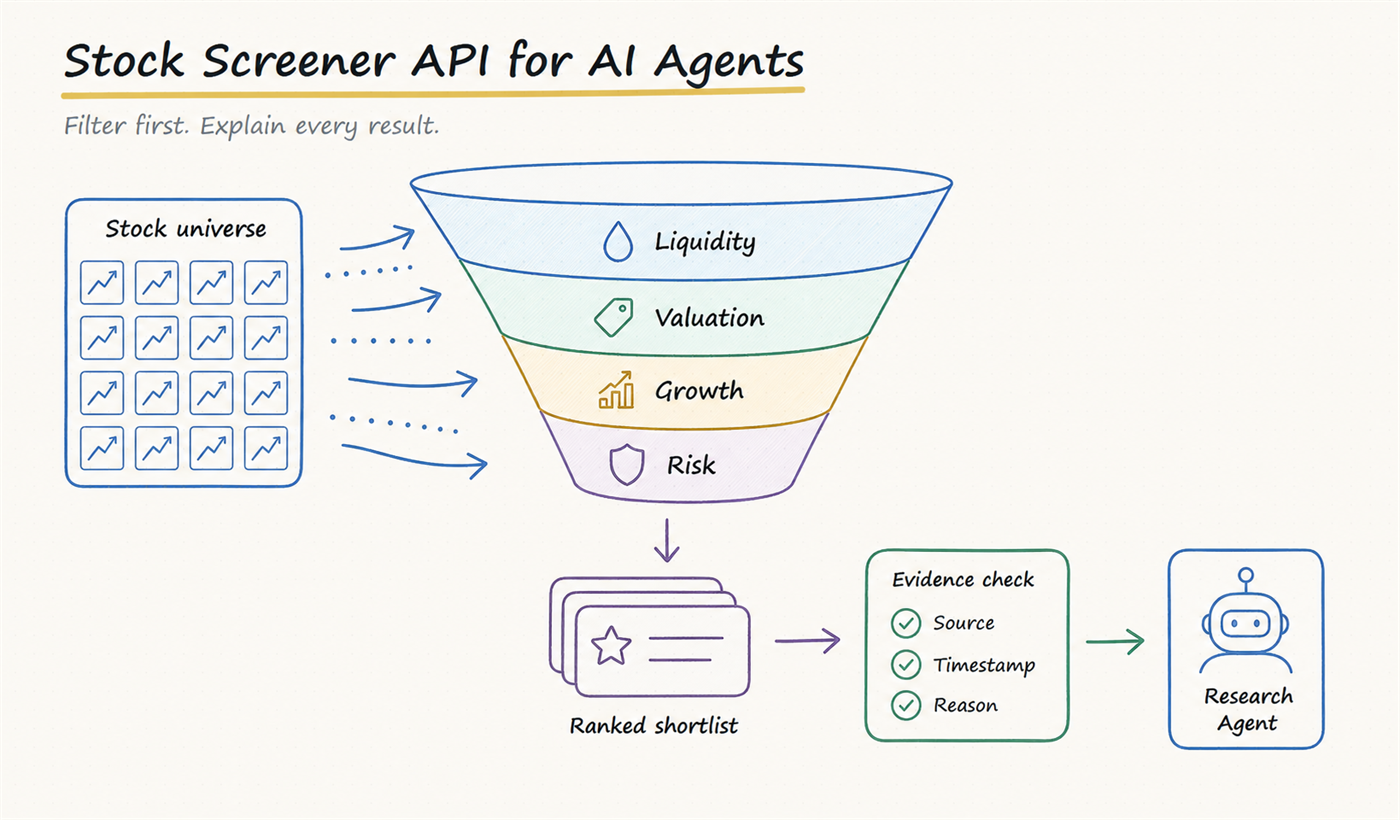
What Is a Stock Screener API for AI Agents? 什么是面向 AI Agent 的股票筛选 API?
A stock screener API lets applications filter a universe of stocks by metrics such as market cap, sector, valuation, revenue growth, margins, volume, momentum, or risk. For AI agents, the important part is not only filtering. The agent must inspect criteria, cite sources, and explain the result.
股票筛选 API 让应用按市值、板块、估值、收入增长、利润率、成交量、动量或风险等指标筛选股票池。对 AI Agent 来说,关键不只是筛选,还要检查条件、引用来源并解释结果。
What Stock Screening Agents Actually Need 股票筛选 Agent 真正需要什么
Exchange, country, sector, industry, market cap, liquidity, ETF exclusion, and listing status.
交易所、国家、板块、行业、市值、流动性、ETF 排除和上市状态。
Valuation, growth, margins, debt, free cash flow, momentum, volatility, volume, and news context.
估值、增长、利润率、债务、自由现金流、动量、波动率、成交量和新闻背景。
Matched criteria, rank, score, source timestamp, missing fields, and reason text for each result.
每个结果的匹配条件、排名、分数、来源时间戳、缺失字段和原因说明。
What to Compare Before Choosing a Stock Screener API 选择股票筛选 API 前应该比较什么
| Factor 维度 | Why it matters for agents 为什么对 Agent 重要 |
|---|---|
| Filter depth 筛选深度 | Agents need more than sector and market cap when building research lists. Agent 构建研究列表时,不只需要板块和市值。 |
| Data freshness 数据新鲜度 | Screening stale fundamentals after earnings can produce misleading results. 财报发布后用过期基本面筛选,可能产生误导结果。 |
| Source transparency 来源透明度 | A research agent should preserve where the metric came from and when it was updated. 研究 Agent 应保留指标来源和更新时间。 |
| Ranking logic 排名逻辑 | If results are sorted, agents need to know whether the sort is by value, quality, momentum, or risk. 如果结果被排序,Agent 需要知道排序依据是价值、质量、动量还是风险。 |
Common Ways to Build Stock Screeners 构建股票筛选器的常见方式
Use fixed filters such as market cap, P/E, revenue growth, and volume.
使用市值、市盈率、收入增长和成交量等固定筛选条件。
Filter first, then sort matched stocks by quality, value, momentum, or risk signals.
先筛选,再按质量、价值、动量或风险信号对匹配股票排序。
Let an agent gather fundamentals, price data, filings, news, and context before recommending a shortlist.
让 Agent 在生成候选列表前收集基本面、价格数据、公告、新闻和背景。
Why Stock Screener APIs Are Hard for AI Agents 为什么股票筛选 API 对 AI Agent 很难
A human can review a screener table and understand its assumptions. An AI agent needs those assumptions in the API response. It needs to know which universe was screened, which fields were missing, whether data is fresh, and why each stock passed the filters.
人类可以查看筛选表并理解其假设。AI Agent 需要这些假设直接出现在 API 返回中。它需要知道筛选了哪个股票池、哪些字段缺失、数据是否新鲜,以及每只股票为什么通过筛选。
How QVeris Routes Stock Screener Workflows QVeris 如何路由股票筛选工作流
Search for stock screener, financial ratios, market data, sector filters, news, and filings capabilities.
搜索股票筛选、财务比率、市场数据、板块过滤、新闻和公告能力。
free discoveryReview required parameters, supported filters, output fields, cost, latency, and source quality.
检查必填参数、支持的筛选条件、输出字段、成本、延迟和来源质量。
schema awareSend clean JSON to AI research agents, dashboards, alerts, and portfolio review workflows.
把干净的 JSON 返回给 AI 研究 Agent、看板、预警和组合复核工作流。
agent readyDecision Matrix for Stock Screener APIs 股票筛选 API 决策矩阵
| If you need... 如果你需要... | Choose... 优先选择... |
|---|---|
| Basic filtering by sector or market cap 按板块或市值做基础筛选 | A simple stock screener API 简单股票筛选 API |
| Fundamental screening 基本面筛选 | Financial statements, ratios, and company data APIs 财务报表、比率和公司数据 API |
| Explainable AI stock shortlists 可解释 AI 股票候选列表 | Screening plus source checks, filings, and market context 筛选加来源检查、公告和市场背景 |
| Production AI agent workflows 生产级 AI Agent 工作流 | QVeris capability routing and fallback QVeris 能力路由和 fallback |
Turn a Screening Idea into Clear Rules把选股想法变成清楚规则
“Find high-quality growth stocks at a reasonable price” sounds clear to a person, but an API needs exact choices. The agent should resolve those choices and return them with the shortlist.
“寻找估值合理的高质量成长股”对人来说似乎很清楚,但 API 需要精确条件。Agent 应把这些选择解析出来,并与候选列表一起返回。
Specify exchanges, countries, security types, listing status, price, market cap, liquidity, and trading history. Decide how to handle ETFs, ADRs, IPOs, financial firms, and delisted names.
明确交易所、国家、证券类型、上市状态、价格、市值、流动性和交易历史,并决定如何处理 ETF、ADR、IPO、金融企业与退市证券。
State whether growth is quarterly, trailing, or multi-year; whether valuation is trailing or forward; and how momentum windows and adjustments are calculated.
说明增长指单季度、过去十二个月还是多年口径,估值使用历史值还是预期值,以及动量窗口和复权方式如何计算。
A missing value may exclude a company, leave one factor unranked, use a peer median, or trigger another call. Never turn missing into zero unless zero is economically correct.
缺失值可以排除公司、让某个因子不参与排名、使用同业中位数,或触发另一次调用。除非经济含义确实为零,否则不能直接填零。
Filters enforce hard limits; rankings order the survivors. Return raw factor values and transformed scores so analysts can see why a company ranks highly.
过滤负责执行硬约束,排名负责排列剩余候选。应同时返回原始因子值与转换分数,让分析师理解公司为什么排名靠前。
Make Every Shortlist Explainable让每一份候选列表都可解释
A production screen should leave a trail from the original request to the final rank. That makes changes reviewable instead of mysterious.
生产级筛选应保留从原始请求到最终排名的完整路径,让变化可以被复核,而不是变成黑箱。
Save the request, resolved rules, universe, as-of time, providers, schemas, formulas, code version, ordered results, and exclusion reasons under one run ID.
在同一个运行 ID 下保存请求、解析后的规则、股票池、截至时间、供应商、Schema、公式、代码版本、排序结果与排除原因。
Report input count, output count, warnings, and elapsed time as the pipeline fetches fields, validates freshness, filters, normalizes, ranks, and enriches.
在获取字段、验证新鲜度、过滤、标准化、排名和补充信息的每个阶段,报告输入数量、输出数量、警告与耗时。
Provide passed rules, factor contributions, peer group, timestamps, missing values, and source links. Keep calculations outside the model and ask it to explain only the supplied evidence.
提供已通过规则、因子贡献、同业组、时间戳、缺失值和来源链接。计算留在模型之外,只让模型解释已提供的证据。
Use filings and news enrichment only for the final shortlist or ambiguous cases. Present the output as a research aid with visible assumptions and limitations—not as an automatic investment recommendation.
公告与新闻补充通常只需用于最终候选或有歧义的案例。结果应作为带有清晰假设与限制的研究辅助,而不是自动投资建议。
Validate the Screen Before Production正式使用前,先验证筛选逻辑
A convincing historical chart is not enough. Validation should prove that the data existed at the time, the rules are robust, and the live workflow can be operated reliably.
一条漂亮的历史曲线远远不够。验证必须证明数据在当时真实可得、规则足够稳健,并且正式工作流能够可靠运行。
| Validation验证项 | What to check检查内容 | Failure to avoid需要避免的问题 |
|---|---|---|
| Point in time时点数据 | Filing availability, index membership, delisted names, and publication lag on each observation date每个观察日的公告可用时间、指数成分、退市证券和发布滞后 | Look-ahead and survivorship bias前视偏差与幸存者偏差 |
| Robustness稳健性 | Start dates, rebalance frequency, holding period, thresholds, costs, turnover, concentration, and regimes起始日期、再平衡频率、持有期、阈值、成本、换手、集中度与市场环境 | A result that disappears after a small parameter change参数稍有变化,结果就完全消失 |
| Evidence证据 | Raw fields, exclusion reasons, factor sums, timestamps, source links, and adversarial edge cases原始字段、排除原因、因子汇总、时间戳、来源链接与对抗案例 | A polished explanation attached to the wrong calculation错误计算配上看似漂亮的解释 |
| Shadow pilot影子试点 | Useful matches, false positives, missing candidates, provider failures, cost, and review time有效匹配、误报、遗漏候选、供应商失败、成本与复核时间 | Promoting a screen before the team understands its operating behavior团队尚未理解运行表现就直接上线 |
After launch, monitor drift in the universe, missing-data rate, factor distributions, turnover, sector concentration, provider coverage, and explanation quality. The screen is explainable only when the whole path from intent to final shortlist can be inspected.
上线后持续监控股票池漂移、缺失率、因子分布、换手率、板块集中度、供应商覆盖和解释质量。只有从用户意图到最终候选列表的整条路径都可检查,筛选才真正可解释。
Stock Screener API FAQ股票筛选 API 常见问题
A screener usually applies fundamental, valuation, quality, growth, or longer-horizon market filters to a defined universe. A scanner more often watches fast-changing intraday conditions such as price, volume, gaps, or technical events. An agent may use both at different stages.
Yes, if the API returns the resolved rules, raw values, transformed factor scores, rank contributions, timestamps, missing fields, and source references. The model should explain that structured evidence rather than infer the screening logic from a ticker list.
Not every exploratory screen needs a full strategy backtest. Any screen used repeatedly for ranking, alerts, portfolio research, or investment decisions should still be checked with point-in-time data, simple baselines, realistic costs, robustness tests, and out-of-sample periods.
The policy should be explicit. A company may be excluded, left unranked for one factor, compared with a peer median, or sent for another data call. The result must distinguish “failed the rule” from “could not be evaluated.”
筛选器通常在明确股票池上应用基本面、估值、质量、增长或较长周期的市场条件;扫描器更常用于监控盘中快速变化的价格、成交量、跳空或技术事件。Agent 可以在不同阶段同时使用两者。
可以,前提是 API 返回解析后的规则、原始值、转换后的因子分数、排名贡献、时间戳、缺失字段和来源引用。模型应解释这些结构化证据,而不是只根据股票代码列表猜测筛选逻辑。
一次性探索不一定需要完整策略回测。但只要筛选会重复用于排名、预警、组合研究或投资决策,就应使用时点数据、简单基准、真实成本、稳健性测试和样本外期间进行验证。
处理政策必须明确。可以排除公司、让某个因子不参与排名、使用同业中位数,或发起另一次数据调用。结果必须区分“没有通过规则”和“无法评估”。
Build Explainable Stock Screening with QVeris 用 QVeris 构建可解释股票筛选
QVeris does not replace a stock screener API. It helps AI agents discover screening capabilities, inspect supported filters, call the right data tools, and add filings, market data, or news context when a shortlist needs explanation. For related data choices, see the QVeris stock API comparison guide, official filings from SEC EDGAR, market data references such as Polygon.io, and Alpha Vantage docs.
QVeris 不是替代股票筛选 API,而是帮助 AI Agent 发现筛选能力、检查支持的筛选条件、调用正确数据工具,并在候选列表需要解释时补充公告、市场数据或新闻背景。相关数据选择可参考 QVeris 的 股票 API 对比指南、SEC EDGAR 官方公告、Polygon.io 等市场数据参考,以及 Alpha Vantage 文档。