
TrueFoundry Alternatives
Matched to Governance Scope
TrueFoundry 替代方案:按治理范围选择
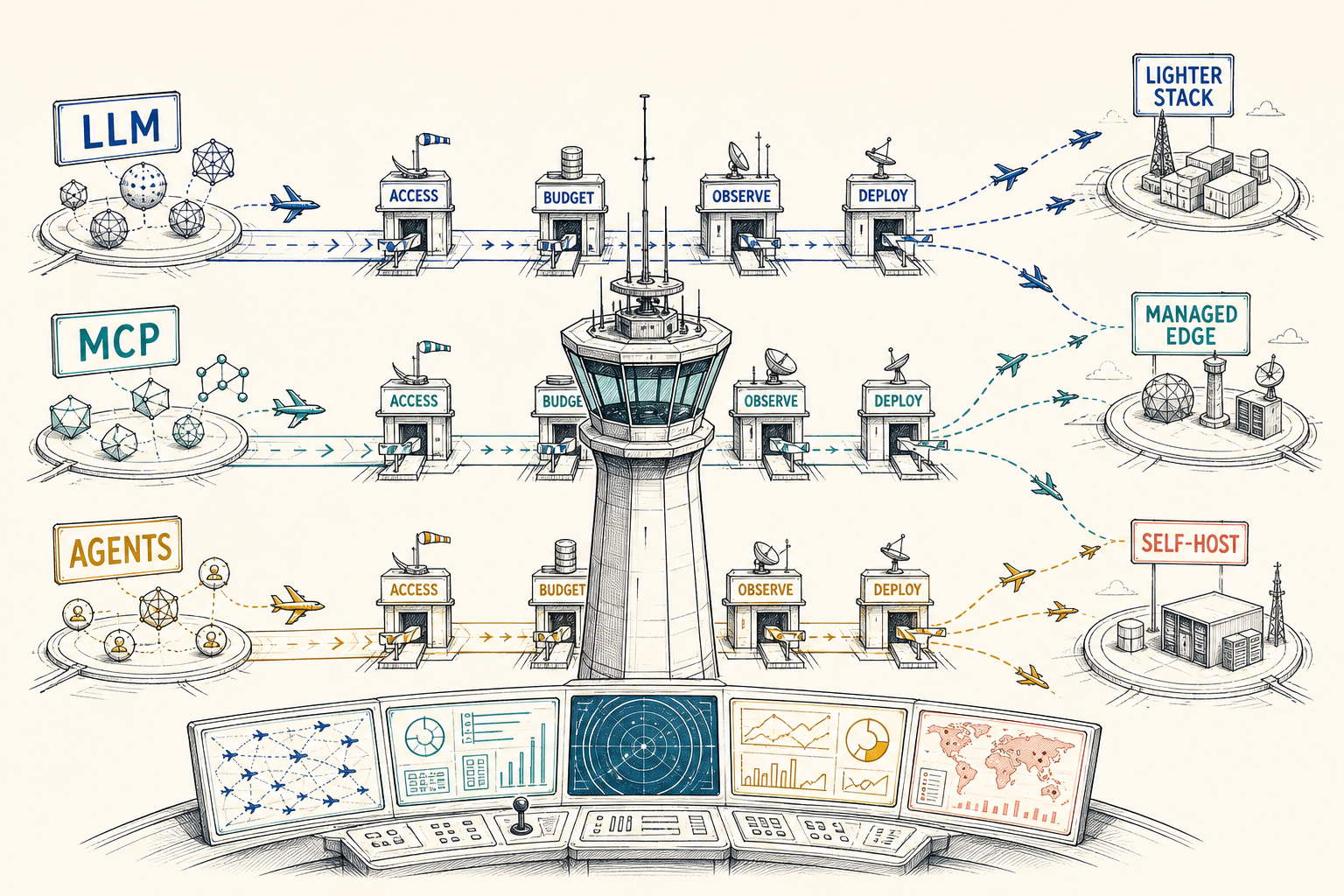
Separate model routing, enterprise policy, MCP governance, and agent deployment before you compare products. The closest feature list is not always the best operating fit.
先拆分模型路由、企业策略、MCP 治理与智能体部署,再比较产品。功能表最接近,并不等于运营方式最合适。
TL;DR
Its official scope spans access, rate and budget controls, routing, guardrails, observability, a prompt playground, and MCP registry and gateway functions.
A team needing a model proxy may not benefit from an enterprise platform; a regulated platform team may outgrow a routing-only service.
Feature checklists hide the harder questions: who owns policy, how evidence is exported, and where credentials and data cross boundaries.
QVeris complements the gateway when agents must discover and call external data and tools with traceable evidence.
官方范围包括访问、限流与预算、路由、护栏、可观测性、提示词 Playground,以及 MCP 注册表与网关。
只需要模型代理的团队未必从企业平台受益;受监管的平台团队也可能很快超出单纯路由服务的边界。
清单会掩盖更难的问题:谁拥有策略、证据如何导出、凭证和数据在哪里跨越边界。
当智能体需要发现和调用外部数据与工具时,QVeris 提供可追踪的能力层,与网关形成互补。
Start with the control plane you actually need 从真正需要的控制面开始
TrueFoundry is not merely a URL in front of model providers. Its documentation presents an enterprise layer for many models, credentials, policies, budgets, load balancing, guardrails, observability, prompts, and MCP services. That breadth is valuable when one platform team must give many application teams governed access. It is excess surface area when one product squad only needs stable fallback and spend visibility.
TrueFoundry 不只是放在模型供应商前面的一个 URL。官方文档把它定义为覆盖多模型、凭证、策略、预算、负载均衡、护栏、可观测性、提示词与 MCP 服务的企业层。当一个平台团队要为多个应用团队提供受治理的访问时,这种广度很有价值;若单个产品组只需要稳定回退和成本可见性,则可能过重。
Provider normalization, retries, fallback, load balancing, streaming semantics, and model availability.
Identity, model allowlists, quotas, budgets, content rules, approvals, and audit retention.
MCP discovery, server trust, tool permissions, credential isolation, and call evidence.
Where the data plane runs, how it upgrades, and who owns incidents and capacity.
供应商标准化、重试、回退、负载均衡、流式语义与模型可用性。
身份、模型白名单、配额、预算、内容规则、审批与审计保留。
MCP 发现、服务器信任、工具权限、凭证隔离与调用证据。
数据面运行位置、升级方式,以及事故和容量由谁负责。
Why teams evaluate TrueFoundry alternatives 团队为何评估 TrueFoundry 替代方案
The immediate requirement is a lightweight OpenAI-compatible proxy, not a full enterprise AI platform.
Security requires a self-hosted data plane, a cloud-native service already approved, or an edge footprint near applications.
Teams already standardize on OpenTelemetry, SIEM, cost dashboards, or API policy and do not want a second control plane.
Tool discovery and trust may be owned independently from inference traffic, making a bundled MCP layer less important.
当前需求是轻量、兼容 OpenAI 的代理,而不是完整企业 AI 平台。
安全要求自托管数据面、已批准的云原生服务,或靠近应用的边缘节点。
团队已统一使用 OpenTelemetry、SIEM、成本看板或 API 策略,不希望再引入第二套控制面。
工具发现与信任可能和推理流量分开管理,因此打包的 MCP 层并非关键。
Eight alternatives, mapped to distinct jobs 按不同任务映射 8 个替代方案
| Option 选项 | Best-fit job 最适合任务 | Trade-off to validate 需要验证的取舍 |
|---|---|---|
| Portkey | Managed gateway, guardrails, and observability 托管网关、护栏与可观测性 | Enterprise feature and deployment requirements 企业功能与部署要求 |
| LiteLLM | Open-source multi-provider proxy 开源多供应商代理 | Your team owns reliability and upgrades 可靠性与升级由团队负责 |
| Kong AI Gateway | AI policy inside an existing API platform 在已有 API 平台中治理 AI | Platform weight without an existing Kong estate 没有 Kong 基础时的平台体量 |
| Cloudflare AI Gateway | Edge-native control and analytics 边缘原生控制与分析 | Fit with your cloud and policy model 与云和策略模型的匹配度 |
| Helicone | LLM observability-led workflows 可观测性主导的 LLM 工作流 | Depth of routing and policy controls 路由与策略控制深度 |
| Bifrost | High-throughput self-hosted data plane 高吞吐自托管数据面 | Control-plane and operator maturity 控制面与运维成熟度 |
| Requesty | Hosted multi-model routing for product teams 面向产品团队的托管多模型路由 | Governance depth for regulated workloads 受监管工作负载所需治理深度 |
| QVeris | Discoverable, auditable external capabilities 可发现、可审计的外部能力 | Complementary tool layer, not inference routing 它是互补工具层,不是推理路由 |
Use an evidence-based control-plane scorecard 使用基于证据的控制面评分卡
Score a production-shaped workload, not a vendor demo. Weight each category before testing: routing fidelity 20%, identity and policy 20%, observability and audit 20%, deployment and operations 20%, MCP and agent fit 10%, and commercial portability 10%. Require a linked artifact for every score.
使用接近生产的工作负载评分,而不是供应商演示。测试前先确定权重:路由保真度 20%、身份与策略 20%、可观测与审计 20%、部署与运营 20%、MCP 与智能体匹配度 10%、商业可迁移性 10%。每个分数都必须附证据。
- Replay streaming, structured output, tool calls, timeouts, rate limits, and malformed provider responses.
- Prove tenant isolation and the path from human identity to service identity and provider credential.
- Export logs and traces into the systems your incident and compliance teams already use.
- Measure the operator hours required for upgrades, policy changes, and an intentional provider outage.
- 回放流式输出、结构化输出、工具调用、超时、限流与异常供应商响应。
- 证明租户隔离,以及人员身份到服务身份和供应商凭证的完整路径。
- 把日志与调用链导入事故和合规团队现用的系统。
- 测量升级、策略变更和模拟供应商中断所需的运维时间。
Migrate by governance domain, not by endpoint 按治理域迁移,而不是只换端点
First inventory identities, credentials, routes, budgets, guardrails, logs, dashboards, MCP servers, and retention rules. Create a parity owner for each domain. Run shadow telemetry, then canary one low-risk tenant before changing shared SDK defaults. A successful HTTP response does not prove policy or audit parity.
先盘点身份、凭证、路由、预算、护栏、日志、看板、MCP 服务器与保留规则,并为每个治理域指定一致性负责人。先运行影子遥测,再选择一个低风险租户做 Canary,最后才修改共享 SDK 默认值。HTTP 成功响应不代表策略或审计已经一致。
Rollback gate: keep the old route until request counts, token usage, cost attribution, policy decisions, and audit exports reconcile for one complete operating cycle.
回滚门槛:在请求数、Token、成本归属、策略决策与审计导出完整核对一个运营周期前,保留旧路由。
Where QVeris belongs in the architecture QVeris 在架构中的位置
An AI gateway decides how an inference request reaches a model. QVeris addresses a different boundary: how an agent finds an external capability, understands its contract, invokes it under controlled credentials, and retains evidence. Use a shared trace ID to connect model decisions with downstream tool calls.
AI 网关决定推理请求如何到达模型。QVeris 处理另一条边界:智能体如何发现外部能力、理解调用契约、在受控凭证下执行,并保留证据。可以使用共享调用链 ID 连接模型决策与后续工具调用。
A Production Evaluation Plan for TrueFoundry alternativesTrueFoundry 替代方案的生产评估方案
A feature table can identify candidates, but it cannot prove operational fit. Evaluate TrueFoundry alternatives with the workloads, policies, failure conditions, and evidence requirements that the team will actually own after migration.
功能表可以帮助筛选候选方案,却无法证明生产适配性。评估TrueFoundry 替代方案时,应使用团队迁移后真正需要承担的工作负载、策略、失败条件和证据要求。
Inventory representative requests and record model deployment, gateway policy, evaluation, observability, infrastructure ownership, identity, compliance, and developer self-service. Include volumes, tail latency, quality thresholds, regulated data, operator steps, monthly spend, and the incidents the current system already knows how to handle.
盘点有代表性的请求,并记录模型部署、网关策略、评估、可观察性、基础设施责任、身份、合规和开发者自服务。同时纳入流量、长尾延迟、质量门槛、受监管数据、人工步骤、月度支出,以及现有系统已经能够处理的事故类型。
To validate TrueFoundry Alternatives, replay saved cases against each candidate. Compare accepted parameters, streaming events, structured output, tool calls, error classes, usage accounting, and source metadata. Mark every difference as required, adaptable, or a migration blocker.
验证“TrueFoundry 替代方案”时,用保存的案例重放每个候选方案,比较参数、流式事件、结构化输出、工具调用、错误类别、用量计量和来源元数据,并将差异标记为必须保留、可以适配或阻断迁移。
To validate TrueFoundry Alternatives, measure end-to-end task completion, output quality, p50 and tail latency, availability, retry amplification, fallback behavior, and accepted-result cost. Include rate limits, malformed responses, regional loss, schema drift, and provider outages.
验证“TrueFoundry 替代方案”时,衡量端到端任务完成率、输出质量、常规与长尾延迟、可用性、重试放大、故障切换行为和合格结果成本,并加入限流、畸形响应、区域丢失、Schema 漂移与供应商中断。
Before rolling out TrueFoundry Alternatives, version routing and policy outside the vendor, preserve trace identifiers, stage read-only traffic first, define rollback signals, and retain a direct-provider or previous-platform path until evidence meets the acceptance threshold.
上线“TrueFoundry 替代方案”前,在供应商之外版本化路由与策略,保留追踪标识,先迁移只读流量,定义回滚信号,并在证据达到验收门槛前保留直连供应商或原平台路径。
FAQ
No. Its documented platform scope also includes guardrails, observability, prompt workflows, and MCP registry and gateway capabilities.
LiteLLM and Bifrost are focused candidates, but compare operational ownership and failure behavior rather than image size alone.
Possibly when AI traffic must inherit an established API platform. Validate model-specific streaming, tool calls, caching, and observability.
No. QVeris is a complementary capability-access layer rather than a model routing and AI platform control plane.
不是。其官方平台范围还包括护栏、可观测性、提示词工作流,以及 MCP 注册表与网关。
LiteLLM 与 Bifrost 是重点候选,但应比较运维归属和故障行为,不能只看镜像大小。
若 AI 流量需要继承已有 API 平台,可能可以;仍需验证流式、工具调用、缓存与可观测性。
不会。QVeris 是互补的能力访问层,而不是模型路由与 AI 平台控制面。