
Zapier MCP vs QVeris: Best Zapier MCP Alternative for Developers
Zapier MCP is a no-code bridge connecting AI agents to 9,000+ business applications through pre-configured tools.[1] QVeris is a capability routing network with 10,000+ capabilities, natural language discovery, and pay-per-call pricing.[2] The core trade-off: pre-configured SaaS integrations vs dynamic capability discovery.
- Your AI Agent needs financial vertical data (market data, KYC, crypto)
- You want natural language discovery instead of dashboard configuration
- Call volumes are variable — pay-per-call beats subscription lock-in
- You need SDK, REST API, or CLI programmatic control
- You're a non-technical user automating SaaS business workflows
- You need 9,000+ app integrations (Gmail, Slack, Salesforce, etc.)
- You want zero-code setup in minutes
- You're already a Zapier customer with an existing plan
30-second verdict: If you're a developer building production AI agents with financial data needs, QVeris is the clear choice. If you need quick, no-code SaaS automation, Zapier MCP works well. They can also be used together — Zapier MCP for SaaS operations, QVeris for capability discovery and financial data.
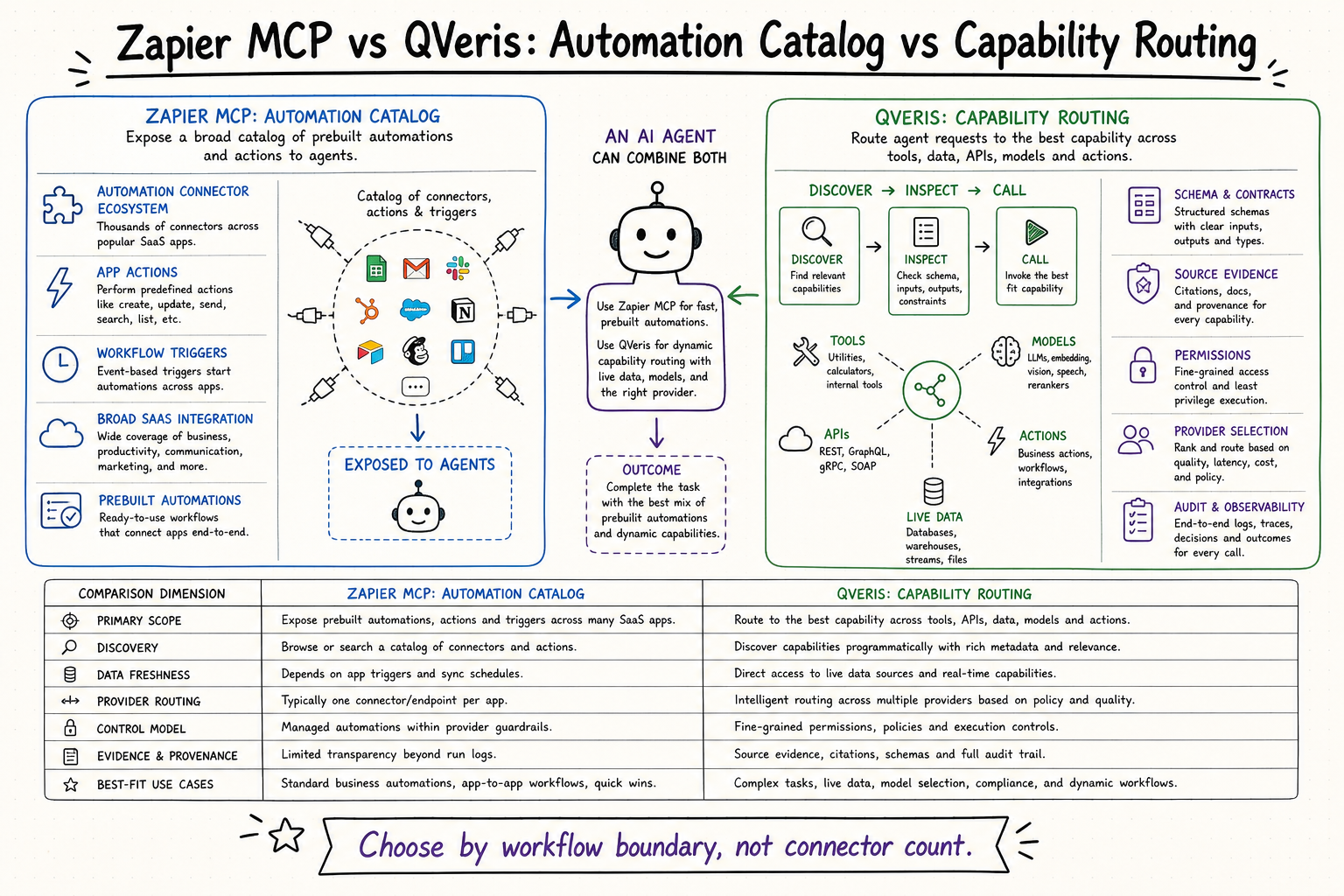
What They Are: Core Trade-offs
Zapier MCP is a no-code bridge that exposes Zapier's 9,000+ app ecosystem as MCP tools for AI agents.[1] QVeris is a capability routing network with 10,000+ capabilities across 15+ categories.[2] Here's how they differ:
- QVeris: An AI-Agent-native capability routing network. Built for developers who need breadth (10,000+ capabilities[2]), discovery flexibility (natural language), financial vertical depth (quant, fixed income, risk, research, crypto, alt data), and cost efficiency (pay-per-call with free discovery). Best for evolving AI Agent architectures and multi-source integration needs.
- Zapier MCP: A no-code bridge to 9,000+ business applications (30,000+ actions) using pre-configured MCP tools.[1] Built for non-technical users who want AI to operate Gmail, Slack, Salesforce, and more without writing code. Best for teams that need quick SaaS automation with minimal setup.
Architecture: How Each Platform Works
A picture is worth a thousand words. Here's how the two platforms compare at the architectural level.
Pre-configured SaaS bridge
- Visit mcp.zapier.com dashboard
- Select apps & actions to expose
- Generate MCP server URL
- Connect AI client (Claude, ChatGPT, Cursor)
- Call tools via natural language
Dynamic capability routing network
- Natural language Discover — describe what you need
- Inspect latency, cost & reliability (always free)
- Choose integration: CLI / MCP / SDK / REST
- Agent makes sandboxed Call
- Credits consumed — pay only for execution
The key difference: Zapier MCP is a configuration-then-call model — you decide what tools are available before the agent starts. QVeris is a discover-then-call model — the agent discovers capabilities dynamically at runtime, inspects them before committing, and pays only for execution.
Discovery: Dashboard vs Natural Language
How you find and select tools differs fundamentally between these platforms:
- QVeris: Natural language Discover. Describe what you need — "find me tools for real-time stock prices" — and QVeris returns matching capabilities with pricing, latency, and parameter details. No dashboard browsing required. Discovery is always free.[2]
- Zapier MCP: Visual dashboard at mcp.zapier.com. Select which apps and actions to expose, generate an MCP server URL, then connect your AI client. Every new tool requires this workflow.[1]
The real advantage of QVeris's approach shows up when you're not sure what exists. Natural language discovery lets you explore by describing your goal, not browsing a pre-defined taxonomy.
🔍 Try QVeris Discovery — Live
Type what you want your AI Agent to do, and see how QVeris's natural language discovery works.
Matching Capabilities
Inspect any capability to see full SLA, latency, and per-call pricing — all before you write a single line of code.
Zapier MCP vs QVeris: Feature Comparison
| Feature | Zapier MCP | QVeris |
|---|---|---|
| Tool discovery | Pre-configured via dashboard | Natural language (Discover) |
| Pre-call inspection | Not available | Always-free latency / cost preview |
| Financial vertical data | Not available | Six dedicated domains |
| SaaS app breadth | 9,000+ apps | Partial (not core focus) |
| Agent framework support | MCP clients only | 14+ platforms |
| SDK / API | Not available | Python SDK + REST + CLI |
| MCP support | Unidirectional | Bidirectional |
| Sandboxed execution | Not available | Built-in sandbox |
| Pricing model | Subscription (2 Tasks/call) | Pay-per-use, no expiry |
Integration Breadth & Developer Experience
The platforms take fundamentally different approaches to integration — and that determines which developers they serve.
Integration Methods
MCP Server
Connect Claude, ChatGPT, Cursor
Python SDK
Programmatic tool calling
REST API
Any language or framework
CLI
Zero-token tool calling
QVeris offers four integration paths — Zapier MCP offers one (MCP via dashboard). QVeris supports 14+ agent frameworks out of the box including Hermes Agent, OpenClaw, Cursor, and Claude Code.[2]
Financial Vertical Depth
Zapier MCP connects AI agents to business applications. QVeris connects AI agents to financial data infrastructure — a domain Zapier MCP cannot address:
- Real-time equity and options pricing
- Cryptocurrency spot and derivatives data
- KYC/AML verification services
- Macroeconomic indicators and yield curves
- Alternative data signals and investment research
Pricing: Subscription vs Pay-Per-Call
Pricing is where the gap becomes most apparent — especially at scale. Zapier MCP charges 2 Tasks per tool call, making high-volume usage expensive. QVeris uses pay-per-call with free discovery.[2]
| Dimension | Zapier MCP | QVeris |
|---|---|---|
| Free tier | 100 tasks/month | 1,000 signup + 100 daily |
| Entry paid | $19.99/mo — 750 tasks (~375 calls) | $19 — 10,000 credits |
| 10,000 calls/month | ~$600+/mo | $19/mo |
| Credit expiry | Monthly reset | Never expires |
| Subscription required | Yes | No — Scale On-Demand |
| Discover / Inspect | N/A | Always free |
See exactly how much each platform costs at your call volume.
Decision Matrix: Which Fits You
Use this framework to make your decision:
✓ Choose QVeris if:
- You're a developer building production AI agents — need SDK, API, CLI
- Your use case involves financial vertical data (market data, KYC, crypto)
- You operate at high call volumes — 10K calls on QVeris = $19 vs ~$600 on Zapier MCP
- Your agents need to discover tools dynamically at runtime
- You want predictable, subscription-free pricing with credits that never expire
✓ Choose Zapier MCP if:
- You're a non-technical user — zero-code setup is your priority
- Your use case is SaaS business automation (Gmail, Slack, Salesforce)
- You need 9,000+ app integrations — broadest in the industry
- You want quick setup in minutes, no SDK or API key management
- You're already a Zapier customer extending your existing setup
Can They Be Used Together?
Yes. A mature AI agent architecture might use Zapier MCP for business application operations (sending emails, updating CRMs, managing calendars) and QVeris for capability discovery and financial data (market data, KYC, investment research, crypto signals). There is no technical conflict.
Switching from Zapier MCP to QVeris
Sign up at qveris.ai — no credit card required. Receive 1,000 free credits + 100 daily.
Use natural language to find the capabilities your agent needs. Inspect SLA, latency, and per-call cost before integrating.
Connect via CLI, MCP, Python SDK, or REST API. Test in parallel with Zapier MCP, then migrate when ready. No data migration required.
FAQ: Zapier MCP vs QVeris
Try QVeris Free — 1,000 Credits + 100 Daily
Free discovery lets you explore 10,000+ capabilities before writing any code. Only pay per call when your AI Agent executes in production. No subscription lock-in, no credit card required.
Methodology & References
Last updated:
Data sources: QVeris capabilities and pricing from internal product specifications. Zapier MCP data from zapier.com/mcp and zapier.com/pricing (verified May 2026). All claims annotated with references.
Update cadence: Reviewed quarterly. Pricing and feature data refreshed every 90 days.
References
- Zapier MCP Official Page — Product specs, app count (9,000+). Pricing at zapier.com/pricing. Verified May 2026.
- QVeris Documentation — Capability catalog (10,000+ capabilities, 15+ categories), pricing, SLA. Verified May 2026.
- Zapier MCP Server Announcement — Task consumption (2 tasks/call) and integration workflow. Verified May 2026.