
ZenMux Alternatives
Protocol Fidelity Before Convenience
ZenMux 替代方案:先验证协议保真度
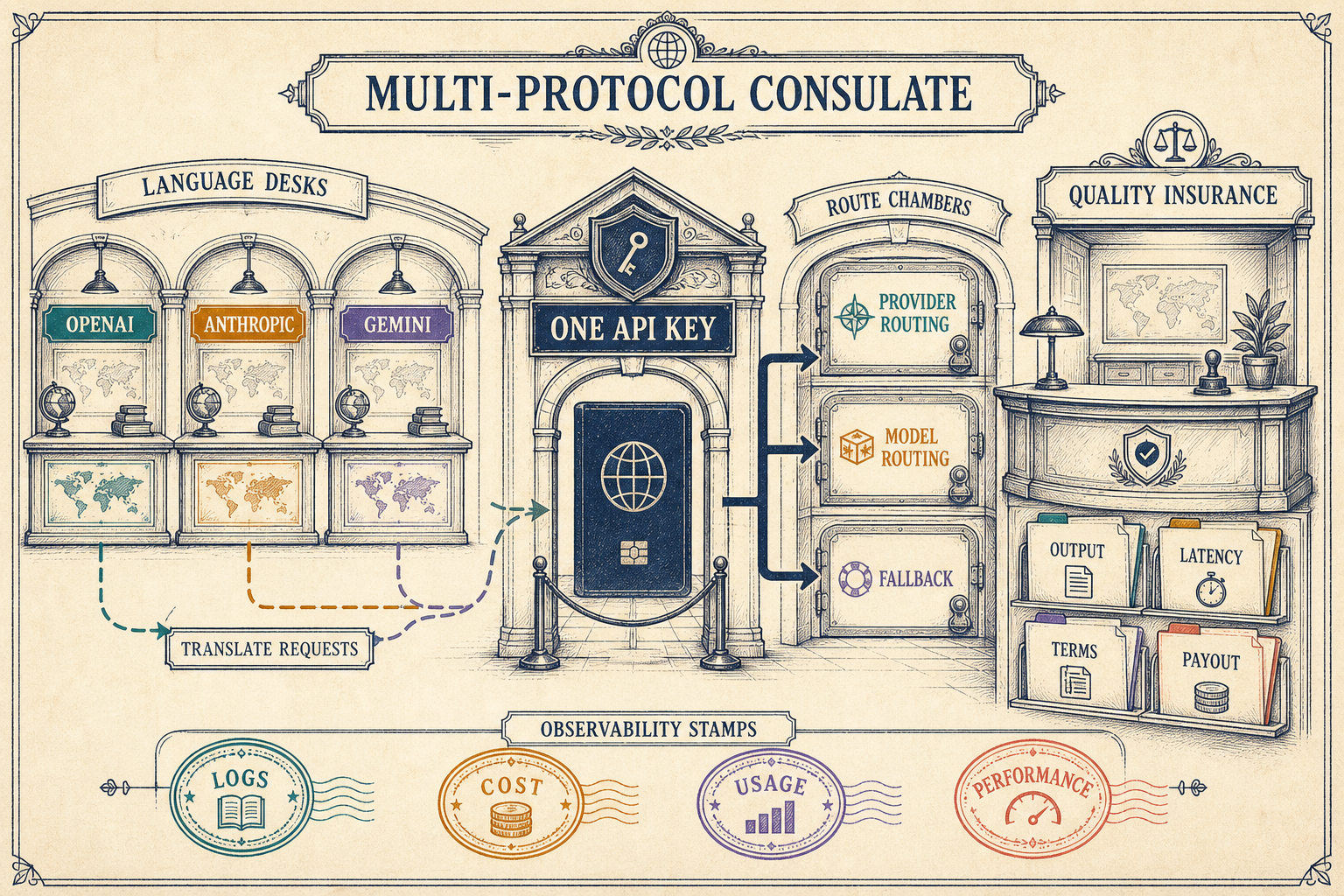
One key can serve OpenAI, Anthropic, and Gemini-style clients, but cross-protocol translation changes semantics. Test native behavior, routing evidence, billing, and quality terms before choosing convenience.
一个密钥可服务 OpenAI、Anthropic 与 Gemini 风格客户端,但跨协议翻译会改变语义。选择便利前,应测试原生行为、路由证据、账单与质量条款。
TL;DR
Current documentation lists OpenAI Chat Completions and Responses, Anthropic Messages, and Google Gemini endpoints with cross-protocol model calling.
System prompts, tools, structured output, reasoning, citations, safety fields, caching, streaming events, token counts, and errors need task-level tests.
Provider routing chooses an upstream for one model; model routing chooses a different model. Their quality, cost, and rollback evidence should not be mixed.
A quality or latency payout has value only when trigger, evidence, exclusions, amount, timing, and dispute path match the workload.
当前文档列出 OpenAI Chat Completions 与 Responses、Anthropic Messages、Google Gemini 端点,并支持跨协议调用模型。
System 提示词、工具、结构化输出、Reasoning、引用、安全字段、缓存、流式事件、Token 与错误都需任务级测试。
供应商 Routing 为同一模型选上游;模型 Routing 选择不同模型。质量、成本与回滚证据不应混在一起。
质量或延迟赔付只有在触发条件、证据、除外、金额、时间和争议路径匹配工作负载时才有价值。
Preserve the protocol features your application uses 保留应用实际使用的协议功能
| Surface 接口 | Fidelity tests 保真测试 |
|---|---|
| OpenAI Chat | Roles, tool choice, structured output, logprobs, multimodal inputs, streaming chunks, usage, and finish reasons Role、工具 Choice、结构化输出、Logprobs、多模态、流式分块、用量与 Finish Reason |
| OpenAI Responses | Response items, built-in tools, reasoning summaries, background state, events, and response lifecycle Response Item、内置工具、Reasoning Summary、后台状态、事件与生命周期 |
| Anthropic Messages | System placement, content blocks, tool use and result blocks, thinking, citations, cache controls, and stop reasons System 位置、Content Block、工具 Use/Result、Thinking、引用、缓存控制与 Stop Reason |
| Gemini | Contents and parts, system instruction, safety ratings, function calls, grounding, files, candidates, and streaming Contents/Parts、System Instruction、安全评分、函数调用、Grounding、文件、Candidate 与流式 |
Eight alternatives by protocol and access model 按协议与访问模式划分的 8 个替代方案
| Option 选项 | Strongest fit 最强适配 | Validate first 优先验证 |
|---|---|---|
| OpenRouter | Broad LLM access and provider routing 广泛 LLM 访问与供应商路由 | Protocol breadth and model semantics 协议广度与模型语义 |
| LiteLLM | Self-hosted provider normalization and virtual keys 自托管供应商标准化与虚拟密钥 | Operations and cross-protocol fidelity 运维与跨协议保真 |
| Portkey | Managed gateway, policy, guardrails, and observability 托管网关、策略、护栏与可观测 | Protocol-native feature support 协议原生功能支持 |
| Helicone Gateway | Model access with deep request observability 带深度请求可观测的模型访问 | Routing and enterprise policy 路由与企业策略 |
| Vercel AI Gateway | AI SDK and application-platform integration AI SDK 与应用平台集成 | Non-Vercel protocol clients 非 Vercel 协议客户端 |
| NanoGPT | Low-friction multi-model access and payments 低门槛多模型访问与支付 | Enterprise protocol and governance needs 企业协议与治理需求 |
| APIpie | Simple OpenAI-style multi-model endpoint 简单 OpenAI 风格多模型端点 | Documentation, routing, and support depth 文档、路由与支持深度 |
| Direct provider APIs | Maximum native semantics and provider support 最大原生语义与供应商支持 | Multiple SDKs, accounts, reliability, and billing 多 SDK、账户、可靠性与账单 |
Evaluate quality insurance like an SLO contract 像评估 SLO 合同一样评估质量保险
ZenMux documentation presents an insurance-backed mechanism for poor output quality or excessive latency. Before assigning value, obtain the current binding terms and map: eligible plans and models, quality detector, latency threshold, measurement location, required request metadata, exclusions, payout formula and cap, claim or automatic process, evidence access, false-positive and false-negative handling, dispute process, and changes to the terms.
ZenMux 文档介绍了针对输出质量差或延迟过高的保险机制。赋予价值前,应取得当前有约束力的条款,并映射:适用套餐与模型、质量检测器、延迟阈值、测量位置、请求元数据要求、除外、赔付公式与上限、自动或申领流程、证据访问、误报漏报处理、争议流程与条款变更。
Operational rule: a payout does not restore a failed user task. Keep retries, fallbacks, quality checks, and incident response even when financial compensation applies.
运营规则:赔付不能恢复失败的用户任务。即使有经济补偿,也要保留重试、回退、质量检查与事故响应。
A cross-protocol and routing proof 跨协议与路由验证
- Run the same task through its native provider protocol and each supported ZenMux-compatible protocol; compare request and response semantics.
- Use tools, structured output, reasoning, citations, caching, multimodal input, and streaming; diff every event and usage field.
- Force one upstream failure and one slow response; verify provider route, model route, fallback, logs, billing, and any insurance evidence separately.
- Replay a trace from request ID to protocol adapter, selected model and provider, price, output, quality decision, and payout state.
- 通过原生供应商协议和每个 ZenMux 兼容协议运行同一任务,比较请求与响应语义。
- 使用工具、结构化输出、Reasoning、引用、缓存、多模态与流式,Diff 每个事件和用量字段。
- 强制一个上游失败与一个慢响应,分别验证供应商路由、模型路由、故障切换、日志、账单与保险证据。
- 从请求 ID 回放到协议适配器、所选模型与供应商、价格、输出、质量决策与赔付状态。
Keep a canonical internal request model 保留规范内部请求模型
Do not let one provider protocol become the hidden domain model for every application. Define internal capabilities and explicit adapters for messages, tools, structured output, reasoning, citations, multimodal parts, cache controls, streaming events, usage, and errors. Log transformations and unsupported fields. Dual-run native and translated paths before moving traffic, and keep a direct-provider rollback for critical features.
不要让某个供应商协议成为所有应用的隐藏领域模型。为 Message、工具、结构化输出、Reasoning、引用、多模态 Part、缓存控制、流式事件、用量与错误定义内部能力和显式适配器;记录转换与不支持字段。迁移流量前双轨运行原生与翻译路径,并为关键功能保留直接供应商回滚。
Protocol routing and capability routing 协议路由与能力路由
ZenMux or another model platform translates and routes inference protocols. QVeris helps the resulting agent discover and call external data, APIs, and tools under governed contracts and credentials. Shared trace context links model protocol decisions to downstream action evidence.
ZenMux 或其他模型平台翻译并路由推理协议;QVeris 帮助生成的智能体在受治理契约与凭证下发现和调用外部数据、API 与工具。共享调用链上下文连接模型协议决策与下游动作证据。
A Production Evaluation Plan for ZenMux alternativesZenMux 替代方案的生产评估方案
A feature table can identify candidates, but it cannot prove operational fit. Evaluate ZenMux alternatives with the workloads, policies, failure conditions, and evidence requirements that the team will actually own after migration.
功能表可以帮助筛选候选方案,却无法证明生产适配性。评估ZenMux 替代方案时,应使用团队迁移后真正需要承担的工作负载、策略、失败条件和证据要求。
Inventory representative requests and record provider reach, protocol compatibility, model aliases, routing policy, price transparency, regional access, fallbacks, and support. Include volumes, tail latency, quality thresholds, regulated data, operator steps, monthly spend, and the incidents the current system already knows how to handle.
盘点有代表性的请求,并记录供应商覆盖、协议兼容、模型别名、路由策略、价格透明度、区域访问、故障切换和支持。同时纳入流量、长尾延迟、质量门槛、受监管数据、人工步骤、月度支出,以及现有系统已经能够处理的事故类型。
To validate ZenMux Alternatives, replay saved cases against each candidate. Compare accepted parameters, streaming events, structured output, tool calls, error classes, usage accounting, and source metadata. Mark every difference as required, adaptable, or a migration blocker.
验证“ZenMux 替代方案”时,用保存的案例重放每个候选方案,比较参数、流式事件、结构化输出、工具调用、错误类别、用量计量和来源元数据,并将差异标记为必须保留、可以适配或阻断迁移。
To validate ZenMux Alternatives, measure end-to-end task completion, output quality, p50 and tail latency, availability, retry amplification, fallback behavior, and accepted-result cost. Include rate limits, malformed responses, regional loss, schema drift, and provider outages.
验证“ZenMux 替代方案”时,衡量端到端任务完成率、输出质量、常规与长尾延迟、可用性、重试放大、故障切换行为和合格结果成本,并加入限流、畸形响应、区域丢失、Schema 漂移与供应商中断。
Before rolling out ZenMux Alternatives, version routing and policy outside the vendor, preserve trace identifiers, stage read-only traffic first, define rollback signals, and retain a direct-provider or previous-platform path until evidence meets the acceptance threshold.
上线“ZenMux 替代方案”前,在供应商之外版本化路由与策略,保留追踪标识,先迁移只读流量,定义回滚信号,并在证据达到验收门槛前保留直连供应商或原平台路径。
FAQ
Current quickstart material lists OpenAI Chat Completions and Responses, Anthropic Messages, and Google Gemini-compatible endpoints.
Its documentation presents cross-protocol calling. Validate the Claude features your application uses against native Anthropic behavior.
No. Treat it as a commercial term layered on top of fallbacks, evaluation, user recovery, and incident response.
No. QVeris is a complementary external capability layer rather than a multi-protocol model API.
当前 Quickstart 列出 OpenAI Chat Completions 与 Responses、Anthropic Messages 与 Google Gemini 兼容端点。
其文档展示跨协议调用;应把应用使用的 Claude 功能与原生 Anthropic 行为比较。
不能。它是叠加在回退、评估、用户恢复与事故响应上的商业条款。
不会。QVeris 是互补外部能力层,而非多协议模型 API。