
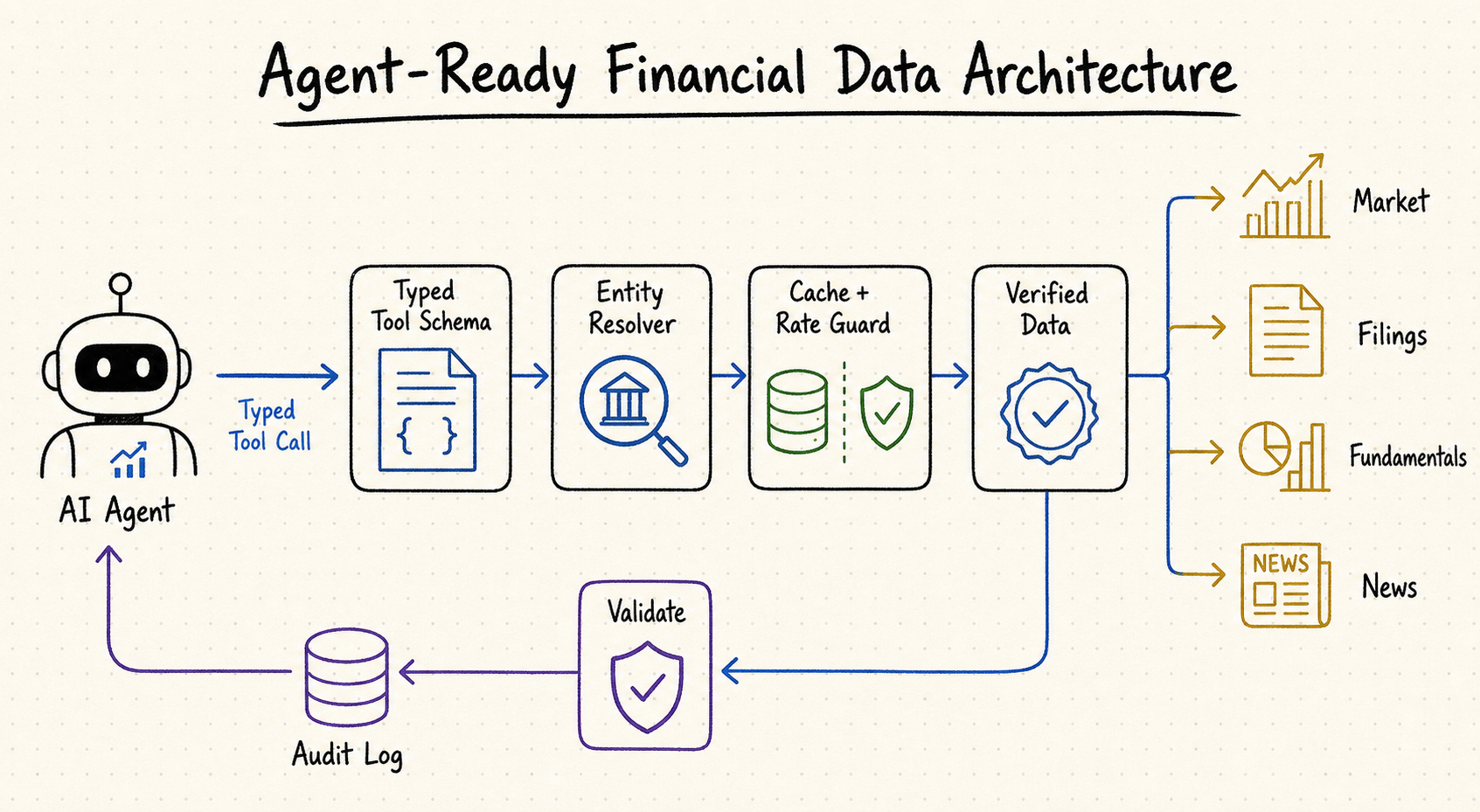
AGENT-READY FINANCIAL DATA面向 AGENT 的金融数据
Financial Data API for AI Agents面向 AI Agent 的金融数据 API
Evaluate schemas, identifiers, coverage, point-in-time history, cost controls, provenance, licensing, and auditability before an agent makes its first call.在 Agent 发起第一次调用前,系统评估工具 Schema、统一标识符、数据覆盖、时点历史、成本控制、来源链、授权与可审计性。
Guide · 16 min read
Last updated 31 July 2026
Market data APIs were designed for dashboards and backtests, where a human writes the query, reads the response, and knows what a CIK is. Agents behave differently: they fan out, they pay for every byte you return, and they pick endpoints from a text description. An API that is excellent for a charting app can be unusable behind an agent. This guide covers what changes, the nine requirements that decide it, how to evaluate a provider in a week, and what it actually costs.
On this page
- The short version
- Why agent workloads break normal APIs
- Nine requirements
- What a good tool schema looks like
- Coverage checklist by dataset
- Budget by workflow, not by question
- Architecture patterns that cut cost 5–10x
- Evaluate a provider in one week
- Licensing and compliance
- Seven common mistakes
- Glossary
The short version
- Judge an API by its tool schemas and identifier model first. Coverage differences between the main providers are smaller than the integration cost differences.
- Budget by workflow, not per question. One agent question is 30–80 calls; a 500-name screen is over 1,500.
- Field selection and caching are worth more than a cheaper per-call price. They routinely cut both the bill and the token spend by an order of magnitude.
- Sort out point-in-time history and licensing before you build, not after your first customer asks for a backtest.
Why agent workloads break normal APIs
A dashboard makes a handful of predictable calls that a developer wrote by hand and tested. An agent makes a variable number of calls that nobody wrote, chosen at runtime from an endpoint description, in bursts, with the entire response body flowing into a context window that costs money per token. Four things change:
Call volume is unpredictable
The same question can cost 12 calls or 200 depending on how the plan decomposes. Monthly quotas designed for dashboards are the wrong unit.
Response size is a direct cost
Every byte returned is read into context and billed twice: once by the data provider, once by the model.
Endpoint choice is probabilistic
The model picks from descriptions. Ambiguous naming produces wrong-endpoint calls that still return 200 OK and quietly wrong data.
Errors must be machine-readable
A human retries a 429. An agent needs a structured error it can reason about, or it invents a plausible answer instead.
Nine requirements
01Typed tool schemas, not just REST docs
An agent picks tools from descriptions. If the provider only ships OpenAPI meant for humans, you will spend weeks writing and tuning tool definitions — and the model will still call the wrong endpoint. Look for schemas designed for function calling, with argument descriptions that disambiguate similar endpoints and explicitly say what each tool is not for.
02Consistent identifiers across datasets
Prices keyed by ticker, fundamentals keyed by CIK and news keyed by company name is three joins the agent has to invent, and inventing joins is how hallucinations get into otherwise correct pipelines. A single entity ID across every dataset, plus one resolver endpoint that maps tickers, ISINs, CUSIPs and names onto it, removes the entire class of error. Ask specifically how ticker changes, mergers and dual listings are handled.
03Predictable pagination and response size
Agents pay for every token they read. An endpoint that returns a 400 KB JSON blob for one query will blow the context window and the budget. Prefer providers with field selection, hard caps on rows per call, and compact key names. A statement endpoint that returns 15 line items instead of 240 is not a minor optimisation — it is the difference between a workable agent and an expensive one.
04Rate limits that survive a fan-out
One agent question routinely becomes 30–80 parallel calls. A 5 requests/second limit that is fine for a dashboard will stall an agent run and, worse, produce partial answers when your retry logic gives up. Check burst limits and concurrency, not just monthly quotas, and check whether 429s carry a Retry-After header.
05Point-in-time correctness
If restated financials silently overwrite history, every backtest you build on the API is wrong and every “what did we know in March” question is unanswerable. Ask whether the data is point-in-time, whether restatements are versioned, and whether index constituents are historical or current-only (survivorship bias hides here).
06Structured, honest errors
There is a large difference between “no data exists for this period”, “you are not licensed for this dataset” and “you are rate limited”. If all three arrive as an empty array, the agent will treat missing data as a zero and report a margin collapse that never happened. Insist on distinct, typed error responses.
07Latency budgets you can plan around
Agent runs are sequential chains of parallel bursts. A p99 of two seconds on a chain of five hops is a ten-second answer before the model has written a word. Ask for p50 and p99 by endpoint, not an average, and test from your own region.
08Coverage that matches your universe
Most providers look identical on US large caps. The differences appear in small caps, non-US listings, OTC names, ADRs, recent IPOs, and anything delisted. Test on the ugliest fifty tickers you care about, never on the demo list.
09Licensing for what you are actually doing
Internal research, client-facing display and redistribution are three different licences. Real-time exchange data usually carries per-user reporting obligations. Sort this out before launch, not after.
What a good tool schema looks like
The description field is not documentation — it is the routing logic. This is the level of specificity that stops a model from calling the fundamentals endpoint when it wanted estimates:
{
  "name": "get_income_statement",
  "description": "Quarterly or annual income statement for one company, as filed. Use for revenue, margins, EPS. Do NOT use for market prices or estimates.",
  "parameters": {
    "entity_id":  { "type": "string", "description": "Qveris entity ID. Resolve tickers with resolve_entity first." },
    "period":     { "type": "string", "enum": ["quarterly", "annual"] },
    "limit":      { "type": "integer", "maximum": 20, "default": 8 },
    "fields":     { "type": "array", "items": { "type": "string" },
                    "description": "Return only these line items. Always set this - full statements are ~15x larger." },
    "as_of":      { "type": "string", "description": "ISO date. Returns data as known on that date (point-in-time)." }
  }
}
Three details matter here: the tool says what it is not for, it forces entity resolution rather than accepting a raw ticker, and it nudges the model toward field selection with a stated cost consequence. Schemas written this way cut wrong-endpoint calls dramatically without any change to the underlying data.
Coverage checklist by dataset
Run this list against any provider before signing. The right answer is not “yes” to everything — it is “yes” to the rows your workflows actually touch.
| Dataset | What to verify | Common gap |
|---|---|---|
| Prices | Adjustment methodology, delisted history, corporate actions | Splits applied, dividends not |
| Fundamentals | As-reported and adjusted, fiscal calendars, restatement versions | Only latest restated figures |
| Filings | Full text, section segmentation, exhibits, non-US equivalents | US only, no section structure |
| News | Entity tagging accuracy, source licensing, dedup of syndicated copies | Headlines licensed, body not |
| Estimates | Consensus history, per-analyst detail, revision timestamps | Current consensus only |
| Ownership & insiders | 13F/13D lag handling, insider transaction codes | Filing date vs trade date confusion |
| Reference data | Sector schemes, share counts, index membership over time | Current constituents only |
Budget by workflow, not by question
Rough call volumes for common agent workflows, so you can size a plan before you build.
| Workflow | Typical calls | What controls the cost |
|---|---|---|
| Screen 500 tickers on 3 metrics | ~1,500 calls | Field selection matters most |
| Deep dive on one company | ~40 calls | Filings parsing dominates cost |
| Daily portfolio digest, 25 holdings | ~120 calls / day | Cache overnight, refresh deltas |
| Backtest a signal, 5 years, 200 names | ~50,000 calls | Bulk endpoints, not per-symbol loops |
| Real-time watchlist, 50 names, market hours | ~23,000 calls / day | Use streaming, not polling |
| Earnings-season sweep, 80 companies | ~3,200 calls / week | Transcript and filing length |
A 40-call deep dive that returns full statement objects can push 200k+ tokens through the model. The same workflow with field selection lands nearer 25k. Measure both lines before you decide a provider is expensive.
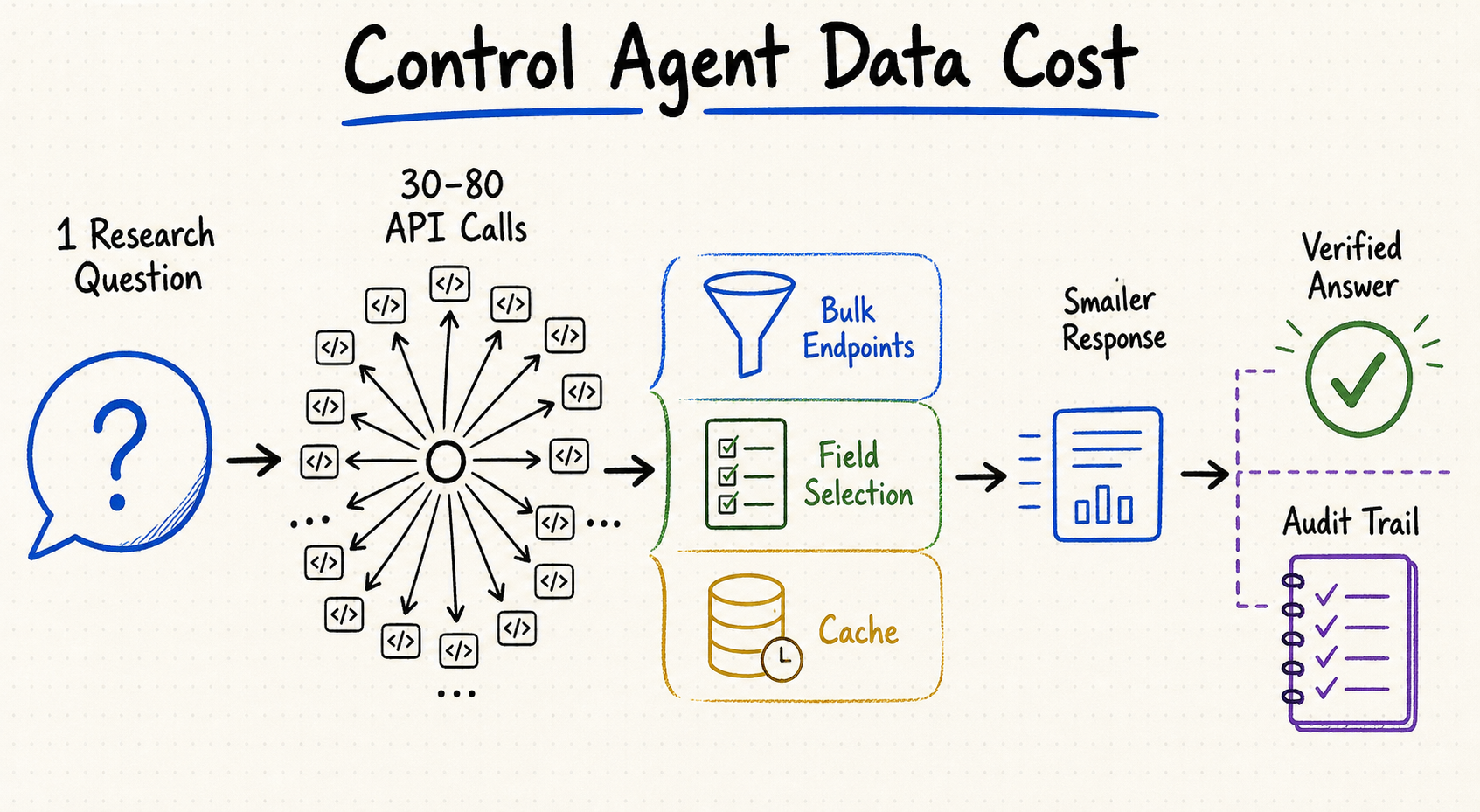
Architecture patterns that cut cost 5–10x
- Cache by (entity, dataset, period). Fundamentals change four times a year. Caching them for a day is not staleness, it is arithmetic. Most agent workloads are 60–80% cache-hittable.
- Resolve entities once per run. Map every ticker in the question to an entity ID up front and pass IDs thereafter. This kills a whole class of duplicate lookups.
- Prefer bulk endpoints over loops. A screen written as 500 single-symbol calls is a bug, not a workload. One bulk call with a field mask does the same job.
- Summarise before the context window. Reduce a 60-page filing to the sections that answer the question in a cheap pre-pass, then reason over that.
- Set a per-run call budget. Hard-cap calls per question and surface the cap in the answer. Runaway agents are a billing incident waiting to happen.
- Log every tool call with its arguments. Without this you cannot debug a wrong answer, and you cannot prove where a figure came from later.
Evaluate a provider in one week
Day 1–2: the ugly universe test
Take fifty of your hardest tickers — small caps, foreign listings, a recent IPO, a delisted name, a company that changed ticker. Pull the same three fields for all of them. Record coverage gaps and silent nulls.
Day 3: the fan-out test
Fire 100 concurrent requests. Measure p50, p99, error rate, and whether 429s are informative. This is the test that most often eliminates a provider.
Day 4: the wrong-endpoint test
Give the raw schemas to a model with ten ambiguous questions and count how often it picks the right tool without your custom prompt engineering.
Day 5: the point-in-time test
Query a company with a known restatement, as-of a date before it. If you get today's numbers back, the API cannot support backtests, whatever the docs say.
Licensing and compliance, in plain terms
Three questions decide most of it. Answer them in writing before you build.
- Who sees the data? Only your team (internal use, usually included), your customers (display licence), or third parties (redistribution, always negotiated).
- How fresh is it? Delayed and end-of-day data is far cheaper and lighter on obligations. Real-time exchange data typically brings per-user reporting and exchange fees that dwarf the API price.
- Does model training count? Many agreements permit querying but prohibit using the data to train or fine-tune models. If your roadmap includes that, raise it at contract time.
A useful rule: if an answer your agent produces could be forwarded outside your company, you need a display licence, not an internal-use one.
Seven common mistakes
- Choosing on headline price per call rather than calls per completed workflow.
- Testing coverage on AAPL, MSFT and NVDA, then discovering the gaps in production.
- Treating an empty response as zero instead of unknown.
- Letting the model see raw tickers instead of resolved entity IDs.
- Polling for real-time data instead of subscribing to a stream.
- Building the backtest before checking whether history is point-in-time.
- Shipping a customer-facing feature on an internal-use licence.
Glossary
| Term | What it means here |
|---|---|
| Fan-out | One agent question expanding into many parallel API calls. |
| Field selection / field mask | Asking the API to return only named fields, cutting payload and token cost. |
| Point-in-time | Data as it was known on a given date, before later restatements. |
| Entity resolution | Mapping a ticker, ISIN, CUSIP or name onto one stable internal identifier. |
| Survivorship bias | Error from building a historical universe out of today's surviving companies. |
| Burst limit | Peak concurrent or per-second requests allowed, distinct from a monthly quota. |
How Qveris handles this
One entity ID across prices, filings, fundamentals and news; tool schemas written for function calling rather than adapted from REST docs; field selection on every endpoint; typed errors that distinguish missing from unlicensed from rate-limited; point-in-time history with versioned restatements; and burst limits sized for agent fan-out. Pricing is per call with the same metric on every plan, so a workflow estimate translates directly into a bill. 1,000 calls per month free to run the tests above.
Frequently asked questions
- What is the best financial data API for AI agents?
- The best fit is whichever provider gives you agent-ready tool schemas, one identifier across datasets, burst-tolerant rate limits and point-in-time history. Raw providers like Polygon or FinancialDatasets.ai cover the data well but leave the agent layer to you; Qveris ships the data and the tool layer together.
- Is there a free stock market API for AI agents?
- Several providers offer free tiers, usually end-of-day data with low call limits — enough to prototype, rarely enough to run an agent in production. Qveris includes 1,000 calls per month free, which is enough to run a full provider evaluation.
- How many API calls does one agent query use?
- More than people expect. A single multi-company question typically fans out to 30–80 calls, and a screen across 500 tickers can exceed 1,500. Budget by workflow rather than by question, and cap calls per run.
- Do I need real-time market data for an AI agent?
- Only for trading and intraday monitoring. Fundamental research, screening and diligence work fine on delayed or end-of-day data, which is far cheaper and has lighter licensing requirements. If you do need real time, subscribe to a stream rather than polling.
- Can I use a financial data API in a client-facing product?
- Only with the right licence. Internal use is usually included by default; displaying data to your customers or redistributing it needs an explicit agreement, and exchange-sourced real-time data adds per-user reporting.
- What is point-in-time financial data and why does it matter?
- Point-in-time data returns figures as they were known on a chosen date, before restatements. Without it, any backtest or historical analysis is contaminated by information that was not available at the time, which makes results look better than they were.
- How do I stop an AI agent from calling the wrong endpoint?
- Write tool descriptions that state what each tool is not for, force entity resolution instead of accepting raw tickers, and return typed errors so a wrong call fails loudly. Ambiguous endpoint naming is the single largest source of wrong-tool calls.
- How much does it cost to run an AI agent on financial data?
- For a research team, data typically runs a few hundred dollars a month, and the model tokens often cost more than the data itself. Field selection and caching usually cut the combined bill by five to ten times, which matters far more than the headline per-call price.
指南 · 16 分钟阅读
最后更新于 2026 年 7 月 31 日
传统市场数据 API 面向仪表盘和回测:由人来编写查询、阅读响应并理解 CIK 等标识符。AI Agent 的工作方式不同:它会并发调用、为返回的每个字节承担模型成本,并根据文字描述自行选择端点。一个适合图表应用的 API,放到 Agent 后面可能完全不可用。本指南说明 Agent 工作负载带来的变化、决定选型的九项要求、一周内评估供应商的方法,以及真实运行成本。
本页目录
简要结论
- 首先评估 API 的工具 Schema 与标识符模型。主流供应商之间的覆盖差异,通常小于集成成本差异。
- 按工作流制定预算,而不是按一个问题计费。一个 Agent 问题通常需要 30–80 次调用;筛选 500 只股票可能超过 1,500 次。
- 字段选择和缓存往往比更低的单次调用价格更有价值,可同时将数据账单和 Token 成本降低一个数量级。
- 在开发前确认时点历史数据与许可范围,不要等客户提出回测需求后才处理。
为什么普通 API 难以支持 Agent
仪表盘只会执行少量、可预测且由开发者测试过的调用。Agent 会在运行时根据端点描述选择工具,以突发并发方式发起数量不确定的请求,并把完整响应放进按 Token 计费的上下文窗口。因此有四项关键变化:
调用量不可预测
同一个问题可能需要 12 次或 200 次调用,取决于规划如何拆解任务。面向仪表盘的月度配额并不是合适单位。
响应大小会直接产生成本
返回的每个字节都会进入上下文,并同时产生数据供应商费用与模型 Token 费用。
端点选择具有概率性
模型依据描述选工具。含糊命名可能调用错误端点,即使返回 200 OK,也会产生悄无声息的错误数据。
错误必须可被机器理解
人能手动重试 429;Agent 需要可推理的结构化错误,否则可能编造一个看似合理的答案。
九项核心要求
01类型化工具 Schema,而不只是 REST 文档
Agent 根据描述选择工具。优先选择为函数调用设计、参数说明清楚、能区分相似端点并明确说明“不适用场景”的 Schema。
02跨数据集的一致标识符
价格用 Ticker、基本面用 CIK、新闻用公司名,会迫使 Agent 自行发明连接逻辑。应使用统一实体 ID,并提供将 Ticker、ISIN、CUSIP 和名称映射到实体的解析端点。
03可预测的分页与响应大小
Agent 会为读取的每个 Token 付费。优先选择支持字段筛选、每次调用有行数上限并使用紧凑字段名的供应商。
04能够承受并发扇出的速率限制
一个问题经常变成 30–80 个并行请求。除了月度配额,还要检查突发限制、并发数,以及 429 是否包含 Retry-After。
05时点正确性
若重述后的财务数据覆盖历史记录,回测与“当时已知什么”的问题都会失真。确认数据是否支持 point-in-time、重述版本和历史指数成分。
06诚实且结构化的错误
“该期间没有数据”“无权访问该数据集”和“触发限流”必须返回不同的类型化错误,不能都表现为空数组。
07可规划的延迟预算
Agent 运行由多轮并发请求串联而成。应索取各端点的 p50 与 p99,并从自己的部署区域进行测试。
08覆盖你的真实股票范围
供应商在美国大盘股上通常表现相似,差异主要出现在小盘股、海外上市、OTC、ADR、新股和退市股票。请用最难处理的 50 个标的测试。
09与你的实际用途匹配的许可
内部研究、面向客户展示和数据再分发对应不同许可。实时交易所数据通常还要求按用户申报。
优秀工具 Schema 的样子
描述字段不是普通文档,而是 Agent 的路由逻辑。下面这种明确说明用途、排除项、实体解析、字段选择和时点日期的结构,能显著减少错误端点调用:
{
  "name": "get_income_statement",
  "description": "Quarterly or annual income statement for one company, as filed. Use for revenue, margins, EPS. Do NOT use for market prices or estimates.",
  "parameters": {
    "entity_id": { "type": "string", "description": "QVeris entity ID. Resolve tickers first." },
    "period": { "type": "string", "enum": ["quarterly", "annual"] },
    "limit": { "type": "integer", "maximum": 20, "default": 8 },
    "fields": { "type": "array", "items": { "type": "string" } },
    "as_of": { "type": "string", "description": "ISO date for point-in-time data." }
  }
}
这里有三个关键点:工具说明了不适用场景;强制先解析实体,而不是直接接受原始 Ticker;并通过明确的成本后果,引导模型使用字段筛选。
按数据集检查覆盖范围
签约前用下表检查供应商。正确答案不是每一项都“支持”,而是支持你的工作流实际会使用的项目。
| 数据集 | 需要验证 | 常见缺口 |
|---|---|---|
| 价格 | 复权方法、退市历史、公司行动 | 处理拆股但未处理股息 |
| 基本面 | 原始披露与调整值、财年日历、重述版本 | 只保留最新重述值 |
| 文件 | 全文、章节切分、附件、非美国对应文件 | 仅美国市场且无章节结构 |
| 新闻 | 实体标注、来源许可、转载去重 | 只有标题授权 |
| 预期 | 一致预期历史、分析师明细、修订时间戳 | 只有当前一致预期 |
| 持仓与内部人 | 13F/13D 延迟、内部人交易代码 | 混淆申报日期与交易日期 |
| 参考数据 | 行业分类、股本、历史指数成分 | 只有当前成分股 |
按工作流而非问题制定预算
下面是常见 Agent 工作流的大致调用量,可用于开发前估算套餐。
| 工作流 | 典型调用量 | 成本控制因素 |
|---|---|---|
| 用 3 个指标筛选 500 只股票 | 约 1,500 次 | 字段筛选最重要 |
| 深入研究一家企业 | 约 40 次 | 文件解析占主要成本 |
| 25 个持仓的每日摘要 | 约 120 次/天 | 隔夜缓存,只刷新变化 |
| 200 个标的、5 年信号回测 | 约 50,000 次 | 使用批量端点 |
| 50 个标的实时监控 | 约 23,000 次/天 | 使用流式订阅而非轮询 |
| 80 家公司的财报季扫描 | 约 3,200 次/周 | 电话会与文件长度 |
一次包含 40 个调用的深度研究,如果返回完整财务报表,可能向模型输入超过 20 万 Token;通过字段筛选可降至约 2.5 万。评估供应商时必须同时测量两项成本。
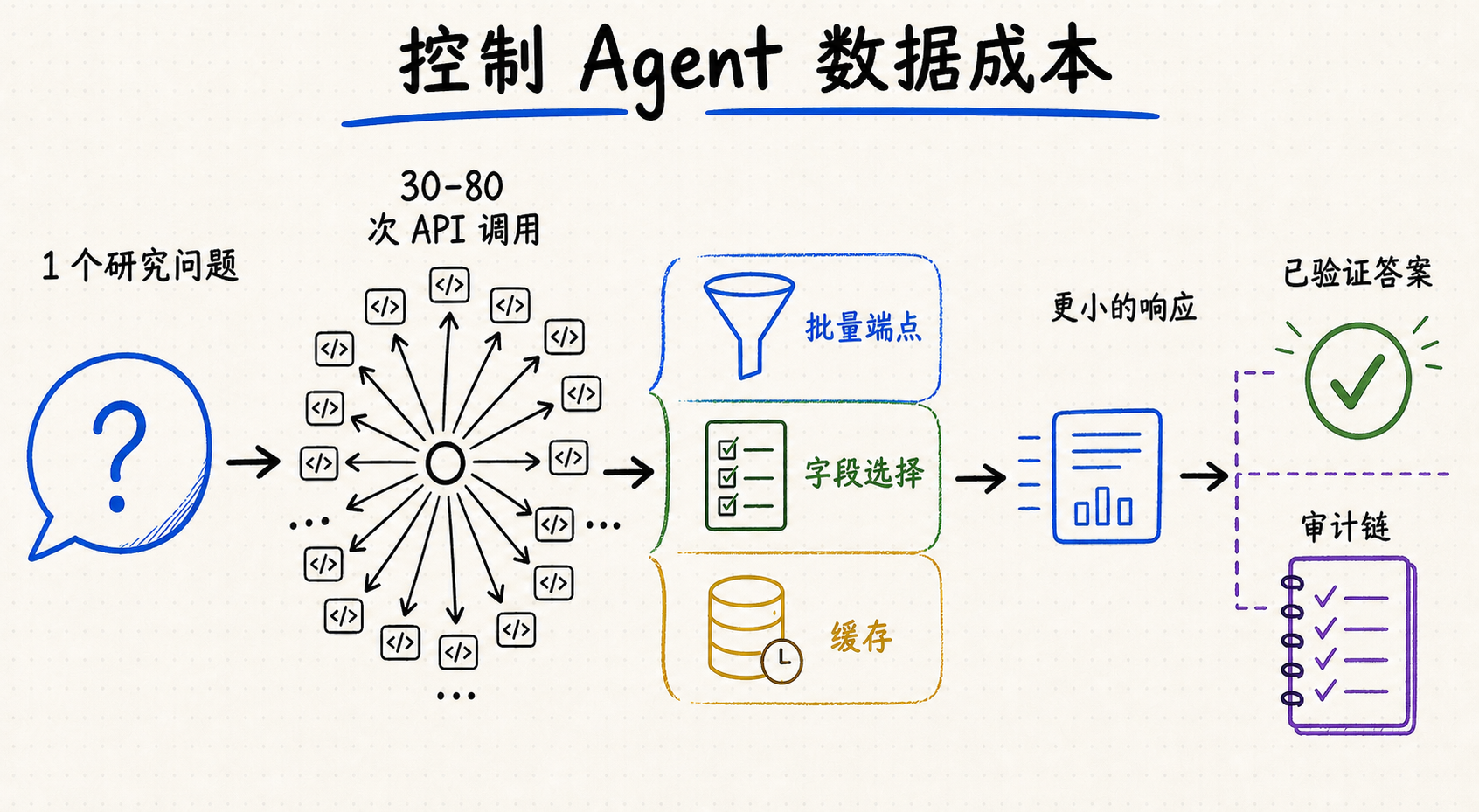
将成本降低 5–10 倍的架构模式
- 按实体、数据集和期间缓存。大多数 Agent 工作负载有 60–80% 的缓存命中空间。
- 每次运行只解析一次实体。先将所有 Ticker 映射到实体 ID,后续调用只传 ID。
- 优先使用批量端点。把 500 个标的写成 500 次单标的调用是实现错误。
- 进入上下文前先做摘要。先从长文件中提取与问题相关的章节。
- 设置单次运行调用预算。硬性限制每个问题的调用数,并在答案中披露限制。
- 记录每次工具调用及参数。否则无法调试错误答案,也无法证明数字来源。
一周内评估供应商
第 1–2 天:困难标的测试
选择 50 个最难处理的标的,包括小盘股、海外上市、新股、退市公司和更换过 Ticker 的公司,记录覆盖缺口与静默空值。
第 3 天:并发扇出测试
发送 100 个并发请求,测量 p50、p99、错误率以及 429 是否提供可操作信息。
第 4 天:错误端点测试
将原始 Schema 交给模型,用十个含糊问题测试其无需自定义 Prompt 时的工具选择准确率。
第 5 天:时点数据测试
选择一家已知发生重述的公司,查询重述前日期;若返回当前数字,该 API 就无法可靠支持回测。
许可与合规
开发前应书面确认三个问题。
- 谁能看到数据?仅团队内部、面向客户展示和第三方再分发对应不同许可。
- 数据需要多新?延迟和日终数据更便宜;实时交易所数据通常带来按用户申报和额外费用。
- 是否允许训练模型?许多协议允许查询,但禁止用数据训练或微调模型。
实用判断:如果 Agent 的答案可能被转发到公司之外,你通常需要展示许可,而不只是内部使用许可。
七个常见错误
- 只比较单次调用价格,而不计算完整工作流的调用量。
- 只用 AAPL、MSFT 和 NVDA 测试覆盖范围。
- 把空响应当成零,而不是未知。
- 让模型直接使用原始 Ticker,而不是稳定实体 ID。
- 用轮询获取实时数据,而不是订阅数据流。
- 未确认时点历史数据就开始构建回测。
- 使用内部许可发布面向客户的功能。
术语表
| 术语 | 本文含义 |
|---|---|
| 并发扇出 | 一个 Agent 问题扩展成多个并行 API 调用。 |
| 字段筛选 | 只让 API 返回指定字段,以减少负载和 Token 成本。 |
| 时点数据 | 返回某个日期当时已知的数据,不包含后续重述。 |
| 实体解析 | 将 Ticker、ISIN、CUSIP 或名称映射到稳定内部标识符。 |
| 幸存者偏差 | 使用今天仍存在的公司构造历史样本造成的错误。 |
| 突发限制 | 允许的峰值并发或每秒请求数,与月度配额不同。 |
QVeris 如何解决这些问题
QVeris 在价格、文件、基本面和新闻之间使用统一实体 ID;提供为函数调用设计的工具 Schema、每个端点的字段筛选、区分缺失数据、无许可与限流的类型化错误、带版本重述的时点历史,以及适合 Agent 并发扇出的突发限制。所有套餐使用相同的单次调用计量方式,并提供每月 1,000 次免费调用用于完成上述测试。
常见问题
- 最适合 AI Agent 的金融数据 API 是什么?
- 最佳选择应提供面向 Agent 的工具 Schema、跨数据集统一标识符、能承受突发并发的速率限制和时点历史数据。QVeris 同时提供数据层与工具层。
- 是否有面向 AI Agent 的免费股票市场 API?
- 多家供应商提供免费层,通常只有日终数据和较低调用上限。QVeris 每月提供 1,000 次免费调用,可用于完成供应商评估。
- 一次 Agent 查询会使用多少 API 调用?
- 一个多公司问题通常会扇出为 30–80 次调用,筛选 500 只股票可能超过 1,500 次。应按工作流制定预算并限制单次运行调用量。
- AI Agent 是否需要实时市场数据?
- 只有交易和盘中监控通常需要实时数据。基本面研究、筛选和尽调可使用延迟或日终数据;需要实时数据时应订阅数据流,而不是轮询。
- 可以在面向客户的产品中使用金融数据 API 吗?
- 必须获得正确许可。内部使用通常默认包含,向客户展示或再分发需要明确协议;实时交易所数据还可能要求按用户申报。
- 什么是时点金融数据,为什么重要?
- 时点数据返回选定日期当时已知的数字,不包含后续重述。缺少它会让回测混入当时无法获得的信息。
- 如何阻止 AI Agent 调用错误端点?
- 在工具描述中写明不适用场景,强制实体解析,并返回类型化错误。含糊的端点命名是错误工具调用的主要来源。
- 运行金融数据 AI Agent 需要多少钱?
- 研究团队的数据费用通常为每月数百美元,模型 Token 成本可能更高。字段筛选和缓存通常可以把综合费用降低 5–10 倍。