
Box Office Is Heating Up. Why Are Film Stocks Not Rising Too? I Re-ran Four Companies with QVeris
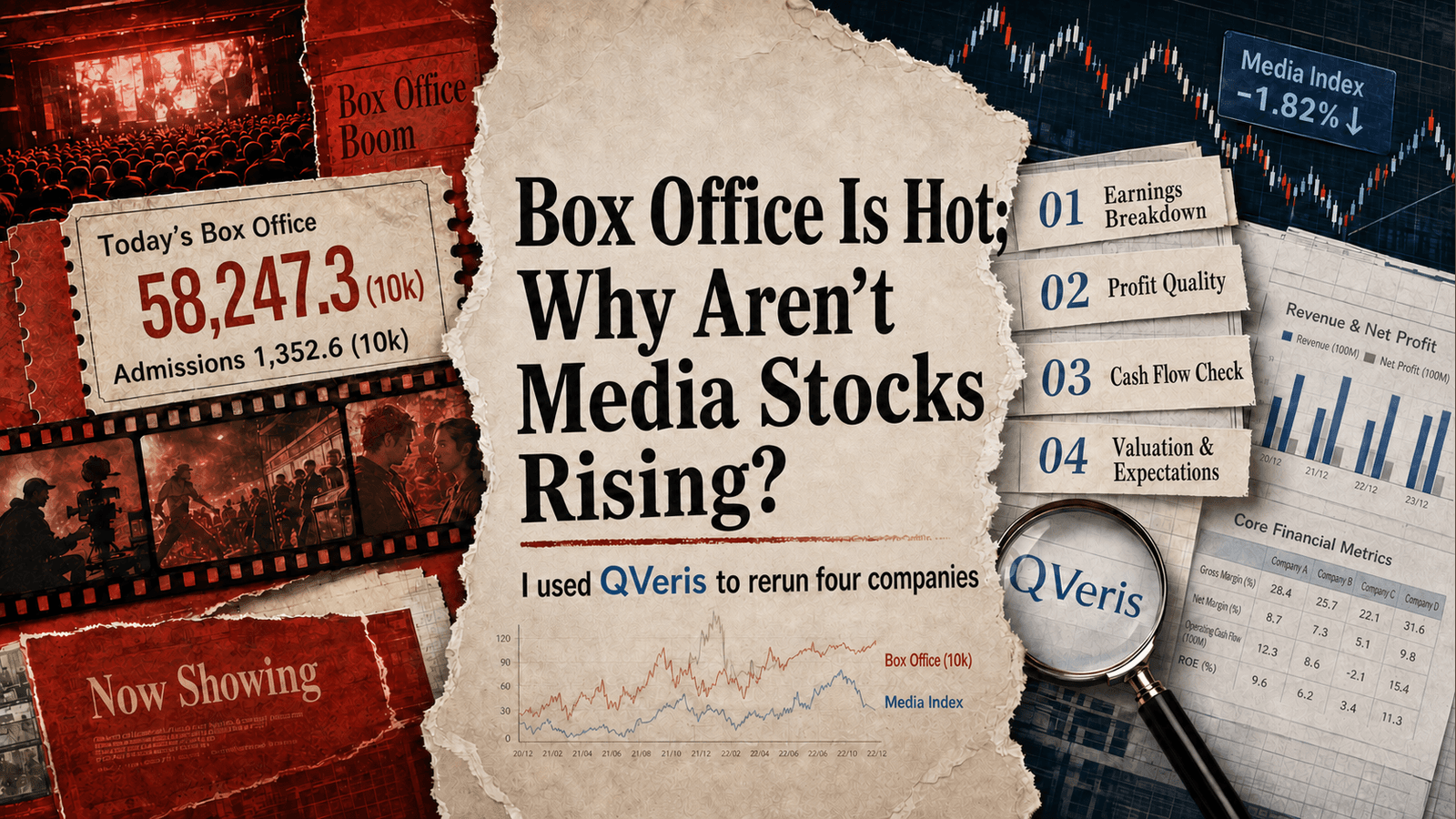
Box Office Heats Up, But Why Aren’t Film Stocks Rising Too? I Re-Ran Four Companies with QVeris
The question I left open three weeks ago, now answered.
On June 23, I used QVeris to analyze Wanda Cinema, Light Century, China Film, and Hengdian Cinema.
At that time, the summer movie season had just begun, and the stock prices and capital flows of the four companies had already started diverging. The article ended with a pending task:
Wait until mid-to-late July to review the same group of companies again.
Today, I’m delivering the results.
This time, I won’t predict which stock will rise or package conclusions based on a single day’s performance. Instead, I re-fetched the market data and capital flow trends for the four companies from June 23 to July 14, then compared the results with the latest box office performance.
The answer is straightforward:
Box office numbers are indeed rising, but the heat is driven by one film, one weekend—not a collective profit increase across all four listed companies.

01 Box Office "Heats Up," But Not a Full Recovery
First, the box office.
As of 1:14 PM on July 13, 2026, the total summer movie season box office had surpassed ¥3 billion; by 8:00 PM the same day, Kung Fu Women had grossed over ¥600 million in three days, topping the summer box office chart.
Daily热度 is even more pronounced. Public data shows Kung Fu Women once held about 48.2% of screening share, contributing over 80.3% of daily box office.
However, another data point cannot be ignored: As of 3:00 PM on July 12, the cumulative summer box office stood at ¥2.831 billion, down 8% year-on-year.
Thus, a more accurate description is not "the film industry is fully recovering," but rather:
A single blockbuster rapidly boosted short-term summer box office热度, but the industry’s cumulative performance still hasn’t exceeded the same period last year.
This is the premise for understanding the subsequent stock divergence.
02 I Re-Ran Four Companies with QVeris
This time, I utilized QVeris’s A-share capital flow tool to query:
- Ruyi Film (formerly Wanda Cinema, 002739.SZ)
- Light Century (300251.SZ)
- China Film (600977.SH)
- Hengdian Cinema (603103.SH)
Note: Wanda Cinema officially renamed to Ruyi Film in April 2026, with the stock code unchanged.
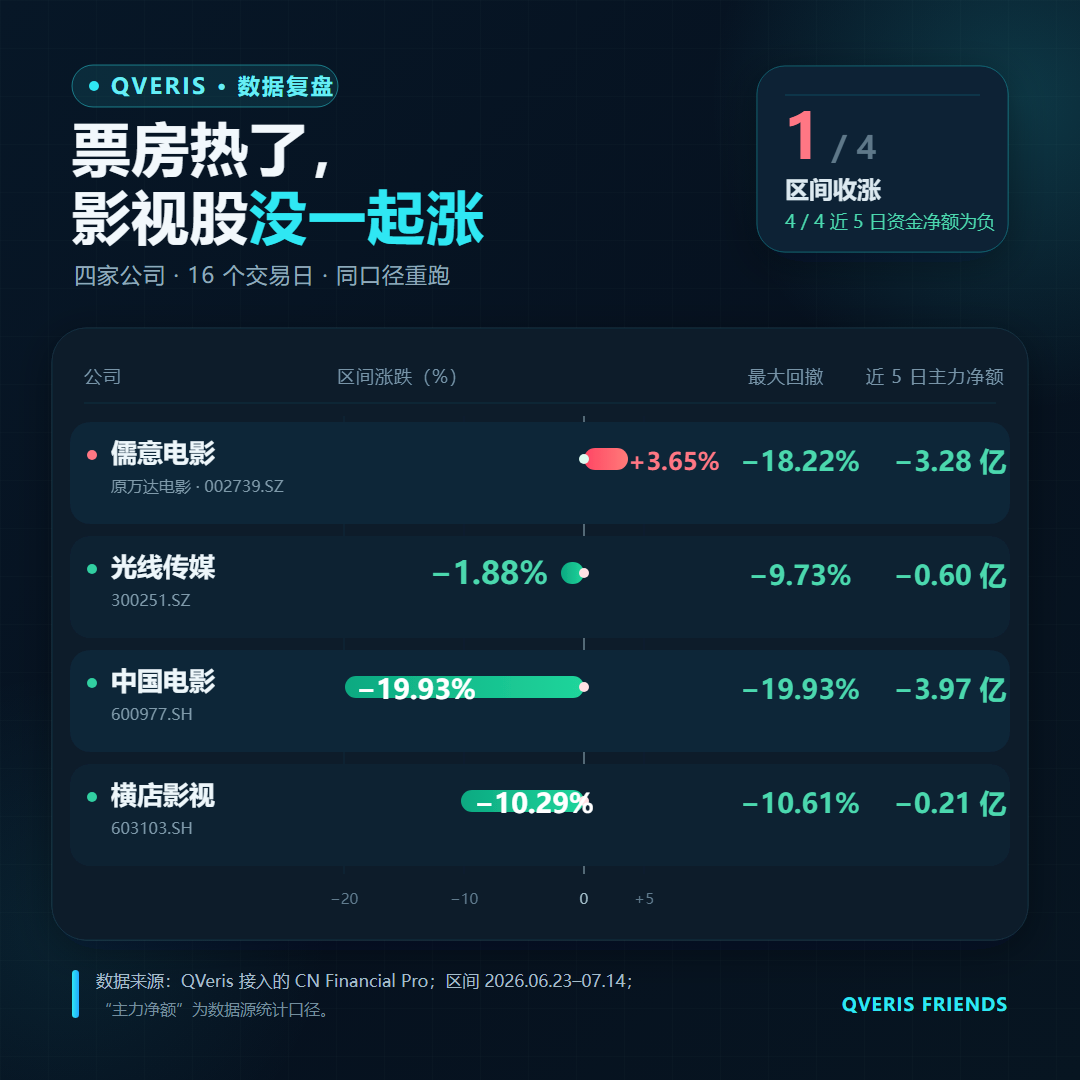
The observation period was June 23 to July 14, spanning 16 trading days. Results are as follows:
<sheet sheet-id="swhWRB" token="Ke9SsqANuhyS91teQEncfU4Rngc"></sheet>
Among the four companies, only Ruyi Film’s closing price remained slightly above June 23.
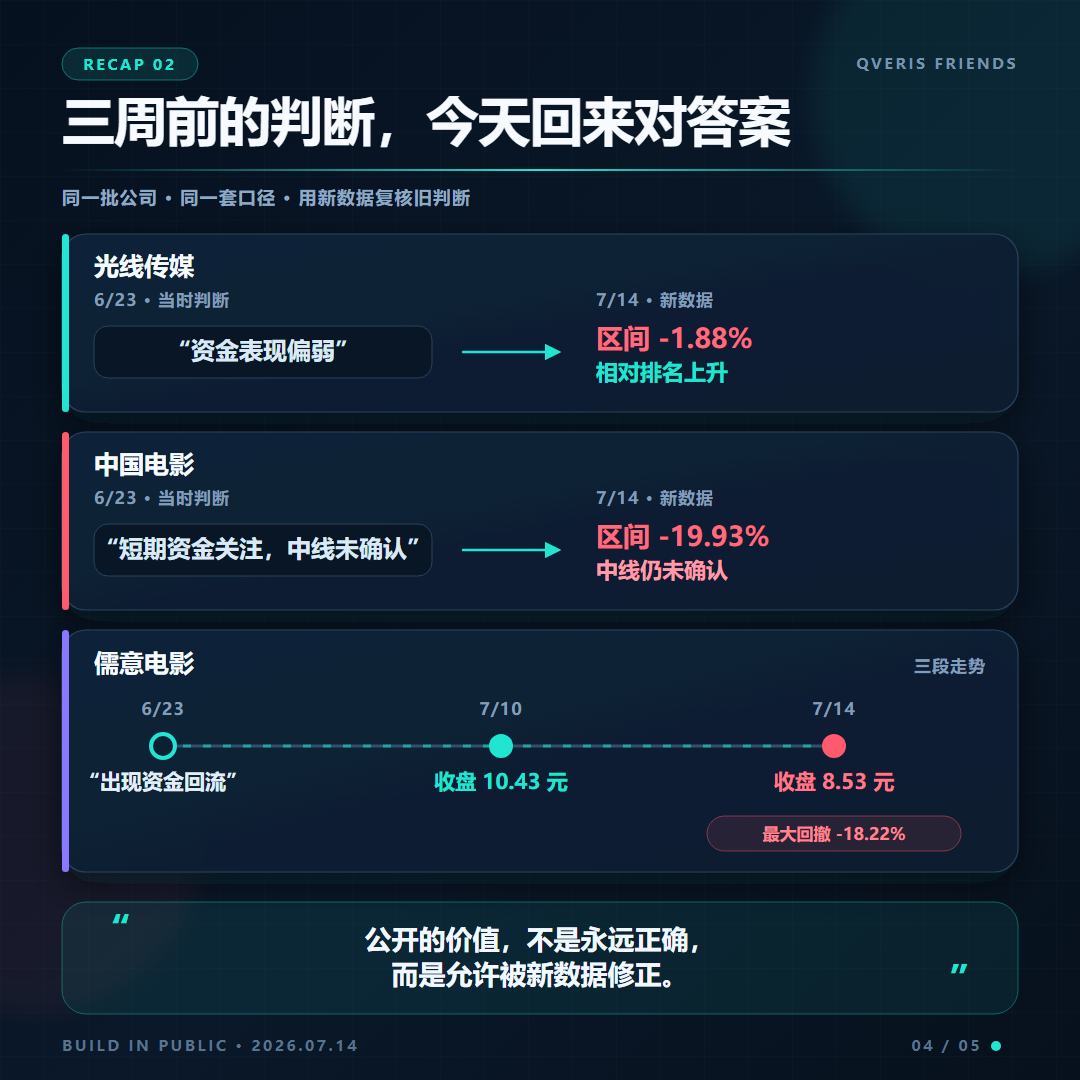
However, its trajectory was not smooth: The stock peaked at ¥10.43 on July 10, then fell to ¥8.53 over two trading days, retracing 18.22% from the intraperiod high.
Light Century ended down 1.88%, becoming the second-best performer among the four.
China Film dropped from ¥15.10 to ¥12.09, a 19.93% decline; Hengdian Cinema fell 10.29%.
More notably: According to this data source’s methodology, all four companies recorded negative net capital flow over the last five trading days as of July 14.
Box office热度 emerged, but film stocks did not rise in tandem.
03 Box Office Isn’t Company Revenue
Increased summer box office doesn’t mean all four companies benefited proportionally.
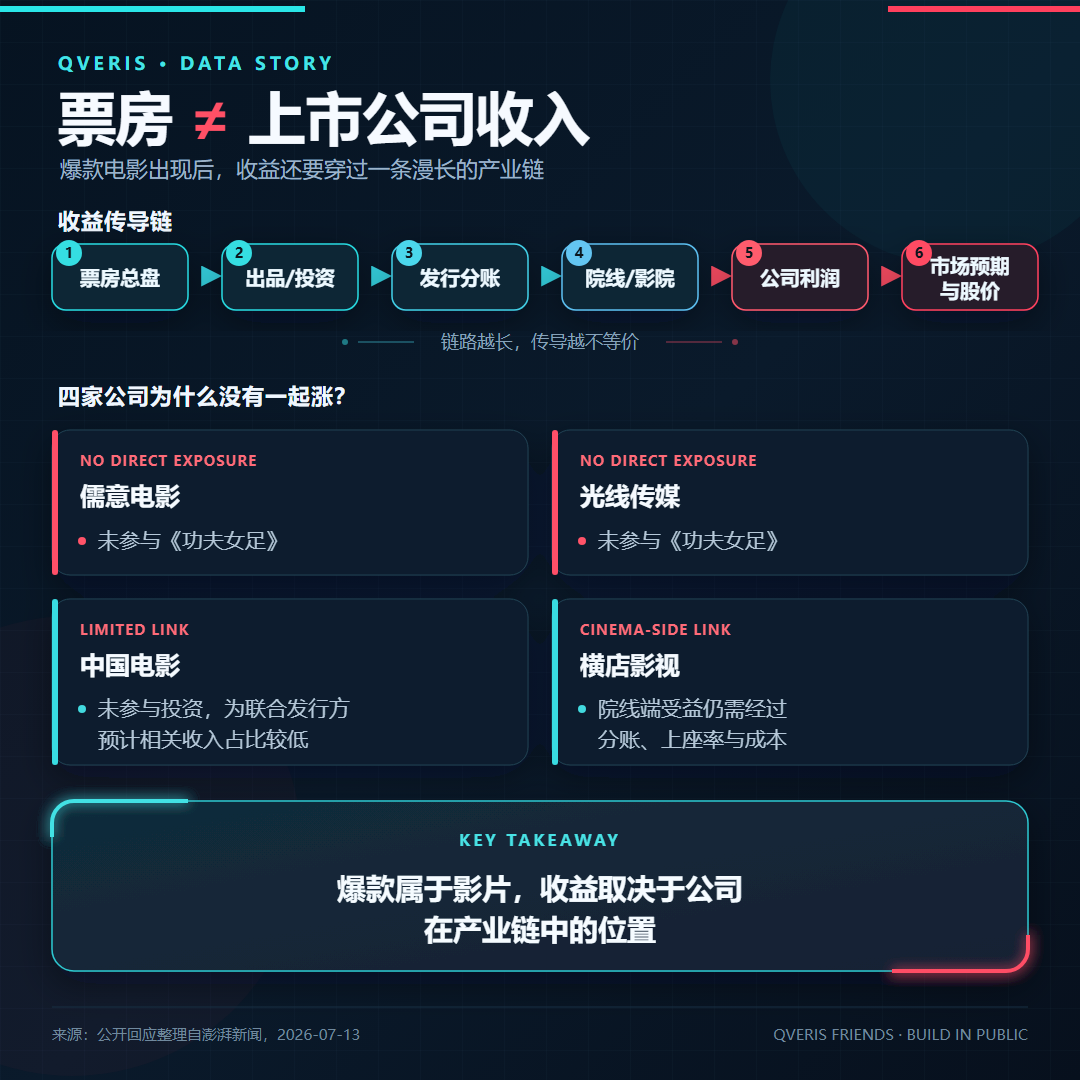
Take the hottest film Kung Fu Women as an example. Public responses show:
- Ruyi Film did not participate in the film.
- Light Century did not participate in the film.
- China Film did not invest but was a joint distributor, with expected revenue accounting for a low proportion of total company revenue.
- Hengdian Cinema could benefit from theater operations, but still needed to go through box office revenue sharing, occupancy rates, and theater costs.
See The Paper’s summary of listed companies’ involvement in the film.
Thus, seeing a film gross ¥600 million doesn’t directly map that amount to any "film stock" company.
A blockbuster in the industry and a company’s actual earnings are two different matters.
What truly needs tracking is revenue attribution: Who invested, who distributed, who owns theaters, and how much revenue each company captured.
04 Market Trading Isn’t Just Box Office Numbers
Box office is historical data; stock prices trade on future expectations.
Before a film’s release, pre-release data, advance sales, screening share, and market discussions may already be priced in. Post-release strong numbers that merely fulfill prior expectations won’t necessarily drive further stock gains.
Moreover, this热度 was highly concentrated on a single film.
A single film capturing over half the screening share is good news for its producers; for companies not involved and waiting for their own films to release, the meaning is entirely different.
Additionally, valuation, company performance, upcoming film schedules, market trends, and capital preferences also influence stock prices simultaneously.
Thus, this data confirms:
Box office performance and the four companies’ stock prices do not move in simple synchrony.
But relying solely on market and capital flow data cannot definitively attribute a single day’s price movement to any specific factor.
05 Revisiting the Three-Week-Old Judgment
The most interesting part of this review isn’t which prediction was "correct," but which needed revision based on new data.
In the June 23 article, Light Century was considered the company with the weakest capital flow. However, based on subsequent period returns, Light Century ranked second ("weakest" relative ranking had changed).
At that time, China Film was the only company among the four with positive returns, and short-term capital attention was high; however, the article also cautioned that its medium-term trend hadn’t been confirmed.
By July 14, China Film became the company with the largest period decline.
Ruyi Film’s earlier capital inflow did correspond to a clear price rise, but this uptrend didn’t sustain.
This is the value of continuous review:
Data at the time may not have been wrong, but judgments formed over short windows shouldn’t be endlessly extrapolated.
Building in public isn’t just about sharing what was correct—it should also include which judgments were overturned by new data.
06 What Did QVeris Do in This Review?
In this practical test, my task for QVeris was:
Query closing prices, returns, net capital flow, and DDE data for 002739.SZ, 300251.SZ, 600977.SH, and 603103.SH from June 23 to July 14, 2026; calculate period returns, max drawdown, and net capital flow over last 5 days; output in table format. Do not make unsubstantiated attributions for price movements.
QVeris connected the dots—finding tools, standardizing parameters, fetching data, and repeating calculations—to allow the question raised three weeks ago to be re-verified today with the same methodology.
Boundary clarification is needed: Stock market and capital flow data were obtained via QVeris; box office and film involvement details came from public media, not market tools. "Net capital flow" refers to the statistical methodology by the data service provider and does not equate to identification of specific institutional identities.
In Closing
After this re-run, my conclusion isn’t "box office and stock prices are unrelated," but rather:
Industry box office improvement won’t automatically and synchronously translate into each listed company’s performance and stock price.
More worth tracking than "how much box office rose" is where the incremental box office ultimately landed, how much expectation was already priced in, and whether short-term capital flow aligns with company fundamentals.
I left a question open three weeks ago; today, I’ve returned with the same dataset to answer it.
For QVeris, this repeatable, verifiable, and correctable process may matter more than delivering a seemingly certain prediction.
Data Note: Stock data as of July 14, 2026, closing; period returns and max drawdown calculated based on daily closing prices.
Disclaimer: This article is solely for QVeris product testing and public data review, not investment advice. Market risks exist; invest with caution.