
AI Agent Tool Discovery:
Find the Right Tools
AI Agent 工具发现:
先找到正确工具
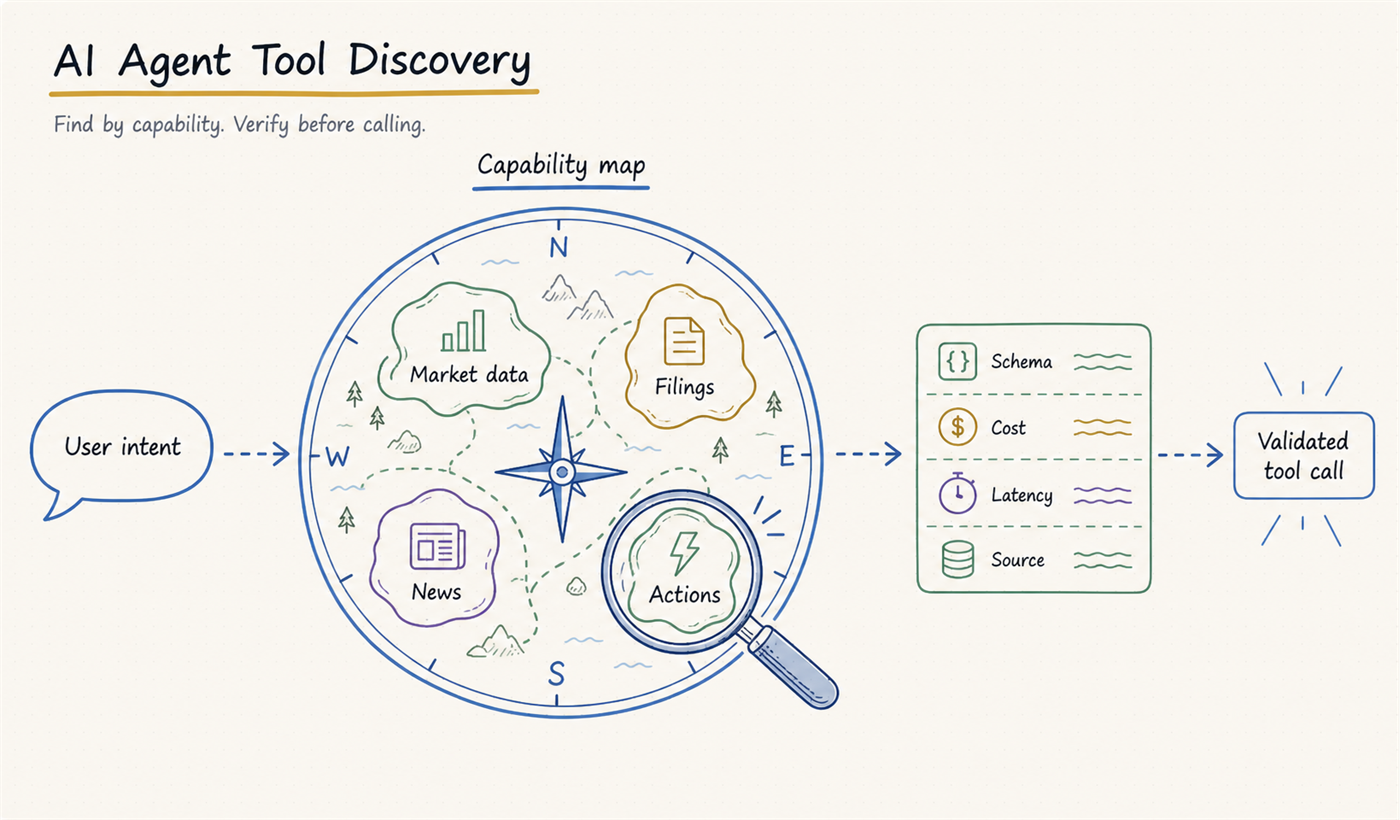
AI agent tool discovery is the step before tool calling: the agent must find candidate tools, inspect schemas, compare metadata, and choose the safest capability before execution.
AI Agent 工具发现发生在工具调用之前:Agent 需要先找到候选工具,检查 schema,对比成本、延迟和来源,再选择最适合执行的能力。
Why AI Agent Tool Discovery Matters 为什么 AI Agent 工具发现很重要
Most AI agents fail not because the model cannot reason, but because the agent does not know which tool exists, which tool is executable, which schema is required, and which provider is reliable for the current task. A static tool list may work for demos, but production agents need discovery, inspection, routing, and validation. That is the core idea behind the QVeris capability network and the Capability Explorer blog.
很多 AI Agent 失败并不是因为模型不会推理,而是因为 Agent 不知道有哪些工具、哪些工具真的能执行、需要什么 schema、哪个 provider 对当前任务更可靠。静态工具列表可以支撑 demo,但生产级 Agent 需要发现、检查、路由和验证。这也是 QVeris 能力网络以及 Capability Explorer 文章 的核心思想。
What Is Tool Discovery for AI Agents? 什么是 AI Agent 工具发现?
Tool discovery for AI agents is the process of finding usable external capabilities from a large, changing universe of APIs, MCP servers, databases, actions, and internal services. It is different from simply listing tools in a prompt. A discovery layer should return candidate tools based on intent, expose parameters before execution, and give the agent enough metadata to decide whether to call, skip, ask for clarification, or route to another provider.
AI Agent 工具发现,是指 Agent 在大量不断变化的 API、MCP Server、数据库、动作和内部服务中,找到真正可用外部能力的过程。它不同于把工具列表硬写进 prompt。好的发现层应该根据任务意图返回候选工具,在执行前暴露参数,并提供足够的元数据,让 Agent 判断是调用、跳过、追问用户,还是路由到另一个 provider。
Understand what the user wants, not just the literal phrase.
理解用户想完成的任务,而不是只匹配字面词。
Search candidate tools by capability, domain, and data need.
按能力、领域和数据需求搜索候选工具。
Read schema, cost, latency, auth, examples, and risk notes.
检查 schema、费用、延迟、认证、示例和风险说明。
Choose the best fit when several tools can answer the same request.
多个工具都能回答时,选择最合适的一个。
Execute the selected tool and validate structured output.
调用选定工具,并验证结构化返回。
Static Tool Lists Break as Agents Scale 为什么静态工具列表会失效
A finance agent may need quotes, filings, transcripts, news, options, crypto, macro data, and portfolio analytics. Listing everything in one prompt makes the agent slower and less reliable.
金融 Agent 可能需要行情、财报、电话会文本、新闻、期权、加密资产、宏观数据和组合分析。把所有工具写进一个 prompt 会让系统更慢,也更不稳定。
One provider may expect ticker, another may expect symbol, and another may require exchange code. The agent needs inspection before calling.
一个 provider 可能需要 ticker,另一个需要 symbol,还有一个需要交易所代码。Agent 必须先检查再调用。
A tool may be cheap but delayed, fast but incomplete, or accurate but expensive. Discovery should expose cost, latency, and source quality.
一个工具可能便宜但延迟,快速但不完整,准确但昂贵。工具发现层应该暴露成本、延迟和来源质量。
AI Agent Tool Discovery vs MCP Tool Discovery AI Agent 工具发现与 MCP 工具发现的区别
MCP gives agents a standard way to expose tools, resources, and prompts. That is important, but MCP alone does not automatically solve ranking, routing, provider comparison, cost awareness, or source validation. QVeris can sit above MCP as a discovery and capability routing layer. This is why the QVeris blog Stop Wiring Up MCP Tools Yourself. Use QVeris. is closely related to tool discovery.
MCP 为 Agent 暴露工具、资源和 prompt 提供了标准方式,这很重要。但 MCP 本身并不会自动解决排序、路由、provider 对比、成本感知或来源验证。QVeris 可以作为 MCP 之上的发现层和能力路由层。这也是 QVeris blog 中 Stop Wiring Up MCP Tools Yourself. Use QVeris. 与工具发现高度相关的原因。
| Layer 层级 | What it does 作用 | What it does not fully solve 尚未完全解决 |
|---|---|---|
| MCP server MCP 服务器 | Exposes tools, resources, prompts, and tool schemas to clients. 向客户端公开工具、资源、Prompt 与工具 Schema。 | Provider ranking, source choice, fallback routing, and cost optimization. 供应商排序、数据源选择、回退路由与成本优化。 |
| Tool registry 工具注册表 | Lists available tools and sometimes their descriptions. 列出可用工具及其说明。 | Runtime selection, quality signals, execution history, and validation. 运行时选择、质量信号、执行历史与结果验证。 |
| QVeris discovery QVeris 能力发现 | Discovers, inspects, routes, calls, and validates capabilities through one workflow. 通过统一工作流发现、检查、路由、调用并验证能力。 | It still needs clear user intent and appropriate permission boundaries. 仍需要明确的用户意图与合理的权限边界。 |
A Finance Agent Example 一个金融 Agent 示例
Imagine a user asks: “Get Apple’s latest earnings, compare them with analyst expectations, and explain the biggest risk factor from the latest filing.” A static tool list does not tell the agent which earnings endpoint, estimate source, SEC filing parser, or summary tool should be used.
假设用户问:“获取 Apple 最新财报,对比分析师预期,并解释最新文件里最大的风险因素。” 静态工具列表无法告诉 Agent 应该使用哪个 earnings endpoint、哪个预期数据源、哪个 SEC 文件解析工具,或者哪个摘要工具。
With AI agent tool discovery, the workflow becomes intent-driven: find earnings tools, inspect required parameters, find filing tools, compare source quality, call the best candidates, and validate timestamps before a model writes the answer.
有了 AI Agent 工具发现,流程会变成意图驱动:先发现财报工具,检查必填参数,再发现 filing 工具,对比来源质量,调用最合适的候选能力,并在模型生成答案前验证时间戳。
intent: "AAPL latest earnings + estimates + risk factors"
discover: earnings, analyst estimates, SEC filings
inspect: schema, latency, cost, source metadata
route: choose best provider for each subtask
call: return structured JSON
validate: ticker, filing date, source URL
How QVeris Handles AI Tool Discovery QVeris 如何处理 AI 工具发现
QVeris is designed around a simple developer workflow: Discover → Inspect → Call. Discovery finds candidate capabilities from natural language intent. Inspect shows the parameters, examples, cost, latency, and success signals before execution. Call executes the selected capability and returns structured output that an agent can use. This workflow pairs naturally with the original QVeris articles on prompt layering for tool calling and agent infrastructure.
QVeris 围绕一个简单的开发者流程设计:Discover → Inspect → Call。Discover 根据自然语言意图找到候选能力;Inspect 在执行前展示参数、示例、成本、延迟和成功信号;Call 执行选定能力并返回 Agent 可使用的结构化结果。这个流程天然适合连接 QVeris 关于 工具调用 prompt 分层 和 Agent 基础设施 的文章。
Agents should find “latest earnings” or “real-time stock quote” without hardcoding one provider.
Agent 应该能搜索“latest earnings”或“real-time stock quote”,而不是预先写死一个 provider。
Inspection reduces hallucinated parameters and prevents unsafe repairs.
检查可以减少错误参数,避免不安全的自动修复。
The agent receives machine-readable results instead of scraping arbitrary text.
Agent 得到机器可读结果,而不是抓取任意文本。
What to Look For in a Tool Discovery Platform 选择工具发现平台时看什么
| Requirement 要求 | Why it matters 为什么重要 | QVeris angle QVeris 的作用 |
|---|---|---|
| Natural-language discovery 自然语言发现 | Agents need to search by task intent, not by prewritten provider lists. Agent 应按任务意图搜索,而不是依赖预先写死的供应商列表。 | Capability discovery starts from what the user needs. 能力发现从用户真实需求出发。 |
| Schema inspection Schema 检查 | Prevents invalid calls, missing required fields, and unsafe parameter repair. 避免无效调用、必填字段缺失及不安全的参数修复。 | Inspect before Call makes execution more predictable. 先检查再调用,让执行结果更可预测。 |
| Quality metadata 质量元数据 | Cost, latency, freshness, success rate, and source quality affect the right choice. 成本、延迟、时效性、成功率和来源质量都会影响选择。 | Routing can compare candidate capabilities before execution. 路由可在执行前比较候选能力。 |
| MCP support MCP 支持 | MCP is becoming a common tool interface for agent clients. MCP 正成为 Agent 客户端常用的工具接口。 | QVeris can complement MCP with discovery and routing. QVeris 可为 MCP 补充发现与路由能力。 |
| Fallback handling 回退处理 | Production agents need another path when a tool fails or returns incomplete data. 生产环境中的 Agent 需要在工具失败或数据不完整时切换路径。 | Discovery can return ranked candidates instead of one brittle tool. 发现层可返回排序后的候选能力,而不是依赖单一工具。 |
Use Cases for AI Agent Tool Discovery AI Agent 工具发现的典型场景
Find earnings, filings, news, estimates, price data, and macro indicators without wiring every source by hand.
自动发现财报、文件、新闻、预期、价格数据和宏观指标,而不是手动接入每个来源。
Help Claude, Cursor, OpenCode, or other clients understand which tool is worth calling.
帮助 Claude、Cursor、OpenCode 或其他客户端判断哪个工具值得调用。
Keep tool choice observable, permission-aware, and easier to audit across teams.
让工具选择更可观测、可控权,并便于团队审计。
The Tool Discovery Lifecycle for Production Agents生产级 Agent 的工具发现生命周期
Discovery is not a one-time search step. A production agent needs a repeatable path from user intent to a qualified capability, a validated call, and feedback that improves the next selection.
工具发现不是一次性的搜索步骤。生产级 Agent 需要一条可重复路径:从用户意图出发,找到合格能力,验证调用结果,再用反馈改进下一次选择。
Search by the job to be done, required data, entity, freshness, geography, and output type. Good retrieval reduces thousands of tools to a shortlist the model can compare without flooding its context.
根据任务、所需数据、实体、新鲜度、地区和输出类型搜索。良好的检索会把成千上万工具缩小为模型能够比较的候选列表,而不会塞满上下文。
Check required parameters, authentication, permissions, provider, cost, latency, freshness, coverage, schema, and failure behavior. Similar descriptions do not guarantee equivalent data or contracts.
检查必填参数、认证、权限、供应商、成本、延迟、新鲜度、覆盖、Schema 和失败行为。描述相似并不代表数据或契约等价。
Record success, schema errors, empty results, latency, fallback use, and user corrections. Selection improves when the discovery layer learns which capabilities actually work for each intent.
记录成功率、Schema 错误、空结果、延迟、备用来源和用户修正。只有发现层知道哪些能力真正适合某类意图,选择质量才会持续提高。
AI Agent Tool Discovery FAQAI Agent 工具发现常见问题
Large tool lists consume context, increase selection errors, expose unnecessary permissions, and make descriptions difficult to maintain. Retrieve a small, relevant candidate set for the current intent instead.
No. Listing tells a client what one connected server exposes. Discovery searches and ranks capabilities across a larger catalog using intent, metadata, quality, policy, and operational signals.
Purpose, supported entities, inputs, output schema, freshness, geographic coverage, provider, authentication, permissions, cost, latency, rate limits, examples, version, and known failure behavior.
QVeris provides a capability layer where agents can search for tools by intent, inspect their contracts and provider signals, and call the selected capability without embedding a static provider list in every prompt.
庞大工具列表会占用上下文、增加选择错误、暴露不必要权限,也让描述难以维护。更好的方式是根据当前意图检索一小组相关候选能力。
不等同。工具列表说明一个已连接 Server 暴露什么;工具发现则根据意图、元数据、质量、政策和运行信号,从更大目录中搜索并排序能力。
用途、支持实体、输入、输出 Schema、新鲜度、地区覆盖、供应商、认证、权限、成本、延迟、限流、示例、版本与已知失败行为。
QVeris 提供能力层,让 Agent 按意图搜索工具、检查契约和供应商信号并调用所选能力,无需在每个提示词中嵌入静态供应商列表。
External References 外部参考资料
For broader context, read the official Model Context Protocol documentation and Anthropic’s guide to tool use. These references explain the tool interface layer; QVeris focuses on discovery, inspection, routing, and financial capability execution above that layer.
如果想了解更广泛的背景,可以阅读官方 Model Context Protocol 文档 和 Anthropic 的 tool use 指南。这些资料解释工具接口层;QVeris 则更关注接口之上的发现、检查、路由和金融能力执行。
Conclusion: Discovery Comes Before Calling 结论:调用之前先发现
AI agent tool discovery is the missing step between reasoning and execution. Before an agent calls an API, it should know what tools exist, what each tool needs, how reliable each source is, and whether the output can be trusted. QVeris turns that process into a repeatable workflow for finance and developer teams building production AI agents.
AI Agent 工具发现是“推理”和“执行”之间缺失的一步。在 Agent 调用 API 之前,它应该知道有哪些工具、每个工具需要什么参数、每个来源是否可靠,以及返回结果是否可信。QVeris 把这个过程变成可重复的工作流,帮助金融和开发者团队构建生产级 AI Agent。