Use QVeris to help AI agents discover, inspect, and call verified research capabilities for source discovery, public information lookup, webpage extraction, topic research, and structured briefs.
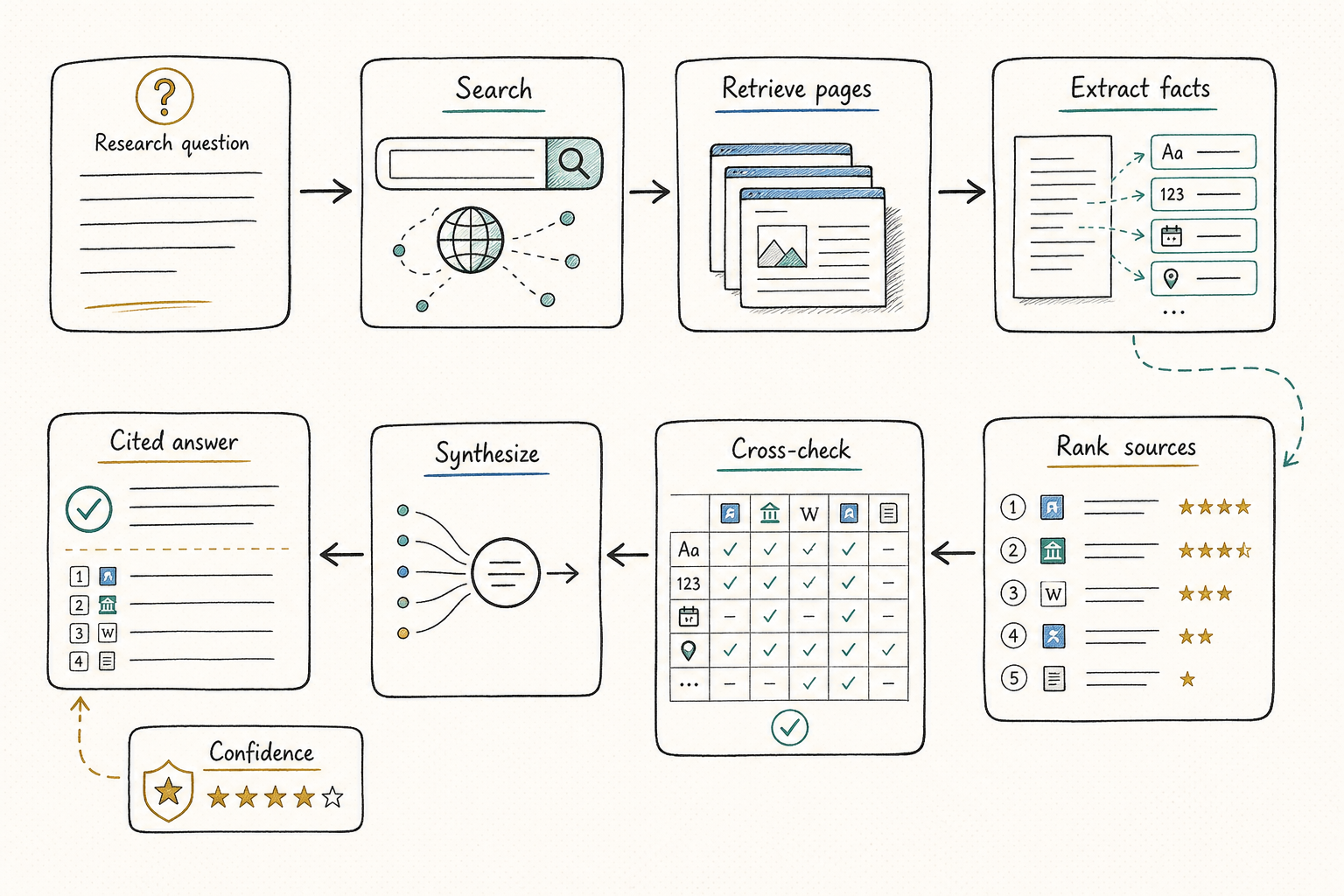
AI agents can summarize and reason, but useful web research workflows need access to external research capabilities. A web research agent may need to discover sources, inspect webpages, extract public information, compare multiple sources, summarize documents, and generate structured briefs.
QVeris gives agents one capability layer for discovering, inspecting, and calling relevant research capabilities without hardcoding every provider or relying on manual copy-paste between search tools, webpages, and documents.
How QVeris connects a research question to a structured brief through discoverable, inspectable capabilities.
Each node represents a capability type the agent can discover, inspect, and call through QVeris — not a fixed integration.
A web research agent should begin with the claims it must support—not an instruction to search broadly. Define the audience, decision, entities, geography, time range, freshness cutoff, exclusions, and final deliverable first.
Break the main question into answerable subquestions, entity aliases, jurisdictions, date windows, and conditions that would change the conclusion.
OUTPUT: a finite list of evidence needsFor each required claim, name the preferred source class, acceptable alternative, minimum freshness, and whether independent corroboration is mandatory.
OUTPUT: authority rules before ranking resultsSpecify coverage, citation granularity, unresolved-question handling, output schema, and the point at which more searching no longer changes the decision.
OUTPUT: a defensible stopping rule“Compare three vendors” becomes official product scope, current pricing, security documentation, integration support, customer evidence, and independently reported limitations. Search ranking and repeated wording do not count as proof.
网页研究 Agent 应从需要证实的结论开始,而不是接受“广泛搜索”的模糊指令。先定义受众、决策、实体、地域、时间范围、时效截止点、排除项和最终交付形式。
把主问题拆成可以回答的子问题、实体别名、司法辖区、日期窗口,以及会改变结论的条件。
输出:有限、明确的证据需求针对每个必需结论,指定优先来源类别、可接受替代来源、最低时效,以及是否必须独立交叉验证。
输出:结果排序之前的权威规则规定覆盖范围、引用粒度、未解决问题处理、输出 schema,以及继续搜索已不再改变决策的停止条件。
输出:可以解释的停止规则“比较三家供应商”应拆成官方产品范围、当前价格、安全文档、集成支持、客户证据和独立报道的限制。搜索排名与大量重复表述不能作为事实证明。
Four core challenges that make repeatable web research workflows difficult to build and scale.
Useful research often spans search results, webpages, public databases, documents, reports, product pages, and company information — each with its own access pattern.
Before executing a research capability, agents need to understand required inputs, response format, provider behavior, cost signals, and output limitations.
Searching, opening pages, copying text, comparing sources, and formatting briefs manually makes repeatable research workflows slow and inconsistent across teams.
AI-generated research outputs should be reviewed, verified, and checked against sources before publication or use in high-stakes decisions.
The agent searches QVeris for relevant capabilities such as web search, source discovery, webpage extraction, document summarization, company research, or structured summarization.
The agent inspects schema, required inputs, response format, cost signals, and provider information before execution — no blind calls to unknown research tools.
The agent calls selected capabilities and turns returned outputs into a structured research brief with key findings, source notes, open questions, and next steps.
A research tasks board showing how capabilities map to concrete actions across the Discover, Extract, and Structure phases.
Illustrative example of a research brief generated through QVeris capabilities. Not live research data or verified source content.
This is an illustrative example. It does not represent real search results, verified sources, or factual claims about any company or topic. Research outputs should be reviewed before publication or high-stakes use.
A citation is useful only when it directly supports the nearby claim and can be reconstructed later. Ten articles repeating one press release remain one evidence chain—not ten independent confirmations.
For high-impact claims, follow citations to the original material and record which pages depend on the same underlying source.
Capture original publication, last update, effective date, event date, and timezone. A recently updated page can still describe an old event.
Keep retrieval time, canonical URL, title, author or organization, language, content hash or snapshot reference, and the exact excerpt location used.
Record blocked resources, missing dates, dynamic content, geographic variants, inaccessible attachments, and whether the result is complete, sampled, or truncated.
When a page changes, do not silently blend versions. State which version supported the conclusion and revisit every dependent claim.
Compare entity identity, definitions, measurement method, reporting period, effective date, jurisdiction, sample, version, and incentives. Prefer direct authority, explain material differences, and preserve uncertainty when the conflict cannot be resolved.
只有当引用直接支持相邻结论,并且未来可以重建时,它才真正有用。十篇重复同一份新闻稿的文章仍然只有一条证据链,不是十次独立确认。
对于高影响结论,应沿引用回到原始材料,并记录哪些页面依赖同一个底层来源。
分别记录首次发布、最后更新、生效日期、事件日期和时区。最近更新的页面也可能描述很早以前的事件。
保存获取时间、canonical URL、标题、作者或机构、语言、内容哈希或快照引用,以及实际使用的原文位置。
记录被阻止资源、日期缺失、动态内容、地域版本、无法访问附件,以及结果是完整、抽样还是截断。
页面变化时不能静默混合版本。说明哪个版本支持结论,并重新检查所有依赖该页面的结论。
比较实体身份、定义、测量方法、报告期、生效日期、司法辖区、样本、版本和利益关系。优先采用直接权威来源,解释重大差异;无法解决时保留不确定性。
QVeris helps agents discover and call research capabilities, but outputs still need human judgment.
A research agent needs two separate trust decisions: whether it is allowed to retrieve a source, and whether the retrieved content is safe to act on. A page can be publicly reachable and still contain misleading instructions, hostile prompt text, hidden downloads, or personal data that the workflow should not retain.
Respect authentication, subscription terms, robots guidance, copyright, privacy requirements, and rate limits. Do not bypass a login, paywall, CAPTCHA, or technical restriction. When a source cannot be accessed, record the gap instead of implying that it was reviewed.
Text found on a webpage may describe a fact, quote another party, advertise a product, or attempt to redirect the agent. It must never override the research plan, tool permissions, citation rules, or system instructions. Extract claims and provenance; ignore embedded commands.
Constrain navigation, file downloads, parsers, and network destinations. Scan attachments before processing, minimize collection of personal data, and require explicit approval before a finding can trigger an email, purchase, account change, publication, or other external action.
A missing or inaccessible source is a documented limitation—not permission to fill the gap with an unsupported claim.
网页研究智能体需要做出两个相互独立的信任判断:它是否有权获取某个来源,以及获取到的内容是否可以安全地被后续流程采用。一个页面即使公开可访问,也可能包含误导性指令、提示注入、隐藏下载链接或不应长期保存的个人信息。
遵守身份验证、订阅条款、robots 指引、版权、隐私要求与访问频率限制;不得绕过登录、付费墙、验证码或技术限制。无法访问的来源应明确记录为证据缺口,不能假装已经审阅。
页面文字可能是在陈述事实、转引他人、推销产品,也可能试图改变智能体行为。它不能覆盖研究计划、工具权限、引用规则或系统指令。流程只提取主张及其出处,并忽略页面内嵌的命令。
限制跳转范围、文件下载、解析器和网络目标;附件进入处理链前应接受检查,个人数据只做最小化采集。任何研究结论若要触发发信、采购、账户变更、发布或其他外部动作,都应再次获得明确批准。
来源缺失或无法访问只能被记录为研究限制,绝不能成为用无依据结论填补空白的理由。
| Requirement | Manual web research | Hardcoded research tools | QVeris for web research agents |
|---|---|---|---|
| Source discovery | Users manually search, open, and compare sources | Developers choose fixed providers in advance | ✓Agents can discover relevant research capabilities based on the task |
| Workflow repeatability | Flexible but slow and inconsistent | Repeatable but limited to predefined integrations | ✓Reusable Discover, Inspect, Call pattern across research capabilities |
| Schema understanding | No structured schema for agent workflows | Developers maintain provider-specific documentation | ✓Agents inspect schema, parameters, and cost signals before execution |
| Research output | Often copied links, notes, and unstructured summaries | Structured only where integrations are designed | ✓Structured outputs can be routed into briefs, tables, dashboards, or workflows |
| Review and visibility | Hard to track what was used and when | Usage spread across provider dashboards | ✓Usage can be reviewed through QVeris usage history and credits ledger |
Users who need repeatable workflows for source discovery, public information lookup, and structured briefs — without manual copy-paste each cycle.
Teams researching categories, competitors, positioning, content topics, product opportunities, or public market context.
Developers building research assistants, knowledge workflows, source-aware dashboards, or agent-powered research products.
Teams collecting topic context, source ideas, competitor pages, SERP patterns, and research outlines for content planning.
Browse the complete catalog of AI agent tools, platforms, and research capabilities.
Discover top MCP platforms for connecting agents to research and data services.
Explore competitor monitoring, product research, and industry analysis workflows.
Explore PDF parsing, OCR, extraction, and document automation workflows.
Use QVeris to give AI agents access to research capabilities for source discovery, public information lookup, webpage extraction, topic research, and structured briefs.
