Turn product, pricing, inventory, and market questions into live data calls, structured analysis, and commerce-ready action briefs through one capability routing layer.
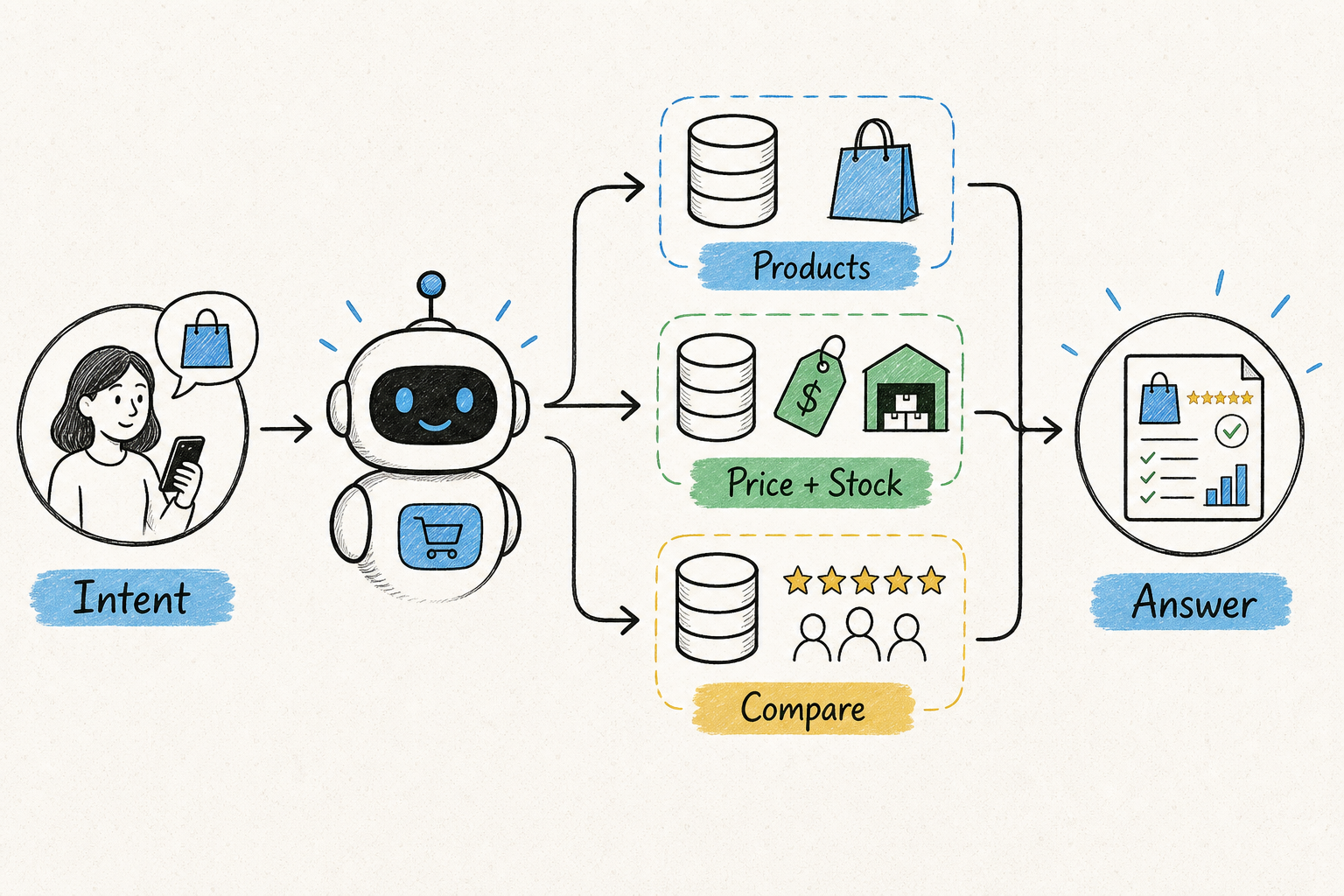
E-commerce changes constantly. Prices move, inventory shifts, competitors launch products, reviews change buyer perception, marketplace trends evolve, and campaigns affect demand. An e-commerce agent that only generates copy or answers from static model memory will miss the real signals behind product performance.
A question like "Why did this product's conversion rate drop this week?" may require product catalog data, pricing history, inventory availability, promotion data, review sentiment, competitor pricing, search trend signals, marketplace performance, chart generation, and merchandising summary generation. Without access to the right tools, the agent can only guess.
QVeris gives e-commerce agents a unified capability routing layer to discover, inspect, and call the right commerce capabilities — product data, pricing tools, inventory signals, reviews, and market intelligence — without hardcoding every data source.
Five layers of capabilities an e-commerce agent needs to go from question to commerce action.
The agent searches QVeris for the right capability based on the commerce question — product data, pricing, inventory, reviews, or market signals.
The agent checks schema, required inputs, expected outputs, latency, cost, and examples before calling any commerce tool.
The agent executes the selected capability and receives structured output — product performance, pricing history, review sentiment, or competitor signals.
The agent combines product, pricing, inventory, review, and market signals into a coherent explanation of what is happening and why.
The agent generates a product update, pricing recommendation, campaign brief, inventory alert, or operations report with next actions.
How an e-commerce agent uses QVeris to investigate a conversion rate decline and recommend actions.
Pull product performance from connected commerce data. Compare conversion rate against previous weeks. Check stock availability and variant-level inventory.
Review recent price and promotion changes. Analyze recent reviews and customer questions. Compare competitor pricing or similar product signals if available.
Generate a chart showing conversion and price movement. Summarize likely drivers from the combined product, pricing, inventory, and review data.
Suggest next actions for merchandising, pricing, or product content. Generate a commerce-ready decision brief for human review.
The backpack's conversion rate declined 9.8% week over week. The decline appears linked to a temporary stockout in the black color variant, a competitor discount on a similar item, and a rise in recent reviews mentioning zipper quality.
This is an illustrative example of e-commerce agent output. It does not represent real product data, store analytics, or guaranteed commercial outcomes. All outputs should be reviewed by qualified humans before merchandising, pricing, or operational decisions.
Six commerce workflows powered by QVeris capabilities.
Generate product-level performance summaries with conversion trends, traffic data, and variance explanations — not just static sales reports.
Track competitor pricing, discount patterns, and product launches. Compare against your catalog and generate pricing recommendations.
Monitor stock levels, identify at-risk SKUs, analyze demand signals, and generate restocking recommendations before outages impact revenue.
Analyze review sentiment, identify emerging quality issues, track customer questions, and route feedback to product and content teams.
Identify underperforming product content, compare against high-converting listings, and generate content improvement recommendations.
Combine product, pricing, inventory, and market data to generate campaign briefs, promotion calendars, and merchandising action plans.
Most e-commerce AI tools stop at writing product descriptions. Commerce teams need agents that can investigate performance, pull live signals, and recommend actions.
| Requirement | Static product tools | QVeris-powered e-commerce agent |
|---|---|---|
| Product data access | Predefined catalog views and fixed exports | ✓Dynamic capability discovery based on the commerce question |
| Pricing context | Limited to internal price history | ✓Can pull competitor pricing, market signals, and external context |
| Review intelligence | Basic sentiment dashboards | ✓Agent can analyze review themes, track emerging issues, and connect to product performance |
| Explanation | Shows metrics but does not explain why | ✓Generates structured explanations with multiple signal sources and recommended actions |
| Adaptability | New questions require new reports | ✓Agents can discover new capabilities dynamically as commerce questions evolve |
Multiple integration paths for commerce systems, data applications, and agent clients
How to instruct an e-commerce agent to use QVeris for commerce intelligence workflows.
Developers building intelligent e-commerce agents that need product data, pricing, inventory, and market signals beyond model context.
Teams managing product catalogs, pricing, inventory, and merchandising who need agent-driven insights and recommendations.
Teams analyzing conversion, revenue, campaign performance, and competitive dynamics with richer external context.
Businesses selling across multiple channels who need unified product intelligence and competitive monitoring.
Teams planning product assortment, pricing strategy, and promotional calendars with data-driven recommendations.
Developers building analytics copilots, pricing agents, or internal commerce tools on top of existing platforms.
Browse the complete catalog of AI agent tools and commerce data capabilities.
Discover top MCP platforms for e-commerce, pricing, and product data workflows.
Explore BI workflows with live data, market signals, and executive reporting.
Explore competitor monitoring, product research, and market analysis workflows.
Let your AI agent discover the right product data, call the right capabilities, and generate commerce-ready insights and actions.
Discover. Inspect. Call. Analyze. Act.
