
AI Model Marketplace
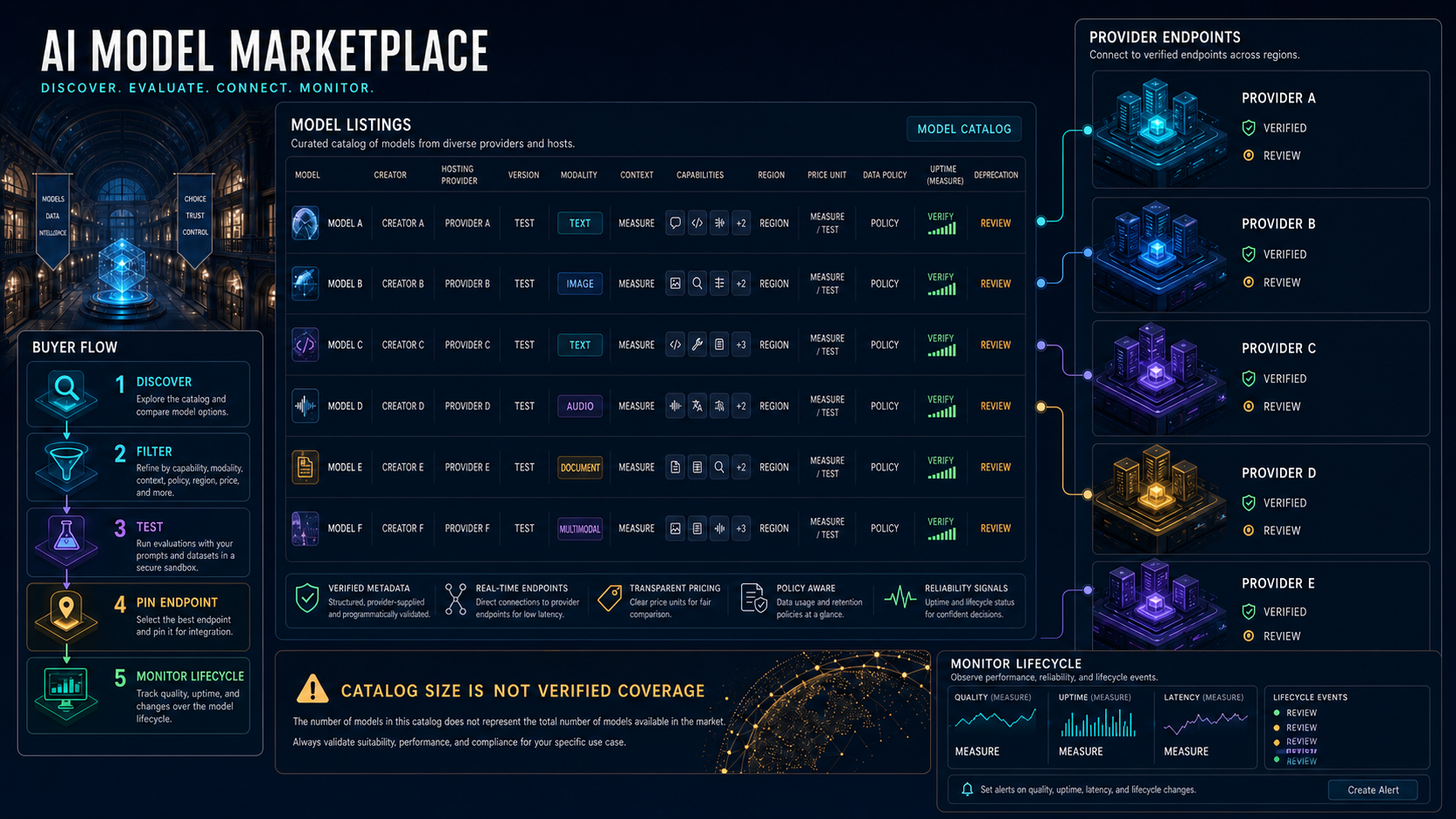
Catalog Size Is Not Verified Coverage
AI 模型市场:目录大不等于覆盖经过验证
A useful marketplace makes model, endpoint and provider provenance visible. Evaluate metadata quality, routing, billing, policy, reliability and lifecycle—not the headline number of models.
有用的模型市场应让模型、端点与供应商来源清晰可见。应评估元数据质量、路由、计费、策略、可靠性与生命周期,而不是模型数量标题。
TL;DR
One model can have several hosted endpoints; a provider can host many models; endpoint behavior and terms can differ.
Capabilities, context, modalities, parameters, region, price unit, data policy, endpoint health and deprecation should drive eligibility.
Run representative prompts and failures against the exact endpoint, not a model family name or marketplace demo.
New hosts, version changes, retirement, policy updates and pricing changes can invalidate a previously correct route.
一个模型可以有多个托管端点;供应商可托管多个模型;端点行为与条款也可能不同。
能力、上下文、模态、参数、区域、计价单位、数据策略、端点健康与弃用应驱动资格判断。
针对具体端点运行代表性提示与故障,而不是只测试模型家族名称或市场 Demo。
新托管方、版本变化、退役、策略更新与价格变化都可能让原本正确的路由失效。
Marketplaces combine discovery, supply and operations 模型市场组合发现、供给与运营
Aggregators expose models from multiple creators and hosting providers through one API and billing view. Hosted inference platforms operate serverless or dedicated endpoints. Cloud catalogs align models with a cloud's identity, networking and procurement. Open-source hubs emphasize artifacts, weights and community metadata.
聚合器通过一个 API 与账单视图暴露多模型创建者和托管供应商;托管推理平台运营无服务器或专属端点;云目录把模型与云身份、网络、采购对齐;开源 Hub 强调制品、权重与社区元数据。
These categories overlap. Determine whether a listing is a model artifact, a callable endpoint, a provider route, or a deployment recipe. Only callable endpoints with verified contract and operational evidence belong in a production routing catalog.
这些类别会重叠。应确定 Listing 是模型制品、可调用端点、供应商路由还是部署方案。只有契约与运行证据经验证的可调用端点才应进入生产路由目录。
Marketplace archetypes 模型市场类型
| Marketplace type 市场类型 | Best fit 最适合 | Verify before choosing 选择前验证 |
|---|---|---|
| Multi-provider aggregator 多供应商聚合器 | One API and bill across models and hosting providers, often with routing and fallback. 通过一个 API 与账单连接多个模型和托管供应商,通常含路由与回退。 | Verify provider identity, endpoint selection, markup, privacy, supported parameters and fallback behavior. 验证供应商身份、端点选择、加价、隐私、参数支持与回退行为。 |
| Hosted inference catalog 托管推理目录 | Serverless and dedicated endpoints for open or proprietary models with platform operations. 为开放或专有模型提供无服务器与专属端点及平台运营。 | Pin model version, quantization, context, capacity, cold behavior, region, support and lifecycle. 固定模型版本、量化、上下文、容量、冷行为、区域、支持与生命周期。 |
| Cloud model catalog 云模型目录 | Models integrated with a cloud's identity, networking, regions, governance and procurement. 模型与云身份、网络、区域、治理与采购集成。 | Compare regional availability, API differences, service quotas, data terms and portability. 比较区域可用性、API 差异、服务配额、数据条款与可移植性。 |
| Open model hub 开放模型 Hub | Artifacts, weights, cards, licenses and community ecosystem for discovery and deployment. 用于发现和部署的制品、权重、模型 Card、许可与社区生态。 | A model page is not a production endpoint; verify serving stack, license, security and operating owner. 模型页面不是生产端点;需验证 Serving 栈、许可、安全与运营负责人。 |
| AI service marketplace AI 服务市场 | Broader catalog spanning text, image, audio, video, OCR or other AI functions. 更广目录,覆盖文本、图像、音频、视频、OCR 或其他 AI 功能。 | Keep category-specific schemas, quality metrics, asynchronous jobs, storage and price units explicit. 显式保留类别特定结构定义、质量指标、异步任务、存储与计价单位。 |
A verified listing needs ten fields 已验证 Listing 需要十类字段
Creator, model version, artifact, serving provider, endpoint ID, region, runtime and quantization.
Modalities, context, tools, structured output, reasoning, files, streaming, embeddings and provider extensions.
License, data use, retention, training, residency, price unit, markup, credits, quota and support.
Release, update, deprecation, health, latency, throughput, error rate, request IDs, usage and incident history.
创建者、模型版本、制品、Serving 供应商、端点 ID、区域、运行时与量化。
模态、上下文、工具、结构化输出、推理、文件、流式、Embedding 与供应商扩展。
许可、数据使用、保留、训练、驻留、计价单位、加价、Credits、配额与支持。
发布、更新、弃用、健康、延迟、吞吐、错误率、请求 ID、用量与事故历史。
Turn a listing into a verified endpoint 把 Listing 转为已验证端点
- Filter by hard capability, region, data, license, price-unit and contract requirements.
- Run conformance, quality, load and failure tests against the exact endpoint and provider route.
- Pin the endpoint, model version and policy; store native IDs and marketplace identifiers together.
- Monitor health, price, policy and lifecycle events; require review before automatic substitutions.
- 按硬性能力、区域、数据、许可、计价单位与合同要求过滤。
- 针对具体端点与供应商路由运行一致性、质量、负载与故障测试。
- 固定端点、模型版本与策略,并同时存储原生 ID 与市场标识。
- 监控健康、价格、策略与生命周期事件;自动替换前必须评审。
Build an internal catalog from verified marketplace evidence 用已验证市场证据构建内部目录
Ingest marketplace metadata as untrusted candidates. A verification pipeline applies eligibility, contract tests, quality thresholds and operational probes. Only approved endpoint versions enter the internal catalog. Routing references internal aliases, while traces preserve external model, endpoint and provider IDs for provenance and billing.
把市场元数据作为不受信候选导入。验证管线执行资格判断、契约测试、质量阈值与运行探测;只有获批端点版本进入内部目录。路由引用内部别名,调用链则保留外部模型、端点与供应商 ID 供来源和计费。
Production rule: a large marketplace accelerates discovery; production trust begins only after endpoint-level verification.
生产规则:大型市场加速发现;生产信任只在端点级验证后开始。
A model marketplace is not a capability marketplace 模型市场不是能力市场
Model marketplaces supply inference endpoints. QVeris indexes broader real-world capabilities: APIs, tools, services and live data. An agent may choose a model from a marketplace, then use QVeris to discover the capability that completes the task.
模型市场提供推理端点;QVeris 索引更广的现实能力:API、工具、服务与实时数据。智能体可以先从市场选择模型,再用 QVeris 发现完成任务的能力。
The Production Operating Model for an AI model marketplaceAI 模型市场的生产运营模型
For AI Model Marketplace, reliability begins when reliable only when requirements, policy, failure behavior, evidence, and ownership are explicit. Turn the diagram into an operating contract that can be tested before launch and during every change.
针对“AI 模型市场”,只有当需求、策略、失败行为、证据和责任都明确时,架构才会真正可靠。应把架构图转成运营契约,并在上线前和每次变更期间持续测试。
Inventory publisher and upstream identity, model version, license, modality, region, safety conditions, benchmark provenance, price effective date, capacity, deprecation, and support. For each workflow, set quality, availability, p50 and tail latency, freshness, privacy, regional, cost, and recovery objectives instead of applying one global policy.
盘点发布者与上游身份、模型版本、许可、模态、区域、安全条件、基准来源、价格生效日期、容量、弃用和支持。为每类工作流分别设置质量、可用性、常规与长尾延迟、新鲜度、隐私、区域、成本和恢复目标,而不是套用一个全局策略。
For AI Model Marketplace, first reject routes that fail capability, authorization, residency, safety, health, or budget constraints. Only then optimize among eligible candidates. Version the policy and record the reason for every decision and override.
针对“AI 模型市场”,先排除不满足能力、授权、驻留、安全、健康或预算约束的路由,再在合格候选项中优化。版本化策略,并记录每次决策与覆盖的原因。
To validate AI Model Marketplace, inject rate limits, slow streams, malformed output, stale control data, credential loss, regional failure, quota exhaustion, schema drift, and dependent-tool outages. Verify bounded retries, semantic fallback, partial results, and safe recovery.
验证“AI 模型市场”时,注入限流、慢速流、畸形输出、过期控制数据、凭证丢失、区域故障、配额耗尽、Schema 漂移和依赖工具中断,验证有界重试、语义故障切换、部分结果和安全恢复。
When operating AI Model Marketplace, trace request, policy version, candidate set, selected route, transformations, attempts, latency, usage, cost, validation, and final task result. Tie alerts to runbooks, assign owners, and use incidents to update tests and acceptance thresholds.
运营“AI 模型市场”时,追踪请求、策略版本、候选集合、所选路由、转换、尝试、延迟、用量、成本、校验和最终任务结果,把告警连接到运行手册,明确负责人,并用事故更新测试与验收门槛。
FAQ
A catalog that helps users discover, access or deploy models and often connects listings to hosted endpoints, providers or billing.
Only after filtering for your required capabilities, regions, policy, endpoint quality, lifecycle and support.
Marketplaces simplify discovery and supply; direct providers preserve native control and may fit committed spend or critical features.
帮助用户发现、访问或部署模型的目录,通常把 Listing 连接到托管端点、供应商或账单。
只有在按所需能力、区域、策略、端点质量、生命周期与支持过滤后才重要。
市场简化发现与供给;直连保留原生控制,并可能更适合承诺支出或关键功能。