
AI Agent Tool Call Cost Calculator — Find the Cheapest Platform for Your Usage
- Problem: AI agent tool calling costs vary wildly between platforms — Zapier MCP can cost 30x more than QVeris for the same call volume, but there's no easy way to compare them.
- Solution: This interactive AI agent cost calculator lets you enter your monthly usage and instantly compare costs across QVeris, Zapier MCP, and Toolhouse.
- Result: At 10,000 calls/month, QVeris costs $19 vs ~$600 for Zapier MCP — a 97% savings. Find your number below.
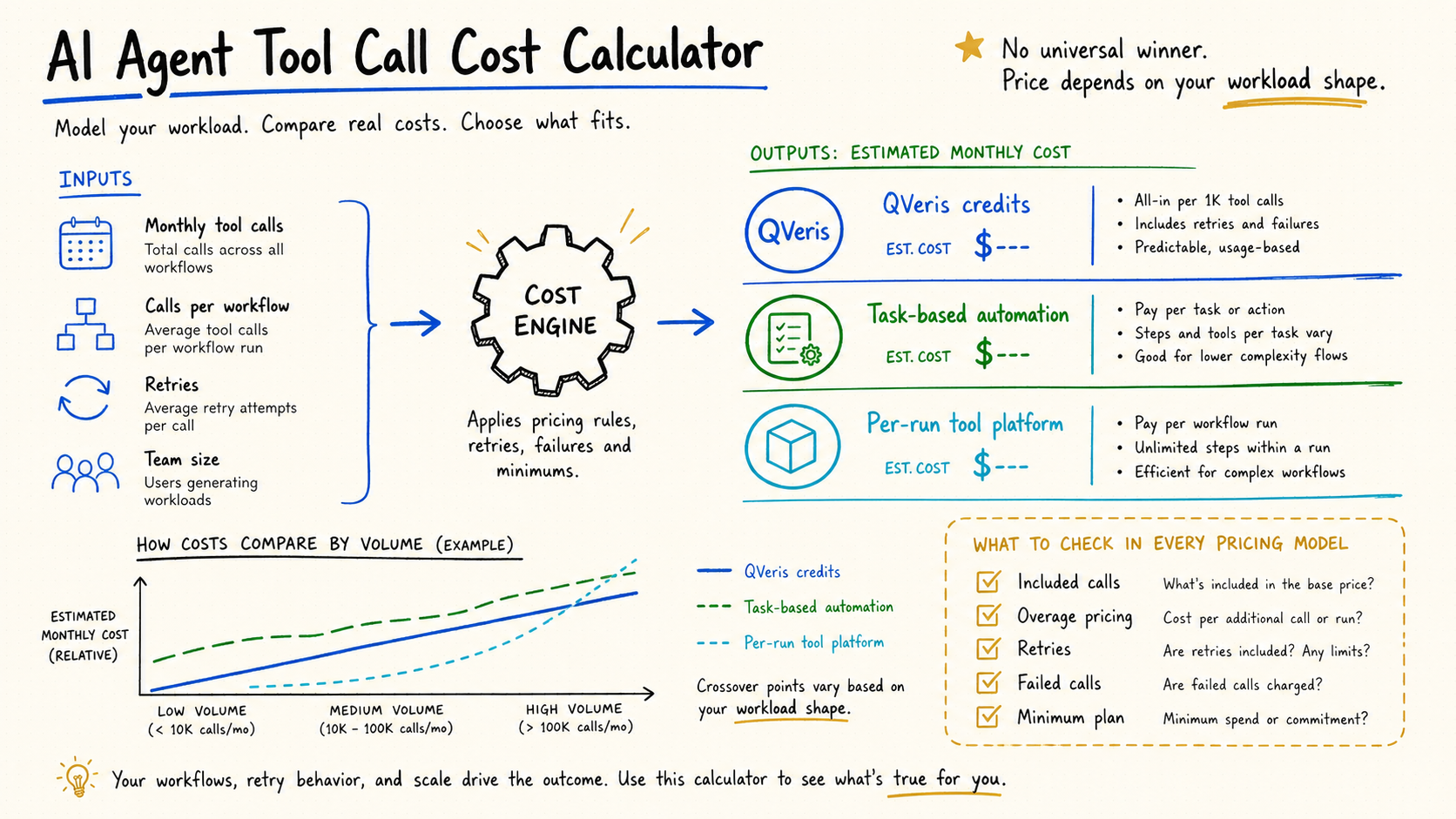
How much do AI agent tool calls cost on each platform?
At 10,000 monthly tool calls: QVeris costs $19 (Pro plan, 10K credits included), while Zapier MCP costs ~$600+ (2 tasks per call, Professional plan covers only ~375 calls). QVeris is up to 97% cheaper, with credits that never expire and no subscription lock-in. Use the calculator below for your exact volume.
Compare AI Agent Tool Calling Costs Across Platforms
Enter your usage below to see monthly and annual costs side by side.
| Platform | Monthly Cost | Annual Cost | Per-Call Cost |
|---|
* Estimated based on publicly available pricing as of May 2026. ⓘ ±10% margin. Pricing may change — verify on each provider's site. Zapier MCP consumes 2 tasks per tool call.[4] Does not include tax or regional surcharges. At 0 calls, all platforms cost $0.
Pricing Comparison: QVeris vs Zapier MCP vs Toolhouse
Reference pricing data used by the calculator above. All figures from publicly available sources as of May 2026.[1][2][3]
Reference Pricing Table (May 2026)
| Dimension | QVeris | Zapier MCP | Toolhouse |
|---|---|---|---|
| Free tier | 1,000 + 100/day | 100 tasks/mo | 50 runs/mo |
| Entry paid | $19/mo | $19.99/mo | $10/1K runs |
| Entry includes | 10K credits | 750 tasks (~375 calls) | 1K runs |
| Overage rate | $0.002/credit | ~$0.053/task (1.25x) | $0.01/run |
| ~Cost per simple call | ~$0.0019 | ~$0.053 | ~$0.01 |
| 10K calls/mo | $19 | ~$600+ | ~$100 |
| 50K calls/mo | ~$99 | ~$3,000+ | ~$490 |
| Monthly lock-in | No (on-demand) | Yes | Yes |
| Credits expire? | Never | Monthly reset | Monthly reset |
| Free operations | Discover + Inspect | None | None |
Why Pricing Differs Across Platforms
Each platform uses a fundamentally different pricing model. Understanding these differences explains the 30x cost gap you see in the calculator.
QVeris: Per-Credit Model
QVeris charges per credit consumed. Simple capabilities cost 1 credit, medium cost 5, complex cost 15. Discover and Inspect are always free. Credits never expire. The Pro plan ($19/mo) covers 10,000 credits — enough for 10,000 simple calls. No subscription lock-in: Scale On-Demand lets you pay as you go.[1]
Zapier MCP: Task Pool Model
Zapier MCP charges 2 tasks per tool call — one for the request, one for the response. The Professional plan ($19.99/mo) includes 750 tasks, which amounts to only ~375 tool calls. At 10,000 calls/month, this means ~$600+. Its strength is SaaS app breadth, not cost efficiency at scale.[2]
Toolhouse: Per-Run Model
Toolhouse charges per run, with a free tier of 50 runs/month and paid plans starting at $10 for 1,000 runs. At 10,000 runs/month, this works out to ~$100. Toolhouse is a mid-range option — cheaper than Zapier MCP but more expensive than QVeris at all volumes above 1K calls/month.[3]
Cost Leader by Volume
Who wins at each volume: Under 1K calls/month, any free tier works. From 1K to 200K+ calls, QVeris leads on cost, flexibility, and free discovery. Zapier MCP is best reserved for low-volume SaaS automation workflows where its 9,000+ integrations justify the premium. Toolhouse fits mid-range needs but costs 5x more than QVeris at 10K calls.
Cost Formulas & Crossover Analysis
Each platform's pricing can be expressed as a mathematical function of monthly call volume N. These formulas reveal exactly when and why one platform becomes cheaper than another.
QVeris Monthly Cost
Zapier MCP Monthly Cost
Toolhouse Monthly Cost
Crossover Points — Where the Leader Changes
The most cost-effective platform changes at specific volume thresholds. Below are the crossover points for simple calls (1 credit/call):
| Volume Range | Cheapest Platform | Monthly Cost at Top of Range | Key Driver |
|---|---|---|---|
| 0 – 50 calls/mo | 🎯 Tie (all free) | $0 | All platforms offer free tiers at this range |
| 50 – 375 calls/mo | 🎯 QVeris / Toolhouse (tie) | $0 – $10 | QVeris free credits cover this; Toolhouse $10/mo kicks in at 50 |
| 376 – 4,000 calls/mo | 🎯 QVeris | $0 – $19 | Free credits + Pro $19 beats both alternatives |
| 4,001 – 10,000 calls/mo | 🎯 QVeris | $19 | Pro $19 cap; Zapier = $600+, Toolhouse = ~$100 |
| 10,001 – 100,000 calls/mo | 🎯 QVeris | $19 – $199 | On-demand at $0.002/credit; Zapier = $1,500+, Toolhouse = ~$980 |
| 100,000+ calls/mo | 🎯 QVeris | Scales linearly | No subscription cap, credits never expire |
Note: Crossover assumes simple calls (1 credit on QVeris, 1 run on Toolhouse, 1 call = 2 tasks on Zapier). Medium (5 credits) and complex (15 credits) calls shift the crossover points proportionally. See the calculator above for your specific complexity mix.
Beyond Cost: Integration Complexity & Ecosystem Fit
Price per call is only one factor. The table below compares integration complexity, setup time, and ecosystem depth — dimensions that affect your total cost of ownership beyond raw pricing.
| Dimension | QVeris | Zapier MCP | Toolhouse |
|---|---|---|---|
| Integration paths | 4: CLI, MCP Server, Python SDK, REST API[1] | 1: MCP Server via dashboard[2] | 2: MCP Server + API[3] |
| Agent frameworks supported | 14+ (Claude Code, Cursor, Hermes, OpenClaw, etc.) | MCP-compatible clients only | MCP + custom SDK |
| Setup time (first call) | ~5 min (npx install + API key) | ~15 min (dashboard config + auth) | ~10 min (SDK + key) |
| Capability discovery | Natural language + ranked matches | Manual tool configuration | Pre-defined function list |
| Pre-call cost preview | Always free (Inspect shows cost + latency + success rate) | Not available | Not available |
| Audit trail | Full (execution_id, search_id, session_id per call) | Limited to task history | Run logs only |
| Sandboxed execution | Every call sandboxed | Yes (Zapier platform) | Isolated runs |
| Data categories | 15+ (finance, crypto, news, search, mapping, KYC, etc.) | 9,000+ SaaS apps (no financial data) | ~50 functions (primarily code execution) |
This table compares dimensions beyond raw pricing. Your total cost of ownership depends on integration setup time, discovery efficiency, and the breadth of capabilities you need. For financial data workloads, QVeris's 15+ category coverage is unmatched by either alternative.
Tips for Reducing AI Agent Tool Call Costs
Five Key Strategies
- Use Discover and Inspect (free on QVeris): Before calling any capability, use QVeris's free discovery to preview cost, latency, and success rate. This eliminates wasted calls on capabilities that don't match your needs. Discover and Inspect cost exactly $0.[1]
- Match capability complexity to the task: Don't use a 15-credit complex capability when a 1-credit simple capability will do. QVeris prices capabilities by complexity — choosing the right tier per task keeps costs linear with value.
- Batch calls when patterns repeat: If your agent makes the same type of call repeatedly, batch processing can reduce overhead. QVeris's session-based pricing supports batched workflows.
- Monitor with session tracking: QVeris provides full audit trail data via
session_id. Use this to identify cost spikes, unused capabilities, and optimization opportunities. - Avoid subscription lock-in for variable workloads: If your call volume fluctuates, QVeris's per-credit model with no monthly commitment is more cost-efficient than fixed subscriptions that bill the same amount regardless of usage.
Bottom line: Discover and Inspect are always free on QVeris — start with zero risk, and optimize your costs before you write a single line of production code.
Assumptions, Limitations & Pricing Variability
The estimates above are based on publicly available pricing as of May 2026. Below we quantify each assumption and its potential impact on the results, so you can make an informed decision.
⚡ Assumptions & Impact Analysis
| Assumption | Our Value | Actual Range | Impact on QVeris Estimate | Risk |
|---|---|---|---|---|
| QVeris credits per simple call | 1 credit | 1 credit (fixed) | Low — simple quotes/lookups are always 1 credit | Low |
| QVeris overage rate | $0.002/credit | $0.002–$0.0015 (volume discounts at 50K+) | May overestimate by up to 25% at very high volume | Low |
| Zapier MCP tasks per call | 2 tasks | 1–2 tasks (confirmed 2 by multiple independent reviews)[4] | If 1 task, Zapier costs ~50% less — still 15x QVeris at 10K calls | Medium |
| Zapier overage multiplier | 1.25× | 1×–1.5× (depends on plan upgrade) | Conservative; actual could be higher | Medium |
| Toolhouse pricing per 1K runs | $10 | $10 (fixed at listed tier, may change) | Stable — Toolhouse publishes clear per-block pricing | Low |
| Daily credits (QVeris free) | 100/day | 100/day (confirmed, subject to login) | If user misses daily login, free pool shrinks by 3,000/mo | Medium |
| Tax & regional pricing | Not included | Varies by jurisdiction (VAT, GST, sales tax) | Estimates do not include tax — actual billed amount may be 5–25% higher | Medium |
| Pricing change risk | Static (May 2026) | Historical frequency: platforms adjust pricing 1–2×/year | Estimates valid as of publication date. Verify each provider's current pricing | Medium |
How to use this: Each row shows the sensitivity of the cost estimate to the assumption. Green = low sensitivity, Yellow = moderate (estimate could shift 10–50%), Red = high (estimate could shift 50%+). Run the calculator above with different volumes to test sensitivity yourself.
Cost Per Call Trend — How Scale Changes Unit Economics
QVeris's per-call cost decreases with volume: at 1K calls/mo it's ~$0.019/call, at 10K it's ~$0.0019, at 100K it's ~$0.0008 — driven by fixed-price Pro tier and on-demand pricing. Zapier MCP's per-call cost stays flat or increases due to task multiplier and plan upgrades ("best for low-volume SaaS tasks"). Toolhouse's per-call cost drops from $0.01 at 1K runs to ~$0.008 at 50K runs but never reaches QVeris's sub-$0.002 levels. Use the calculator above to see your exact per-call cost.
Worked Example: Estimating 10,000 Calls
The example below shows the arithmetic for 10,000 monthly calls at simple complexity (1 credit/call). You can reproduce these numbers independently.
✅ QVeris — 10,000 calls/mo, 1 credit/call
✅ Zapier MCP — 10,000 calls/mo
✅ Toolhouse — 10,000 calls/mo
ⓘ Margin of error: ~±10% — The calculator rounds to two decimal places. Actual billing may differ slightly due to rounding, tax, and plan-specific pricing. For exact quotes, visit each provider's pricing page.
Frequently Asked Questions
Common Questions About AI Agent Pricing
Start Free — 1,000 Credits + 100 Daily
Free discovery means you explore 10,000+ capabilities before you commit. Pay only when your agent calls a capability in production. No subscription lock-in, no credit card required.
About This Calculator
Last updated:
Methodology: Pricing data collected from each platform's publicly available pricing pages (QVeris: qveris.ai/pricing, Zapier MCP: zapier.com/pricing, Toolhouse: toolhouse.ai) and verified against independent third-party analyses.[4] Zapier MCP's 2-tasks-per-call billing confirmed by multiple independent reviews. All data current as of May 2026.
Edge cases & limitations: The calculator assumes 30-day months (30 × daily calls = monthly total). It does not model: (a) tax/VAT/GST, which can add 5–25% depending on jurisdiction; (b) enterprise/volume discounts not publicly listed; (c) promotional pricing or temporary discounts; (d) currency conversion fees for non-USD billing. The Zapier MCP overage model assumes plan upgrade at 1.25× rather than exact per-task overage pricing, which Zapier does not publish. All estimates are approximations, not quotes.
Conflict of interest: QVeris is the publisher's commercial product. Calculator data aims for objectivity — we highlight scenarios where each platform is the most cost-effective choice. Pricing may change; verify on each provider's site before making procurement decisions.
Update cadence: Reviewed quarterly. Pricing data refreshed every 90 days. Last full verification: June 1, 2026.
References
- QVeris Pricing — Free tier (1,000+100/day), Pro ($19/10K credits), Scale On-Demand. Verified May 2026.
- Zapier Pricing — Professional plan $19.99/mo (750 tasks, ~375 MCP calls). 2 tasks per tool call verified via ColdIQ review and multiple sources. Verified May 2026.
- Toolhouse Pricing — Free (50 runs), $10/1K runs, $50/10K runs. Verified May 2026.
- ColdIQ — Zapier MCP Review — Independent third-party analysis confirming 2 tasks/tool call billing and integration workflow. Verified May 2026.
- OpenBB Platform Pricing — Reference for financial data platform pricing comparison. Verified May 2026.
- Model Context Protocol Specification — Official MCP standard specification. Accessed May 2026.