
Best AI Gateway
Choose an Operating Model, Not a Feature Count
最佳 AI 网关:选择运营模型,不要只数功能
The best AI gateway is the one whose traffic path, control plane, evidence model, and ownership match your workloads. This guide separates managed, self-hosted, edge, enterprise, observability-first, routing-first, aggregator, and private-VPC choices.
最佳 AI 网关应让流量路径、控制平面、证据模型与责任边界匹配实际工作负载。本指南区分托管、自托管、边缘、企业 API 平台、可观测优先、路由优先、聚合器与私有 VPC 路线。
TL;DR
Decide whether the gateway is managed, self-hosted, edge-native, part of an API platform, or a provider marketplace before comparing checkboxes.
Name who rotates keys, handles 429s, operates retries, restores state, investigates traces, approves policy, and pays for telemetry.
A unified endpoint is useful only when tools, structured output, streaming, usage, errors, reasoning and multimodal payloads survive translation.
Portkey, LiteLLM, Bifrost, Kong, Cloudflare, Vercel, Requesty and OpenRouter represent different operating models, not one ordered ladder.
在比较功能勾选之前,先决定网关是托管、自托管、边缘原生、企业 API 平台的一部分,还是供应商市场。
明确谁负责密钥轮换、处理 429、运营重试、恢复状态、调查调用链、审批策略与支付遥测成本。
只有当工具、结构化输出、流式、用量、错误、推理与多模态请求数据能经受转换时,统一端点才有价值。
Portkey、LiteLLM、Bifrost、Kong、Cloudflare、Vercel、Requesty 与 OpenRouter 代表不同运营模型,而不是单一排名。
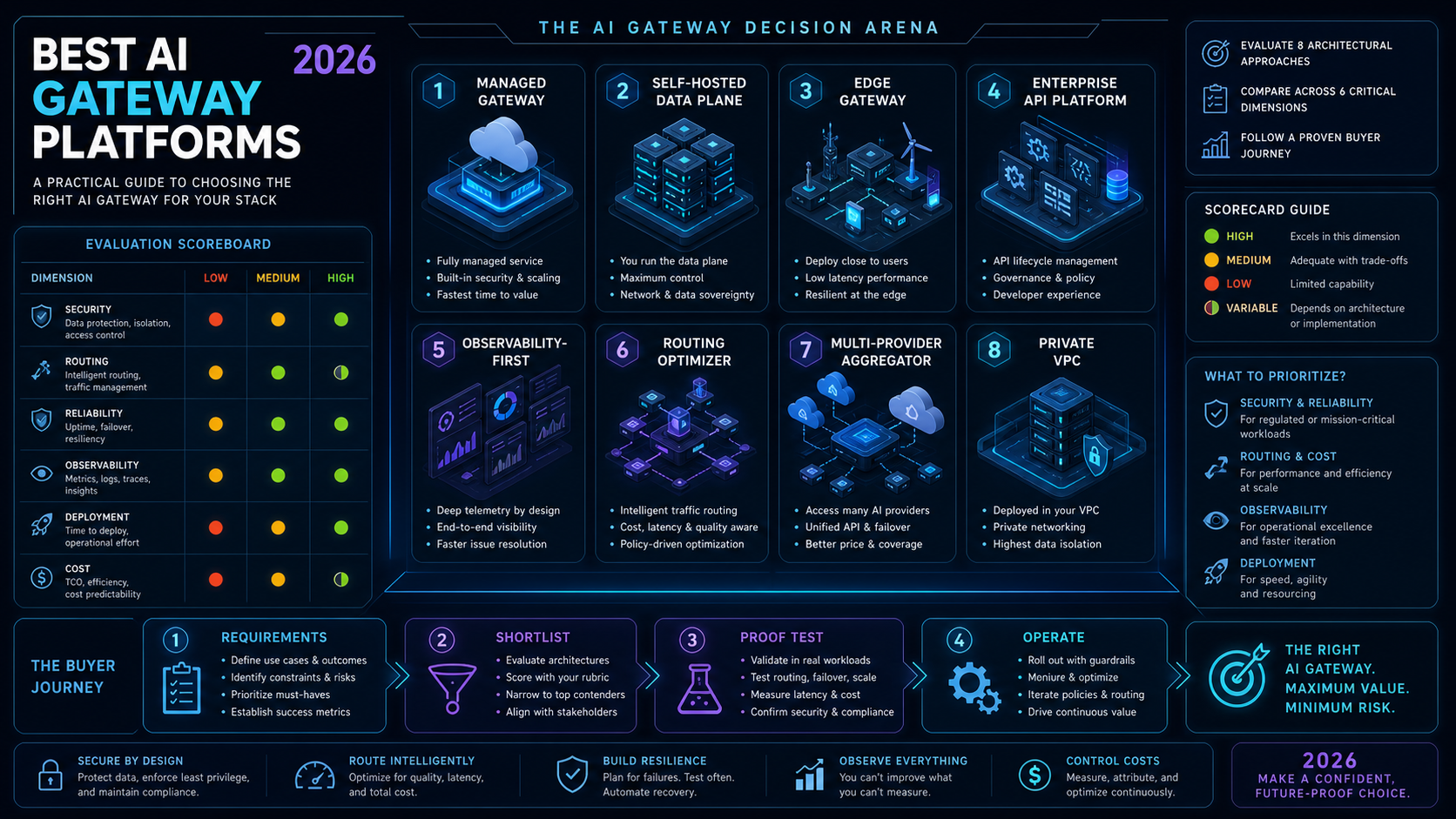
Eight gateway archetypes shape the market 八类网关架构构成选型地图
Managed suites prioritize time to value and integrated operations. Self-hosted data planes prioritize control and portability. Edge gateways move control near users. Enterprise API platforms extend existing governance into AI traffic.
托管套件强调快速交付与集成运营;自托管数据平面强调控制与可移植性;边缘网关把控制靠近用户;企业 API 平台把既有治理扩展到 AI 流量。
Observability-first tools shorten diagnosis. Routing optimizers specialize in model decisions. Aggregators simplify model supply and billing. Private-VPC designs maximize isolation. Many products span categories, so compare the exact edition and topology.
可观测优先工具缩短诊断;路由优化器专注模型决策;聚合器简化模型供给与账单;私有 VPC最大化隔离。很多产品跨越多类,因此应比较具体版本与拓扑。
A practical 2026 AI gateway shortlist 实用的 2026 AI 网关候选清单
| Platform 平台 | Best fit 最适合 | Verify before choosing 选择前验证 |
|---|---|---|
| Portkey Portkey | Teams wanting gateway routing, guardrails, observability, prompts, administration and managed operations together. 希望同时获得网关路由、护栏、可观测性、提示词、管理与托管运营的团队。 | Validate edition boundaries, hosting, synchronous guardrail latency, retention, pricing and self-host scope. 验证版本边界、托管方式、同步护栏延迟、保留期、价格与自托管范围。 |
| LiteLLM LiteLLM | Platform teams wanting a broad OpenAI-format proxy plus Python SDK, routing, keys, budgets and extensibility. 需要广泛 OpenAI 格式代理、Python SDK、路由、密钥、预算与扩展性的平台团队。 | Own upgrades, databases, HA, scaling, plugin quality, provider drift and long-term operations. 承担升级、数据库、高可用、扩缩、插件质量、供应商漂移与长期运维。 |
| Bifrost Bifrost | Teams prioritizing a self-hosted, high-performance gateway, Go integration, provider failover and transparent control. 重视自托管高性能网关、Go 集成、供应商回退与透明控制的团队。 | Verify feature maturity, cluster topology, protocol coverage, telemetry, support and operational staffing. 验证功能成熟度、集群拓扑、协议覆盖、遥测、支持与运维人力。 |
| Kong AI Gateway Kong AI 网关 | Organizations extending established API gateway policy, plugins, ingress, identity and governance into LLM traffic. 把成熟 API 网关策略、插件、Ingress、身份与治理扩展到 LLM 流量的组织。 | Map AI feature licensing, control-plane mode, plugin compatibility, configuration complexity and resource needs. 核对 AI 功能许可、控制平面模式、插件兼容、配置复杂度与资源需求。 |
| Cloudflare AI Gateway Cloudflare AI 网关 | Teams using Cloudflare's edge and wanting analytics, logs, caching, rate limits, retries, fallback and dynamic routes. 使用 Cloudflare 边缘,并需要分析、日志、缓存、限流、重试、回退与动态路由的团队。 | Verify provider feature parity, data path, regional needs, transformation semantics and vendor-specific limits. 验证供应商功能一致性、数据路径、区域要求、转换语义与特定限制。 |
| Vercel AI Gateway Vercel AI 网关 | Web and AI SDK teams wanting managed multi-provider access, catalog discovery, budgets, observability and fallbacks. 需要托管多供应商访问、目录发现、预算、可观测性与回退的 Web/AI SDK 团队。 | Verify protocol surfaces, provider/model availability, routing controls, data terms, billing and platform coupling. 验证协议面、供应商/模型可用性、路由控制、数据条款、计费与平台耦合。 |
| Requesty Requesty | Teams prioritizing cost-aware routing, provider resilience, BYOK, budgets, cohorts, experiments and model evidence. 重视成本感知路由、供应商韧性、BYOK、预算、分组、实验与模型证据的团队。 | Test policy expressiveness, sticky behavior, observability export, data handling and total cost on real traffic. 用真实流量测试策略表达力、粘性行为、可观测导出、数据处理与总成本。 |
| OpenRouter OpenRouter | Developers wanting broad hosted model/provider supply through one API, with routing, fallbacks and catalog metadata. 希望通过一个 API 获得广泛托管模型/供应商供给、路由、回退与目录元数据的开发者。 | Treat it as managed aggregation: validate provider provenance, parameter support, privacy filters, billing and control depth. 把它视为托管聚合器:验证供应商来源、参数支持、隐私过滤、计费与控制深度。 |
Score six production dimensions 按六个生产维度评分
Identity, tenant isolation, secrets, provider allowlists, data residency, retention, prompt/response policy, approvals and audit export.
Provider and model selection, retries, fallbacks, timeouts, circuit breaking, health signals, caching, idempotency and overload behavior.
Chat, responses, messages, tools, structured output, streaming order, usage, errors, reasoning controls, files and multimodal data.
Request and trace IDs, model/provider provenance, route decisions, policy versions, TTFT, latency, tokens, cache, guardrails, errors and cost.
Managed versus self-hosted topology, HA, upgrades, rollback, backup, DR, capacity, on-call, support, control-plane failure and portability.
Markup, subscription, credits, provider commitments, BYOK, infrastructure, telemetry, storage, egress, engineering and incident cost.
身份、租户隔离、密钥、供应商 Allowlist、数据驻留、保留、提示/响应策略、审批与审计导出。
供应商/模型选择、重试、回退、超时、熔断、健康信号、缓存、幂等性与过载行为。
Chat、Responses、Messages、工具、结构化输出、流式顺序、用量、错误、推理控制、文件与多模态数据。
请求/调用链 ID、模型/供应商来源、路由决策、策略版本、TTFT、延迟、Token、缓存、护栏、错误与成本。
托管/自托管拓扑、高可用、升级、回滚、备份、灾备、容量、值班、支持、控制平面故障与可移植性。
加价、订阅、Credits、供应商承诺、BYOK、基础设施、遥测、存储、出口、工程与事故成本。
Run a two-week production proof 执行两周生产验证
- Freeze a representative corpus: chat, tools, structured output, long context, images, audio, embeddings and high-concurrency streams.
- Replay identical traffic through two or three shortlisted architectures and compare semantic output, not only HTTP success.
- Inject 429, 5xx, slow provider, dropped stream, invalid key, quota breach, control-plane loss and telemetry outage.
- Give on-call engineers one broken session and time discovery, reconstruction, root cause, mitigation and verified recovery.
- Model three-year cost at realistic traffic, retention, regions, support and platform staffing; then test migration and rollback.
- 固定代表性语料:对话、工具、结构化输出、长上下文、图像、音频、Embedding 与高并发流式。
- 通过两到三种候选架构回放相同流量,比较语义输出,而不只看 HTTP 成功。
- 注入 429、5xx、慢供应商、流中断、无效密钥、配额超限、控制平面与遥测中断。
- 给值班工程师一个故障会话,计时发现、重建、根因、缓解与恢复验证。
- 按真实流量、保留期、区域、支持与平台人力计算三年成本,再测试迁移与回滚。
Design the evidence envelope before the gateway 先设计证据封装,再选择网关
Define a vendor-neutral request envelope containing tenant, actor, workload, trace ID, idempotency key, allowed models/providers, privacy class, budget, timeout, route policy, schema requirements and audit tags. Require the gateway to append provider, model, endpoint, policy version, retry chain, cache status, guardrail verdict, token usage, latency, cost and error semantics.
定义供应商中立的请求封装,包括租户、Actor、工作负载、调用链 ID、Idempotency 密钥、允许的模型/供应商、隐私级别、预算、超时、路由策略、结构定义要求与审计标签。要求网关附加供应商、模型、端点、策略版本、重试链、缓存状态、护栏结论、Token、延迟、成本与错误语义。
Production rule: the gateway is replaceable only when traffic contracts, evidence fields and failure semantics belong to your platform.
生产规则:只有当流量契约、证据字段与故障语义属于自身平台时,网关才可替换。
QVeris sits above the AI gateway category QVeris 位于 AI 网关类别之上
QVeris should not be ranked as another model gateway. A gateway selects and governs inference; QVeris helps the resulting agent Discover, Inspect and Call external APIs, tools, services and live data. Connect them with shared trace context and separate retry policies.
QVeris 不应作为另一个模型网关参与排名。网关选择并治理推理;QVeris 帮助生成的智能体发现、检查并调用外部 API、工具、服务与实时数据。二者用共享调用链连接,但重试策略分离。
The Production Operating Model for a best-fit AI gateway最适合团队的 AI Gateway的生产运营模型
For Best AI Gateway, reliability begins when reliable only when requirements, policy, failure behavior, evidence, and ownership are explicit. Turn the diagram into an operating contract that can be tested before launch and during every change.
针对“最佳 AI 网关”,只有当需求、策略、失败行为、证据和责任都明确时,架构才会真正可靠。应把架构图转成运营契约,并在上线前和每次变更期间持续测试。
Inventory provider abstraction, policy enforcement, identity, routing, fallbacks, caching, observability, evaluations, budgets, residency, deployment model, and operator skill. For each workflow, set quality, availability, p50 and tail latency, freshness, privacy, regional, cost, and recovery objectives instead of applying one global policy.
盘点供应商抽象、策略执行、身份、路由、故障切换、缓存、可观察性、评估、预算、驻留、部署模式和运营技能。为每类工作流分别设置质量、可用性、常规与长尾延迟、新鲜度、隐私、区域、成本和恢复目标,而不是套用一个全局策略。
For Best AI Gateway, first reject routes that fail capability, authorization, residency, safety, health, or budget constraints. Only then optimize among eligible candidates. Version the policy and record the reason for every decision and override.
针对“最佳 AI 网关”,先排除不满足能力、授权、驻留、安全、健康或预算约束的路由,再在合格候选项中优化。版本化策略,并记录每次决策与覆盖的原因。
To validate Best AI Gateway, inject rate limits, slow streams, malformed output, stale control data, credential loss, regional failure, quota exhaustion, schema drift, and dependent-tool outages. Verify bounded retries, semantic fallback, partial results, and safe recovery.
验证“最佳 AI 网关”时,注入限流、慢速流、畸形输出、过期控制数据、凭证丢失、区域故障、配额耗尽、Schema 漂移和依赖工具中断,验证有界重试、语义故障切换、部分结果和安全恢复。
When operating Best AI Gateway, trace request, policy version, candidate set, selected route, transformations, attempts, latency, usage, cost, validation, and final task result. Tie alerts to runbooks, assign owners, and use incidents to update tests and acceptance thresholds.
运营“最佳 AI 网关”时,追踪请求、策略版本、候选集合、所选路由、转换、尝试、延迟、用量、成本、校验和最终任务结果,把告警连接到运行手册,明确负责人,并用事故更新测试与验收门槛。
FAQ
There is no context-free winner. The best fit matches your protocol, deployment, governance, evidence, reliability, team and cost constraints.
Self-host when control, residency, customization or portability justifies owning HA, upgrades, security, capacity, telemetry and incident response.
No. It can simplify a client migration, but production requires behavioral tests for every feature and failure path you use.
Prefer one synchronous owner per workload. Add a second layer only with an explicit role, asynchronous telemetry where possible, and no duplicate retries.
没有脱离上下文的冠军;最佳适配应匹配协议、部署、治理、证据、可靠性、团队与成本约束。
当控制、驻留、定制或可移植性值得承担高可用、升级、安全、容量、遥测与事故响应时再自托管。
不够。它能简化客户端迁移,但生产仍需对实际使用的每项功能与故障路径做行为测试。
每个工作负载最好只有一个同步负责人;仅在角色明确、尽量异步遥测且不重复重试时增加第二层。