
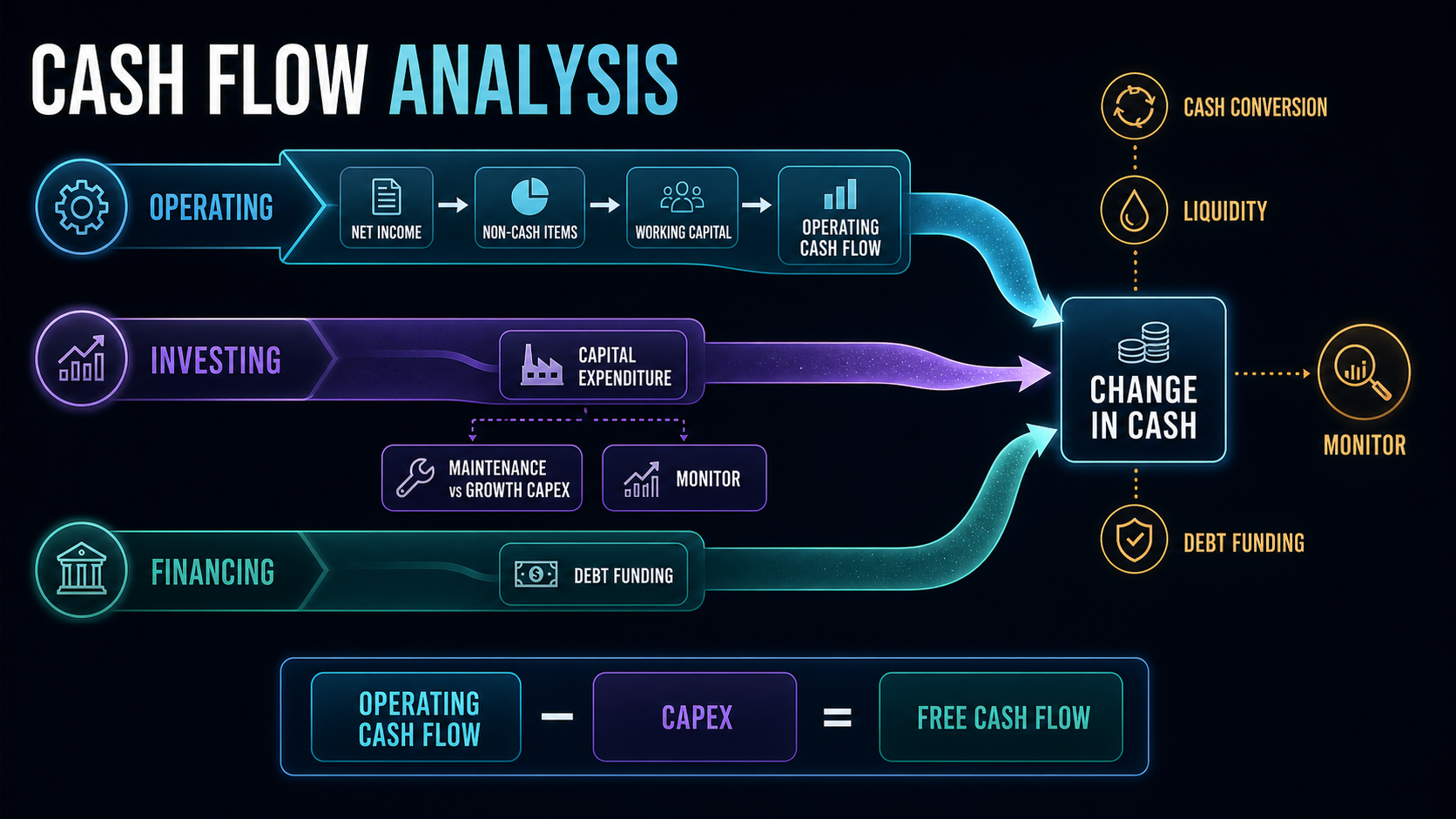
What cash flow analysis reveals现金流分析能够揭示什么
Cash flow analysis studies cash inflows, outflows, timing, sources, and uses across operating, investing, and financing activities. It tests liquidity, cash conversion, capital needs, funding dependence, and the sustainability of distributions or reinvestment.
现金流分析研究经营、投资和融资活动中的现金流入、流出、时点、来源与用途,用于检验流动性、现金转化、资本需求、融资依赖,以及分配或再投资能否持续。
A profitable company can consume cash while receivables or inventory grow. A loss-making company can temporarily generate cash through working-capital release or asset sales. Financing can increase the cash balance without proving the business generates cash. Analysis therefore asks why cash changed, not merely whether it increased.
盈利公司可能因应收或存货增长而消耗现金;亏损公司也可能通过释放营运资本或出售资产暂时产生现金;融资会提高现金余额,却不能证明主营业务具备现金创造能力。因此应追问现金为什么变化,而不只是现金是否增加。
Statement identity报表恒等关系
Operating cash flow
+ Investing cash flow
+ Financing cash flow
+ FX / other effects
= Change in cash
The ending balance must also reconcile with cash and cash equivalents on the balance sheet, subject to the reporting definition.
期末余额还应与资产负债表中的现金及现金等价物勾稽,但需注意报告口径。
Read the three cash flow statement sections读懂现金流量表的三类活动
The SEC’s financial-statement guide organizes cash flows into operating, investing, and financing activities. Classification rules differ in some respects across accounting frameworks, so verify policy and keep peer comparisons consistent.
SEC财务报表指南将现金流分为经营、投资和融资活动。不同会计准则的分类规则在部分项目上存在差异,因此必须核实政策并保持同行比较口径一致。
Core business cash主营业务现金
Cash generated or used by principal operations, often reconciled from net income under the indirect method.
主营经营活动产生或使用的现金,间接法通常从净利润开始勾稽。
- Non-cash charges and gains
- Receivables, inventory, and payables
- Taxes, interest, and other operating items
- 非现金费用与收益
- 应收、存货与应付
- 税、利息及其他经营项目
Long-term resource moves长期资源变动
Purchases and sales of long-lived assets, investments, and businesses reveal reinvestment and portfolio choices.
长期资产、投资与业务的购买和出售,反映再投资及资产组合选择。
- Capital expenditure and asset sales
- Acquisitions and divestitures
- Investment purchases and maturities
- 资本开支与资产出售
- 收购与处置
- 投资购买与到期
Capital-provider cash资本提供者现金
Transactions with lenders and shareholders show how operations and investment are funded or cash is returned.
与债权人和股东的交易说明经营与投资如何获得资金,以及现金如何返还。
- Borrowing and repayment
- Share issuance and repurchase
- Dividends and related distributions
- 借款与偿还
- 发股与回购
- 股息及相关分配
Reconcile net income to operating cash flow把净利润勾稽到经营现金流
Under the indirect method, operating cash flow begins with net income, reverses non-cash items, removes investing or financing gains and losses, and adjusts for operating assets and liabilities. A gap between earnings and cash is not automatically good or bad; its source, persistence, and business context matter.
间接法从净利润出发,调整非现金项目,剔除属于投资或融资活动的损益,再调整经营性资产和负债。盈利与现金存在差异不自动代表好坏,关键是差异来源、持续时间及业务语境。
Accounting profit会计利润
- Revenue and expense recognition
- Depreciation, amortization, impairment
- Provisions, deferred tax, equity compensation
- Gains or losses on investing activities
- 收入与费用确认
- 折旧、摊销与减值
- 准备、递延税与股权薪酬
- 投资活动产生的损益
Operating cash经营现金
- Collections versus receivable growth
- Inventory purchases and turnover
- Supplier terms and payable movement
- Contract balances and other accruals
- 回款与应收增长
- 存货采购与周转
- 供应商账期与应付变化
- 合同余额与其他应计项目
| Movement变动 | Typical cash effect典型现金影响 | Question to ask需要追问 |
|---|---|---|
| Receivables rise应收上升 | Uses operating cash占用经营现金 | Growth, timing, mix, terms, or collection pressure?来自增长、时点、结构、账期还是回款压力? |
| Inventory rises存货上升 | Uses operating cash占用经营现金 | Planned build, inflation, bottleneck, or slowing demand?是计划备货、通胀、瓶颈还是需求放缓? |
| Payables rise应付上升 | Provides operating cash提供经营现金 | Normal growth, better terms, or stretched suppliers?是正常增长、账期改善还是拖延供应商付款? |
| Deferred revenue rises递延收入上升 | Often provides cash before revenue通常在确认收入前提供现金 | Contract duration, refund risk, and future delivery obligation?合同期限、退款风险与未来履约义务如何? |
Define free cash flow before using it使用自由现金流前先明确口径
A common simple proxy is operating cash flow minus capital expenditure. OpenStax describes this formulation in its operating and free cash flow guide. But “free cash flow” is not a single universal GAAP or IFRS line item. FCFF, FCFE, company-defined adjusted FCF, and a simple CFO-minus-capex proxy can differ materially.
常见简化口径是经营现金流减资本开支,OpenStax的经营现金流与自由现金流指南也介绍了该形式。但“自由现金流”并非统一的GAAP或IFRS报表项目;FCFF、FCFE、公司调整口径及CFO减资本开支可能存在重大差异。
Simple FCF proxy简化FCF
Useful for a transparent first pass, subject to capex classification.
适合透明的初步分析,但受资本开支分类影响。
Operating cash flow − Capital expenditureFCFF企业自由现金流
Cash available to debt and equity capital after operating reinvestment.
完成经营再投资后,可供债权和股权资本使用的现金。
After-tax operating cash − reinvestmentFCFE股权自由现金流
Cash available to equity holders after debt flows and required reinvestment.
考虑债务流和必要再投资后,可供股东使用的现金。
FCFF − after-tax interest + net borrowingAlways document whether capex is gross or net of asset sales, whether acquisitions are included, and whether stock-based compensation or lease payments are adjusted.
必须记录资本开支是总额还是扣除资产出售、是否纳入收购,以及是否调整股权薪酬或租赁付款。
Evaluate cash flow quality in context结合语境评估现金流质量
CFA Institute’s material on financial-report quality highlights differences between net income and operating cash flow, accounting policies, risk disclosures, and classification. Signals should trigger investigation, not unsupported accusations.
CFA Institute关于财务报告质量的资料强调净利润与经营现金流差异、会计政策、风险披露及分类。信号应触发调查,而不是支持未经证实的指控。
Evidence of resilient cash generation现金创造较有韧性的证据
- Operating cash tracks normalized earnings over a cycle
- Working-capital swings have operational explanations
- Maintenance needs are covered before distributions
- Funding and maturity profiles match investment duration
- 经营现金在完整周期内与规范后盈利大致匹配
- 营运资本波动有经营解释
- 先覆盖维持性投入再进行分配
- 融资与到期结构匹配投资期限
Cash flow red flags to investigate需要调查的现金流红旗
- Persistent cash below earnings without a growth explanation
- Receivables or inventory repeatedly outrun sales
- Operating cash supported by stretched payables or classification shifts
- Buybacks or dividends depend on new debt or asset sales
- 现金长期低于盈利且无法由增长解释
- 应收或存货反复快于销售增长
- 经营现金依赖拖延应付或分类变更
- 回购或股息依赖新增债务或出售资产
Stress-test the timing of cash, not only annual totals压力测试现金时点,而不只看全年总额
Annual positive cash flow can hide a short-term funding gap. Map opening liquidity, committed facilities, minimum operating cash, seasonal working capital, taxes, interest, debt maturities, capex, dividends, and plausible downside scenarios by month or quarter.
全年现金流为正也可能掩盖短期资金缺口。应按月或季度绘制期初流动性、已承诺额度、最低经营现金、季节性营运资本、税、利息、债务到期、资本开支、股息及合理下行情景。
Slower receivable days and customer concentration.
应收天数变慢与客户集中度。
Demand shock, obsolescence, and purchase commitments.
需求冲击、过时与采购承诺。
Maturities, covenants, rates, collateral, and access.
到期、契约、利率、抵押与可获得性。
Which capex, acquisition, dividend, or buyback can move?
哪些资本开支、收购、股息或回购可以调整?
How to perform cash flow analysis step by step如何逐步完成现金流分析
Verify scope and source核实范围与来源
Record period, currency, accounting framework, filing version, cash definition, and restatements.
记录期间、币种、会计准则、公告版本、现金定义与重述。
Map CFO, CFI, and CFF拆分CFO、CFI与CFF
Identify recurring operations, reinvestment, asset transactions, borrowing, repayment, and distributions.
识别经常性经营、再投资、资产交易、借还款与分配。
Reconcile earnings to cash勾稽盈利与现金
Explain non-cash items, working capital, taxes, interest, gains, losses, and classifications.
解释非现金项目、营运资本、税、利息、损益与分类。
Define FCF consistently统一FCF定义
Document capex, acquisitions, leases, stock compensation, and debt treatment before comparison.
比较前记录资本开支、收购、租赁、股权薪酬与债务处理。
Compare trend and peers比较趋势与同行
Use multiple periods and peer definitions; explain seasonality and business-model differences.
使用多个期间和同行口径,并解释季节性及商业模式差异。
Stress and monitor压力测试与监控
Track conversion, liquidity runway, maturities, covenants, capex, and revision triggers.
追踪现金转化、流动性期限、到期、契约、资本开支与修订触发器。
Use cash flow data with lineage and definitions使用现金流数据时保留来源与口径
Authorized data access已授权的数据访问
QVeris can help AI workflows discover and call authorized tools. Where the user’s plan and license permit, FMP can provide cash flow statements, other financial statements, company data, and related endpoints. Confirm current fields and availability in the FMP developer documentation.
QVeris可帮助AI工作流发现并调用已授权工具;在用户套餐和许可允许时,FMP可提供现金流量表、其他财务报表、公司数据及相关端点。当前字段和可用性应以FMP开发者文档为准。
Analyst responsibility分析者责任
APIs do not determine whether a classification is comparable, capex is maintenance or growth, a working-capital swing is temporary, or funding is sustainable. Preserve source URL, filing period, units, signs, definitions, adjustments, and human review.
API不能自动判断分类是否可比、资本开支属于维持还是增长、营运资本波动是否暂时,或融资能否持续。必须保留来源URL、报告期、单位、正负号、定义、调整与人工复核。
For broader cross-statement work, continue to the QVeris financial statement analysis guide. For profit differences, see EBITDA vs net income.
如需更广泛的跨报表分析,请阅读QVeris财务报表分析指南;如需理解利润口径差异,请阅读EBITDA与净利润。
Cash flow analysis questions现金流分析常见问题
What is cash flow analysis in simple terms?简单来说,什么是现金流分析?
It explains where cash came from, where it went, why it changed, and whether operations can support reinvestment, obligations, and distributions.
它解释现金从哪里来、流向哪里、为什么变化,以及经营能否支撑再投资、义务与分配。
What are the three types of cash flow?现金流的三种类型是什么?
Operating activities relate to core operations, investing activities to long-term assets and investments, and financing activities to debt and equity capital providers.
经营活动对应主营业务,投资活动对应长期资产和投资,融资活动对应债务与股权资本提供者。
Why is operating cash flow different from net income?为什么经营现金流与净利润不同?
Accrual accounting, non-cash charges, gains and losses, taxes, and working-capital timing create differences. The indirect method reconciles them.
权责发生制、非现金费用、损益、税项和营运资本时点都会造成差异,间接法负责勾稽。
How do you calculate free cash flow?如何计算自由现金流?
A common simple proxy is operating cash flow minus capital expenditure, but FCFF, FCFE, and company-adjusted definitions differ. State the definition before comparing.
常见简化口径是经营现金流减资本开支,但FCFF、FCFE与公司调整口径不同,比较前必须说明定义。
Is negative investing cash flow bad?投资现金流为负一定不好吗?
No. It may reflect productive capex or acquisitions, but it can also reflect poor allocation. Assess expected economics, maintenance needs, funding, and execution.
不一定。它可能来自有生产力的资本开支或收购,也可能反映配置不佳,应评估预期经济性、维持需求、资金和执行。
What are common cash flow red flags?常见现金流红旗有哪些?
Persistent cash below earnings, receivables or inventory outrunning sales, stretched payables, classification shifts, repeated asset sales, and distributions funded by new debt merit investigation.
现金长期低于盈利、应收或存货快于销售、拖延应付、分类变化、反复出售资产,以及用新债支持分配,都值得调查。