
What financial statement analysis is for财务报表分析要解决什么问题
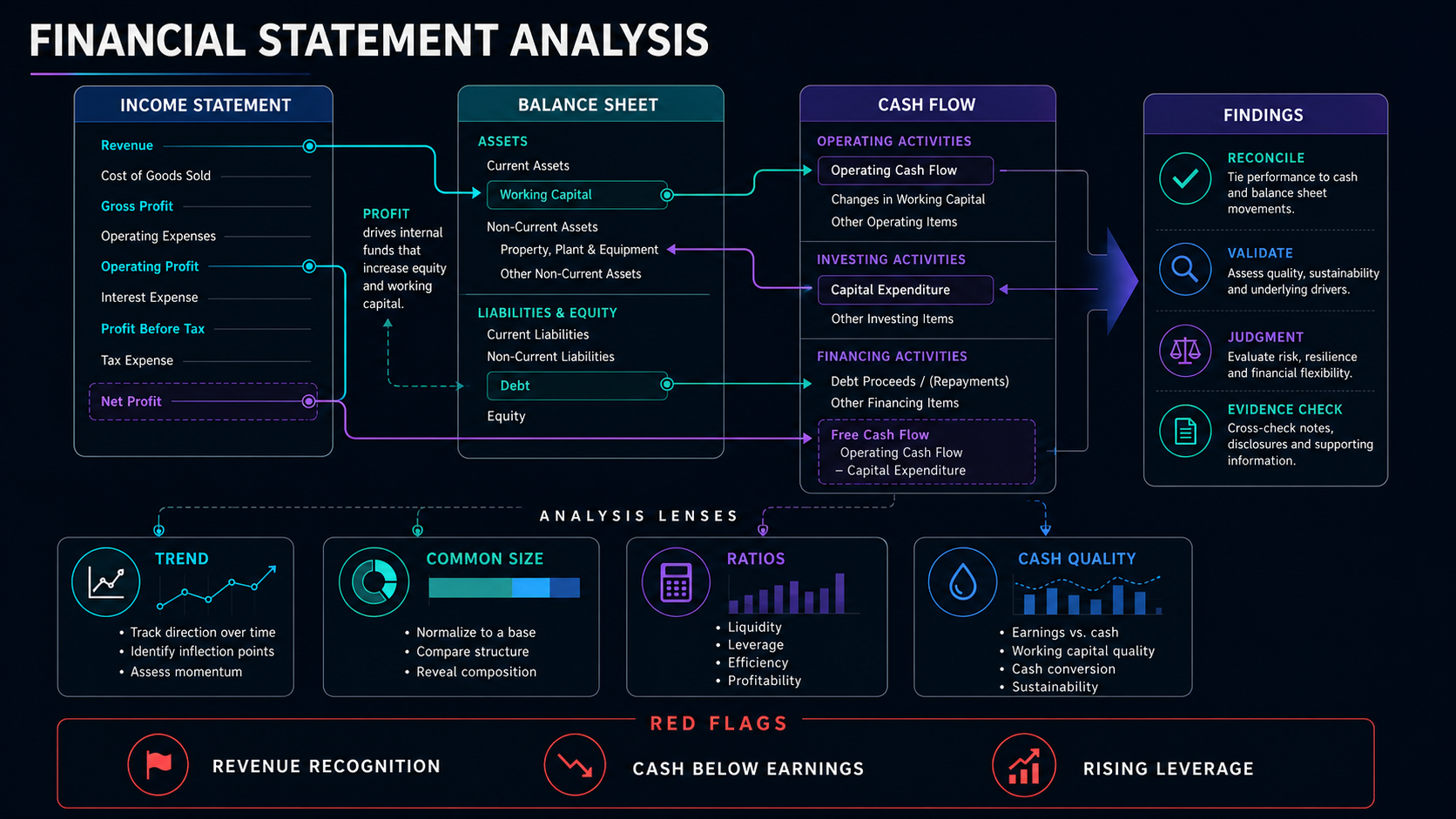
Financial statement analysis evaluates performance, financial position, cash generation, and reporting quality by connecting the income statement, balance sheet, cash flow statement, equity statement, notes, and management discussion. The goal is to explain changes and their durability—not merely calculate ratios.
财务报表分析通过连接利润表、资产负债表、现金流量表、权益变动表、附注与管理层讨论,评估经营表现、财务位置、现金创造与报告质量。目标是解释变化为什么发生、能否持续,而不只是计算比率。
Did operations improve?经营是否改善?
Separate price, volume, mix, cost, and one-off effects.
拆分价格、销量、结构、成本与一次性影响。
Can the company absorb stress?公司能否承受压力?
Review liquidity, working capital, leverage, maturities, and commitments.
检查流动性、营运资本、杠杆、到期与承诺。
Do earnings convert to cash?盈利是否转化为现金?
Reconcile net income, operating cash flow, capex, and financing.
勾稽净利润、经营现金流、资本开支与融资。
Read each statement, then test the connections先读单表,再检查报表之间的连接
The statements use different clocks. The balance sheet is a point-in-time position; the income and cash flow statements cover a period. Comparing a flow with a closing balance without using an average or matching period can distort ratios. The SEC financial statements guide also emphasizes footnotes and MD&A as essential context.
三张报表使用不同的“时钟”:资产负债表反映时点,利润表与现金流量表反映期间。若把期间流量直接与期末余额比较而不使用平均数或匹配期间,比率可能失真。SEC财务报表指南也强调附注和管理层讨论是必要语境。
Income statement利润表
How did revenue become operating and net income?
Tie margins to volume, pricing, mix, costs, interest, and tax.
Treating nonrecurring gains or capitalization choices as recurring operations.
收入如何转化为营业利润与净利润?
把利润率与销量、价格、结构、成本、利息和税项连接。
把非经常性收益或资本化选择当作持续经营表现。
Balance sheet资产负债表
What resources and obligations exist at period end?
Trace growth into receivables, inventory, fixed assets, debt, and equity.
Ignoring maturities, leases, goodwill, contingencies, or off-balance commitments.
期末有哪些资源、义务与融资来源?
把增长追踪到应收、存货、固定资产、债务与权益。
忽略到期结构、租赁、商誉、或有事项与表外承诺。
Cash flow statement现金流量表
Where did cash come from and where did it go?
Reconcile net income to operating cash and distinguish capex from financing.
Assuming all operating cash is freely distributable or all capex is optional.
现金从哪里来、流向哪里?
把净利润勾稽到经营现金流,并区分资本开支与融资。
假设所有经营现金都可自由分配,或所有资本开支都可取消。
Four financial statement analysis techniques四种财务报表分析方法
Use techniques together. Horizontal and vertical analysis identify where to investigate; ratios summarize relationships; cash-flow analysis tests whether reported results are funded and repeatable. A result is meaningful only after definitions, periods, currencies, and peer groups are aligned.
这些方法应结合使用。横向与纵向分析帮助定位问题,比率概括数字关系,现金流分析检验报告结果是否有资金支撑、能否重复。只有统一口径、期间、币种与同行组后,结论才有可比性。
Horizontal analysis横向分析
Compare the same line across periods using absolute and percentage changes. Investigate base effects, acquisitions, disposals, accounting changes, and restatements.
以金额和百分比比较同一项目的跨期变化,同时检查基数效应、并购、处置、会计变更与重述。
Vertical or common-size analysis纵向或共同比分析
Express income-statement items as a share of revenue and balance-sheet items as a share of assets. Compare composition across periods and differently sized peers.
把利润表项目表示为收入占比,把资产负债表项目表示为资产占比,以比较不同时期和不同规模公司的结构。
Ratio analysis比率分析
Group metrics by growth, profitability, efficiency, liquidity, leverage, and coverage. Use consistent definitions and explain the operating driver behind each movement.
按增长、盈利、效率、流动性、杠杆与偿付能力组织指标,保持口径一致,并解释每项变化背后的经营驱动。
Cash flow and quality analysis现金流与质量分析
Reconcile profit to operating cash, inspect working-capital movements, classify recurring capex, and identify reliance on borrowing, equity issuance, or asset sales.
把利润勾稽到经营现金,检查营运资本变化,识别经常性资本开支,并判断对借款、发股或出售资产的依赖。
The narrower QVeris pages on horizontal vs vertical analysis and financial ratio analysis provide deeper treatment without duplicating this cross-statement workflow.
Reconcile earnings with cash and the balance sheet把盈利与现金及资产负债表勾稽起来
The most informative analysis often sits between statements. Revenue growth accompanied by faster receivable growth may reflect payment terms, mix, seasonality, or collection pressure. Profit growth with weak operating cash may reflect working capital, non-cash income, capitalization, or classification—not automatically manipulation, but always a question to investigate.
最有价值的分析往往发生在报表之间。收入增长但应收增长更快,可能来自付款条件、客户结构、季节性或回款压力;利润增长但经营现金偏弱,可能来自营运资本、非现金收益、资本化或分类。它不自动等于操纵,但必须进一步调查。
Reported earnings报告盈利
- Revenue recognition and contract terms
- Capitalized versus expensed costs
- Provisions, impairments, and one-offs
- Tax, interest, minority, and share-count effects
- 收入确认与合同条款
- 资本化成本与费用化成本
- 准备、减值与一次性项目
- 税、利息、少数股东与股本影响
Cash and position现金与财务位置
- Receivables, inventory, payables, and contract balances
- Operating cash conversion and capex needs
- Debt proceeds, repayments, dividends, and buybacks
- Liquidity, maturity ladder, and covenant headroom
- 应收、存货、应付与合同余额
- 经营现金转化与资本开支需求
- 举债、还款、股息与回购
- 流动性、到期阶梯与契约空间
Test earnings quality without jumping to accusations检验盈利质量,但不要轻率下结论
CFA Institute’s current material on evaluating financial-report quality highlights accounting-policy comparisons, period changes, ratios, cash-versus-income differences, risk disclosures, compensation, and insider transactions. These are investigation signals, not standalone proof of poor reporting.
CFA Institute当前关于财务报告质量评估的资料强调:比较会计政策与期间变化,检查比率、现金与利润差异、风险披露、薪酬及内部人交易。这些只是调查信号,不能单独证明报告质量有问题。
Unusual revenue timing, relaxed estimates, repeated “one-offs,” or policy differences from peers.
异常收入时点、放宽估计、反复出现的“一次性”项目或与同行不同的政策。
Persistent cash below earnings, receivables or inventory outrunning sales, and supplier financing effects.
现金长期低于盈利,应收或存货增速持续快于销售,以及供应商融资影响。
Rising leverage, short maturities, weak coverage, covenant pressure, guarantees, or large impairments.
杠杆上升、短期到期集中、偿付覆盖变弱、契约压力、担保或重大减值。
How to analyze financial statements step by step如何逐步完成财务报表分析
Define the decision and period定义决策与期间
Set the company, reporting basis, currency, horizon, peer group, and question before collecting metrics.
先确定公司、报告准则、币种、期限、同行组与研究问题。
Verify source and version核实来源与版本
Use filings and notes; record filing date, accession or URL, amendments, restatements, and units.
使用公告与附注,记录提交日、编号或URL、修订、重述与单位。
Normalize the dataset规范数据集
Align fiscal periods, currencies, signs, share basis, segment definitions, and unusual items.
统一财年、币种、正负号、股本、分部定义与异常项目。
Run trend and structure tests执行趋势与结构测试
Apply horizontal, common-size, and ratio analysis; flag material deltas for explanation.
使用横向、共同比与比率分析,标记需要解释的重大变化。
Reconcile the statements勾稽三张报表
Trace net income to cash, working capital to operations, capex to assets, and financing to debt and equity.
把净利润追踪到现金,把营运资本追踪到经营,把资本开支追踪到资产,把融资追踪到债务和权益。
Write findings with evidence用证据写结论
Separate facts, calculations, interpretations, risks, unanswered questions, and monitoring signals.
区分事实、计算、解释、风险、未决问题与监控信号。
Use data tools without losing source discipline使用数据工具,但不能丢失来源纪律
What the workflow can automate工作流可自动化什么
QVeris can help an AI workflow discover and invoke authorized tools. Where plan and license allow, FMP can supply statements, company profiles, ratios, and related reference data through documented endpoints. Check the current FMP developer documentation for field definitions and availability.
QVeris可帮助AI工作流发现并调用已授权工具;在套餐和许可允许时,FMP可通过文档化端点提供报表、公司资料、比率及相关参考数据。字段定义和可用性应查阅最新FMP开发者文档。
What analysts still own分析者仍需负责什么
Automation does not guarantee comparable definitions, resolve every restatement, explain management estimates, or prove causality. Preserve source lineage, validate signs and units, document adjustments, review filings and footnotes, and keep human approval for judgments.
自动化不能保证所有定义可比,不能处理全部重述,也不能解释管理层估计或证明因果。必须保留来源链路,验证正负号和单位,记录调整,复核公告与附注,并对判断保留人工审批。
Financial statement analysis questions财务报表分析常见问题
What are the main methods of financial statement analysis?财务报表分析的主要方法有哪些?
Horizontal analysis, vertical or common-size analysis, ratio analysis, and cash-flow or quality analysis are the core methods. They work best together.
核心方法包括横向分析、纵向或共同比分析、比率分析以及现金流或质量分析,组合使用效果更好。
Which statement should I analyze first?应该先分析哪张报表?
There is no universal order. Start with the business question, then scan all three statements before drilling into the statement most relevant to the issue.
没有统一顺序。先明确业务问题,再快速浏览三张报表,然后深入与问题最相关的报表。
Why can profit rise while operating cash falls?为什么利润上升但经营现金下降?
Working-capital use, non-cash gains, revenue timing, capitalization, tax, and classification can create the gap. Reconcile the cash-flow adjustments and balance-sheet movements.
营运资本占用、非现金收益、收入确认时点、资本化、税项与分类都可能造成差异,应勾稽现金流调整和资产负债表变化。
What is a common-size financial statement?什么是共同比财务报表?
It expresses each line as a percentage of a base, typically revenue for the income statement and total assets for the balance sheet, to compare structure.
它把各项目表示为基准项目的百分比,利润表通常以收入为基准,资产负债表通常以总资产为基准,用于比较结构。
What are financial statement red flags?财务报表有哪些红旗信号?
Examples include unusual recognition, repeated one-offs, weak cash conversion, working-capital divergence, rising leverage, short maturities, policy changes, and unclear disclosures. Each requires context.
例如异常确认、反复的一次性项目、现金转化偏弱、营运资本背离、杠杆上升、短期到期、政策变更与披露不清,但都必须结合语境调查。
Can software complete financial statement analysis?软件能否完成财务报表分析?
Software can collect, normalize, calculate, compare, and flag. It cannot reliably replace source review, accounting judgment, business context, causality assessment, or decision accountability.
软件可以收集、规范、计算、比较和标记,但不能可靠替代来源复核、会计判断、业务语境、因果评估与决策责任。