
The answer will appear here
Choose models and send one question below.The answer will appear here
Choose models and send one question below.Model comparison
Model capability positioning
These task suggestions are editorial starting points. Specifications and prices describe QVeris’s November 11 public catalog; benchmark rows retain their original settings.
| Model | Official capability and evidence | Suggested first task | Usage boundary |
|---|---|---|---|
| Claude Fable 5.2 | Difficult reasoning and long-horizon work. Documentation | Review a complex SQL join or break a migration into verifiable steps. | Always-on thinking. This page supplies no execution tools. |
| Gemini 4 Carbon | Google’s latest publicly available frontier model (November 10): extended coding, research and knowledge work. Release | Audit a multi-step debugging plan or reconcile structured financial tables. | Official agent demos include tools and repeated verification; this page is text-only. |
| GPT-6.1 Sol | OpenAI positions Sol for complex coding, computer use and professional work. Documentation | Review the same SQL aggregation or implement a small, testable feature. | Native tool calling requires Responses API; a text reply is not a completed agent task. |
| Kimi K3.1 Pro | Moonshot’s release covers coding, 3D creation and financial research. Technical blog | Try Chinese source synthesis or a parametric modeling plan. | This is Pro, not Highspeed. Tool-assisted demos require their own runtime. |
Model specifications on QVeris
| Model | Context tokens | Max output tokens | Catalog inputs |
|---|---|---|---|
| Claude Fable 5.2 | 1,000,000 | 128,000 | file, image, text |
| Gemini 4 Carbon | 1,048,576 | 943,718 | image, text |
| GPT-6.1 Sol | 1,050,000 | 128,000 | image, text |
| Kimi K3.1 Pro | 1,048,576 | 1,048,576 | image, text |
Catalog limits are serving limits, not a guarantee that maximum input and output fit together. File input is not enabled in this article’s composer.
Pricing and transparent usage math
| Model | Input tier starts | Input Credits / M | Output Credits / M | Cache-read Credits / M |
|---|---|---|---|---|
| Claude Fable 5.2 | 0+ | 4,200 | 21,000 | 105 |
| Gemini 4 Carbon | 0+ | 1,050 | 5,250 | 52.5 |
| GPT-6.1 Sol | 0+ | 1,050 | 5,250 | 52.5 |
| GPT-6.1 Sol | 272000+ | 2,100 | 7,875 | 105 |
| Kimi K3.1 Pro | 0+ | 1,015.9275 | 5,314.1025 | 101.5875 |
Public QVeris prices checked November 11, 2026. The table preserves every published token-price tier; GPT-6.1 Sol has a second tier starting at 272,000 input tokens. No separate request fee is listed. The public catalog does not expose cache-write rates; check request-specific billing before relying on them. Live catalog
For 1,000 uncached input and 200 output tokens: cost = (input tokens × input rate + output tokens × output rate) / 1,000,000. Fable 5.2: 8.40 Credits; Gemini 4 Carbon: 2.10; GPT-6.1 Sol: 2.10; Kimi K3.1 Pro: about 2.079. This fixed-use example is not a measured bill; reasoning and longer output change usage.
Anthropic standard USD / million tokens: $8 input, $40 output, $0.20 cache read; cache writes $10 (5m) / $16 (1h). Fast mode is separately priced at $16 / $80. These vendor prices are separate from Credits; this page does not imply QVeris exposes fast mode. Official prices
Model strengths and official evaluations
Released on November 9, 2026, Claude Fable 5.2 targets difficult reasoning and extended agent work. Anthropic positions Opus 5.5 as the everyday starting point; Fable is an option when the task demands more. Official release
QVeris lists the exact model claude-fable-5-2. Its public entry supports text, images and files as input, with text output. The inline trial is text-only; it does not execute code or operate a browser.
The native model has a 1M context and 128K output limit. Adaptive thinking is always on; the native API defaults to high effort. A short page trial is not equivalent to an hours-long agent run. Model documentation
From the original release: what improved
| Evaluation | Fable 5.1 | Fable 5.2 | Difference / setting |
|---|---|---|---|
| FrontierCode 2.0 | 32.4% | 49.1% | +16.7 pp · Xhigh effort |
| FrontierSWE v2 | 56.3% | 69.9% | +13.6 pp · Highest available effort unless noted |
| Chartography · no tools | 44.8% | 73.4% | +28.6 pp · No tools; chart recognition |
Higher is better in these vendor-reported tests. They do not establish a universal win rate or predict this page’s short answers.
Official robotics evaluation: RoboDojo Sim
RoboDojo Sim tests whether a model can control a simulated two-arm robot from camera images. It probes visual understanding and action control together. Anthropic ran the models in the same harness at their highest available effort levels.
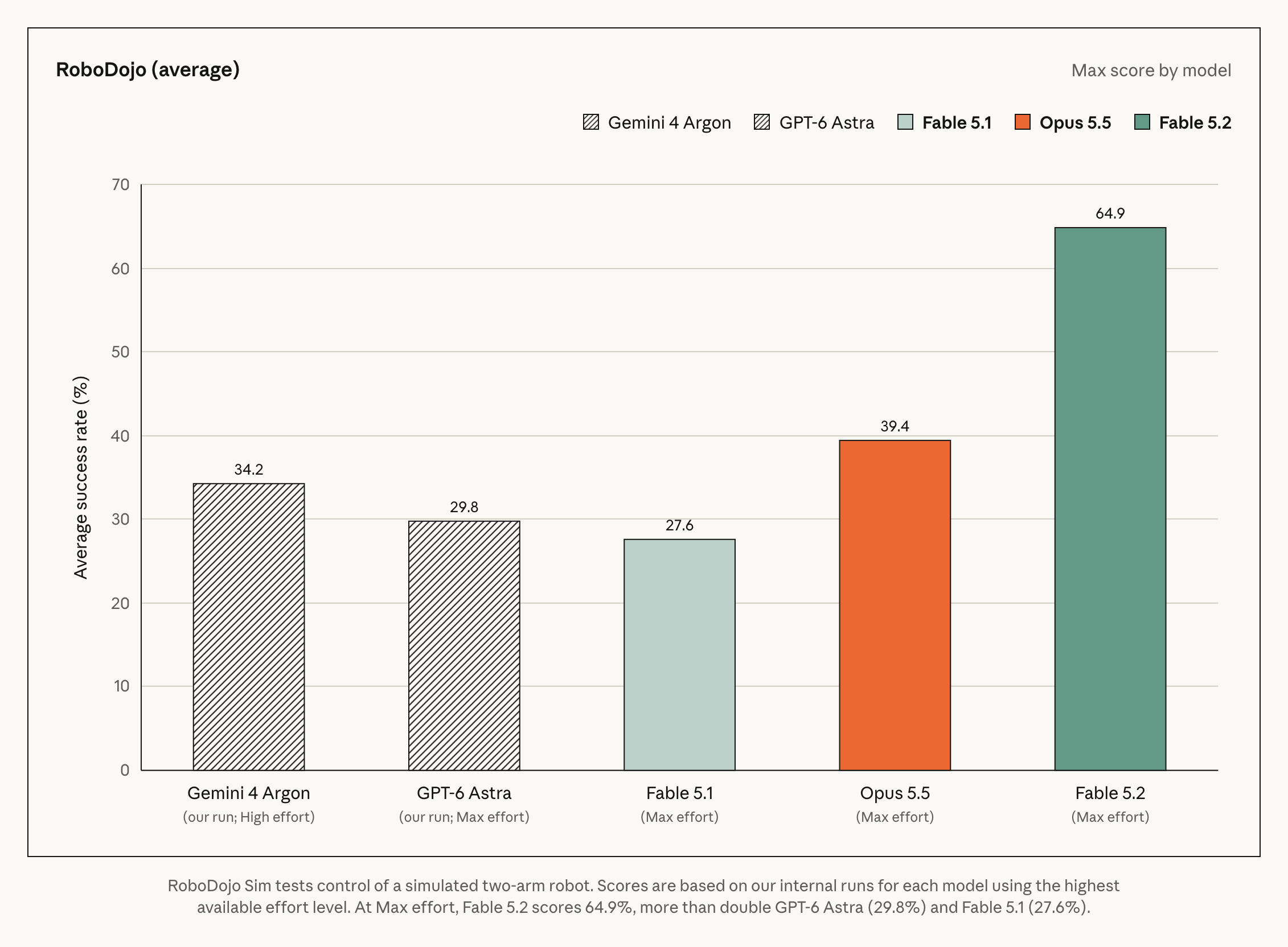
RoboDojo average success rate (%) · highest score per model. Source: Anthropic official release. Open the chart to inspect the full-size original.
Fable 5.2 scores 64.9%, compared with Opus 5.5 at 39.4%, Gemini 4 Argon at 34.2%, GPT-6 Astra at 29.8%, and Fable 5.1 at 27.6%. The gaps are 25.5 percentage points versus Opus 5.5 and 37.3 points versus Fable 5.1.
The chart uses High effort for Gemini 4 Argon and Max for the other four models. These are vendor-reported simulation results, not QVeris reruns or a general real-world robot success rate. Argon and Astra are different models from the Carbon and Sol options above.
Independent measurements: capability and cost
| Source / setting | Observed result | Interpretation |
|---|---|---|
| Artificial Analysis · v5.0.1 · Max / Default Fallback | Index 65; $26.54 per index task; 44.4 minutes per task. | Nine-evaluation aggregate, not 65% accuracy. These costs are not QVeris charges. Sample count is not stated in the summary. |
| Ultralytics · UL37 v2 | 360 images / 36 datasets; Fable 5.2 mAP50 0.544 vs Fable 5.1 0.427. | Default effort, production annotation pipeline plus SAM 3.1 refinement. Different from text-only reasoning tests. |
Real tests: official cases and X users
The following are source-reported tests, checked November 11. Official customer examples, independent measurements and X demonstrations are labelled separately. Dollar estimates are not QVeris bills.
Official customer test: SQL correctness
Oracle’s Liyu Gong tested a query joining country debt summaries, repayment history and regional benchmarks. The comparison asks whether the business totals are correct, beyond whether the SQL runs.
| Comparison | Claude Fable 5.2 | Two unnamed models |
|---|---|---|
| Query execution | Returned a result | Ran successfully |
| Business totals | Matched the expected result | Overcounted totals by 5–8× |
| Reported outcome | Correct business result in this task | Runnable SQL produced incorrect totals |
The original statement does not publish the full prompt, comparator identities or sample count; it is not a general success-rate ranking. Read the original customer statement
Community tests: inspect the actual trade-offs
| Task / input | Fable 5.2 result | Comparator result | Difference / judgment | View |
|---|---|---|---|---|
| Voxel film-opening recreation | Fable 5.2 Extra: 29 min; $56.89 API-equivalent. | GPT-6.1 Sol xhigh: 3h26m; $12.02. | Same reference video; faster, about 4.7× the cost. Title edges and exposed set boundaries remain. No objective score. | Results / demo @thehypedotnews Test report |
| Three.js monster bedroom | First pass: 1h32m; $27.50 API-equivalent. | Fable 5.1: 1h14m; $28.03. | Shared room brief, different monster requirements. 5.2 is slower here; an arm pose remains awkward. Not identical inputs. | Results / demo @thehypedotnews |
| 3D seaplane · Claude Code | Low: Lumina 3D index 1,100; High: 1,115. The X clip is Low. | Opus 5.5 xHigh: 1,097 in the author’s index. | Author prefers the scene’s aircraft, water and controls. Settings differ; index points are not success rates. | Results / demo @LuminaBench Test report |
| Security X-ray annotation · 10 images | Fable 5.2 refused all 10. | Fable 5.1 refused one; Opus 5.5 answered all ten. | Ultralytics reran native API requests. This is an availability failure in that dataset, not a universal vision score. | Results / demo Glenn Jocher Test report |
Use these cases to choose acceptance checks: business totals for SQL, completion time and cost for agent work, visual defects for 3D output, and refusal handling for image pipelines. Complete original prompts are not available for every case.
Usage notes and FAQ
Choose two models and send the same text. Five complete tasks ask for runnable SQL with checks, an async search fix with regression tests, an interactive 3D seaplane, an auditable financial report, and a playable bedroom animation. Each includes inputs and acceptance criteria. Generated code and reports require execution or review; this page does not award automatic correctness scores for them. For the creative cases below, compare planning and code explanations here, then validate full projects in a separate execution environment.
Use the Agent comparison prompt
Click “Let an Agent compare models” at the top, then paste into your agent. The prompt includes a runnable SQL fixture and an optional 3D task, with source links, acceptance checks and cost reporting. Copying it requires no login and sends no model request. The fixtures are editorial adaptations, not the original customers’ unpublished prompts.
Is Fable always better than Opus?
No. Match the task, effort and budget. Token price alone does not predict the cost of a finished task.
How should I judge the page trial?
Check correctness before speed. Each side has a 3,072-output-token limit and no execution tools. Its results do not reproduce the original X projects.
Why can one side fail?
Availability, budget, output limits and upstream errors can differ. Preserve partial answers; an unverified model identity or incomplete response is not a zero score.
What changes in native API integration?
Adaptive thinking cannot be disabled. Omit temperature, top_p and top_k; forced tool choices any/tool are unsupported. Native documentation also specifies 30-day retention unless expressly authorized otherwise.
Sources and related guides
- Anthropic release and customer cases
- Fable 5.2 specifications and pricing
- Gemini 4 Carbon public release
- GPT-6.1 Sol documentation
- Opus 5.5 documentation
- Kimi K3.1 Pro technical release
- Artificial Analysis: Max / Default Fallback
- Ultralytics: UL37 annotation tests
- LuminaBench: creation tests and original outputs
- thehype: two Three.js comparisons
- Fable 5.2 on QVeris
- GPT-6.1 Terra
- Kimi K3.1 Pro