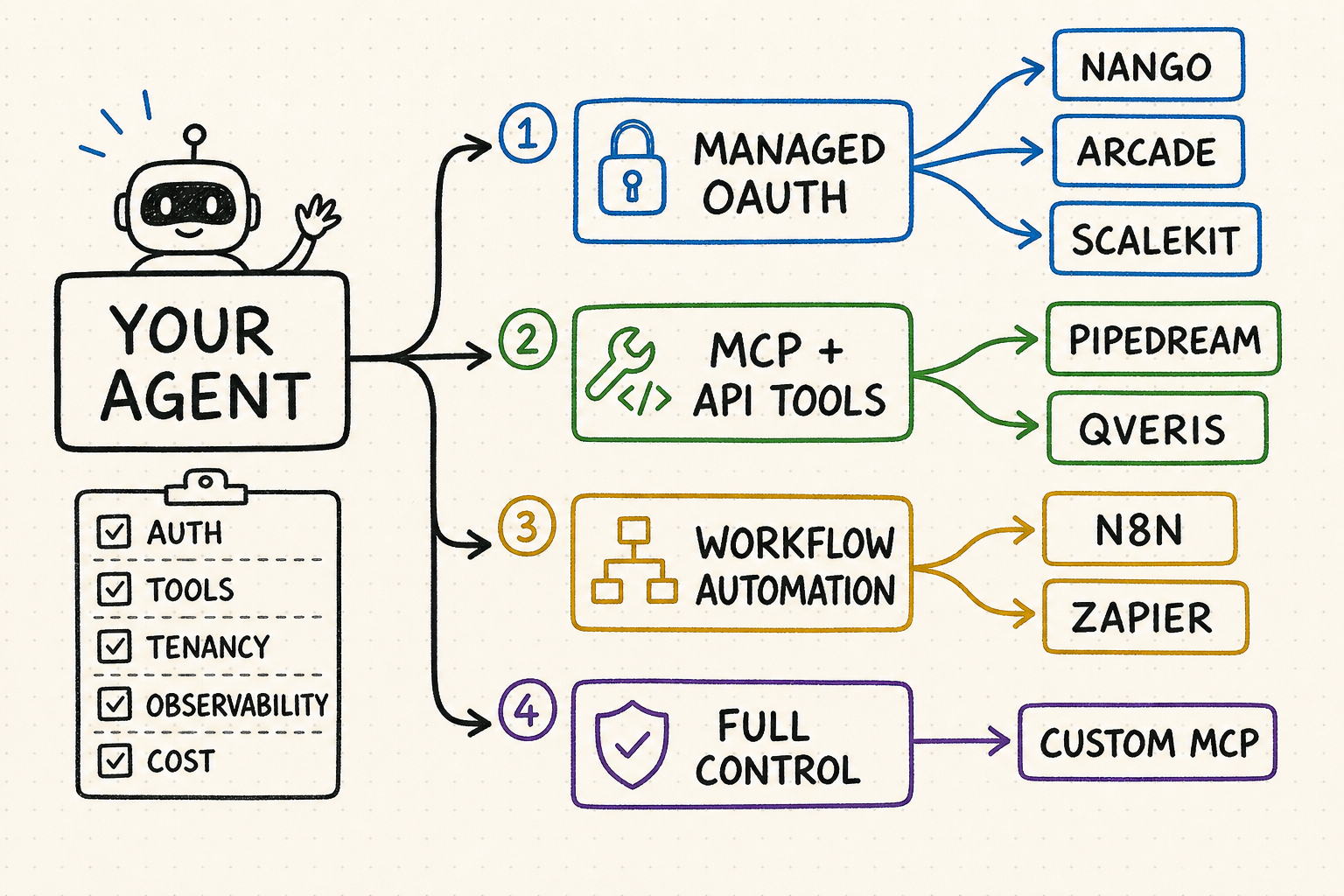
The closest Composio alternatives are Nango, Arcade, Scalekit and Pipedream Connect when the job is managed OAuth plus agent tool access. QVeris, n8n, Zapier MCP, Smithery, LangChain and custom MCP servers are useful alternatives for adjacent jobs such as capability routing, workflow automation, registry discovery or full infrastructure ownership. Start with the layer you are replacing—not the longest feature list.
如果你的核心需求是托管 OAuth 与 Agent 工具访问,最接近 Composio 的替代方案是 Nango、Arcade、Scalekit 和 Pipedream Connect。QVeris、n8n、Zapier MCP、Smithery、LangChain 与自建 MCP 服务器更适合能力路由、工作流自动化、注册发现或完全自主管理等相邻需求。正确的选择应从“你要替换哪一层”开始,而不是比较谁的功能列表最长。
Search results often place every “agent tool” product in one list, but these products solve different infrastructure problems. Composio combines connected accounts, authentication and executable toolkits. A fair comparison therefore separates direct integration alternatives from adjacent platforms. This guide evaluates both groups, explains the trade-offs, and includes a migration checklist for teams that already run Composio in production.
Data and public pricing were checked on July 27, 2026. Catalog sizes and plan limits change frequently; verify the linked vendor page before signing a contract.
搜索结果经常把所有“Agent 工具”产品放进同一份榜单,但它们解决的基础设施问题并不相同。Composio 把连接账户、身份认证与可执行工具包组合在一起,因此公平的比较必须区分直接集成替代方案与相邻能力平台。本文同时评估两类产品,解释真实取舍,并为已经在生产环境使用 Composio 的团队提供迁移清单。
本文于 2026 年 7 月 27 日核对了公开产品信息与价格。工具目录数量和套餐限制变化较快,采购前请以文中链接的厂商页面为准。
The “type” column matters most. A direct alternative can own connected accounts and authenticated actions; an adjacent alternative may still be excellent, but it replaces a different layer.
| Platform | Type | Best for | Auth / tenancy | MCP / tools | Deployment |
|---|---|---|---|---|---|
| Nango | Direct | OAuth, syncs and integration infrastructure | Managed connected accounts | Agent tools and MCP | Cloud or self-host path |
| Arcade | Direct | Secure agent actions and authorization | Agent-centric user auth | Tool execution and MCP | Managed platform |
| Scalekit | Direct | Enterprise-ready connected apps | Managed auth and tenant controls | 500+ connectors and agent tools | Managed platform |
| Pipedream | Direct / adjacent | Broad APIs, MCP and code workflows | Managed OAuth available | 3,000+ APIs, 10,000+ tools | Managed platform |
| QVeris | Adjacent | Capability discovery and provider routing | Platform/API authentication | MCP, CLI, SDK and REST | Managed network |
| Smithery | Adjacent | MCP server discovery and distribution | Varies by server | MCP-native registry | Registry / hosted services |
| n8n | Adjacent | Visual, stateful workflow automation | Workflow credentials | MCP client/server nodes | Cloud or self-host |
| Zapier MCP | Adjacent | No-code business app actions | Managed app connections | 8,000+ app ecosystem | Managed platform |
| LangChain | Build layer | Custom agent orchestration | You design it | Framework and adapters | Your infrastructure |
| Custom MCP | Build layer | Maximum security and control | You own it | You define every tool | VPC, on-prem or air-gapped |
表格中最重要的是“类型”。直接替代方案能够接管连接账户与授权操作;相邻替代方案也可能非常优秀,但它替换的是另一层能力。
| 平台 | 类型 | 最适合 | 认证 / 多租户 | MCP / 工具 | 部署方式 |
|---|---|---|---|---|---|
| Nango | 直接替代 | OAuth、数据同步与集成基础设施 | 托管连接账户 | Agent 工具与 MCP | 云端或自托管路径 |
| Arcade | 直接替代 | 安全的 Agent 操作与授权 | 面向 Agent 的用户认证 | 工具执行与 MCP | 托管平台 |
| Scalekit | 直接替代 | 企业级连接应用 | 托管认证与租户控制 | 500+ 连接器与 Agent 工具 | 托管平台 |
| Pipedream | 直接 / 相邻 | 广泛 API、MCP 与代码工作流 | 提供托管 OAuth | 3,000+ API、10,000+ 工具 | 托管平台 |
| QVeris | 相邻方案 | 能力发现与提供商路由 | 平台 / API 认证 | MCP、CLI、SDK、REST | 托管网络 |
| Smithery | 相邻方案 | MCP 服务器发现与分发 | 取决于具体服务器 | MCP 原生注册中心 | 注册 / 托管服务 |
| n8n | 相邻方案 | 可视化、有状态的工作流自动化 | 工作流凭据 | MCP 客户端 / 服务端节点 | 云端或自托管 |
| Zapier MCP | 相邻方案 | 无代码商业应用操作 | 托管应用连接 | 8,000+ 应用生态 | 托管平台 |
| LangChain | 构建层 | 自定义 Agent 编排 | 自行设计 | 框架与适配器 | 自有基础设施 |
| 自建 MCP | 构建层 | 最高安全性与控制权 | 完全自主管理 | 自行定义每个工具 | VPC、本地或隔离环境 |
Composio is an integration platform for AI agents. Its useful unit is not merely an API endpoint: it combines a toolkit, an authenticated connected account, schemas the model can call, and execution infrastructure. That removes work around OAuth consent, token refresh, scopes, credentials and action invocation.
At the time of this review, the official toolkit catalog displayed 1,403 toolkits, and current documentation describes Sessions as the successor to Tool Router for loading relevant tools and managing connected accounts in a user-scoped context. That makes Composio strongest when a product must let many end users connect Gmail, GitHub, Slack or similar SaaS accounts and then allow an agent to act on their behalf.
Public pricing showed 20,000 tool calls on the free plan, $29 for 200,000 calls and $229 for 2 million calls, while the pricing page also announced changes effective August 15. This is exactly why buyers should compare the billing unit—not just the monthly sticker price. A “call” can mean an authorization event, tool execution, workflow task or provider API request depending on the platform.
Composio 是面向 AI Agent 的集成平台。它提供的并不只是一个 API 端点,而是把工具包、已授权连接账户、可供模型调用的 Schema 与执行基础设施组合在一起,从而减少 OAuth 同意流程、令牌刷新、权限范围、凭据保管和动作调用方面的开发工作。
本次核对时,官方工具目录显示 1,403 个 Toolkit;当前文档把 Sessions 描述为 Tool Router 的后续方案,用于在用户范围内加载相关工具并管理连接账户。因此,当产品需要让大量终端用户连接 Gmail、GitHub、Slack 等 SaaS 账户,并允许 Agent 代表用户执行操作时,Composio 最有优势。
公开价格页显示:免费套餐含 20,000 次工具调用,29 美元套餐含 200,000 次,229 美元套餐含 200 万次;同时页面还公告了 8 月 15 日起生效的价格调整。这说明采购时不能只看月费,而要比较“计费单位”:不同平台可能按授权事件、工具执行、工作流任务或底层 API 请求计费。
Composio can still be the right answer. Teams usually evaluate alternatives because one architectural constraint matters more than catalog size:
Composio 仍然可能是正确答案。团队寻找替代方案,通常不是因为目录不够大,而是下面某项架构约束比目录数量更重要:
Developer-first integration infrastructure for OAuth, data syncs, webhooks and agent tools.
Nango is one of the closest direct Composio alternatives because it owns the connected-account layer. It supports more than 900 APIs, managed authorization, sync infrastructure and an MCP/agent path. A self-hosting option is particularly relevant for teams that need more control over credentials or deployment.
Best for: SaaS products that need multi-tenant OAuth, background syncs and an integration layer they can operate with more control.
Directness: high — it can replace the connected-account and integration infrastructure layer.面向开发者的集成基础设施,覆盖 OAuth、数据同步、Webhook 与 Agent 工具。
Nango 是最接近 Composio 的直接替代方案之一,因为它能够接管连接账户这一层。它支持 900 多个 API、托管授权、同步基础设施以及 MCP / Agent 使用路径。对于希望加强凭据或部署控制的团队,自托管选项尤其有价值。
最适合:需要多租户 OAuth、后台同步,并希望对集成层拥有更多运维控制权的 SaaS 产品。
直接程度:高——能够替换连接账户与集成基础设施层。Agent-focused authorization and secure tool execution with MCP support.
Arcade is designed around an agent acting for a user. It combines authorization, tool definitions and execution, making it a direct candidate when the hard problem is safely performing user-approved actions. Its public free allowance included 2,000 authorization events and 2,000 tool calls when checked.
Best for: developers building assistants that perform sensitive, user-authorized SaaS actions and need an explicit security boundary.
Directness: high for agent authentication and executable tools.面向 Agent 的授权与安全工具执行平台,并支持 MCP。
Arcade 围绕“Agent 代表用户执行操作”来设计,把授权、工具定义和执行组合在一起。如果最难的问题是安全执行用户批准的操作,它就是直接候选方案。核对时,其公开免费额度包含 2,000 次授权事件和 2,000 次工具调用。
最适合:构建会执行敏感、用户授权 SaaS 操作的助手,并需要明确安全边界的开发团队。
直接程度:在 Agent 认证与可执行工具方面很高。Enterprise authentication plus connected-app infrastructure for agent products.
Scalekit combines connected apps with broader authentication and enterprise controls. Its public materials describe 500+ connectors, and its free tier included 5,000 tool calls when checked. It deserves consideration when B2B identity, tenant administration and agent integrations must share one governance model.
Best for: B2B agent products that want connected apps, tenant governance and enterprise authentication under one vendor.
Directness: high when authentication governance is a first-class requirement.把企业身份认证与 Agent 产品的连接应用基础设施结合起来。
Scalekit 把连接应用与更广泛的认证、企业控制组合在一起。其公开资料描述了 500 多个连接器;核对时,免费套餐包含 5,000 次工具调用。当 B2B 身份、租户管理与 Agent 集成需要共享同一套治理模型时,它值得重点评估。
最适合:希望由同一厂商提供连接应用、租户治理与企业认证的 B2B Agent 产品。
直接程度:当认证治理是一等需求时很高。Managed OAuth, broad API coverage, MCP tools and code-level workflow orchestration.
Pipedream Connect and MCP now make Pipedream much more direct than older comparisons suggest. Official documentation lists more than 3,000 integrated APIs and over 10,000 tools, with managed OAuth and MCP access. Teams can combine those tools with event-driven workflows and custom Node.js, Python, Go or Bash steps.
Best for: developers who need Composio-like app access plus programmable, event-driven orchestration.
Directness: medium to high—the strongest overlap is managed app connections and MCP tools.同时提供托管 OAuth、广泛 API、MCP 工具与代码级工作流编排。
Pipedream Connect 与 MCP 已经让 Pipedream 比旧版对比文章描述的更接近直接替代方案。官方文档列出 3,000 多个集成 API 和 10,000 多个工具,并提供托管 OAuth 与 MCP 访问。团队还可以把这些工具与事件驱动工作流及 Node.js、Python、Go、Bash 自定义步骤结合。
最适合:既需要类似 Composio 的应用访问,又需要可编程、事件驱动编排的开发团队。
直接程度:中到高——重叠最明显的是托管应用连接与 MCP 工具。Capability discovery, inspection and provider-independent tool calling for AI agents.
QVeris is an adjacent alternative, not a clone of Composio. Composio starts with a named application and a user-authorized connection. QVeris starts with an intent—such as retrieving market data—and lets an agent discover, inspect and call a suitable capability without hard-coding one provider into the agent.
Best for: agents that need provider-independent APIs, data capabilities and runtime tool discovery.
Directness: low for OAuth; high relevance when “which provider” should be abstracted away.为 AI Agent 提供能力发现、调用前检查与提供商无关的工具调用。
QVeris 是相邻替代方案,而不是 Composio 的复制品。Composio 从指定应用和用户授权连接开始;QVeris 从意图开始,例如获取市场数据,让 Agent 在不把单一提供商写死进代码的情况下发现、检查并调用合适能力。
最适合:需要提供商无关 API、数据能力和运行时工具发现的 Agent。
直接程度:对 OAuth 较低;当系统需要抽象“使用哪个提供商”时相关性很高。A discovery and distribution layer for the MCP server ecosystem.
Smithery helps developers find and distribute MCP servers. That can replace the catalog-discovery part of a stack, but a registry entry does not automatically provide the same authentication, tenant isolation, execution reliability or support contract as a managed integration platform.
Best for: MCP-first teams that already own execution and authentication but need a registry.
Directness: low—primarily a discovery alternative, not full integration infrastructure.面向 MCP 服务器生态的发现与分发层。
Smithery 帮助开发者发现和分发 MCP 服务器。它可以替换技术栈中的目录发现部分,但一个注册条目并不会自动提供与托管集成平台相同的认证、多租户隔离、执行可靠性或支持承诺。
最适合:已经掌握执行和认证能力、只缺注册中心的 MCP 优先团队。
直接程度:低——主要替代发现层,而不是完整集成基础设施。Visual, stateful workflow automation with cloud and self-hosted deployment choices.
n8n is the better choice when the real requirement is a durable business process: wait for an approval, branch on a value, retry an API, persist state and notify a human. Its MCP nodes can connect agents to workflows, but n8n remains workflow-first rather than a drop-in per-user agent integration layer.
Best for: internal automation and long-running processes where approvals, state and retries matter more than dynamic tool selection.
Directness: medium for actions, low for multi-tenant agent authorization.提供云端与自托管选择的可视化、有状态工作流自动化平台。
n8n 更适合真实需求是持久业务流程的场景:等待审批、按条件分支、重试 API、保存状态并通知人工。其 MCP 节点可以连接 Agent 与工作流,但 n8n 仍然以工作流为中心,不是每用户 Agent 集成层的直接替代品。
最适合:审批、状态和重试比动态工具选择更重要的内部自动化与长时间运行流程。
直接程度:对动作执行为中等,对多租户 Agent 授权较低。No-code access to an established ecosystem of more than 8,000 business apps.
Zapier MCP gives agents access to actions across Zapier’s 8,000+ app ecosystem. It is attractive when business teams already understand Zapier and want useful actions without building integration code. Its trade-off is the task-based automation model and less control over low-level execution.
Best for: business teams that value fast no-code setup over infrastructure customization.
Directness: medium for app actions; weaker for custom agent infrastructure.以无代码方式访问拥有 8,000 多个商业应用的成熟生态。
Zapier MCP 让 Agent 访问 Zapier 8,000 多个应用生态中的动作。若业务团队已经熟悉 Zapier,并希望无需开发集成代码就获得可用操作,它很有吸引力;代价是按任务计费的自动化模型,以及对底层执行较少的控制。
最适合:更重视快速无代码配置、而不是基础设施定制的业务团队。
直接程度:对应用动作中等,对自定义 Agent 基础设施较弱。A framework for composing custom agents and tools—not a managed integration service.
LangChain is useful when a team wants to own the orchestration code and assemble provider SDKs, tools and MCP clients itself. It can remove platform dependency, but it does not automatically solve connected-account storage, refresh-token rotation, integration maintenance or production support.
Best for: engineering teams that want framework flexibility and accept responsibility for integration operations.
Directness: low—it is a build layer, not managed integration infrastructure.用于组合自定义 Agent 与工具的框架,而不是托管集成服务。
LangChain 适合希望掌握编排代码,并自行组合提供商 SDK、工具和 MCP 客户端的团队。它能减少平台依赖,但不会自动解决连接账户存储、刷新令牌轮换、集成维护与生产支持。
最适合:重视框架灵活性,并愿意承担集成运维责任的工程团队。
直接程度:低——它是构建层,不是托管集成基础设施。Full ownership of schemas, authentication, execution policy and deployment.
A custom MCP server is appropriate when compliance, latency, proprietary systems or security boundaries make a managed platform unacceptable. The team can expose only approved tools, keep credentials inside its environment and define exact audit behavior. The cost is not the server code alone: OAuth integrations, API changes, observability, retries and incident response become permanent product responsibilities.
Best for: organizations with dedicated platform teams, strict data boundaries or proprietary internal APIs.
Directness: potentially complete, but only after substantial engineering investment.完全掌握 Schema、认证、执行策略与部署环境。
当合规、延迟、专有系统或安全边界不允许使用托管平台时,自建 MCP 服务器是合理选择。团队可以只暴露批准过的工具,把凭据保留在自身环境,并精确定义审计行为。但成本不只是写一个服务器:OAuth 集成、API 变化、可观测性、重试和事故响应都会成为长期产品责任。
最适合:拥有专门平台团队、严格数据边界或专有内部 API 的组织。
直接程度:理论上可以完全替代,但前提是投入大量工程资源。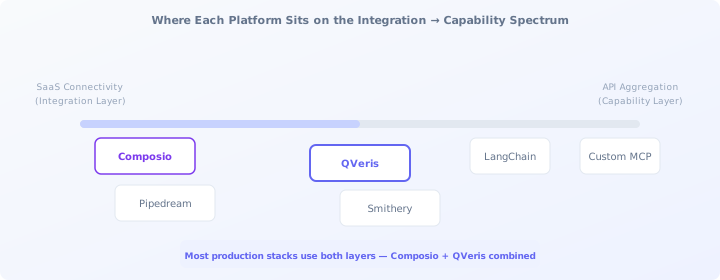
These products overlap at “an agent calls a tool,” but the control planes are different. Composio manages a user’s connection to a named SaaS application. QVeris helps an agent find and call a capability without binding the agent to one underlying provider. Treating them as identical creates a false choice.
| Question | Composio | QVeris |
|---|---|---|
| Starting point | Connect this user to this app | Find a capability for this intent |
| Core control | OAuth, connected accounts, action execution | Discovery, inspection and provider routing |
| Strong example | Send email from the user’s Gmail account | Retrieve suitable financial data without hard-coding one provider |
| Not the primary job | Provider-independent capability routing | Per-user SaaS OAuth lifecycle |
For a deeper feature-by-feature breakdown, use the dedicated Composio vs QVeris comparison. Keeping the full comparison there prevents this alternatives guide from competing with a page built for that exact search intent.
两者都能让“Agent 调用工具”,但控制面不同。Composio 管理某个用户到指定 SaaS 应用的连接;QVeris 帮助 Agent 在不绑定单一底层提供商的情况下发现并调用能力。把两者当成完全相同的产品,会制造一个错误的二选一。
| 问题 | Composio | QVeris |
|---|---|---|
| 起点 | 把这个用户连接到这个应用 | 为当前意图寻找能力 |
| 核心控制 | OAuth、连接账户、动作执行 | 发现、检查与提供商路由 |
| 典型场景 | 从用户的 Gmail 账户发送邮件 | 在不写死单一提供商的情况下获取合适金融数据 |
| 非核心任务 | 提供商无关的能力路由 | 每用户 SaaS OAuth 生命周期 |
如果需要逐项功能比较,请阅读独立的 Composio 与 QVeris 对比。把完整比较保留在专门页面,也能避免本替代方案指南与面向该搜索意图的页面互相竞争。
| If your primary requirement is… | Start with | Proof required before buying |
|---|---|---|
| Managed OAuth plus background data sync | Nango | Exact APIs, sync freshness and self-host operations |
| User-authorized agent actions | Arcade | Scope policy, auth events and execution logs |
| B2B identity plus connected apps | Scalekit | Tenant administration and connector depth |
| Broad APIs plus code workflows and MCP | Pipedream | Cost per end-user task and tool filtering |
| Provider-independent capability routing | QVeris | Coverage, contracts and runtime behavior for your domain |
| Visual, durable automation | n8n | State, retries, permissions and workflow governance |
| No-code business app actions | Zapier MCP | MCP action coverage and task cost |
| Private, highly controlled infrastructure | Custom MCP | Full staffing and maintenance budget |
| 如果你的首要需求是…… | 优先评估 | 购买前必须验证 |
|---|---|---|
| 托管 OAuth 加后台数据同步 | Nango | 具体 API、同步新鲜度与自托管运维 |
| 用户授权的 Agent 动作 | Arcade | 权限策略、授权事件与执行日志 |
| B2B 身份加连接应用 | Scalekit | 租户管理与连接器深度 |
| 广泛 API、代码工作流与 MCP | Pipedream | 单次终端任务成本与工具筛选 |
| 提供商无关的能力路由 | QVeris | 具体领域的覆盖、契约与运行行为 |
| 可视化、持久自动化 | n8n | 状态、重试、权限与工作流治理 |
| 无代码商业应用动作 | Zapier MCP | MCP 动作覆盖与任务成本 |
| 私有、高度受控的基础设施 | 自建 MCP | 完整人员配置与维护预算 |
Nango, Arcade and Scalekit are the closest direct alternatives when managed authentication and tool access for user-connected SaaS accounts are central. Pipedream Connect is also relevant when managed OAuth must be combined with a large API and MCP catalog. QVeris, n8n and Zapier solve adjacent rather than identical problems.
当核心需求是为用户连接的 SaaS 账户提供托管认证与工具访问时,Nango、Arcade 和 Scalekit 是最接近的直接替代方案。若还需要把托管 OAuth 与大型 API、MCP 目录结合,Pipedream Connect 也值得评估。QVeris、n8n 和 Zapier 解决的是相邻问题,并非完全相同的问题。
Nango is strong for developer-first OAuth, syncs and self-hosting options. Arcade focuses on agent authorization and secure execution. Scalekit combines connected apps with enterprise identity controls. Test exact scopes, token custody, tenant separation and revocation behavior before deciding.
Nango 适合开发者优先的 OAuth、同步和自托管;Arcade 重点解决 Agent 授权与安全执行;Scalekit 把连接应用与企业身份控制结合。决定前应实测具体 Scope、令牌保管、租户隔离与撤销行为。
Pipedream is a strong managed MCP option for broad application coverage. Arcade and Scalekit also expose agent-oriented tools, while Smithery is most useful for discovering servers. Custom MCP offers the most control, but your team owns authentication, reliability and maintenance.
如果重视广泛应用覆盖,Pipedream 是较强的托管 MCP 方案。Arcade 和 Scalekit 也提供面向 Agent 的工具;Smithery 更适合发现服务器。自建 MCP 控制权最高,但认证、可靠性和维护都由团队承担。
Nango provides a self-hosting path for integration infrastructure, n8n can be self-hosted for workflow automation, and custom MCP servers provide complete ownership. They are not interchangeable: evaluate OAuth custody, execution, state, updates and incident response separately.
Nango 为集成基础设施提供自托管路径,n8n 可自托管工作流自动化,自建 MCP 服务器则提供完全控制。三者并不能互换,需要分别评估 OAuth 凭据保管、执行、状态、更新和事故响应。
Yes. Composio can manage user-authorized SaaS actions while QVeris handles capability discovery and provider routing across APIs. This combination makes sense when an agent needs both user-connected applications and provider-independent data capabilities.
可以。Composio 可以管理用户授权的 SaaS 动作,QVeris 则负责跨 API 的能力发现与提供商路由。当 Agent 同时需要用户连接应用和提供商无关的数据能力时,两者可以组合使用。
Inventory toolkits, actions, scopes and accounts; create contract tests; migrate one low-risk integration; run old and new systems in parallel; compare authorization success, execution reliability, latency and cost; then move higher-risk actions. Do not revoke old credentials until rollback and audit requirements are satisfied.
先盘点工具包、动作、权限范围和账户,建立契约测试;迁移一个低风险集成;让新旧系统并行运行;比较授权成功率、执行可靠性、延迟和成本;再迁移高风险动作。在回滚和审计要求满足前,不要撤销旧凭据。
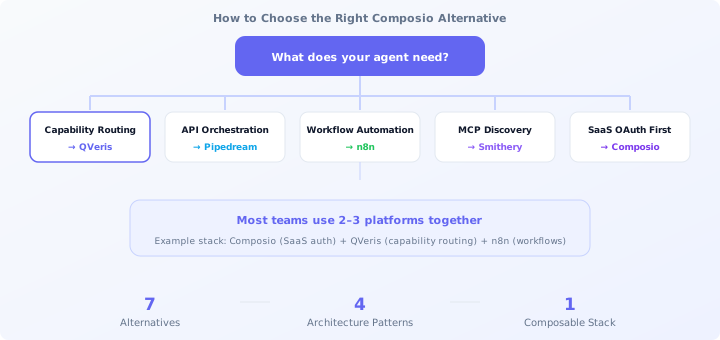
Choose Nango when OAuth plus sync infrastructure is the main job; Arcade when user-authorized agent execution is central; Scalekit when connected apps must sit inside a broader B2B identity model; and Pipedream when broad APIs, MCP and programmable workflows must coexist.
Choose QVeris for provider-independent capability discovery, n8n for durable visual workflows, Zapier MCP for no-code business actions, Smithery for MCP discovery, and custom MCP only when full control justifies the engineering burden. Keep Composio if its managed connected-account model already matches the workload and migration would not produce a measurable gain.
The best proof is a production-shaped pilot: connect real test tenants, execute the exact read and write actions, simulate expired consent and rate limits, inspect audit logs, and calculate cost per completed user task. Vendor feature grids cannot answer those questions for you.
Sources checked: Composio pricing, Composio toolkits, Pipedream MCP, Nango pricing, Arcade pricing, and Scalekit pricing.
如果主要任务是 OAuth 加同步基础设施,优先选择 Nango;如果核心是用户授权的 Agent 执行,选择 Arcade;如果连接应用必须纳入更广泛的 B2B 身份模型,选择 Scalekit;如果广泛 API、MCP 和可编程工作流必须共存,选择 Pipedream。
需要提供商无关的能力发现时选择 QVeris;需要持久可视化工作流时选择 n8n;需要无代码商业动作时选择 Zapier MCP;需要 MCP 发现时选择 Smithery;只有当完全控制值得额外工程负担时才选择自建 MCP。如果 Composio 的托管连接账户模型已经匹配真实负载,而且迁移无法带来可衡量收益,那么继续使用 Composio 反而更理性。
最可靠的证据不是功能表,而是接近生产环境的试点:连接真实测试租户,执行实际读写动作,模拟授权过期和限流,检查审计日志,并计算每次完成用户任务的成本。厂商功能表无法替你回答这些问题。
已核对来源:Composio 价格、Composio Toolkit、Pipedream MCP、Nango 价格、Arcade 价格与 Scalekit 价格。
Discover, inspect and call provider-independent capabilities for your AI agents.
Explore QVeris