Former Liblib CTO Starts a New Venture: Building Infrastructure for the Agent Era
A founder story about leaving a successful AI image platform to build the action layer that every AI agent will need.
QVeris Founder & CEO
Former CTO · Liblib AI
Why Leave a Successful Company?
The AI image platform was working.
Liblib had built one of the most popular AI image generation platforms in China. The product was growing, the team was strong, and the market was expanding. So why leave?
Because the next decade of AI isn't about generating images. It's about agents that act. And agents that act need infrastructure to find, route, and execute real-world capabilities at scale.
The infrastructure gap was obvious.
Three observations drove the decision:
Observation 1
Agents were multiplying. Every major model lab was shipping agent features. Developers were building agent products. The ecosystem was forming fast.
Observation 2
Tools were fragmented. 10,000+ APIs existed for agents. But they were scattered, unindexed, and incompatible. No unified discovery or routing.
Observation 3
The window was open. Infrastructure layers get built once, early, and become defaults. The window to build the capability routing network for agents was open — but not forever.
The Vision: Action Infrastructure for the Agent Era
Kubernetes + Zapier + Homebrew — for AI tools
Like Kubernetes
Standardizes how agents discover and route to capabilities — the same way Kubernetes standardized how services discover and route to each other. One control plane for all tool access.
Like Zapier
Connects agents to thousands of real-world tools and services — without requiring custom integrations for each one. One connection, all capabilities.
Like Homebrew
A trusted, community-verified registry of capabilities — so agents and developers can find and install exactly what they need. Verified, versioned, ready to call.
But purpose-built for AI agents. Not adapted from something else.
What We're Building
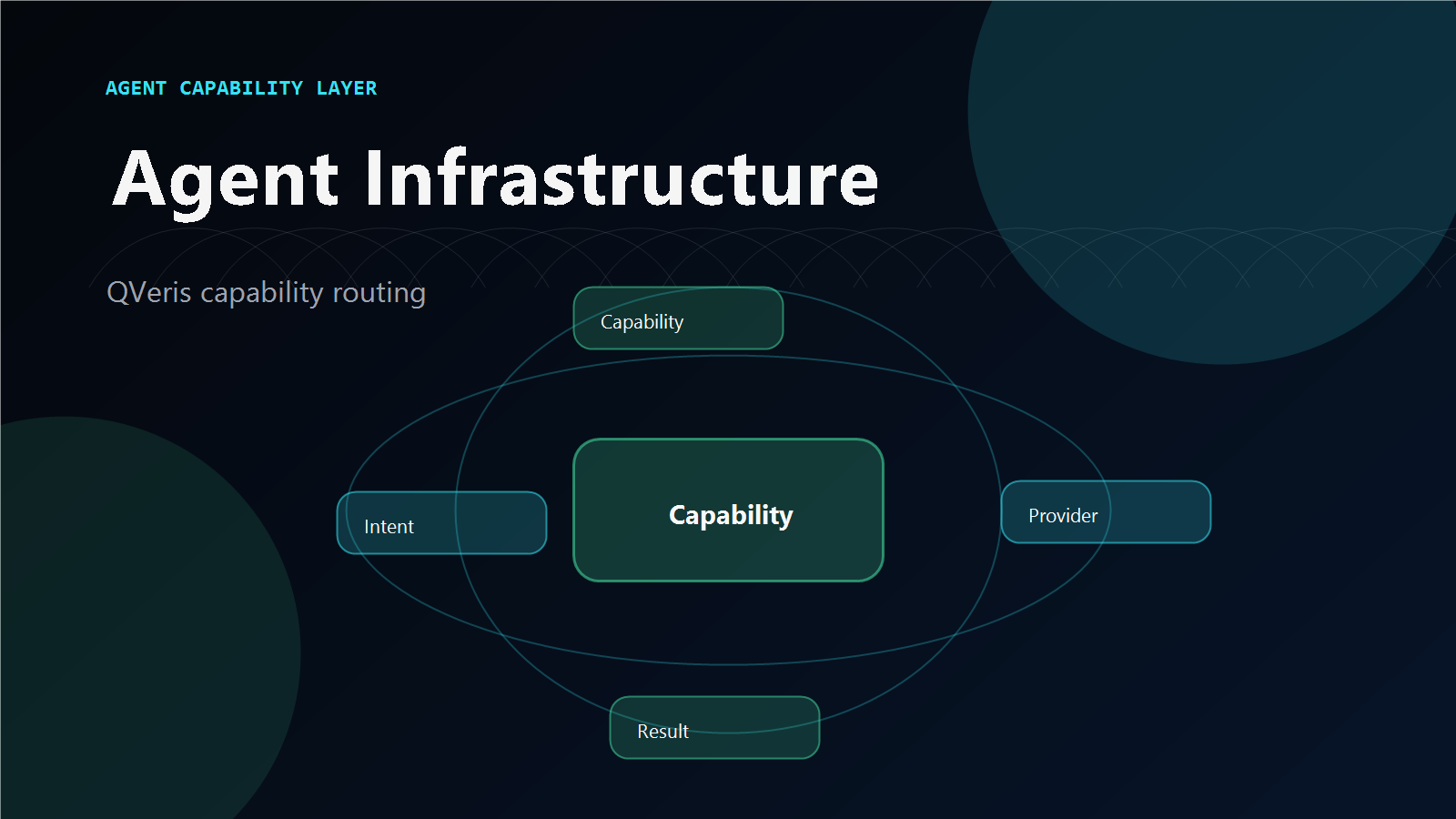
The shared infrastructure layer for the agent ecosystem.
Capability Discovery
A semantic search engine for tools. Agents describe what they need in natural language. QVeris returns ranked matches with quality signals. No API names to memorize. No documentation to hunt down.
Intelligent Routing
When multiple providers offer the same capability, QVeris routes to the best match — based on task requirements, provider availability, cost, latency, and success rate. Not random. Not hardcoded. Optimized.
Sandboxed Execution
Every tool call runs in an isolated sandbox with parameter validation, authentication handling, and consistent JSON output. One protocol for all capabilities. No per-provider parsing. No broken pipelines.
Full Audit Trail
Unique execution IDs, session-level tracing, and full call records for debugging, cost tracking, and compliance — built in from day one. Every call logged. Every result traceable.
Why Now
What We've Shipped
QVeris NetworkLIVE
10,000+ verified capabilities across 15+ categories. The core routing infrastructure.
View Providers →QVeris CLILIVE
Universal API gateway from the terminal. Discover, inspect, and call any tool in natural language.
Install CLI →MCP ServerLIVE
Tool gateway for IDE agents — Cursor, Claude Code, and all MCP-compatible environments.
Set Up MCP →QVerisBotLIVE
Production AI assistant with native access to 500+ data providers and 10,000+ APIs.
Try QVerisBot →